
TYO:4186
Every microchip is, at heart, a photograph — circuit patterns projected onto silicon through a light-sensitive coating. That coating, called photoresist, is one of the most critical materials in chipmaking, and a Japanese company founded in 1936 is among the handful that lead the world in making it. Tokyo Ohka Kogyo is the quiet chemistry behind the chip age.
The chemical that prints the chip
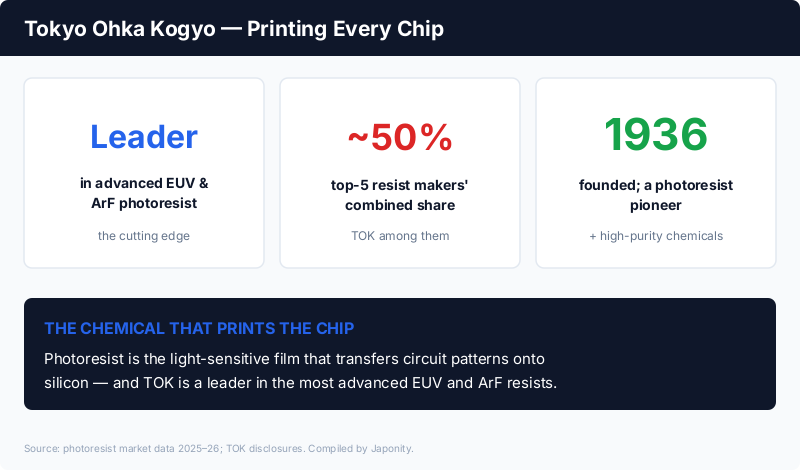
Photoresist is applied to a silicon wafer, exposed to patterned light through lithography, then developed — leaving behind the microscopic circuitry of a chip. The purer and more precise the resist, the finer the circuits that can be made. Tokyo Ohka Kogyo (TOK), founded in 1936, is a global leader in this material, especially in the most advanced EUV and ArF immersion photoresists used for cutting-edge chips. It sits among a small group of top-five resist makers who together hold roughly half the market — a group strikingly dominated by Japanese firms.
At the cutting edge of lithography
As the industry pushes to ever-smaller chip geometries with EUV lithography, photoresist becomes harder to make and more valuable — the resist must respond perfectly to extreme-ultraviolet light with minimal defects. TOK’s deep expertise in EUV resists places it at the frontier of advanced manufacturing, and the company is expanding capacity to meet rising demand. Beyond resists, it makes high-purity chemicals and cleaning materials for fabs.
Why it matters for global partners and investors
- Investors get exposure to leading-edge semiconductor manufacturing through a critical materials supplier that benefits as chips advance, regardless of which chipmaker wins.
- The chip industry depends on a few resist makers; TOK’s EUV expertise makes it strategically important to advanced-node production.
- The driver to watch is EUV adoption, which raises both demand and the technical bar for photoresist — favouring established leaders like TOK.
Frequently asked questions
What does Tokyo Ohka Kogyo make?
TOK is a Japanese specialty-chemicals company and a world leader in photoresist — the light-sensitive material used to print circuit patterns onto silicon wafers — particularly advanced EUV and ArF resists, plus high-purity fab chemicals.
Why is photoresist important?
Photoresist is essential to lithography, the step that defines a chip’s circuitry. Its quality limits how small and precise chips can be, making advanced resists critical to leading-edge manufacturing.
Who leads the photoresist market?
A small group of mostly Japanese makers — TOK, JSR, Fujifilm, and Shin-Etsu, plus Korea’s Dongjin — hold the majority of the market, with TOK and JSR especially strong in EUV resists.
Looking to source semiconductor materials from, or partner with, a Japanese leader? Contact Japonity — we connect international businesses with Japan’s best companies, products, and technologies.
Interested in Japanese business opportunities?
Whether you're looking for technology partners, engineering talent, or market insights — we can help connect you with the right Japanese organizations.
Get in Touch →