The world’s biggest technology companies have decided Japan is where they will build the engines of the AI era. More than $26 billion in hyperscaler capital is flowing into Japanese data centers — and the constraint shaping the race is no longer chips or capital, but power. That bottleneck is where the next wave of business opportunity lives.
The capital wave
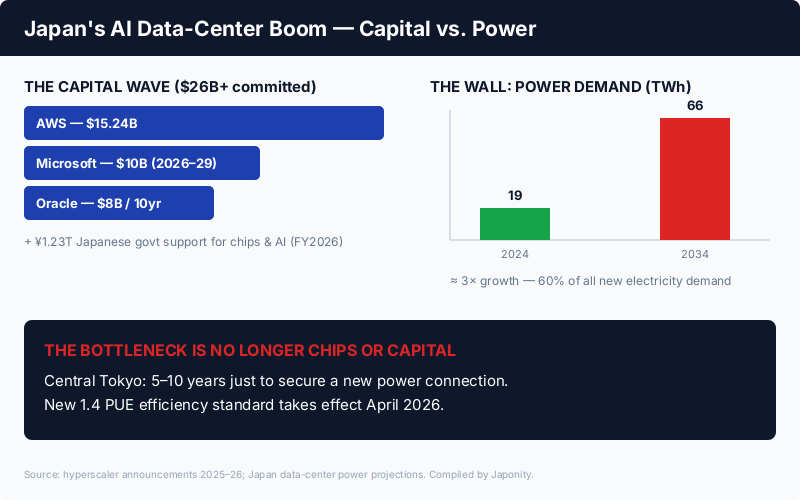
In April 2026, Microsoft committed $10 billion (¥1.6 trillion) to Japan through 2029 for AI infrastructure, cybersecurity, and workforce development — more than tripling its previous $2.9 billion, two-year pledge. It is not alone. AWS has committed $15.24 billion, and Oracle pledged $8 billion over ten years. Together, hyperscalers have lined up well over $26 billion for Japanese AI infrastructure.
The market noticed. SoftBank shares jumped more than 18% as a Japan tech rally pushed the Nikkei 225 to record highs; chip-tool makers Tokyo Electron and Advantest rose 7–9% on AI-driven optimism; and cloud provider Sakura Internet surged as much as 20% after being named a Microsoft–SoftBank partner. Japan’s government is reinforcing the trend, earmarking roughly ¥1.23 trillion for advanced semiconductor and AI development in fiscal 2026.
SoftBank itself is reinventing its domestic footprint, repurposing former LCD-panel and semiconductor factory sites into AI data-center capacity, while serving as one of the highest-profile compute investors in OpenAI’s Stargate program.
Why Japan, and why now
Several forces converge to make Japan unusually attractive:
- Digital sovereignty. Governments and enterprises increasingly want AI compute on home soil, under domestic law. Microsoft has explicitly framed its investment around sovereign cloud capability for Japan.
- A “China +1” safe harbour. For global firms diversifying away from geopolitical risk, Japan offers a stable, allied, rule-of-law location with deep engineering talent.
- Proximity to demand. Japan is the world’s third- or fourth-largest economy with low-latency reach across East Asia — ideal for serving regional AI workloads.
- Government tailwind. Direct subsidies for chips and AI, plus support for the underlying grid and semiconductor supply chain, de-risk the buildout.
The wall: electricity
Capital is no longer the binding constraint. Power is.
Japan’s data-center electricity consumption is projected to triple — from about 19 TWh in 2024 to as much as 66 TWh by 2034 — accounting for roughly 60% of the country’s entire growth in electricity demand over the decade. The grid was not built for this.
The clearest symptom is in Tokyo, where operators report waits of five to ten years simply to secure a new power connection in the urban core, alongside shortages of construction capacity. On top of that, new efficiency rules take effect in April 2026, requiring designs to meet a 1.4 PUE (power usage effectiveness) standard — a meaningful bar for AI facilities running power-hungry GPUs.
In other words: the demand is unlimited, the chips are arriving, and the electrons are the chokepoint.
The workarounds — where the opportunity is
Every constraint in this story is generating a market. The industry’s responses are themselves investable, partnerable opportunities:
- Move out of Tokyo. Operators are pushing to regions with spare power and cool climates. Sakura Internet is scaling its Ishikari (Hokkaido) site toward roughly 10,800 GPUs, targeting full renewable power by 2027. Cooler air and renewable supply turn geography into a competitive advantage.
- Liquid cooling. AI racks run far too hot for traditional air cooling. KDDI’s new Osaka–Sakai data center, built with HPE and NVIDIA Blackwell, uses direct liquid cooling as a template for modular “AI factories.” Cooling is now a fast-growing hardware and engineering category.
- Photonics to cut power. NTT, building on its IOWN initiative, is partnering with Broadcom on optical semiconductor devices aimed at cutting data-center power use by up to 50%. If it works at scale, Japan exports a solution to a global problem.
- New generation and modular design. Renewables, grid upgrades, on-site generation, and compact urban data-center formats are all being pulled forward by AI demand.
Why this matters for global partners
For international operators and investors, Japan’s AI buildout is a rare combination of enormous, government-backed demand and a clearly defined bottleneck. The opportunity is less about competing with hyperscalers and more about supplying the picks and shovels:
- Power and energy: developers of renewable generation, grid technology, storage, and on-site power have a captive, fast-growing customer base.
- Thermal management: liquid-cooling systems, components, and engineering services are in structural shortage.
- Optical and efficiency tech: anything that reduces watts per token aligns with both the PUE rule and the economics of the buildout.
- Site development and construction: the shortage of construction capacity is itself a services opportunity.
- GPU cloud and managed AI: regional players like Sakura Internet show there is room beyond the hyperscalers for specialised compute providers.
Frequently asked questions
How much are companies investing in Japanese AI data centers?
Over $26 billion in hyperscaler capital has been committed, including Microsoft’s $10 billion (2026–2029), AWS’s $15.24 billion, and Oracle’s $8 billion over ten years — plus roughly ¥1.23 trillion in Japanese government support for chips and AI in fiscal 2026.
What is the biggest constraint on Japan’s data-center growth?
Electricity. Data-center power demand is set to triple to as much as 66 TWh by 2034, and securing a new power connection in central Tokyo can take five to ten years. New facilities must also meet a 1.4 PUE efficiency standard from April 2026.
Where is the opportunity for foreign companies?
In the supply chain around the buildout — renewable and grid power, liquid cooling, power-efficient optical technology, construction and site development, and specialised GPU cloud services — rather than competing head-on with the hyperscalers.
Building, supplying, or investing in Japan’s AI infrastructure? Contact Japonity — we connect international businesses with Japan’s best companies, products, and technologies.
Interested in Japanese business opportunities?
Whether you're looking for technology partners, engineering talent, or market insights — we can help connect you with the right Japanese organizations.
Get in Touch →