TYO:3402
Every Boeing 787 that takes off is built largely from a material made by a company most travellers have never heard of. Toray Industries — founded as a humble rayon mill a century ago — is now the world’s largest maker of carbon fiber, and one of the quiet material foundations of modern aerospace, energy, and mobility.
From a rayon mill to the material age
Toray was founded in 1926 as Toyo Rayon, making artificial silk. A century later it is one of Japan’s largest chemical and materials groups, with revenue of roughly ¥2.5 trillion spanning fibers, films, chemicals, water-treatment membranes, and advanced composites. But its single most strategically important business is the one that began as a long-shot bet in the 1970s: carbon fiber.
The world’s carbon-fiber leader
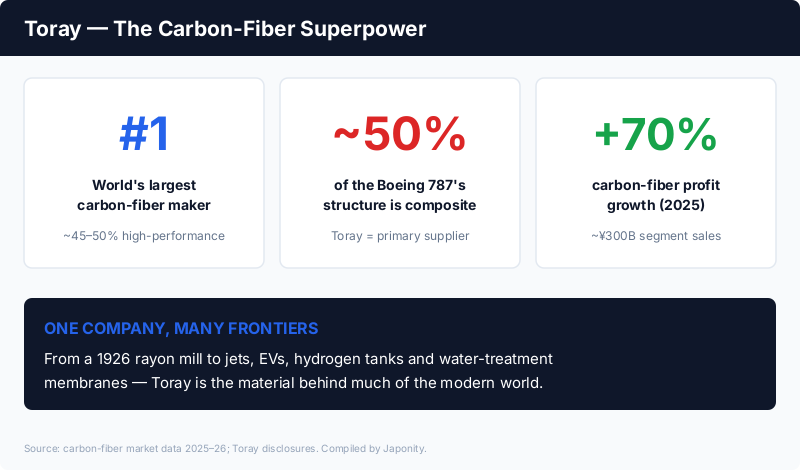
Toray’s TORAYCA carbon fiber is the industry benchmark. The company holds an estimated 45–50% of the global high-performance carbon-fiber market — the strongest, lightest grades used where failure is not an option.
The clearest demonstration is in the sky. Roughly 50% of the Boeing 787 Dreamliner’s structure, by weight, is carbon-fiber composite — including the wings and fuselage — and Toray is the primary supplier of that material under long-term contracts. Its T800 and T1100 grades made it possible to build a commercial airliner whose body is more composite than metal, cutting weight and fuel burn dramatically.
Beyond aerospace
Carbon fiber’s reach is widening fast, and Toray sits at the centre of each new frontier:
- Mobility: lightweighting for electric vehicles, where every kilogram saved extends range.
- Clean energy: blades for ever-larger wind turbines, which depend on stiff, light composites.
- Hydrogen: high-pressure Type IV tanks for hydrogen storage and fuel-cell vehicles are wound from carbon fiber — a market that grows directly with the hydrogen economy.
- Sporting goods: the bicycles, golf shafts, and tennis racquets that first popularised the material.
Carbon fiber is also where the profits are accelerating: in 2025 the segment posted around ¥300 billion in sales with profits up more than 70%, as aerospace demand recovered and energy applications scaled.
A diversified materials empire
Carbon fiber is the headline, but Toray’s depth is in its breadth. It is a global leader in reverse-osmosis membranes for desalination and water treatment, a major supplier of battery separators and optical films for electronics, and still one of the world’s big fiber and textile makers. This portfolio turns Toray into a pure-play bet on the material problems of the 21st century: lighter transport, cleaner water, stored energy.
Why it matters for global partners and investors
For international readers, Toray is a textbook Japanese “hidden champion” — globally dominant, technically unassailable, and largely invisible to consumers.
- Investors gain exposure to several megatrends at once — aerospace recovery, EV lightweighting, wind power, and hydrogen — through one materials supplier rather than a single end-market bet.
- Manufacturers designing lighter, stronger, or more sustainable products will, sooner or later, encounter Toray as the upstream source of the material that makes it possible.
- The frontier to watch is recycling. Carbon fiber’s weakness has been end-of-life; Toray and peers are racing to commercialise recycled fiber, and whoever solves it cheaply unlocks the next wave of adoption.
Frequently asked questions
What does Toray Industries make?
Toray is a Japanese chemicals and materials group best known as the world’s largest maker of carbon fiber (TORAYCA). It also produces water-treatment membranes, films, battery separators, resins, and textiles, with revenue around ¥2.5 trillion.
Is Toray really in the Boeing 787?
Yes. About half of the 787’s structure by weight is carbon-fiber composite, and Toray is the primary supplier of that material under long-term agreements, using its T800 and T1100 grades.
Why does Toray matter for the energy transition?
Carbon fiber is essential to EV lightweighting, large wind-turbine blades, and high-pressure hydrogen storage tanks. As those industries scale, demand for Toray’s materials grows with them.
Looking to source advanced materials from, or partner with, a Japanese leader? Contact Japonity — we connect international businesses with Japan’s best companies, products, and technologies.
Interested in Japanese business opportunities?
Whether you're looking for technology partners, engineering talent, or market insights — we can help connect you with the right Japanese organizations.
Get in Touch →