TYO:7733
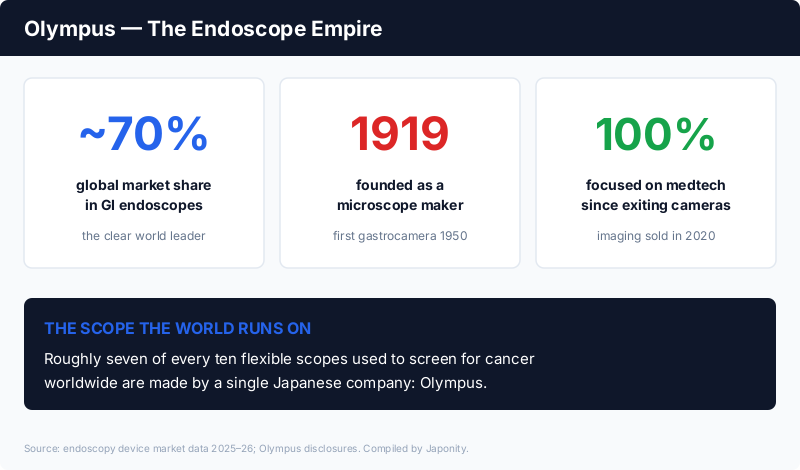
If you have ever had a colonoscopy or gastroscopy, the instrument that looked inside you was probably made by Olympus. The Tokyo company controls roughly 70% of the world’s gastrointestinal endoscope market — a near-monopoly built over a century, and the foundation of its bet to become a pure medical-technology company.
From microscopes to the inside of the body
Olympus was founded in 1919 making microscopes. Its defining leap came in 1950, when it built the world’s first practical gastrocamera — a tiny camera on a flexible tube that could photograph the inside of the stomach. That invention created an entire field of medicine and set Olympus on the path to dominate it.
A 70% grip on a critical market
Today Olympus holds approximately 70% of the global market for gastrointestinal (GI) endoscopes — the flexible scopes used to detect and treat cancers of the stomach, colon, and esophagus. Few companies in any industry hold such a share of a market that matters this much: endoscopy is the front line of cancer screening worldwide.
The moat is not just optics. It is the combination of image quality, the breadth of compatible therapeutic tools, the service and repair network, and — crucially — the training relationships with the physicians who learn on Olympus systems and rarely switch. Rivals such as Fujifilm and Hoya/Pentax compete hard, but Olympus’s installed base and ecosystem are formidable.
The bet on pure medtech
For decades Olympus was also famous for cameras. In 2020 it sold its imaging business, ending a storied camera lineage to focus entirely on medical technology and life science. The strategy is clear: concentrate capital on the high-margin, defensible endoscopy and therapeutic-device franchise, and expand from diagnosis into treatment — endotherapy tools, energy devices, and minimally invasive surgery.
The challenges, named plainly
Olympus’s dominance has come with real scrutiny. The company faced serious quality and regulatory problems, including infections linked to its duodenoscopes and a U.S. Food and Drug Administration warning letter over manufacturing and quality-system issues, prompting recalls and a major remediation effort. It has also worked through governance and leadership turbulence. For a company whose products go inside patients, quality execution is not a side issue — it is the franchise, and how thoroughly Olympus fixes it will shape the next decade.
The AI frontier
The next battleground is software. AI-assisted endoscopy — systems that flag polyps and suspicious lesions in real time as the physician scopes — improves detection rates and is becoming a standard expectation. Olympus’s installed base of scopes is a natural platform for these tools, turning a hardware monopoly into a recurring software and analytics opportunity.
Why it matters for global partners and investors
- Investors get exposure to a structurally growing market — an ageing world means more screening and more procedures — through the clear category leader.
- AI and software partners have an obvious distribution target: the worldwide fleet of Olympus scopes is the rails on which diagnostic AI can ride.
- The watch item is execution: quality remediation and governance will determine whether Olympus converts its dominance into durable trust.
Frequently asked questions
What is Olympus’s market share in endoscopes?
Olympus holds roughly 70% of the global gastrointestinal endoscope market, making it the dominant supplier of the scopes used in cancer screening and treatment.
Does Olympus still make cameras?
No. Olympus sold its imaging/camera business in 2020 to focus entirely on medical technology and life science. The camera brand now lives on under separate ownership.
What challenges does Olympus face?
It has dealt with quality and regulatory issues, including duodenoscope-related infections and an FDA warning letter over manufacturing quality, alongside governance changes. Resolving these is central to protecting its market leadership.
Looking to partner with, supply, or invest in Japan’s medical-technology leaders? Contact Japonity — we connect international businesses with Japan’s best companies, products, and technologies.
Interested in Japanese business opportunities?
Whether you're looking for technology partners, engineering talent, or market insights — we can help connect you with the right Japanese organizations.
Get in Touch →