TYO:6268
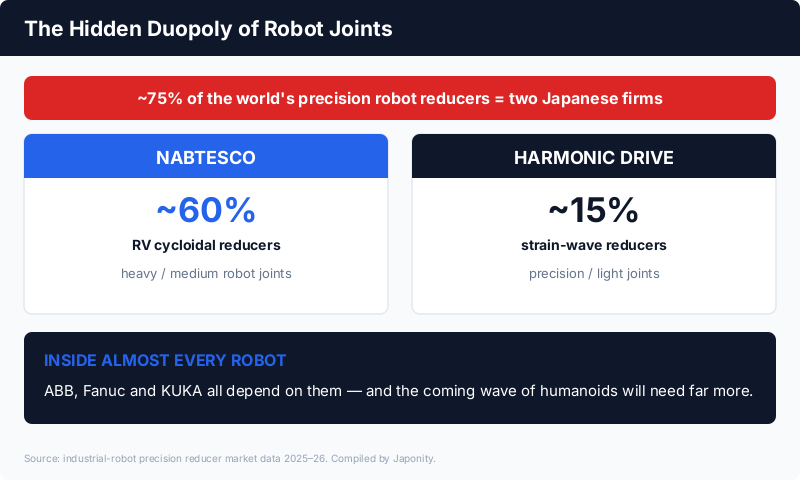
Every industrial robot in the world bends at its joints — and inside almost every one of those joints sits a precision gear made by one of two Japanese companies. Nabtesco and Harmonic Drive Systems together supply around 75% of the precision reduction gears the global robot industry runs on. They are the most important robotics companies you have never heard of.
The part that makes a robot a robot
A robot arm is only as good as its joints. To move heavy loads with precision, an electric motor’s fast, weak rotation must be converted into slow, powerful, exact motion — with virtually zero “backlash,” the tiny slop that would otherwise ruin accuracy. The component that does this is the precision reduction gear, and it is fiendishly hard to make well. Get it wrong and the robot is imprecise, unreliable, or short-lived.
This is the choke point of robotics. And it is dominated by two Japanese firms, each owning a different gear technology for a different kind of joint.
Nabtesco: the heavy joints
Nabtesco is the global leader in RV (cycloidal) reduction gears, commanding roughly 60% of the market for medium-to-heavy robot joints — the shoulders and elbows that carry serious weight. Its gears are prized for rigidity and durability under high load, which is why they sit inside the large industrial robots that build cars and move pallets.
Harmonic Drive: the precise joints
Harmonic Drive Systems pioneered the strain-wave gear (the original “Harmonic Drive”), a uniquely compact, lightweight, zero-backlash mechanism. It holds around 15% of the global reducer market, concentrated in the precise, lighter joints — wrists, smaller robots, and anywhere accuracy matters more than brute force. The two companies are independently listed but together form the segment’s defining duopoly.
Why nobody can easily break in
Together these two supply roughly 75% of the world’s robot precision reducers — and their customers are the giants of robotics themselves. ABB, Fanuc, KUKA, Yaskawa and the rest build robots around these Japanese gears rather than make their own, because decades of metallurgy, manufacturing tolerances, and field-proven reliability cannot be replicated quickly. A new entrant must match not just the design but the consistency, at scale, across millions of units.
The humanoid tailwind
The most exciting shift is the rise of humanoid robots. Where a typical industrial arm has six joints, a humanoid has many more — often 20 to 40 actuators, each potentially needing a precision reducer. If humanoids scale even modestly, demand for high-precision gears could rise by an order of magnitude. That puts Nabtesco and Harmonic Drive at the centre of one of the most hyped frontiers in technology — supplying the picks and shovels regardless of which humanoid maker wins.
Why it matters for global partners and investors
- Investors get exposure to the entire robotics and humanoid wave without betting on a single robot brand — every arm, whoever makes it, likely contains these components.
- Robot builders and integrators depend on these suppliers; understanding their capacity, lead times, and roadmaps is strategic for anyone scaling automation.
- The risk to watch is capacity and competition: Chinese reducer makers are improving fast and targeting this exact choke point, making it one of the key battlegrounds of the robot age.
Frequently asked questions
What is a precision reduction gear, and why does it matter?
It is the component in a robot joint that converts a motor’s fast rotation into slow, powerful, highly accurate motion with almost no backlash. It largely determines a robot’s precision and reliability, making it one of the most critical parts in robotics.
Who makes most of the world’s robot reducers?
Two Japanese companies: Nabtesco (RV cycloidal gears, ~60% of heavy/medium joints) and Harmonic Drive Systems (strain-wave gears, ~15% globally). Together they supply roughly 75% of the market, including to ABB, Fanuc, and KUKA.
How do humanoid robots change the picture?
Humanoids use far more actuators than industrial arms — often 20 to 40 each — so even modest adoption could multiply demand for precision reducers, directly benefiting these two suppliers.
Looking to source robotics components from, or partner with, Japan’s automation leaders? Contact Japonity — we connect international businesses with Japan’s best companies, products, and technologies.
Interested in Japanese business opportunities?
Whether you're looking for technology partners, engineering talent, or market insights — we can help connect you with the right Japanese organizations.
Get in Touch →