TYO:8058
When Warren Buffett went looking for his biggest bet outside the United States, he chose five Japanese companies most Westerners cannot name. The sogo shosha — Japan’s general trading houses — are sprawling, centuries-old conglomerates that trade, invest, and operate in almost every industry on Earth. They are a business model unique to Japan, and one of the most quietly powerful forces in global commerce.
A business model found nowhere else
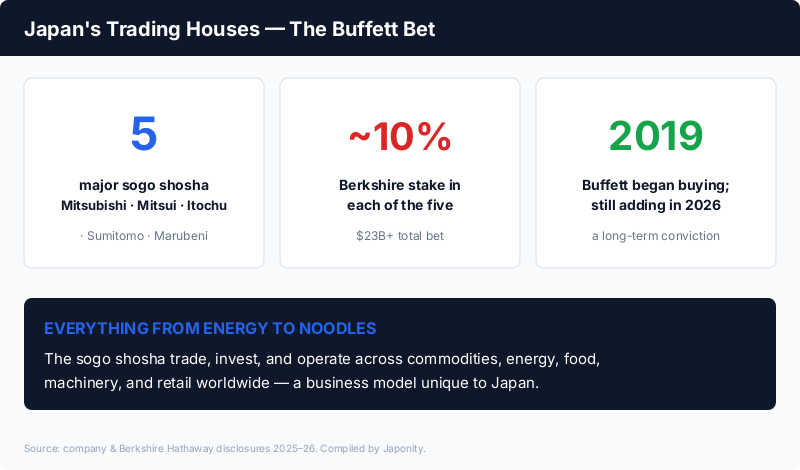
The five major sogo shosha — Mitsubishi Corporation, Mitsui & Co., Itochu, Sumitomo Corporation, and Marubeni — defy easy description. They are not pure traders, nor banks, nor manufacturers. Instead they do all of it: buying and selling commodities, financing and operating projects, and owning stakes in businesses across energy, metals, food, machinery, chemicals, infrastructure, and retail. A single trading house might supply liquefied natural gas, run a salmon farm, own a convenience-store chain, and develop a power plant — all at once.
The Buffett bet
Berkshire Hathaway began buying into all five in 2019 and has kept adding ever since, lifting its stakes toward and past 10% in each, a position now worth well over $23 billion. Buffett has praised the trading houses’ diversified operations, disciplined capital allocation, and steadily rising dividends — qualities that mirror his own philosophy. His very public endorsement put a global spotlight on companies that had spent decades operating in the background, and signalled to international investors that Japan’s old conglomerates had reformed into shareholder-friendly compounding machines.
Why it matters for global partners and investors
- For investors, the sogo shosha offer diversified, dividend-growing exposure to global commodities, energy transition, and Japanese capital discipline — the logic behind Berkshire’s bet.
- For businesses, the trading houses are unrivalled gateways into and out of Japan: they can source, finance, distribute, and co-invest across borders, making them powerful partners for market entry.
- The shift to watch is their pivot from pure resource trading toward energy transition, food security, and digital and infrastructure investment.
Frequently asked questions
What is a sogo shosha?
A sogo shosha is a Japanese general trading house — a diversified conglomerate that trades commodities, invests in and operates businesses, and provides financing across many industries worldwide. The five majors are Mitsubishi, Mitsui, Itochu, Sumitomo, and Marubeni.
Why did Warren Buffett invest in them?
Berkshire Hathaway began buying the five trading houses in 2019, attracted by their diversified operations, disciplined capital allocation, and rising dividends. It has raised its stakes toward and past 10% in each, a bet now worth over $23 billion.
How are trading houses useful to foreign businesses?
They act as gateways into and out of Japan, able to source, finance, distribute, and co-invest globally — making them powerful partners for companies entering the Japanese market or sourcing from it.
Looking to partner with, or invest alongside, Japan’s trading and industrial giants? Contact Japonity — we connect international businesses with Japan’s best companies, products, and technologies.
Interested in Japanese business opportunities?
Whether you're looking for technology partners, engineering talent, or market insights — we can help connect you with the right Japanese organizations.
Get in Touch →