Private
In a world captivated by chatbots and generative AI, ABEJA is solving a different — and arguably more urgent — problem: bringing artificial intelligence to the physical operations that power the global economy. From factory floors to retail stores, ABEJA’s AI platform is helping some of Japan’s largest companies see what humans cannot, decide faster than humans can, and operate more efficiently than ever before.
Who Is ABEJA?
Founded in 2012 by CEO Daisaku Okada, ABEJA (the name means “bee” in Spanish) was one of the earliest AI startups in Japan. At a time when deep learning was still an academic curiosity for most Japanese companies, ABEJA was already building practical computer vision and machine learning systems for enterprise clients.
Today, ABEJA is listed on the Tokyo Stock Exchange (TSE Growth, 5765) and serves over 300 enterprise clients across manufacturing, retail, logistics, and infrastructure. Their mission is straightforward: make AI usable in the real world, not just in research papers.
The Platform: ABEJA Platform
ABEJA’s core offering is not a single AI product but an end-to-end platform that covers the entire AI lifecycle:
- Data collection and annotation — automated pipelines for gathering and labeling training data from cameras, sensors, and edge devices
- Model development — tools for building, training, and fine-tuning machine learning models without requiring a team of PhD researchers
- Deployment and monitoring — seamless deployment to cloud or edge environments with continuous performance tracking
- Retraining and improvement — automated feedback loops that keep models accurate as real-world conditions change
This platform approach is critical. Many companies have experimented with AI proof-of-concepts that never make it to production. ABEJA’s platform is specifically designed to close that gap — turning experimental models into operational systems that run 24/7.
Manufacturing: Eyes on Every Production Line
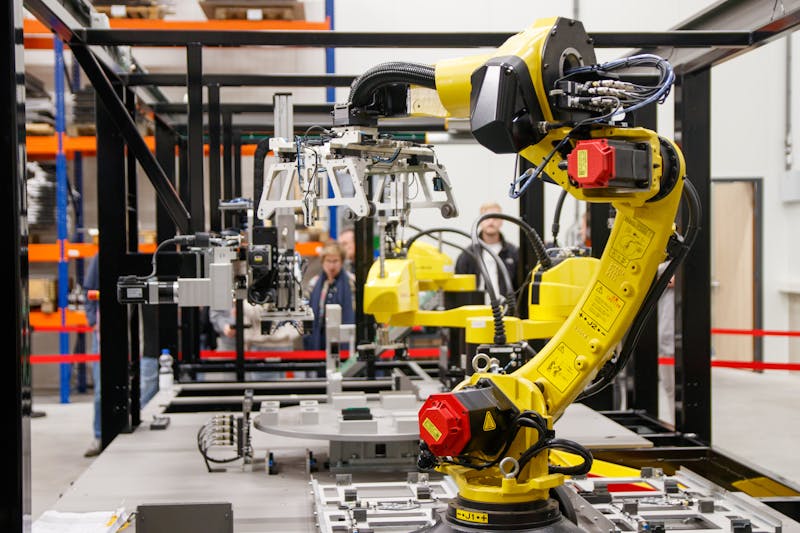
Manufacturing is where ABEJA’s impact is most visible. Japanese manufacturers are famous for their quality standards, but human visual inspection has inherent limits: fatigue, inconsistency, and the inability to inspect every single unit at high speed.
ABEJA’s computer vision systems change this equation entirely.
Defect detection: ABEJA deploys AI-powered visual inspection on production lines that can identify microscopic defects — scratches, discoloration, dimensional errors — at speeds no human inspector can match. One automotive parts manufacturer reported a 90% reduction in missed defects after implementing ABEJA’s system.
Predictive maintenance: By analyzing sensor data from machinery, ABEJA’s platform predicts equipment failures before they happen. Unplanned downtime in manufacturing can cost millions of yen per hour. Predictive maintenance turns reactive repairs into scheduled interventions, saving both money and production capacity.
Process optimization: ABEJA’s AI analyzes production data to identify bottlenecks, optimize workflows, and reduce waste. In an industry where margins are measured in fractions of a percent, even small efficiency gains translate into significant competitive advantage.
Retail: Understanding the Customer
ABEJA’s retail analytics solution, ABEJA Insight for Retail, uses in-store cameras and AI to give retailers something they have never had: the same depth of behavioral data that e-commerce platforms take for granted.
Customer flow analysis: Where do customers walk? Which displays do they stop at? How long do they spend in each section? ABEJA’s AI maps customer movement patterns in real time, helping retailers optimize store layouts and product placement.
Demographic insights: Without collecting personal information, ABEJA’s system provides aggregate demographic data — age groups, gender distribution, visit frequency — that helps retailers understand who their customers actually are, not who they assume them to be.
Conversion optimization: By correlating foot traffic with point-of-sale data, ABEJA helps retailers understand their true conversion rates and identify why customers leave without buying. Major retail chains including AEON have used these insights to redesign stores and increase sales.
Staff allocation: ABEJA’s platform predicts customer traffic by hour and day, enabling retailers to schedule staff efficiently — reducing labor costs during quiet periods while ensuring adequate coverage during peaks.
The ABEJA Approach: Why It Works
Several factors distinguish ABEJA from both global AI giants and smaller Japanese competitors:
1. Industry-Specific Knowledge
ABEJA does not sell generic AI. Their teams include domain experts who understand manufacturing processes, retail operations, and logistics workflows. This means their AI models are trained on relevant data, tuned for real conditions, and deployed with practical operational constraints in mind.
2. Edge AI Capability
Many AI systems require sending data to the cloud for processing — impractical in factories with latency requirements or in retail environments with bandwidth constraints. ABEJA’s platform supports edge deployment, running AI models directly on local devices. This enables real-time decision-making where milliseconds matter.
3. Japanese Enterprise DNA
Selling AI to Japanese enterprises is notoriously difficult. Companies demand exhaustive testing, guaranteed uptime, hands-on support, and a level of customization that Silicon Valley firms rarely provide. ABEJA has spent over a decade building these relationships and understands that in Japan, trust is earned through consistent delivery, not impressive pitch decks.
4. Partnership Ecosystem
ABEJA has built strategic partnerships with major technology companies including Google Cloud, NVIDIA, and NEC. These partnerships ensure that ABEJA’s platform leverages the latest hardware and cloud infrastructure while maintaining the flexibility to run on diverse customer environments.
Key Clients and Results
While ABEJA does not publicly disclose all client names, their customer base includes companies across critical sectors:
- Automotive manufacturers — visual inspection and production optimization
- AEON Group — retail analytics across Japan’s largest retail network
- Daikin Industries — manufacturing AI for one of the world’s largest HVAC manufacturers
- Infrastructure companies — AI-powered monitoring for bridges, tunnels, and power facilities
- Logistics providers — warehouse automation and demand forecasting
Recent Developments
Generative AI integration: ABEJA has incorporated large language models into their platform, enabling natural language interfaces for data analysis and report generation. Factory managers can now query production data in plain Japanese rather than writing SQL or navigating dashboards.
ABEJA LLM Series: The company has developed its own Japanese-optimized language models, recognizing that general-purpose LLMs often underperform on specialized Japanese business terminology and industrial vocabulary.
Sustainability AI: ABEJA is expanding into environmental monitoring, using AI to help manufacturers measure and reduce their carbon footprint — a growing priority as Japan pushes toward carbon neutrality by 2050.
The Competitive Landscape
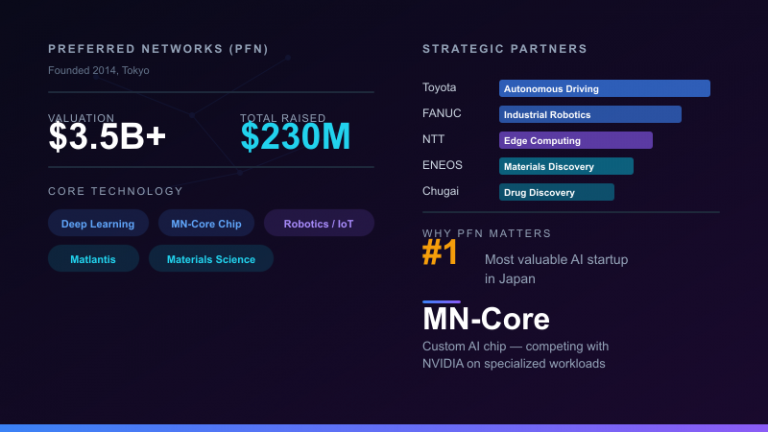
ABEJA operates in a space with both global and local competitors. Google, AWS, and Microsoft all offer AI/ML platforms, but these are horizontal tools that require significant customization. On the Japanese side, companies like Preferred Networks and AI inside address different segments (research/robotics and OCR, respectively).
ABEJA’s position is unique: a platform company with deep vertical expertise in physical operations. They are not trying to build the smartest AI model in the world. They are trying to make AI work reliably in the messiest, most complex environments — and that is a much harder problem.
For International Partners
ABEJA’s technology is particularly relevant for:
- Global manufacturers entering or expanding in Asia who need AI-powered quality control and process optimization
- Retail companies looking for proven in-store analytics beyond what Western solutions offer
- System integrators seeking an enterprise-grade AI platform to deploy for their own clients
- Investors interested in Japan’s AI infrastructure layer — the picks-and-shovels play in a market where AI adoption is accelerating
As Japanese companies face mounting pressure from labor shortages and global competition, the demand for AI that works in physical operations will only grow. ABEJA, with over a decade of experience and hundreds of enterprise deployments, is positioned at the center of that transformation.
Interested in Japanese business opportunities?
Whether you're looking for technology partners, engineering talent, or market insights — we can help connect you with the right Japanese organizations.
Get in Touch →