Executive Summary
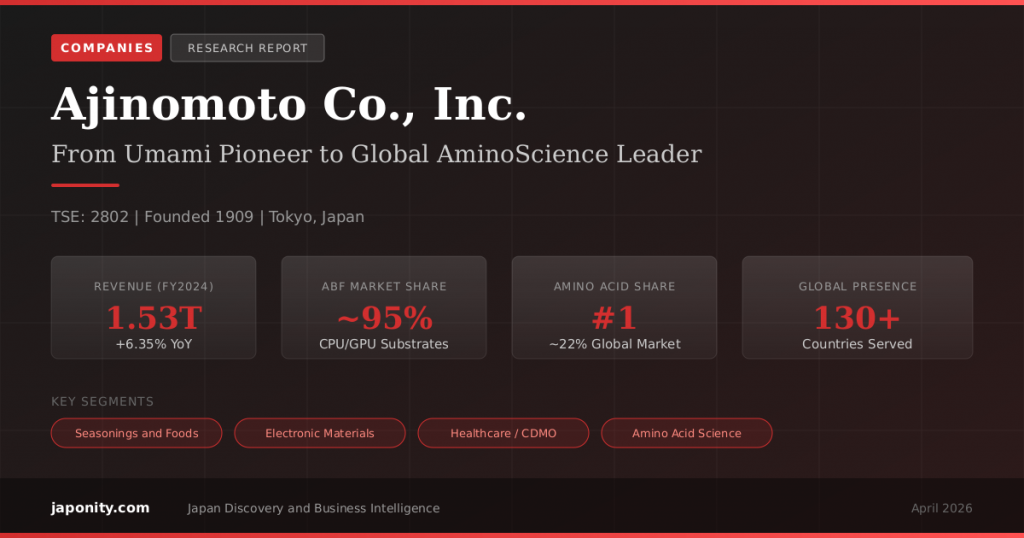
Ajinomoto Co., Inc. (TSE: 2802) is far more than the inventor of MSG. Founded in 1909, this Tokyo-based conglomerate has evolved into a ¥1.53 trillion revenue powerhouse operating in 31 countries with ~35,000 employees, selling products in over 130 markets worldwide. While best known for its umami seasonings, Ajinomoto commands dominant global positions in amino acid production, holds an extraordinary ~95% share of the semiconductor substrate insulation material (ABF) market for CPUs and GPUs, and is aggressively expanding into healthcare and pharmaceutical CDMO services. With a market capitalization of approximately ¥4.2 trillion (as of March 2026), Ajinomoto represents one of Japan’s most compelling cases of science-driven diversification — and a significant partner opportunity for businesses seeking entry into Japanese technology, food ingredients, and healthcare value chains.
Company Overview
| Item | Detail |
|---|---|
| Official Name | Ajinomoto Co., Inc. (味の素株式会社) |
| Founded | 1909 |
| Headquarters | Chuo-ku, Tokyo, Japan |
| Stock Listing | TSE: 2802 |
| Revenue (FY2024, ending Mar 2025) | ¥1.53 trillion (~$10.1B) |
| Business Profit (FY2024) | ¥159.3 billion (+7.9% YoY) |
| Employees | ~34,862 |
| Countries of Operation | 31 countries, products sold in 130+ |
| Factories Worldwide | 24 countries and regions |
| Market Cap | ~¥4.2 trillion (Mar 2026) |
| CEO | Taro Fujie (President & CEO) |
Core Business Segments
- Seasonings & Foods — AJI-NO-MOTO, Cook Do, Knorr, HON-DASHI, frozen foods
- Healthcare & Others — Amino acid-based pharmaceuticals, Bio-Pharma Services (CDMO), electronic materials (ABF)
- Frozen Foods — Gyoza, fried rice, edamame (strong in Japan, growing in North America)
Global Market Position
Amino Acids: The Undisputed World Leader
Ajinomoto is the undisputed global leader in fermentation-based amino acids. The company holds an estimated 20-22% of the global amino acid market, spanning food-grade, pharmaceutical-grade, and feed-grade products. The global commercial amino acids market was valued at USD 31.8 billion in 2024 and is projected to reach USD 42.8 billion by 2029.
| Amino Acid Segment | Ajinomoto Market Share | Key Competitors |
|---|---|---|
| Overall Amino Acids | ~20-22% | Evonik, CJ CheilJedang, Kyowa Hakko Bio |
| Pharmaceutical Amino Acids (API) | ~22% | Evonik, Amino GmbH, Kyowa Hakko Bio |
| Food Amino Acids | ~18-22% | CJ CheilJedang, Daesang, ADM |
| MSG (Monosodium Glutamate) | #1 Global | Fufeng Group, Meihua Holdings |
Seasonings & Foods: A Truly Global Footprint
Ajinomoto’s seasoning and food products reach consumers in over 130 countries. The company’s “Five Stars” markets — Thailand, Indonesia, Vietnam, Philippines, and Brazil — represent its strongest overseas positions, where localized products and deep distribution networks have been built over decades. The AJI-NO-MOTO brand itself is available in virtually every supermarket across Southeast Asia and Latin America.
Financial Analysis
Revenue & Profitability Trends
| Metric | FY2023 (Mar 2024) | FY2024 (Mar 2025) | FY2025E (Mar 2026) |
|---|---|---|---|
| Revenue | ¥1.44 trillion | ¥1.53 trillion | ¥1.618 trillion (target) |
| YoY Growth | -1.3% | +6.35% | +5.7% (projected) |
| Business Profit | ¥147.7 billion | ¥159.3 billion | ¥180.0 billion (target) |
| Business Profit Margin | ~10.3% | ~10.4% | ~11.1% (target) |
| Net Profit Margin | ~5.8% | ~6.0% | Improving |
Q3 FY2025 Highlights (9 months ending Dec 2025)
Ajinomoto reported record Q3 results with cumulative sales of ¥1,164.1 billion (101% of full-year FY2024) and business profit of ¥145.9 billion (+5% YoY), driven primarily by strong performance in electronic materials and healthcare.
Revenue by Segment
The Healthcare & Others segment showed the strongest momentum with sales increasing 11.5% YoY and segment business profit up 16.6%, driven by electronic materials and Bio-Pharma Services.
Regional Strategy
Revenue Composition by Region (Seasonings & Foods)
| Region | Share of Revenue | Key Markets | Strategy |
|---|---|---|---|
| Asia | 47% | Thailand, Indonesia, Vietnam, Philippines | Localized products, deep distribution |
| Japan | 32% | Domestic | Premium products, frozen foods leadership |
| Americas | 16% | Brazil, Peru, Mexico, USA | Expanding processed food & frozen |
| EMEA | 5% | France, Belgium, Turkey | Bio-Pharma, specialty ingredients |
Timeline of Global Expansion
| Year | Milestone |
|---|---|
| 1909 | Founded in Tokyo; commercialized MSG (umami seasoning) |
| 1917 | First overseas office established in New York |
| 1950s | Overseas production begins in Southeast Asia and Latin America |
| 1962 | Local production starts in Thailand — first ASEAN factory |
| 1960s-70s | Factories established in Philippines, Malaysia, Peru, Indonesia, Brazil |
| 1979 | Nearly half of all AJI-NO-MOTO produced outside Japan |
| 1996 | ABF (Ajinomoto Build-up Film) developed; entry into electronics |
| 2002 | ASEAN regional HQ established in Bangkok |
| 2014 | Windsor Quality Holdings acquired (North America frozen foods) |
| 2020s | Healthcare & electronic materials become key growth drivers |
ASEAN: The Crown Jewel
Southeast Asia remains Ajinomoto’s most important overseas region. The company adapted its production to use locally available sugar cane instead of soybeans as feedstock for amino acid fermentation, dramatically reducing costs and enabling local production. Today, Ajinomoto operates major factories across Thailand, Indonesia, Vietnam, and the Philippines, with products deeply embedded in local food cultures.
Brazil & Latin America
Ajinomoto entered Brazil in the 1960s, riding the wave of Japanese immigration and cultural familiarity with umami flavoring. Brazil is now one of the company’s “Five Stars” markets, with a full portfolio of seasonings, menu-specific products, and processed foods adapted to Brazilian palates. Operations also span Mexico and Peru.
The ABF Story: How a Seasoning Company Became Critical to Global Semiconductors
Perhaps the most remarkable chapter in Ajinomoto’s corporate history is its accidental dominance of the semiconductor substrate market. In the 1990s, researchers at Ajinomoto’s food laboratories discovered that a resin compound derived from amino acid chemistry could serve as an excellent insulating material for circuit board substrates. This material, branded ABF (Ajinomoto Build-up Film), became the foundation of modern high-performance chip packaging.
Market Dominance
| ABF Metric | Data |
|---|---|
| Market Share (CPU/GPU substrates) | ~95% of insulating material for CPU/GPU substrates |
| Global ABF Substrate Market (2025) | USD 4.89 billion |
| Projected Market (2033) | USD 9.55 billion (CAGR 10.6%) |
| Key Customers | Intel, AMD, NVIDIA, TSMC, and virtually all major chipmakers |
| Capacity Expansion | 50%+ output increase planned by 2030 (Gunma & Kawasaki plants) |
Why it matters: Without ABF, modern CPUs and GPUs cannot be manufactured at scale. Every NVIDIA AI chip, every Intel processor, and every AMD GPU relies on Ajinomoto’s insulating film. This gives a Japanese seasoning company an extraordinary chokepoint position in the global semiconductor supply chain — a fact that has significant geopolitical and investment implications.
The ABF business sits within the Healthcare & Others segment and has shown six consecutive quarters of significant growth as demand for AI chips and high-performance computing surges worldwide.
Healthcare & Bio-Pharma Diversification
Ajinomoto is aggressively leveraging its amino acid expertise to build a major healthcare business:
Bio-Pharma Services (CDMO)
Ajinomoto Bio-Pharma Services is a global Contract Development and Manufacturing Organization (CDMO) with facilities in Belgium, India, the United States, and Japan. It provides pharmaceutical development and manufacturing services spanning:
- Small molecule APIs and intermediates
- Oligonucleotide synthesis
- Antibody-Drug Conjugates (ADC) — using proprietary AJICAP technology (won “Best ADC Preclinical Publication 2024” at 2025 World ADC Awards)
- Corynex protein expression technology
- High-potency APIs (HPAPIs)
AminoScience Platform
Ajinomoto’s long-term vision centers on “AminoScience” — the application of amino acid research to four growth pillars: Healthcare, Food & Wellness, ICT (electronic materials), and Green (sustainability). This framework positions the company to extract maximum value from its core competency in amino acid biochemistry across multiple high-growth sectors.
Competitive Landscape
| Segment | Ajinomoto Position | Key Competitors | Competitive Advantage |
|---|---|---|---|
| Amino Acids (overall) | #1 globally | Evonik, CJ CheilJedang, Kyowa Hakko Bio, DSM | Fermentation tech leadership, scale, 115+ years of R&D |
| Seasonings & MSG | #1 globally | CJ CheilJedang, Nestle, Unilever, Fufeng | Brand recognition, ASEAN/LatAm distribution depth |
| ABF (Electronic Materials) | ~95% market share | Sekisui Chemical (~25%) | Near-monopoly, industry standard, deep customer lock-in |
| Pharma CDMO | Growing player | Lonza, Samsung Biologics, WuXi | Amino acid chemistry expertise, AJICAP ADC technology |
| Frozen Foods (Japan) | Top 3 | Nichirei, Maruha Nichiro, Nissui | Brand strength, R&D-driven product innovation |
Business Opportunities
Ajinomoto’s unique position creates several compelling business and partnership opportunities:
For Food & Ingredient Companies
- Co-development of amino acid-enriched products — Ajinomoto actively partners on protein fortification and functional ingredients
- Distribution partnerships in ASEAN — Leverage Ajinomoto’s unmatched distribution network across Southeast Asia
- Halal-certified ingredient sourcing — Ajinomoto’s Malaysian and Indonesian operations serve the global halal market
For Semiconductor & Electronics Companies
- ABF supply agreements — Essential for any company involved in advanced chip packaging
- Next-generation substrate materials — Ajinomoto is investing in next-gen ABF variants for AI/HPC applications
- Supply chain risk assessment — Understanding ABF dependency is critical for semiconductor supply chain planning
For Pharmaceutical Companies
- CDMO services — Ajinomoto Bio-Pharma Services offers end-to-end development and manufacturing
- ADC development — AJICAP technology provides a differentiated platform for antibody-drug conjugates
- Amino acid-based drug intermediates — Leveraging 115 years of amino acid production expertise
For Investors
- Diversified exposure — Ajinomoto offers rare cross-sector exposure: consumer staples + semiconductor materials + healthcare
- AI chip proxy — ABF’s near-monopoly makes Ajinomoto an indirect play on AI hardware growth
- Emerging market consumer growth — Deep penetration in high-growth ASEAN and Latin American markets
Outlook
Ajinomoto enters FY2025 (ending March 2026) with strong tailwinds across its key growth segments:
Near-Term (FY2025-2026)
- Revenue target: ¥1.618 trillion — representing continued mid-single-digit growth
- Business profit target: ¥180.0 billion — implying margin expansion to ~11.1%
- Electronic materials expected to maintain strong growth trajectory as AI chip demand continues to surge
- Bio-Pharma Services building momentum with AJICAP ADC platform and expanding CDMO capacity
Medium-Term (2027-2030)
- ABF capacity expansion: 50%+ output increase from Gunma and Kawasaki plants by 2030
- AminoScience transformation: Shifting portfolio mix toward higher-margin healthcare and electronic materials
- ASEAN & India growth: Expanding capacity and product lines in the world’s fastest-growing consumer markets
- Sustainability leadership: Targeting 50% reduction in environmental impact through bio-cycle optimization
Key Risks
- Yen volatility — 68% of seasonings revenue is overseas, creating significant FX exposure
- ABF concentration risk — Over-reliance on a single material for semiconductor industry could be disrupted by alternative technologies
- Commodity costs — Raw material prices (sugar cane, tapioca) affect fermentation-based production economics
- Competitive pressure from Chinese amino acid producers — Fufeng and Meihua expanding aggressively in feed-grade and food-grade amino acids
The Bottom Line
Ajinomoto is a uniquely positioned Japanese company that defies simple categorization. It is simultaneously a consumer staples leader, a critical semiconductor supply chain node, and a growing healthcare player — all united by a century of amino acid science. For international businesses, investors, and partners, understanding Ajinomoto’s multifaceted operations is essential to navigating Japanese industrial capabilities and global supply chains.
This report was researched and produced by Japonity.com — Japan Discovery & Business Intelligence Platform.
Need a custom market research report on Japanese industries, companies, or products? We accept commissioned research projects (調査代行). Contact us to discuss your specific intelligence needs.
Published: April 2026
Interested in Japanese business opportunities?
Whether you're looking for technology partners, engineering talent, or market insights — we can help connect you with the right Japanese organizations.
Get in Touch →