TYO:5108
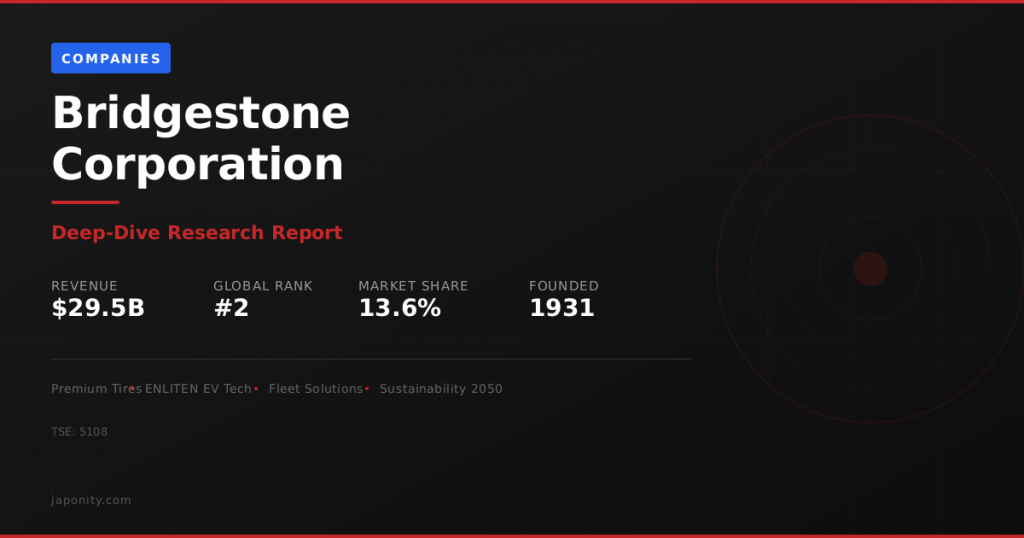
Bridgestone Corporation, founded in 1931 in Kurume, Japan, has grown from a small domestic tire maker into the world’s second-largest tire manufacturer by revenue. With FY2025 revenue of ¥4.43 trillion ($29.5B), 180+ production facilities across 150+ countries, and a bold pivot toward premium tires, EV mobility, and data-driven fleet solutions, Bridgestone stands as one of Japan’s most globally influential industrial companies. This deep-dive examines the financial performance, competitive positioning, and strategic direction that define Bridgestone today.
Company Overview
| Item | Details |
|---|---|
| Official Name | Bridgestone Corporation (bridgestone.com) |
| Founded | 1931 by Shōjirō Ishibashi, Kurume, Fukuoka |
| Headquarters | Kyōbashi, Chūō-ku, Tokyo |
| Stock Listing | Tokyo Stock Exchange Prime (5108) |
| Employees | ~130,000 worldwide |
| Production Facilities | 180+ plants in 24 countries |
| Global Presence | 150+ countries |
| CEO | Shuichi Ishibashi (Global CEO) |
The company name “Bridgestone” is a clever translation of founder Shōjirō Ishibashi’s surname: ishi (stone) + hashi (bridge), reversed into English word order. What began as a small tire workshop in Kyushu has become a global industrial powerhouse spanning tires, rubber products, automotive parts, and digital mobility solutions.
Global Market Position
Bridgestone holds the #2 position in the global tire industry, just behind Michelin of France. The tire market is a $190+ billion global industry, and the top three players command roughly 37% of total share.
Top 10 Global Tire Companies by Revenue (2025)
| Rank | Company | Country | Market Share |
|---|---|---|---|
| 1 | Michelin | France | 14.1% |
| 2 | Bridgestone | Japan | 13.6% |
| 3 | Goodyear | USA | 9.6% |
| 4 | Continental | Germany | 6.9% |
| 5 | Pirelli | Italy | 4.0% |
| 6 | Sumitomo Rubber | Japan | 3.8% |
| 7 | Hankook | South Korea | 3.8% |
| 8 | Yokohama Rubber | Japan | 3.6% |
| 9 | Zhongce Rubber | China | 2.9% |
| 10 | Sailun Group | China | 2.4% |
Source: Tire Business Global Tire Report 2025
The gap between Michelin and Bridgestone has narrowed in recent years, with Bridgestone aggressively expanding its premium tire segment. The two companies compete head-to-head in nearly every category: passenger cars, trucks, mining, aircraft, and motorsport.
Financial Analysis
FY2025 Consolidated Results
| Metric | FY2025 | YoY Change |
|---|---|---|
| Revenue | ¥4,429.5B ($29.5B) | -0.01% |
| Adjusted Operating Profit | ¥493.7B ($3.3B) | +2% |
| Operating Profit | ¥381.2B ($2.5B) | -14% |
| Net Income (attributable) | ¥327.3B ($2.2B) | +15% |
| Adj. Operating Margin | 11.1% | +0.2pp |
Source: Bridgestone IR Financial Results
Despite flat top-line revenue (impacted by foreign exchange headwinds), Bridgestone delivered strong bottom-line improvement. The 15% jump in net income reflects effective cost management and a strategic shift toward higher-margin premium products. On a constant-currency basis, revenue actually increased year-on-year.
Revenue by Region (9-Month Indicative Data)
| Region | Revenue (9M) | Operating Profit (9M) | YoY Profit Change |
|---|---|---|---|
| Japan | ¥912B | ¥132B | -3% |
| Americas | ¥1,570B | ¥158B | +21% |
| EMEA | ¥626B | ¥33B | +100%+ |
| Asia-Pacific, India & China | ¥373B | ¥41B | -2% |
The Americas segment remains Bridgestone’s largest revenue generator, accounting for roughly 45% of global sales. The EMEA region showed a dramatic turnaround, more than doubling earnings on flat sales through operational restructuring and premium mix improvement.
The Firestone Acquisition: A Defining Chapter
No analysis of Bridgestone is complete without examining the 1988 acquisition of Firestone Tire & Rubber Company — one of the largest cross-border acquisitions by a Japanese company at the time.
Key Timeline
| Year | Event |
|---|---|
| 1983 | Bridgestone purchases a Firestone plant in Tennessee — its first North American facility |
| 1987 | Bridgestone approaches Goodyear for a merger; talks collapse over valuation |
| Feb 1988 | Bridgestone bids $1.25B for Firestone; Pirelli counters |
| Mar 1988 | Bridgestone closes the deal at $2.6B ($80/share) |
| 1989 | Operations integrated as Bridgestone/Firestone, Inc. |
| 1990-92 | $1B in losses during difficult integration period |
| 1993+ | Return to profitability; global scale advantage realized |
Source: Bridgestone Corporate History
The Firestone deal transformed Bridgestone from a strong Asian player into a true global contender. Despite initial losses exceeding $1 billion, the acquisition gave Bridgestone immediate access to the massive North American market, Firestone’s dealer network, and manufacturing capacity that would have taken decades to build organically.
EV & Mobility Strategy
Bridgestone has positioned itself at the forefront of the electric vehicle revolution with its proprietary ENLITEN technology platform, designed to address the unique demands of EVs: higher torque, heavier battery weight, and range optimization.
ENLITEN Technology Roadmap
| Metric | 2024 | 2025 Target | 2026 Target | 2030 Target |
|---|---|---|---|---|
| OE Car Models with ENLITEN | 117 | 170 | 250 | 500+ |
| Replacement Products (cumulative) | 30 | 38 | 45 | 100 |
| ENLITEN-Equipped REP Ratio | 50% | 58% | 65% | 100% |
| Premium Tire Sales Ratio | 63% | 67% | 70% | 80%+ |
Key EV-specific products include:
- Turanza EV — Bridgestone’s first EV-dedicated tire, optimized for range extension without sacrificing tread life or wet performance
- ENLITEN-equipped OE tires — supplied to global automakers including Tesla, BMW, Mercedes-Benz, and emerging EV manufacturers
- Ultra-High Rim Diameter (20″+) tires — now 32% of OE sales and 13% of replacement sales in North America and Europe
Bridgestone announced a ¥27 billion ($180M) strategic investment across three Japanese plants to boost premium and EV tire production capacity by approximately 3,000 tires per day, focused on 20-inch and larger sizes. Additional investments of $85 million in India and $2 billion globally for premium plant upgrades underscore the scale of this strategic pivot.
Solutions Business
Beyond tires, Bridgestone is building a high-margin solutions business centered on data-driven fleet management and mobility services.
Webfleet: Europe’s Leading Fleet Telematics
| Metric | Value |
|---|---|
| Business Customers | 60,000+ worldwide |
| European Subscriptions | ~783,000 |
| European Market Share | ~5.1% |
| Award | Frost & Sullivan European Fleet Telematics Company of the Year 2025 (3rd time in 5 years) |
Source: Bridgestone EMEA Press
Key innovations in the solutions portfolio:
- Webfleet Fleet Advisor — AI-powered tool that combines generative AI with real-time fleet data for instant business-critical insights
- EV Services Platform — helps fleets transition to electric vehicles with route optimization and charging management
- OEM.connect — partner program connecting with leading trailer manufacturers for integrated telematics
- Bridgestone Mobility Solutions — comprehensive tire-as-a-service and fleet care programs
The solutions business represents Bridgestone’s strategic evolution from a “product company” to a “solutions company,” creating recurring revenue streams and deeper customer relationships.
Motorsport Legacy
Motorsport has been integral to Bridgestone’s brand building and tire technology development for over four decades.
Formula 1 Era (1997–2010)
Bridgestone’s 14-year run in Formula 1 remains one of the most successful tire supplier campaigns in the sport’s history. Key achievements:
- 5 Drivers’ Championships — including Mika Häkkinen (1998, 1999) and Michael Schumacher (2001–2004)
- 5 Constructors’ Championships — McLaren (1998) and Ferrari (2001–2004)
- Sole supplier from 2007–2010, providing tires for the entire F1 grid
Current Motorsport Strategy
After concluding its Worldwide Olympic and Paralympic Partnership at the end of 2024, Bridgestone announced a renewed commitment to global motorsports platforms, including:
- FIA ecoRally Cup — EV and hybrid rally championship
- Super GT and Super Formula — Japan’s premier racing series
- IndyCar and IMSA — North American racing platforms
- F1 bid — Bridgestone has expressed interest in returning as F1 tire supplier when Pirelli’s contract ends
Sustainability
Bridgestone has set one of the tire industry’s most ambitious sustainability agendas, with clear milestones toward carbon neutrality and circular economy targets.
Environmental Targets
| Goal | 2026 Target | 2030 Target | 2050 Vision |
|---|---|---|---|
| CO2 Reduction (vs. 2011) | 50%+ | 50%+ | Carbon neutral |
| Recycled/Renewable Materials | 39%+ | 40% | 100% |
| Water Consumption Reduction | Significant | 30%+ | Minimized |
Key Sustainability Initiatives
- 75% Recycled/Renewable Tire — Bridgestone has developed a demonstration tire made from 75% recycled and renewable materials, including recycled PET bottles, recycled steel, and natural rubber from guayule
- Guayule Research — Over $100 million invested in developing guayule (a desert shrub native to the US Southwest) as an alternative to traditional Hevea rubber from Southeast Asia. Commercial production targeted by end of decade
- Tire Pyrolysis — Recovering carbon black and oil from end-of-life tires for reuse in new products
- ENLITEN 63% Tire — Already supplying tires with a 63% recycled and renewable material ratio
Competitive Landscape
Bridgestone vs. Major Competitors
| Dimension | Bridgestone | Michelin | Goodyear |
|---|---|---|---|
| Revenue (2025) | ~$29.5B | ~$30.5B | ~$17B |
| Global Share | 13.6% | 14.1% | 9.6% |
| HQ | Tokyo, Japan | Clermont-Ferrand, France | Akron, Ohio, USA |
| EV Strategy | ENLITEN platform | e.Primacy / Pilot Sport EV | ElectricDrive |
| Fleet Solutions | Webfleet (60K+ clients) | Connected Fleet | Tire Intelligence |
| Sustainability Pledge | Carbon neutral 2050 | Carbon neutral 2050 | Net zero 2050 |
| Motorsport | Super GT, IndyCar, ecoRally | WEC, Le Mans | NASCAR |
| Key Advantage | Mining tires, Japan OE dominance | Premium brand, Michelin Guide | North America strength |
While Michelin holds a slight revenue edge, Bridgestone’s operating margins are competitive, and its dominance in ultra-large mining tires and Japanese OE fitments provides a defensive moat. The growing Chinese competitors (Zhongce, Sailun) present a long-term threat in the value segment, reinforcing Bridgestone’s strategic pivot to premium.
Business Opportunities for Global Partners
Bridgestone’s strategic direction creates several opportunities for international business partners:
- EV Supply Chain Partners — As Bridgestone expands ENLITEN production globally, suppliers of sustainable materials, advanced polymers, and silica have partnership potential
- Fleet Technology Integration — Webfleet’s open API and OEM.connect program offer integration opportunities for telematics, logistics, and fleet management companies
- Sustainability Material Suppliers — Bridgestone’s commitment to 100% sustainable materials by 2050 creates demand for recycled carbon black, bio-based chemicals, and alternative natural rubber sources
- Mining & Infrastructure — Bridgestone’s ultra-large tire division serves major mining companies worldwide; distributors and service providers in resource-rich regions have growth opportunities
- Retail & Distribution — Bridgestone operates a global network of branded retail outlets and is expanding its direct-to-consumer digital channels
Outlook
Bridgestone enters the second half of the 2020s with clear strategic priorities: premium products, EV readiness, digital solutions, and sustainability. The company’s Mid-Long-Term Business Strategy targets an adjusted operating margin of 14%+ by 2030, driven by the continued shift to high-rim-diameter tires, ENLITEN technology adoption across its full product range, and growth of the recurring-revenue solutions business.
Key catalysts to watch include:
- ENLITEN adoption rate among global OEMs (target: 250 models by end of 2026)
- Guayule commercialization timeline for US-sourced natural rubber
- Webfleet expansion into North American and Asian markets
- Potential F1 return as a tire supplier post-Pirelli contract
- Mining tire demand driven by global infrastructure investment
With nearly a century of tire-making expertise, a global manufacturing footprint, and a clear roadmap for the mobility revolution, Bridgestone remains one of Japan’s most consequential industrial companies — and a compelling partner for businesses seeking to engage with Japanese manufacturing excellence.
About Japonity Research
Japonity provides in-depth research reports on Japanese companies, technologies, and market opportunities for global business professionals. Need a custom research report on a Japanese company or industry? Contact our research team for tailored analysis and business matching support.
Interested in Japanese business opportunities?
Whether you're looking for technology partners, engineering talent, or market insights — we can help connect you with the right Japanese organizations.
Get in Touch →