TYO:6902
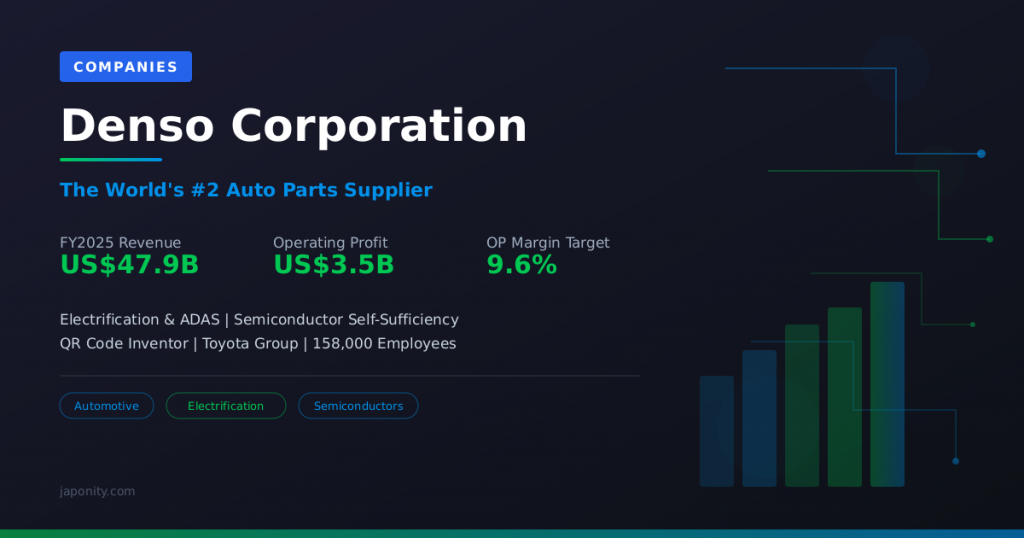
Denso Corporation, the world’s second-largest automotive parts supplier, posted US$47.9 billion in revenue for fiscal 2025 and is now pivoting aggressively toward electrification, ADAS, and semiconductor self-sufficiency. This deep-dive report examines the company’s financials, global footprint, technology bets, and partnership opportunities for international businesses.
Executive Summary
Founded in 1949 as a spinoff from Toyota Motor Corporation, Denso Corporation (TYO: 6902) has grown into a global powerhouse with approximately 158,000 employees across 35+ countries. In fiscal year 2025, the company delivered ¥7.16 trillion (US$47.9 billion) in consolidated revenue and ¥519.0 billion (US$3.5 billion) in operating profit—a 36.4% year-on-year increase. Looking ahead, its new CORE 2030 mid-term plan targets ¥3.7 trillion in cumulative R&D spending and ¥4 trillion in electrification and intelligence-related sales by 2031.
Company Overview
| Item | Details |
|---|---|
| Official Name | DENSO Corporation (デンソー株式会社) |
| Founded | December 16, 1949 |
| Headquarters | Kariya, Aichi, Japan |
| President & CEO | Shinnosuke Hayashi |
| Stock Listing | Tokyo Stock Exchange Prime (6902) |
| Employees | ~158,000 worldwide (FY2025) |
| Global Presence | 35+ countries, 200+ subsidiaries |
| Fortune Global 500 | Consistently ranked |
Business Segments
Denso organizes its operations into six reportable segments that reflect its strategic evolution from a traditional automotive supplier to a mobility technology company:
| Segment | Key Products | Strategic Focus |
|---|---|---|
| Electrification Systems | Inverters, battery management, motor controllers | EV/HEV powertrain electrification |
| Powertrain Systems | Fuel injection, ignition, exhaust | High-efficiency ICE, bridge to electrification |
| Thermal Systems | HVAC, heat pumps, radiators, condensers | EV thermal management |
| Mobility Electronics | ECUs, sensors, vision systems | ADAS, autonomous driving |
| Industrial Solutions | FA equipment, industrial robots, QR readers | Factory automation, non-automotive growth |
| Food Value Chain | Agricultural tech, food processing equipment | Farm-to-table automation |
Global Market Position
Denso holds the #2 position globally among automotive parts suppliers by revenue, trailing only Robert Bosch GmbH of Germany. This ranking has been consistent for over a decade and reflects Denso’s deep integration into the Toyota Group supply chain as well as its expanding relationships with other global OEMs including Honda, Ford, General Motors, and Stellantis.
Revenue by Region (FY2025)
| Region | Revenue (¥ Bn) | Revenue (US$ Bn) | YoY Change | Share of Total |
|---|---|---|---|---|
| Japan | 4,216.4 | 28.2 | +1.2% | 58.9% |
| Asia (ex-Japan) | 1,940.1 | 13.0 | -2.3% | 27.1% |
| North America | 1,863.2 | 12.5 | +5.4% | 26.0% |
| Europe | 718.7 | 4.8 | -8.0% | 10.0% |
Note: Regional figures include inter-segment transactions, so totals exceed consolidated revenue.
Japan remains the dominant market, but North America showed the strongest growth at +5.4%, driven by increasing EV component orders from U.S. automakers. European revenue declined 8.0%, partly due to currency effects and weakening European auto production.
Financial Analysis
Five-Year Financial Trajectory
| Metric | FY2021 | FY2022 | FY2023 | FY2024 | FY2025 |
|---|---|---|---|---|---|
| Revenue (¥ Tn) | 4.94 | 5.52 | 6.40 | 7.15 | 7.16 |
| Operating Profit (¥ Bn) | 236.8 | 347.0 | 398.5 | 380.4 | 519.0 |
| OP Margin | 4.8% | 6.3% | 6.2% | 5.3% | 7.2% |
| Net Income (¥ Bn) | 168.1 | 271.9 | 304.6 | 312.8 | 419.1 |
| R&D Spend (¥ Bn) | ~350 | ~380 | ~420 | ~480 | ~500 |
FY2025 was a standout year: operating profit surged 36.4% to ¥519 billion despite nearly flat revenue growth (+0.2%). This margin expansion was driven by business improvement activities, cost discipline, and favorable product mix shifts toward higher-margin electrification components.
FY2026 Forecast
| Metric | FY2025 (Actual) | FY2026 (Forecast) | Change |
|---|---|---|---|
| Revenue | ¥7,161.8 Bn | ¥7,050.0 Bn | -1.6% |
| Operating Profit | ¥519.0 Bn | ¥675.0 Bn | +30.1% |
| OP Margin | 7.2% | 9.6% | +2.4pp |
Revenue is expected to dip slightly due to a stronger yen assumption, but operating profit is forecast to jump another 30% to ¥675 billion, pushing the operating margin to 9.6%—nearing double digits for the first time. The company also targets an 11% ROE by 2030.
The Toyota Relationship
Denso’s relationship with Toyota is fundamental to understanding the company. Toyota Motor Corporation currently holds approximately 25% of Denso’s shares, making it the largest shareholder. Including stakes held by Toyota Industries (~10%) and Aisin Corporation, the broader Toyota Group historically controlled over 35% of Denso.
However, a significant restructuring is underway. In 2025, the Toyota Group announced plans to unwind cross-shareholdings:
- Toyota Motor — Stake to decrease from ~25% to ~20%, remaining the largest shareholder
- Toyota Industries — Stake to decrease from ~10% to ~6%
- Aisin — Stake to be fully divested
This move aims to improve capital efficiency across the group while maintaining the collaborative engineering relationship that has been central to both companies’ success. Denso supplies approximately 30% of Toyota’s automotive components, and this operational partnership is expected to continue regardless of equity changes.
Electrification Strategy
Denso is making its largest-ever strategic bet on vehicle electrification. Under the CORE 2030 plan, the company targets:
- ¥1.9 trillion in electrification sales by 2031 (up from ~¥800 billion currently)
- ¥3.7 trillion in cumulative R&D investment over five years (FY2027–FY2031)
- Focus areas: inverters, e-axles, battery management systems, heat pump HVAC for EVs
Key Electrification Products
| Product Category | Application | Competitive Edge |
|---|---|---|
| Power Modules / Inverters | BEV/HEV drivetrain control | In-house SiC chip development |
| Battery Management Systems | Battery state monitoring, balancing | Toyota partnership integration |
| Electric Compressors | EV cabin climate control | #1 global share in e-compressors |
| Heat Pump Systems | Energy-efficient EV heating | Extends EV range in cold climates |
| Motor & Alternator | Hybrid/PHEV systems | Decades of hybrid experience with Toyota |
Denso’s advantage in electrification comes from its vertically integrated approach: it designs the semiconductors, builds the power modules, integrates them into inverters, and delivers complete thermal management systems—all under one roof.
ADAS & Autonomous Driving
Under CORE 2030, Denso targets ¥1.0 trillion in ADAS-related sales by 2031. The company positions itself as a Tier 1 integrator of autonomous driving systems, providing:
- Vision sensors — Camera and image recognition systems
- Millimeter-wave radar — Long-range detection for highway ADAS
- LiDAR integration — In partnership with sensor specialists
- Domain controllers (ECUs) — Central computing for sensor fusion
- V2X communication modules — Vehicle-to-infrastructure connectivity
Denso has partnered with Foretellix for ADAS verification and is investing heavily in AI-based perception systems. The company’s stated goal is to eliminate car accidents by improving ADAS coverage across all vehicle segments, not just premium models.
Semiconductor Strategy
Perhaps Denso’s most differentiated move among Tier 1 suppliers is its push toward semiconductor self-sufficiency. While most competitors rely entirely on external chipmakers, Denso has been designing and manufacturing its own automotive semiconductors for decades.
In-House Semiconductor Roadmap
| Area | Strategy | Target |
|---|---|---|
| Power Semiconductors (SiC) | Large-diameter wafer production with partners, full SiC launch | Cost reduction for BEV inverters |
| Analog ICs / ASICs | In-house design of rugged automotive-grade chips | Unique differentiation for sensors & ECUs |
| Microcontrollers | Standardization across product lines | Supply chain resilience, cost optimization |
| In-House Production Target | Scale to ¥500 billion in semiconductor sales | Originally targeted by 2025 |
ROHM Partnership
In a landmark move, Denso and ROHM Co., Ltd. reached a basic agreement in May 2025 to establish a strategic semiconductor partnership. The collaboration focuses on:
- Co-developing analog ICs for EVs, ADAS, and autonomous driving
- Joint manufacturing of power semiconductors
- Strengthening capital ties (Denso is exploring acquiring a significant stake in ROHM)
This partnership positions Denso at the center of Japan’s power semiconductor consolidation—a national strategic priority as the country seeks to rebuild its chip industry competitiveness.
QR Code: Denso’s Hidden Legacy
One of Denso’s most surprising contributions to global technology is the invention of the QR code. In 1994, engineers at DENSO WAVE (then a division of Denso) developed the two-dimensional barcode to solve a practical factory problem: tracking automotive parts more efficiently than one-dimensional barcodes allowed.
Key Facts About Denso’s QR Code
- 200x more data than traditional barcodes
- 10x faster scanning speed
- Error correction — Readable even when partially damaged
- Open standard — Denso chose not to exercise its patent rights, enabling free global adoption
- Kanji/Kana support — Originally designed to encode Japanese characters for factory use
The decision to make QR code specifications publicly available—while retaining but not enforcing patents—was a deliberate strategy that accelerated global adoption. By 2002, Japanese mobile phones with QR readers drove mass consumer uptake, and the technology now processes billions of transactions daily worldwide. This open innovation philosophy reflects the Denso Group’s broader approach to technology leadership.
Factory Automation & Robotics
Beyond automotive, Denso operates a significant industrial solutions business through DENSO WAVE and DENSO Robotics. The company has been building industrial robots since the 1960s and is the world’s largest user of small assembly robots.
| Metric | Figure |
|---|---|
| Robots Deployed Globally | ~130,000 units |
| In-House Robot Usage | 21,500+ units |
| Robot Applications | Assembly, welding, inspection, material handling, pick & place, and 20+ more |
| Market Position | #1 in small assembly robots globally |
Denso’s approach is unique: it develops and battle-tests its FA technologies in its own factories before commercializing them. This “eat your own cooking” model ensures reliability and gives the company deep domain expertise that pure-play robotics firms struggle to match.
Competitive Landscape
| Company | HQ | Auto Revenue (US$ Bn) | Employees | Key Strength |
|---|---|---|---|---|
| Robert Bosch | Germany | ~56 | ~420,000 | Broadest product range, IoT ecosystem |
| DENSO | Japan | ~48 | ~158,000 | In-house semiconductors, Toyota integration |
| ZF Friedrichshafen | Germany | ~47 | ~165,000 | Chassis & driveline, commercial vehicles |
| Magna International | Canada | ~43 | ~179,000 | Contract manufacturing, body & exterior |
| Continental AG | Germany | ~42 | ~190,000 | Tires, ADAS, displays, infotainment |
Denso’s Competitive Advantages
- Vertical integration — From semiconductor design to complete systems
- Toyota ecosystem — Guaranteed base volume, deep co-development
- R&D intensity — ~7% of revenue dedicated to R&D annually
- Thermal dominance — Global leader in automotive HVAC and EV thermal management
- Japanese manufacturing excellence — Monozukuri culture and kaizen-driven operations
Key Risks
- Toyota dependency — Despite diversification, Toyota Group still represents the majority of sales
- Currency exposure — Yen fluctuations significantly impact reported results
- China risk — Increasing competition from local Chinese suppliers in the EV space
- EV transition speed — Legacy ICE component revenue declining faster than EV revenue grows
Business Opportunities
For international companies looking to engage with Denso, several strategic opportunities exist:
For Technology Partners
- Semiconductor collaboration — Denso actively seeks partners for SiC wafer production, analog IC design, and next-gen chip packaging
- ADAS sensor fusion — Opportunities to integrate LiDAR, radar, and camera technologies into Denso’s perception platforms
- AI/ML for manufacturing — Denso’s CORE 2030 plan explicitly calls for AI-led manufacturing innovation
For Suppliers & Distributors
- Non-automotive FA equipment — Denso is actively expanding industrial robot sales outside automotive
- Food value chain technology — Agricultural automation and food processing equipment for global markets
- Aftermarket parts distribution — Thermal and powertrain components for the global aftermarket
For Investors
- Margin expansion story — OP margin moving from 5% to nearly 10% within two years
- Cross-shareholding unwinding — Toyota Group share sales create market liquidity
- Semiconductor optionality — ROHM partnership could create a Japanese automotive chip champion
Outlook
Denso stands at a pivotal moment. The company has successfully navigated the post-pandemic supply chain crisis, dramatically improved profitability, and laid out a clear roadmap for the electrified, software-defined vehicle era. Its unique position—combining semiconductor expertise, thermal system dominance, and deep OEM relationships—provides a foundation that few competitors can replicate.
The CORE 2030 plan is ambitious but grounded in Denso’s track record of execution. If the company achieves its targets, it will have transformed from a traditional auto parts maker into a vertically integrated mobility technology platform—one that designs chips, builds power electronics, manages thermal systems, and enables autonomous driving.
For global businesses, Denso represents both a formidable competitor and an attractive partner. Its expanding openness to external collaboration—evidenced by the ROHM partnership, diversification beyond Toyota, and non-automotive growth—creates opportunities that did not exist a decade ago.
Need deeper analysis on Denso or other Japanese companies?
Japonity provides custom research reports, market entry analysis, and partner matching services for businesses targeting the Japanese market. Contact us to discuss your needs.
Interested in Japanese business opportunities?
Whether you're looking for technology partners, engineering talent, or market insights — we can help connect you with the right Japanese organizations.
Get in Touch →