TYO:6326
Executive Summary
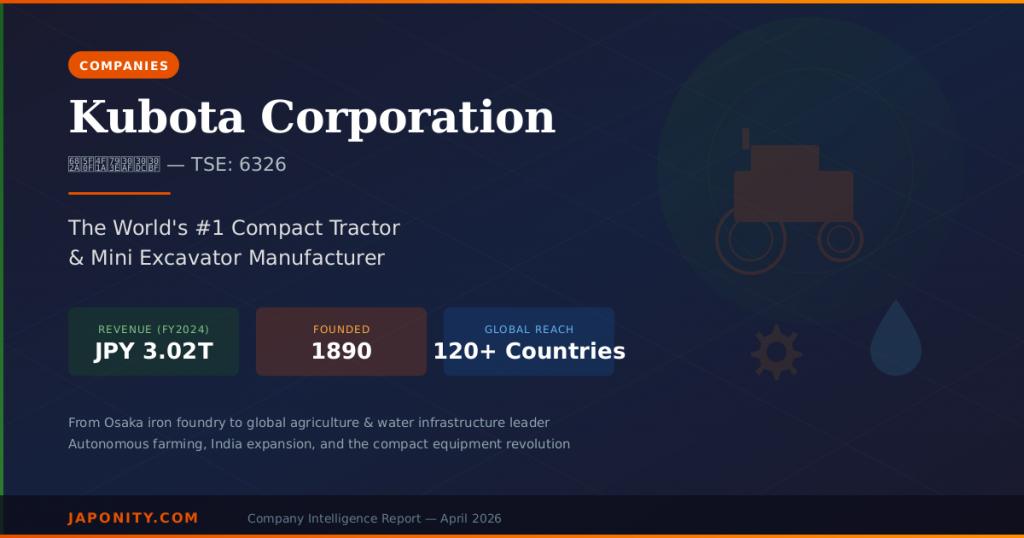
Kubota Corporation (株式会社クボタ, TSE: 6326) is a 136-year-old Japanese industrial conglomerate and the world’s largest manufacturer of compact tractors and mini excavators. With consolidated revenue of JPY 3.02 trillion (approximately USD 20 billion) in FY2024, a market capitalization exceeding JPY 2.99 trillion, and approximately 52,000 employees, Kubota operates across over 120 countries with a uniquely diversified portfolio spanning farm machinery, construction equipment, water infrastructure, and environmental solutions.
Unlike competitors that focus solely on large-scale agriculture, Kubota has built a dominant global franchise in the compact equipment segment — owning the #1 position in sub-40 HP tractors in North America and the #1 global market share in mini excavators (0–6 ton class). The company’s GMB2030 long-term vision positions it as an “Essentials Innovator for Supporting Life,” targeting food, water, and environment as interconnected growth pillars.
This report provides a comprehensive analysis of Kubota’s market position, financial performance, regional strategies, technology initiatives, and business opportunities for international partners and investors.
1. Company Overview
| Item | Details |
|---|---|
| Company Name | Kubota Corporation (株式会社クボタ) |
| Founded | 1890, by Gonshiro Kubota in Osaka |
| Headquarters | Naniwa-ku, Osaka, Japan |
| President & Representative Director | Yuichi Kitao |
| Stock Listing | Tokyo Stock Exchange Prime (6326) / OTC: KUBTY |
| Employees | ~52,000 (consolidated, 2025) |
| Countries of Operation | 120+ |
| Global Ranking | #1 in compact tractors (sub-40 HP) & mini excavators (0–6 ton) |
| Key Segments | Farm & Industrial Machinery / Water & Environment / Other |
| FY2024 Revenue | JPY 3.02 trillion (~USD 20B) |
| Market Capitalization | ~JPY 2.99 trillion (Feb 2026) |
Corporate History & Milestones
| Year | Milestone |
|---|---|
| 1890 | Founded by Gonshiro Kubota in Osaka as Ohde Casting — produced castings for weighing equipment |
| 1893 | Began mass production of cast iron pipes for waterworks — first in Japan, addressing cholera outbreaks |
| 1922 | Entered agricultural engine market; began manufacturing kerosene engines |
| 1960 | Launched first Kubota tractor, marking entry into mechanized agriculture |
| 1972 | Established Kubota Tractor Corporation in the United States — first overseas tractor distribution |
| 1974 | Listed on Tokyo Stock Exchange |
| 1988 | Opened first U.S. manufacturing plant in Gainesville, Georgia |
| 2012 | Acquired Kverneland Group (Norwegian agricultural implements) for European expansion |
| 2014 | North American revenue surpassed Japan for the first time |
| 2022 | Acquired majority stake in Escorts Ltd (India) — rebranded as Escorts Kubota Limited |
| 2025 | Partnered with Liebherr for 9–11 ton wheeled excavators; launched Farmtrac collaborative models in India |
| 2026 | Unveiled autonomous M5 Narrow tractor and KVPR Transformer robot concept at CES 2026 |
2. Global Market Position
Kubota occupies a unique niche in the global agricultural and construction equipment landscape. While competitors like Deere & Company focus on large-scale row crop farming, Kubota has built category-defining dominance in compact equipment — a segment experiencing faster growth than the overall market.
Kubota’s #1 Positions Worldwide
| Category | Market Position | Source |
|---|---|---|
| Compact Tractors (sub-40 HP) | #1 in North America — pioneer and market leader since 1972 | Industry analysis |
| Mini Excavators (0–6 ton) | #1 globally — largest market share worldwide | Off-Highway Research 2024 |
| Ductile Iron Pipes | #1 in Japan; major global supplier including world’s largest diameter (2.6m) | Kubota Engineering |
| Rice Transplanting Machines | Leading position in Japan and Asia | Company reports |
Global Market Context
| Market | 2025 Size | 2030–2035 Projection | CAGR |
|---|---|---|---|
| Compact Tractor | USD 8.9B | USD 10.1B (2030) | ~3% |
| Compact Excavator | USD 10.8B | USD 15.7B (2035) | 3.8% |
| Compact Construction Equipment (total) | USD 40B+ | USD 56.05B (2032) | ~5% |
| Global Agriculture Equipment | USD 150B+ | USD 200B+ (2030) | ~4.5% |
3. Financial Analysis
Consolidated Financial Results (FY2022–FY2024)
| Metric | FY2022 | FY2023 | FY2024 | YoY Change |
|---|---|---|---|---|
| Revenue | JPY 2.68T | JPY 3.02T | JPY 3.02T | +0.1% |
| Revenue (USD) | ~USD 18.3B | ~USD 21.5B | ~USD 19.9B | -7.2% |
| Operating Profit | JPY 268B | JPY 316B | JPY 230B | -27.2% |
| Net Income | JPY 194B | JPY 230B | JPY 187B | -18.7% |
| Operating Margin | 10.0% | 10.5% | ~7.6% | -2.9pp |
Source: Kubota FY2024 Financial Results Briefing, StockAnalysis
Revenue by Segment (FY2024)
| Segment | Revenue Share | Key Products |
|---|---|---|
| Farm & Industrial Machinery | ~88.6% | Tractors, combine harvesters, rice transplanters, construction equipment, engines |
| Water & Environment | ~9% | Ductile iron pipes, valves, pumps, water treatment systems, membrane bioreactors |
| Other | ~2.4% | Air conditioning, vending machines, IT solutions |
FY2025 Outlook (Company Forecast)
| Metric | FY2025 Forecast | vs FY2024 |
|---|---|---|
| Revenue | JPY 2,880B | -4.5% |
| Operating Profit | JPY 220B | -30.3% |
The forecast decline reflects headwinds from the strong yen, a significant downturn in the U.S. tractor market, and anticipated impacts from U.S. reciprocal tariffs on Japanese imports.
4. North America Strategy
North America is Kubota’s largest and most important market, having surpassed Japan in revenue contribution in 2014. The company’s success story in North America is a textbook case of niche domination expanding into adjacent categories.
North America Timeline
| Phase | Period | Strategy |
|---|---|---|
| Entry | 1972 | Established Kubota Tractor Corporation; introduced compact tractors to U.S. market — creating an entirely new product category |
| Growth | 1980s–1990s | Built dealer network to 1,100+ locations; became synonymous with sub-40 HP tractors |
| Diversification | 2000s | Leveraged dealer network to launch compact excavators, utility vehicles (RTVs), and mowers |
| Scale | 2010s–Present | Moved upmarket with larger tractors (up to 170 HP); expanded construction equipment lineup; surpassed 1.5 million units sold in the U.S. |
Dealer Network — Kubota’s Competitive Moat
With over 1,100 authorized dealerships across the United States, Kubota’s dealer network is a formidable competitive advantage that took five decades to build. Key characteristics include:
- Full-line capability: Each dealer offers tractors, construction equipment, UTVs, mowers, and implements — creating cross-selling opportunities
- Parts & service infrastructure: Rapid parts delivery network supports high uptime guarantees
- Kubota Credit Corporation: In-house financing supports dealer sales with competitive rates
- Local expertise: Dealers serve as trusted advisors for the hobby farm, landscaping, and small construction segments
The dealer network also enabled Kubota’s mini excavator success. When Kubota entered the North American compact excavator market, it leveraged the existing tractor dealer infrastructure rather than building a separate construction equipment channel — dramatically reducing go-to-market costs.
Tariff & Trade Risk
U.S. reciprocal tariffs represent a near-term headwind. Kubota manufactures some products in the U.S. (Gainesville, Georgia plant) but still imports significantly from Japan. The company’s FY2025 forecast incorporates tariff impacts as a key risk factor.
5. Water & Environment Infrastructure
While most investors and partners know Kubota for tractors, the company’s water infrastructure business is its founding heritage — dating back to 1893 when Kubota began producing cast iron pipes to combat Japan’s cholera epidemic.
Water Business Portfolio
| Product Category | Description | Global Significance |
|---|---|---|
| Ductile Iron Pipes | World’s first earthquake-resistant ductile iron pipes; world’s largest diameter (2.6m) | Critical for disaster-prone regions (Japan, SE Asia, Middle East) |
| Valves & Pumps | Butterfly valves, gate valves, and water pumps for municipal water systems | Deployed across Japan’s water infrastructure |
| Water Treatment (MBR) | Kubota Membrane Bioreactor technology for wastewater treatment | Used globally; key technology for water-scarce regions |
| Environmental Plant Engineering | Complete water/sewage treatment plant design, construction, and O&M | EPC capability for developing country infrastructure |
Strategic Value of Water Business
The water segment represents approximately 9% of consolidated revenue but serves critical strategic purposes:
- Recurring revenue: Infrastructure maintenance contracts provide stable, long-term income
- ESG alignment: Water infrastructure directly supports UN SDG 6 (Clean Water and Sanitation)
- Developing market entry: Water projects create government relationships that can open doors for farm machinery sales
- Technology differentiation: Earthquake-resistant pipe technology and membrane bioreactors are high-margin specialty products
6. Smart Agriculture & Autonomous Technology
Kubota is making aggressive investments in autonomous farming technology, positioning itself as a pioneer in smart agriculture solutions for compact and mid-size farms — a segment largely ignored by competitors focused on large-scale precision agriculture.
Key Technology Initiatives
| Initiative | Status (2026) | Description |
|---|---|---|
| Agri Robo Series | Commercialized (Japan) | Unmanned autonomous tractors, combine harvesters, and rice transplanters operating under human monitoring |
| M5 Narrow Autonomous | Commercializing 2026 | 105.7 HP autonomous tractor developed with Agtonomy; AI-powered sensing for specialty crops (vineyards); 4 units operating in California vineyards |
| M7004 Autonomous | Field validation | Autonomous version of flagship European tractor; proof-of-concept trials ongoing |
| KVPR Transformer Robot | Concept | Versatile platform robot that expands, contracts, and moves along every axis — multi-machine capability in one platform |
| KSAS (Kubota Smart Agri System) | Active | Cloud-based farm management platform integrating machinery data, crop planning, and precision agriculture |
CES 2026 Highlights
Kubota’s CES 2026 exhibition signaled a major strategic shift — positioning the company not as a traditional machinery maker but as an AI-driven agricultural solutions provider. The partnership with Agtonomy for autonomous specialty crop solutions is particularly significant, targeting high-value agriculture (vineyards, orchards) where labor shortages are most acute.
7. Regional Expansion Strategy
India — The Growth Engine
India represents Kubota’s most ambitious growth bet. Through its majority-owned subsidiary Escorts Kubota Limited (EKL), the company is pursuing a multi-pronged strategy:
| Dimension | Current Status | 2030 Target |
|---|---|---|
| Market Share | ~12% (4th largest in India) | ~25% (targeting #2 position) |
| Annual Production | ~120,000 units | ~240,000 units (new factory by 2030) |
| New Factory | Land allotted (200 acres, Yamuna Expressway) | INR 4,500 crore (~USD 530M) investment; 4,000 new jobs |
| Product Strategy | Farmtrac entry-level premium models launched 2025 | Full range from basic to premium; Kubota technology + Escorts cost competitiveness |
| Export Hub | Exports started to Europe & Africa | Global basic tractor supply hub (like Suzuki model) |
Recent India Performance
Escorts Kubota sold 12,119 tractors in March 2026 (+6.6% YoY) and recorded a 20.4% YoY jump in February 2026 to 10,339 units. The company is also targeting double-digit market share in Southern India, currently at 3%.
Regional Strategy Overview
| Region | Strategy | Key Initiatives |
|---|---|---|
| North America | Defend compact dominance; expand upmarket | Larger tractors (up to 170 HP); autonomous specialty crop solutions; construction equipment growth |
| India | Transform into global production hub | Escorts Kubota integration; new mega-factory; export to Africa/SE Asia/Europe |
| Europe | Grow construction equipment; expand farm machinery | Liebherr partnership for wheeled excavators; German plant expansion; M7004 autonomous tractor |
| Southeast Asia | Leverage urbanization-driven demand | Construction equipment focus; rice farming mechanization |
| Africa | Entry via India-made basic tractors | Government subsidy-supported sales; international aid programs |
8. Competitive Landscape
Global Agricultural & Construction Equipment: Key Competitors
| Company | HQ | Revenue (Latest) | Key Strengths | Kubota’s Advantage vs. |
|---|---|---|---|---|
| Deere & Co. | USA | ~USD 61.5B | Brand dominance, precision ag, largest dealer network | Compact segment leadership; lower price points; stronger Asia presence |
| CNH Industrial | Netherlands | ~USD 22.5B | Case IH + New Holland dual brand; strong in large tractors | Mini excavator dominance; water infrastructure diversification |
| AGCO Corp. | USA | ~USD 12B | Fendt premium brand; strong in Europe (~50% revenue) | Asia & compact market strength; construction equipment portfolio |
| Mahindra & Mahindra | India | ~USD 15B (total) | #1 tractor brand globally by volume; Indian market leader | Technology edge; global brand trust; compact construction equipment |
| Yanmar | Japan | ~USD 7B | Diesel engines; marine; similar compact focus | Scale advantage; deeper North American presence; broader product range |
Competitive Positioning Map
| Dimension | Deere | CNH | AGCO | Kubota |
|---|---|---|---|---|
| Large-Scale Agriculture | Dominant | Strong | Strong | Emerging |
| Compact Equipment | Strong | Moderate | Weak | Dominant |
| Construction Equipment | Strong | Moderate | None | Strong (compact) |
| Water Infrastructure | None | None | None | Unique |
| Asia Market Presence | Moderate | Moderate | Weak | Dominant |
| Autonomous Technology | Advanced | Developing | Developing | Advanced (compact segment) |
| India Presence | Limited | Moderate | Limited | Strong (via Escorts) |
9. Business Opportunities
Kubota’s unique market positioning creates several compelling opportunities for international partners, distributors, and investors:
Partnership & Distribution Opportunities
| Opportunity | Target Partner Profile | Value Proposition |
|---|---|---|
| Compact Equipment Distribution | Equipment dealers in emerging markets (Africa, Latin America, Middle East) | Best-in-class compact tractors and excavators with proven dealer support model |
| Water Infrastructure Projects | EPC contractors, municipal authorities, development agencies | Earthquake-resistant pipes, MBR technology, and full EPC capability for water/sewage systems |
| Smart Agriculture Solutions | AgTech integrators, farm management platforms, autonomous technology developers | Kubota’s KSAS platform and autonomous machinery for precision agriculture integration |
| India Manufacturing | Component suppliers, tier-2 manufacturers | Escorts Kubota’s expanding supply chain for its 240,000-unit production target |
| OEM Engine Supply | Equipment manufacturers needing compact diesel/gas engines | Kubota engines are already widely used by third-party equipment manufacturers worldwide |
Investment Thesis
| Factor | Bull Case | Bear Case |
|---|---|---|
| Compact Market Growth | Urbanization, hobby farming, and landscaping drive steady 3–5% CAGR in compact equipment globally | Economic downturns reduce discretionary equipment purchases |
| India Strategy | Escorts Kubota reaches #2 position; India becomes global export hub | Integration challenges; intense competition from Mahindra and TAFE |
| Autonomous Agriculture | First-mover advantage in compact autonomous solutions; labor shortage tailwinds | Technology adoption slower than expected; regulatory barriers |
| Water Infrastructure | Global water crisis drives infrastructure investment; MBR technology gains share | Low-margin government contracts; slow infrastructure spending cycles |
| Currency/Tariff | Yen weakening benefits export competitiveness | U.S. tariffs and yen strength compress margins significantly |
10. GMB2030 Vision & Outlook
Kubota’s GMB2030 (Global Major Brand 2030) long-term vision aims to establish the company as an “Essentials Innovator for Supporting Life” — a company that earns the trust of the greatest number of customers by solving the world’s most fundamental challenges in food, water, and the environment.
Strategic Priorities to 2030
| Priority | Target | Key Actions |
|---|---|---|
| North America Construction | Significant market share increase | Expand product lineup into larger equipment classes; Liebherr partnership |
| ASEAN Farm & Industrial | Sales growth aligned with urbanization | Construction equipment focus; rice farming mechanization |
| India Growth Engine | 25% tractor market share by 2030 | New mega-factory; collaborative Farmtrac models; export hub strategy |
| Smart Agriculture | Commercialize autonomous solutions | Agri Robo series; Agtonomy partnership; KSAS platform expansion |
| K-ESG Management | Industry-leading ESG performance | Carbon neutrality targets; water stewardship; circular economy initiatives |
Near-Term Challenges
- U.S. tariff impact: Reciprocal tariffs on Japanese imports create margin pressure on machinery segment
- Currency volatility: JPY 160B local-currency revenue decline partially masked by weak yen in FY2024
- North American tractor market cyclicality: Post-pandemic demand normalization reducing sales volumes
- Escorts Kubota integration: Combining Japanese quality standards with Indian cost structures remains a work in progress
Long-Term Catalysts
- Global labor shortages: Drive demand for autonomous and compact equipment across agriculture and construction
- Water infrastructure investment: Climate change and urbanization accelerate water system upgrades worldwide
- India demographic dividend: 1.4 billion population with rapidly mechanizing agriculture
- Compact equipment trend: Suburban sprawl, urban farming, and landscaping drive steady compact demand growth
Sources & References
- Kubota FY2024 Financial Results Briefing (Feb 2025)
- Kubota FY2025 Q2 Financial Results
- Kubota GMB2030 Long-Term Vision
- Kubota Mid-Term Business Plan
- Kubota Corporate History & Digital Archives
- Kubota North America Expansion Story
- Kubota (KUBTY) Financial Data — StockAnalysis
- Compact Tractor Market Report 2033 — Data Horizon Research
- Compact Excavator Market Report — Fact.MR
- Compact Construction Equipment Market — MarketsandMarkets
- Kubota Autonomous Tractor at CES 2026 — DTN
- Escorts Kubota India Strategy — Business Standard
This report was researched and produced by Japonity.com — Japan Discovery & Business Intelligence Platform.
Need a custom market research report on Japanese industries, companies, or products? We accept commissioned research projects (調査代行). Contact us to discuss your specific intelligence needs.
Published: April 2026
Interested in Japanese business opportunities?
Whether you're looking for technology partners, engineering talent, or market insights — we can help connect you with the right Japanese organizations.
Get in Touch →