Executive Summary
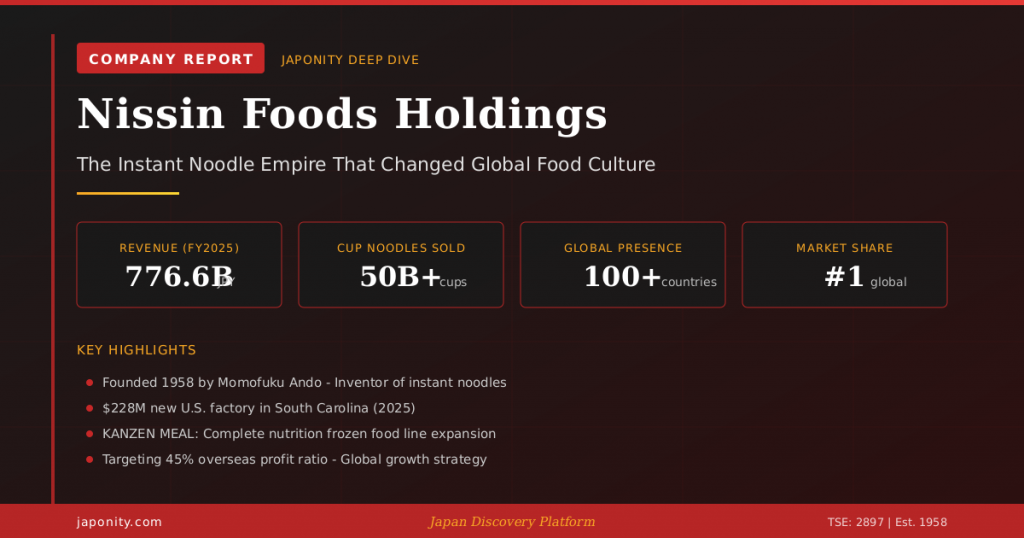
Nissin Foods Holdings Co., Ltd. (TSE: 2897) is the world’s largest instant noodle company and the inventor of an entire food category. Founded by Momofuku Ando in 1958, the company has grown from a backyard shed in Osaka to a global empire with operations in over 100 countries, consolidated revenue of 776.6 billion yen (approx. $5.2B) in FY2025, and a dominant 15% share of the global instant noodle market.
With its iconic Cup Noodles brand surpassing 50 billion cumulative units sold, a $228 million U.S. expansion underway, and bold moves into complete nutrition foods, Nissin represents one of Japan’s most compelling global consumer brands. This report examines the company’s financial performance, regional strategy, innovation pipeline, and competitive positioning for international business partners and investors.
| Metric | Value | Source |
|---|---|---|
| Revenue (FY3/2025) | 776.6 billion JPY (~$5.2B) | Nissin IR |
| Market Capitalization | ~770 billion JPY (~$5.4B) | Stock Analysis |
| Global Market Share | ~15% (instant noodles) | EssFeed |
| Cup Noodles Cumulative Sales | 50+ billion units | Japan Today |
| Countries Served | 100+ | Nissin Corporate |
| Employees | ~14,000+ | DCF Modeling |
| Founded | 1958 | Nissin Foods |
Company Overview: The Ando Legacy
The Man Who Invented Instant Noodles
In post-war Japan, Momofuku Ando (1910-2007) witnessed long lines of hungry people waiting for bowls of ramen in Osaka. Driven by the belief that “Peace will come to the world when the people have enough to eat,” Ando spent a full year experimenting in a small backyard shed in Ikeda, Osaka Prefecture.
On August 25, 1958, he perfected a revolutionary technique: flash-frying noodles after steaming and seasoning them, which simultaneously dehydrated and preserved the noodles. The result was Chikin Ramen — the world’s first instant noodle product. Initially priced at 35 yen (about six times the cost of fresh udon), it was considered a luxury item but quickly became a household staple.
The Cup Noodles Revolution
Ando’s second breakthrough came in 1971 when, at the age of 61, he observed Americans breaking noodles in half and eating them from paper cups. This insight led to the invention of Cup Noodles — combining a waterproof polystyrene container that served as packaging, cooking vessel, and eating bowl in one. Launched on September 18, 1971, Cup Noodles fundamentally transformed how the world consumed instant noodles and opened the door to massive international expansion.
In a 2000 Japanese poll, instant noodles were voted the single most important Japanese invention of the 20th century — ahead of karaoke, the Walkman, and video games.
Space Ram and Beyond
At the age of 95, Ando developed Space Ram — the world’s first space food ramen, consumed aboard the International Space Station in 2005. This demonstrated both his relentless innovation spirit and Nissin’s commitment to pushing boundaries, a philosophy that continues to define the company today.
Global Market Position
The $55 Billion Instant Noodle Industry
The global instant noodle market was valued at USD 55.2 billion in 2025 and is projected to reach USD 91.7 billion by 2034, growing at a CAGR of 5.8%. According to the World Instant Noodles Association (WINA), over 123 billion servings were consumed globally in 2024, with demand projected to reach 120 billion+ servings annually going forward.
| Region | Market Share (2025) | Key Growth Driver |
|---|---|---|
| Asia Pacific | ~55.7% | Staple food culture, massive population |
| North America | ~12% | Convenience food demand, multicultural diets |
| Latin America | ~8% | Brazil market growth, affordability |
| Europe/Middle East | ~7% | Emerging adoption, convenience trend |
| Africa | ~5% | Rapid urbanization, affordable protein |
Source: Dataintelo, GlobeNewsWire
Nissin’s Dominant Position
Nissin Foods holds the #1 position globally with approximately 15% market share and $5.2 billion in revenue (2025). The company operates manufacturing facilities across the United States, Brazil, Mexico, China, Hong Kong, India, Indonesia, Thailand, Vietnam, Korea, Australia, and Hungary, giving it the most geographically diversified production network of any instant noodle company.
Financial Analysis
Revenue Growth Trajectory
| Fiscal Year | Revenue (B JPY) | YoY Growth | Key Driver |
|---|---|---|---|
| FY3/2022 | 569.7 | +4.5% | Pandemic demand, pricing |
| FY3/2023 | 665.6 | +16.8% | Price increases, overseas growth |
| FY3/2024 | 732.9 | +10.1% | Volume recovery, China expansion |
| FY3/2025 | 776.6 | +6.0% | All-segment growth |
Source: Nissin Foods IR – Financial Highlights
Segment Breakdown
| Segment | Revenue Share | Key Brands | FY2025 Trend |
|---|---|---|---|
| Nissin Food Products (Japan) | ~45% | Cup Noodle, Chicken Ramen, U.F.O. | Stable growth, premium mix |
| Myojo Foods (Japan) | ~8% | Charumera, Ippei-chan | Steady |
| Chilled/Frozen/Beverages | ~12% | Chilled noodles, beverages | Growth via KANZEN MEAL |
| The Americas | ~20% | Cup Noodles, Top Ramen, Nissin Lamen | Mixed (US soft, Brazil strong) |
| China/Hong Kong | ~8% | Cup Noodles, Demae Iccho | Recovery, impairment impact |
| Others (Asia/EMEA) | ~7% | Various local brands | Strong growth |
Source: Nissin Foods – Segment Results
Profitability Profile
Japan remains the profit engine, contributing approximately 85% of operating profit despite representing ~75% of revenue. The company is strategically targeting an increase in the overseas profit contribution to 45% of core operating profit, indicating significant room for margin improvement in international markets. For FY2026 H1, the company reported that existing business core operating profit was revised to 68.5 billion yen, reflecting short-term headwinds in the U.S. market.
Regional Strategy Deep Dive
United States: The $228 Million Bet
Nissin entered the U.S. market in 1972, becoming one of the earliest Japanese food companies to establish American operations. The company has made a massive commitment with a $228 million investment in a third U.S. manufacturing facility in Greenville County, South Carolina.
| U.S. Operations | Details |
|---|---|
| Market Entry | 1972 |
| Existing Facilities | Lancaster, PA; Gardena, CA |
| New Facility | Greenville County, SC (640,640 sq ft) |
| Investment | $228 million |
| Operations Start | August 2025 |
| New Jobs | 300+ |
| Sustainability | Solar panels, EV charging, electric forklifts |
While the U.S. instant noodle market faces near-term challenges, Nissin’s long-term strategic commitment is clear. The new South Carolina plant positions the company for recovery and growth as the market stabilizes.
Brazil: Latin America’s Instant Noodle Powerhouse
Nissin entered Brazil in 1981 and has built one of the strongest instant noodle brands in Latin America under the “Nissin Lamen” brand. Brazil represents a key bright spot in the Americas segment, with strong revenue growth partially offsetting U.S. softness. The company has announced plans for a new production plant in Brazil to meet rising demand.
China and Hong Kong
Nissin entered China in 1995 and operates through its Hong Kong-listed subsidiary (HK: 1475). In 2025, the subsidiary reported revenue of HK$4.0 billion (up 5.0% YoY) with a gross profit margin of 34.6%. While mainland China operations recorded 2.7 billion yen in impairment losses on fixed assets, the market shows signs of recovery with improved consumer sentiment.
India: The Next Frontier
Present in India since 1988, Nissin has been building its presence in one of the world’s fastest-growing instant noodle markets. With India’s instant noodle consumption growing rapidly, the market presents significant upside potential for Nissin’s branded products.
Southeast Asia
Nissin operates production facilities in Indonesia, Thailand, and Vietnam — three of the world’s largest instant noodle consuming nations. While facing intense competition from local players like Indofood (Indomie), Nissin leverages its premium positioning and Japanese brand heritage to capture the growing middle-class segment.
Product Innovation Pipeline
KANZEN MEAL: The Complete Nutrition Pivot
In June 2025, Nissin launched KANZEN MEAL — a line of frozen, nutrient-dense comfort food. “Kanzen” means “complete” in Japanese, and this product line represents Nissin’s most significant category expansion beyond instant noodles.
| KANZEN MEAL Details | Information |
|---|---|
| Category | Single-serve frozen meals |
| Target Consumer | Health-conscious, GLP-1 users |
| Initial Varieties | 3 (including Spaghetti Bolognese) |
| Key Feature | Balanced macronutrients, plant protein blend |
| Launch Region | U.S. West Coast (premium/specialty stores) |
| Retailers | Nugget Markets, Bristol Farms, Gelson’s, Harris Teeter |
| Expansion Plan | Rapid rollout through Fall 2025 and Spring 2026 |
Source: Food Dive
Plant-Based and Sustainability Initiatives
Under its EARTH FOOD CHALLENGE 2030 program, Nissin has set ambitious targets:
- Vegetable protein target: Increase use in instant noodle ingredients in Japan to 1,100 tons/year by 2030
- CO2 emissions: Reduce by 30% by 2030, achieve carbon neutrality by 2050
- FoodTech: Replacing animal protein ingredients with vegetable proteins using proprietary technology
Toyota Partnership: Woven City
Nissin has partnered with Toyota Motor Corporation to develop personalized, healthy “Complete Nutrition Meals” using molecular nutritional science for Woven City — Toyota’s experimental smart city in Shizuoka Prefecture. This collaboration applies Toyota Production System principles to food supply chain optimization.
Competitive Landscape
| Company | Revenue (2025) | Market Share | Key Brands | Primary Markets |
|---|---|---|---|---|
| Nissin Foods Holdings | $5.2B | ~15% | Cup Noodles, Top Ramen | Global (100+ countries) |
| Tingyi (Master Kong) | $4.7B | ~12% | Master Kong | China, Southeast Asia |
| Toyo Suisan (Maruchan) | $3.5B | ~9% | Maruchan | Japan, Americas |
| Indofood (Indomie) | ~$3.0B | ~8% | Indomie | Indonesia, Africa, Middle East |
| Sanyo Foods | $2.1B | ~5% | Sapporo Ichiban | Japan, North America |
Source: EssFeed – Top 10 Asian Noodle Companies 2025
Nissin’s Competitive Advantages
- Brand Heritage: As the inventor of instant noodles (1958) and cup noodles (1971), Nissin carries unmatched brand authority and consumer trust
- Geographic Diversification: The most globally distributed production network of any instant noodle company, with factories across 4 continents
- Innovation Pipeline: From Space Ram to KANZEN MEAL, Nissin consistently leads category innovation
- Premium Positioning: While competitors focus on value segments, Nissin commands premium pricing through brand equity and product quality
- R&D Investment: Significant investment in FoodTech, plant-based proteins, and molecular nutrition science
Business Opportunities
Nissin Foods Holdings presents compelling opportunities across multiple dimensions for international partners:
For Ingredient Suppliers
- Nissin’s shift toward plant-based proteins creates demand for new vegetable protein ingredients (target: 1,100 tons/year by 2030)
- New South Carolina facility needs supply chain partners for raw materials
- KANZEN MEAL expansion requires diverse, nutrient-dense ingredient sources
For Distribution Partners
- Expanding into premium/specialty retail channels in the U.S. with KANZEN MEAL
- Growing presence in emerging markets (Africa, Middle East, Central/Eastern Europe)
- E-commerce and D2C channel development opportunities
For Technology Partners
- Smart factory and supply chain optimization (Toyota partnership model)
- Sustainable packaging innovation (CO2 reduction targets)
- Personalized nutrition technology for Woven City and beyond
For Investors
- Defensive consumer staple with consistent revenue growth (CAGR ~9% over 3 years)
- Overseas profit expansion from ~15% to target 45% of core operating profit
- Category expansion into frozen foods and complete nutrition reduces single-product risk
Outlook and Strategic Priorities
Near-Term (FY2026)
The company faces headwinds in the U.S. market, where the instant noodle category continues to experience soft demand. For FY3/2026 H1, revenue decreased 1.3% YoY and core operating profit fell 21.9%. However, recovery is expected in H2, supported by the new South Carolina plant coming online and KANZEN MEAL expansion.
Medium-Term Growth Drivers
- Americas recovery: New production capacity + KANZEN MEAL launch in premium channels
- China rebound: Improved consumer sentiment driving 5%+ revenue growth at the Hong Kong subsidiary
- India acceleration: Tapping into one of the world’s fastest-growing noodle markets
- Category expansion: Frozen foods, complete nutrition, plant-based products
Long-Term Vision
Nissin’s long-term strategy centers on transforming from a “noodle company” into a “food culture company.” The EARTH FOOD CHALLENGE 2030, Toyota/Woven City partnership, and KANZEN MEAL line all point toward a future where Nissin leverages its food technology expertise and global distribution to address broader nutrition and sustainability challenges.
| Strategic Priority | Target | Timeline |
|---|---|---|
| Overseas Profit Ratio | 45% of core operating profit | Medium-term |
| Vegetable Protein Usage | 1,100 tons/year (Japan) | By 2030 |
| CO2 Emissions Reduction | -30% | By 2030 |
| Carbon Neutrality | Net zero | By 2050 |
| New U.S. Plant | Operational | August 2025 |
Source: Nissin EARTH FOOD CHALLENGE 2030, Nissin IR
Japonity Research Services
Want to explore business opportunities with Nissin Foods or other Japanese companies?
Japonity provides in-depth research and business matching services connecting global businesses with Japan’s most innovative companies. Our services include:
- Custom Company Research: Deep-dive reports on any Japanese company, with financial analysis, competitive positioning, and strategic insights
- Business Matching: Direct introductions to Japanese manufacturers, suppliers, and distribution partners
- Market Entry Support: Strategy consulting for companies looking to enter the Japanese market or partner with Japanese firms
- Industry Analysis: Sector-specific reports covering trends, opportunities, and key players in Japanese industries
Contact us at japonity.com/contact to discuss how we can help you connect with Japan’s best companies.
Interested in Japanese business opportunities?
Whether you're looking for technology partners, engineering talent, or market insights — we can help connect you with the right Japanese organizations.
Get in Touch →