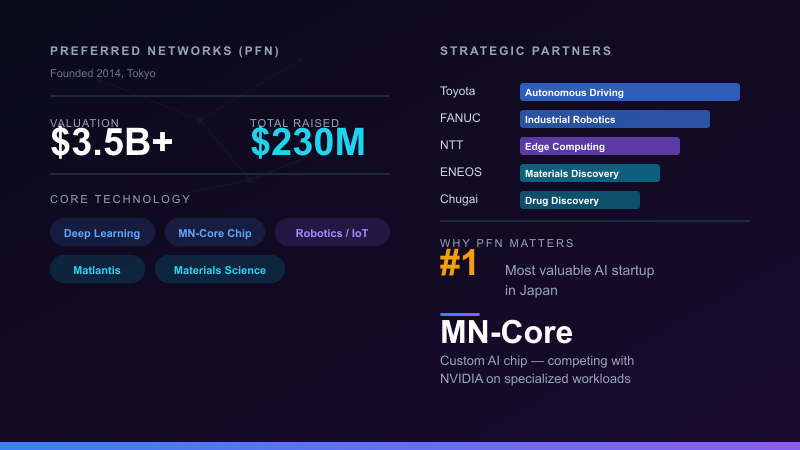
While the world’s attention focuses on OpenAI, Google DeepMind, and Anthropic, Japan’s most valuable AI company has been quietly building something different. Preferred Networks (PFN), founded in 2014 and valued at over $3.5 billion, isn’t chasing the large language model race. Instead, it’s applying deep learning to physical systems — manufacturing robots, autonomous vehicles, drug discovery, and materials science — in ways that could reshape entire industries. For international partners and investors watching Japan’s AI ecosystem, PFN is the company that demands attention.
From Academic Lab to $3.5 Billion Valuation
PFN was founded by Toru Nishikawa (CEO) and Daisuke Okazaki (CTO), both alumni of the University of Tokyo and former colleagues at Preferred Infrastructure, a natural language processing startup they co-founded in 2006. PFN was spun out specifically to focus on deep learning applications for the physical world — a bet that looked unconventional in 2014 when most AI funding chased consumer internet applications.
The bet paid off. PFN has raised over $230 million in total funding, primarily from corporate strategic investors rather than traditional venture capital. Its most significant funding round came from Toyota Motor Corporation, which invested approximately $100 million across multiple rounds, making PFN one of the most well-capitalized AI startups in Japan’s history. The company’s reported valuation exceeds $3.5 billion, making it Japan’s most valuable private AI company by a wide margin.
The Technology Stack: MN-Core and Beyond
PFN’s core differentiation lies in its vertically integrated approach. While most AI startups rely on NVIDIA GPUs and cloud infrastructure, PFN has designed its own custom AI processor: MN-Core.
The MN-Core chip is purpose-built for deep learning workloads. The original MN-Core achieved 524 teraflops of 32-bit floating-point performance per chip — competitive with NVIDIA’s data center offerings for specific workloads while consuming significantly less power. PFN’s supercomputer MN-3, powered by MN-Core processors, briefly ranked among the world’s most energy-efficient supercomputers on the Green500 list.
The second-generation MN-Core 2 further improves performance density. PFN isn’t trying to replace NVIDIA across all workloads — it’s building specialized hardware optimized for the specific deep learning patterns that matter most in industrial applications: real-time robotics inference, molecular dynamics simulation, and autonomous driving perception.
This hardware-software co-design approach is rare among AI startups globally and virtually unique in Japan. It gives PFN a structural cost advantage in deployment scenarios where performance per watt matters more than raw throughput.
Strategic Partnerships: Japan’s Corporate Elite
PFN’s partner list reads like a directory of Japan’s industrial establishment. Each partnership represents a deep technical collaboration, not just a logo on a slide deck:
- Toyota Motor Corporation — PFN’s largest investor and primary partner for autonomous driving technology. The collaboration focuses on applying deep learning to vehicle perception, path planning, and fleet optimization. Toyota’s investment gives PFN access to real-world driving data at a scale that few AI companies outside of Waymo and Tesla can match.
- FANUC Corporation — The world’s largest maker of industrial robots partnered with PFN to develop intelligent manufacturing systems. Their joint work enables FANUC robots to learn tasks through simulation and adapt to variations in real-world conditions — reducing the programming time for new manufacturing tasks from weeks to hours.
- NTT Group — Japan’s dominant telecommunications company works with PFN on edge computing applications, pushing deep learning inference to network edge devices rather than centralized cloud servers.
- ENEOS Holdings — Japan’s largest petroleum refiner funds PFN’s work on materials discovery, using deep learning to accelerate the development of new catalysts, battery materials, and chemical compounds.
- Chugai Pharmaceutical (Roche Group) — PFN applies its deep learning capabilities to drug discovery, specifically molecular simulation and protein structure prediction.
Products: From Research to Revenue
PFN has transitioned from a pure research lab to a company generating commercial revenue across several product lines.
Matlantis: Materials Science as a Service
Matlantis is PFN’s cloud-based materials simulation platform, developed in collaboration with ENEOS. It uses deep learning to simulate atomic interactions at speeds that are orders of magnitude faster than traditional density functional theory (DFT) calculations. Researchers can test material properties virtually before committing to expensive physical experiments.
The platform supports over 70 elements from the periodic table and has attracted customers from chemical companies, battery manufacturers, and semiconductor firms globally. Matlantis represents PFN’s clearest path to recurring SaaS revenue and international scalability, since the platform can serve customers worldwide without physical infrastructure.
Preferred Robotics: Consumer and Commercial Robots
PFN entered the consumer robotics market with cleaning robots powered by its AI technology. While this might seem like a detour for a deep-tech company, the strategy is deliberate: consumer robots generate real-world deployment data, drive hardware cost reduction through volume, and build brand awareness for PFN’s technology in a tangible way.
On the commercial side, PFN’s robotics capabilities — developed through the FANUC partnership — are being packaged for warehouse automation, manufacturing inspection, and logistics applications. These deployments generate higher margins and deeper customer relationships than consumer products.
Competitive Positioning: How PFN Differs from Global AI Leaders
PFN occupies a unique position in the global AI landscape. Understanding what it is — and what it isn’t — is essential for anyone evaluating the company:
- PFN is not an LLM company. While it has the technical capability to train large language models, its strategic focus remains on deep learning for physical systems. This means PFN is not directly competing with OpenAI, Anthropic, or Google for the generative AI market.
- PFN builds custom silicon. Among AI startups globally, very few design their own chips. This puts PFN in a small category alongside companies like Cerebras and Graphcore, but with a distinctly different focus on industrial applications.
- PFN’s business model is partnership-driven. Rather than selling a general-purpose AI platform, PFN embeds deeply into specific industry verticals through long-term corporate partnerships. This limits growth velocity but creates very high switching costs.
- PFN is strategically patient. The company has remained private despite its valuation, avoiding the pressures of public markets. This patience allows it to invest in long-horizon research that public companies would struggle to justify.
Challenges and Risks
PFN faces several structural challenges that international partners and investors should understand:
Revenue scale remains unclear. Despite its high valuation, PFN has not disclosed detailed revenue figures. The company’s income comes from a mix of contract R&D, product sales, and licensing — a model that generates revenue but may not yet show the exponential growth curves that justify a $3.5 billion valuation.
Talent competition is global. PFN competes for the same deep learning engineers that every major tech company wants. While Tokyo offers quality-of-life advantages, PFN must continually invest in compensation and research culture to retain top talent.
Custom hardware is capital-intensive. Designing and manufacturing AI processors requires significant ongoing investment. If MN-Core chips don’t achieve sufficient adoption, the R&D costs could weigh on the company’s financials.
IPO timing uncertainty. PFN has been widely expected to pursue an IPO, but the timing remains unclear. Japanese AI companies that have gone public have shown mixed post-IPO performance.
What This Means for International Partners
For international companies considering engagement with Japan’s AI ecosystem, PFN represents several distinct opportunities:
- Materials science collaboration: Matlantis is PFN’s most internationally accessible product. Chemical companies, battery developers, and semiconductor firms can use the platform without deep PFN integration, making it a natural entry point.
- Manufacturing AI: Companies looking to apply deep learning to robotics and manufacturing processes can benefit from PFN’s FANUC-validated technology stack. The combination of simulation-based training and real-world deployment expertise is difficult to replicate.
- Custom AI hardware licensing: For organizations with specialized inference requirements — particularly in edge computing or energy-constrained environments — PFN’s MN-Core architecture offers an alternative to NVIDIA dependency.
- Investment opportunity: PFN’s eventual IPO will be one of the most closely watched tech listings in Japan. Pre-IPO access through secondary markets or strategic partnership structures may be available for qualified institutional investors.
The Bigger Picture
PFN’s significance extends beyond its own business. The company represents a model for how Japan can compete in AI — not by chasing the same LLM arms race as Silicon Valley, but by applying deep learning to the physical industries where Japan already holds structural advantages: manufacturing, materials science, automotive, and robotics.
If PFN succeeds, it validates an alternative path for AI commercialization — one where domain expertise and hardware-software integration matter more than raw model scale. For a country with the world’s most advanced manufacturing base but historically limited software innovation, that’s a path worth watching closely.
Interested in Japanese business opportunities?
Whether you're looking for technology partners, engineering talent, or market insights — we can help connect you with the right Japanese organizations.
Get in Touch →