Executive Summary
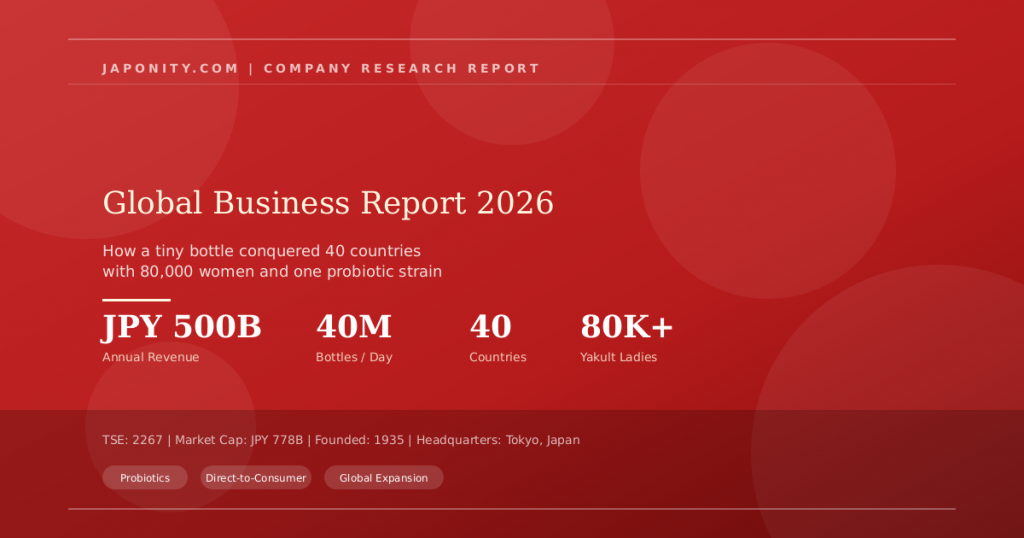
Yakult Honsha Co., Ltd. (TSE: 2267) is one of the most remarkable global success stories to emerge from Japan’s food and beverage industry. Founded in 1935 by microbiologist Dr. Minoru Shirota, the company has grown from a single probiotic drink into a JPY 499.7 billion (USD ~3.3 billion) revenue enterprise operating in 40 countries and regions across six continents.
With approximately 40 million bottles sold daily, a workforce of 29,250 employees plus 80,000+ independent Yakult Ladies, and a market capitalization of JPY 778 billion, Yakult has built an unparalleled direct-to-consumer distribution model that remains virtually impossible for competitors to replicate.
This report provides a comprehensive analysis of Yakult Honsha’s business model, global expansion strategy, scientific foundations, financial performance, and the opportunities it presents for international business partners, distributors, and investors.
1. Company Overview
Corporate Profile
| Item | Details |
|---|---|
| Company Name | Yakult Honsha Co., Ltd. (株式会社ヤクルト本社) |
| Founded | 1935 (incorporated 1955) |
| Headquarters | Minato-ku, Tokyo, Japan |
| Stock Listing | Tokyo Stock Exchange Prime (2267) |
| Employees | 29,250 (consolidated, March 2026) |
| Market Cap | JPY 778 billion (~USD 5.2 billion, March 2026) |
| Revenue (FY2025) | JPY 499.7 billion (~USD 3.3 billion) |
| Core Product | Yakult probiotic drink (Lacticaseibacillus paracasei strain Shirota) |
| Daily Sales | ~40 million bottles worldwide |
| Countries/Regions | 40 |
The Shirota Philosophy: “Shirota-ism”
Dr. Minoru Shirota’s vision was built on three pillars that continue to guide the company today:
- Preventive Medicine (予防医学) — Preventing disease is better than curing it
- A Healthy Intestine Leads to a Long Life (健腸長寿) — Gut health is the foundation of overall wellness
- A Price Affordable to All (誰もが手に入れられる価格) — Health benefits should be accessible to everyone
In 1930, Dr. Shirota became the first scientist to successfully cultivate a strain of lactic acid bacteria strong enough to survive gastric juices and bile to reach the intestines alive. He named the drink “Yakult” — derived from “jahurto,” the Esperanto word for yogurt — and began commercial production in 1935 in Fukuoka, Japan.
Business Segments
| Segment | FY2025 Revenue | % of Total | Description |
|---|---|---|---|
| Food & Beverages (Japan) | JPY 243.0B | 48.6% | Domestic dairy products, Yakult 1000/Y1000, juices |
| Food & Beverages (International) | JPY 229.6B | 46.0% | Overseas probiotic drink operations in 39 markets |
| Pharmaceuticals | ~JPY 15.0B | 3.0% | Anticancer drugs, prescription pharmaceuticals |
| Others | JPY 29.4B | 5.9% | Cosmetics, real estate, Tokyo Yakult Swallows baseball team |
2. Global Expansion Map
90 Years of International Growth
| Decade | Key Milestones |
|---|---|
| 1930s | 1935: First Yakult sold in Fukuoka, Japan |
| 1960s | 1964: Taiwan (first overseas market); 1966: Brazil |
| 1970s | Hong Kong, Thailand, South Korea, Philippines, Singapore |
| 1980s | Indonesia (1981), Australia, Mexico |
| 1990s | Entry into Europe — Netherlands (1994), Belgium, UK, Germany |
| 2000s | China mainland (2002), India (2008), Vietnam, United States |
| 2010s | Middle East (UAE, Oman), Myanmar, expansion across Africa |
| 2020s | GCC region expansion, US production scale-up, Global Vision 2030 announced |
Regional Presence Overview
| Region | Key Markets | Estimated Daily Volume | Distribution Model |
|---|---|---|---|
| Japan | Nationwide | ~11M bottles/day | Yakult Ladies + retail + vending |
| Asia (ex-Japan) | China, Indonesia, Philippines, India, Vietnam, Thailand, South Korea, Taiwan | ~16M bottles/day | Yakult Ladies + modern trade |
| Americas | Brazil, Mexico, USA, Argentina, Uruguay | ~9M bottles/day | Yakult Ladies (Brazil/Mexico) + retail (USA) |
| Europe | 13 countries via Yakult Europe B.V. | ~3M bottles/day | Primarily retail supermarkets |
| Middle East & Africa | UAE, Oman, Bahrain, Kuwait, Qatar, Saudi Arabia | ~1M bottles/day | Retail + foodservice |
Top 5 Markets by Revenue Contribution
| Rank | Market | Approx. Revenue Share | Key Growth Driver |
|---|---|---|---|
| 1 | Japan | ~49% | Yakult 1000/Y1000 premium line |
| 2 | China | ~12% | Urban health consciousness, 6 factories |
| 3 | Indonesia | ~8% | School lunch program, Yakult Mango launch |
| 4 | Mexico | ~7% | Deep Yakult Lady penetration |
| 5 | Brazil | ~6% | Largest overseas product lineup |
3. The Yakult Lady Model
The World’s Largest Direct-to-Consumer Beverage Sales Force
The Yakult Lady system is one of the most distinctive business models in the global food and beverage industry. Yakult is the largest F&B company in the world to successfully operate a direct-to-consumer, subscription-based sales model at scale.
Yakult Lady Network by the Numbers
| Metric | Figure |
|---|---|
| Total Yakult Ladies Worldwide | ~80,000+ |
| Japan | ~32,000 |
| Overseas | ~50,000 |
| Countries with Yakult Ladies | Japan, China, Indonesia, Brazil, Mexico, India, Philippines, Thailand, Vietnam, and others |
| Compensation Model | Commission-based independent contractors |
| Daily Customer Interactions | Millions of household visits per day |
How the Model Works
Yakult Ladies are independent sales representatives who deliver Yakult products directly to homes, offices, hospitals, and schools. The model operates as follows:
- Personal Relationships — Each Yakult Lady builds a regular customer route, visiting the same households weekly
- Health Education — They explain the science behind probiotics and gut health to customers
- Commission Income — Compensation is based on sales volume, with flexible working hours
- Childcare Support — On-site daycare facilities are provided at many Yakult centers, making it particularly attractive for working mothers
- Cold Chain Management — Products are kept refrigerated throughout the delivery process
Why Competitors Cannot Replicate This Model
The Yakult Lady system creates three powerful competitive moats:
- Trust — Face-to-face relationships build brand loyalty that no advertising can match
- Market Intelligence — Direct customer feedback provides real-time consumer insights
- Distribution Reach — Penetrates markets where modern retail infrastructure is limited, particularly in rural areas of Indonesia, India, and Brazil
4. Science Behind Yakult
Lacticaseibacillus paracasei Strain Shirota (LcS)
Yakult’s core scientific asset is the LcS strain (formerly classified as Lactobacillus casei strain Shirota), isolated and cultivated by Dr. Shirota in 1930. The strain has been the subject of extensive peer-reviewed research over nine decades.
Key Scientific Evidence
| Research Area | Key Finding | Source |
|---|---|---|
| Gut Microbiota | LcS survives passage through the gastrointestinal tract of multiple human races and ethnicities, reaching the intestines alive | International Journal of Food Sciences and Nutrition (2023) |
| Immune Function | Regular intake increases Natural Killer (NK) cell activity through IL-12 production, enhancing immunosurveillance | Nature (Yakult Research) |
| Upper Respiratory Infections | Significantly reduced incidence and duration of URTIs in healthy office workers | PMC / European Journal of Nutrition (2017) |
| Stress Relief | Suppressed stress-induced increases in glucocorticoids in both human and animal models | Neurogastroenterology & Motility (2016) |
| Academic Stress | Preserved gut microbiota diversity and relieved abdominal dysfunction in medical students under exam stress | Applied and Environmental Microbiology (2016) |
| Oral Health | Positive effects on dental plaque microbiota composition | PMC (2019) |
The Yakult Product Lineup
| Product | LcS Count | Volume | Key Feature | Market |
|---|---|---|---|---|
| Yakult (Original) | 20 billion | 65ml | Classic probiotic drink | Global |
| Yakult Light | 20 billion | 65ml | 30% less sugar, vitamin D/E added | Global |
| Yakult 1000 | 100 billion | 100ml | Sleep quality + stress relief (FFC) | Japan (home delivery) |
| Y1000 | 100 billion | 110ml | Retail version of Yakult 1000 | Japan + Singapore, Hong Kong |
| Yakult Gold | 30 billion | 65ml | Yakult + galacto-oligosaccharides | Select Asian markets |
The Yakult 1000 Phenomenon
Yakult 1000, launched in October 2019, has become one of the most successful product launches in the global health beverage category:
- Contains 100 billion LcS bacteria per bottle — 5x the original Yakult
- Japan’s first probiotic drink with Food with Function Claims (FFC) certification for sleep quality and stress relief
- Sales reached USD 850 million in 2023, surpassing USD 1.1 billion by March 2024
- Selling 3 million bottles per day in Japan alone
- Viral explosion in 2022 after TV personality Matsuko Deluxe featured it, causing nationwide shortages and forcing the company to double production capacity
- International expansion began in 2025 with Hong Kong and Singapore, with plans for the US market
5. Financial Analysis
FY2025 Financial Summary (Year Ended March 31, 2025)
| Metric | FY2025 | FY2024 | Change |
|---|---|---|---|
| Net Sales | JPY 499.7B | JPY 512.6B | -2.5% |
| Operating Income | JPY 55.4B | JPY 60.1B | -7.8% |
| Operating Margin | 11.1% | 11.7% | -0.6pp |
| Net Income | ~JPY 39.0B | ~JPY 42.5B | ~-8.2% |
Revenue by Segment (FY2025)
| Segment | Revenue | YoY Change | Key Factor |
|---|---|---|---|
| Food & Beverages (Japan) | JPY 243.0B | -3.6% | Domestic volume decline, Y1000 partially offsetting |
| Food & Beverages (Americas) | ~JPY 82.0B | -2.1% | FX headwinds despite volume growth in US |
| Food & Beverages (Asia/Oceania) | ~JPY 128.0B | +1.8% | Indonesia school lunch momentum, India expansion |
| Food & Beverages (Europe) | JPY 12.1B | +17.2% | Fastest-growing region, market penetration gains |
| Others | JPY 29.4B | -18.8% | Cosmetics and other business contraction |
5-Year Revenue Trend
| Fiscal Year | Revenue (JPY B) | Operating Income (JPY B) | Operating Margin |
|---|---|---|---|
| FY2021 | 414.2 | 47.2 | 11.4% |
| FY2022 | 415.6 | 46.8 | 11.3% |
| FY2023 | 483.7 | 56.1 | 11.6% |
| FY2024 | 512.6 | 60.1 | 11.7% |
| FY2025 | 499.7 | 55.4 | 11.1% |
While FY2025 showed a revenue decline, this was largely driven by JPY appreciation reducing the yen value of overseas earnings, rather than fundamental business weakness. In local currency terms, most international markets showed volume growth.
Global Vision 2030 Targets
Yakult Honsha has announced its Global Vision 2030 medium-term plan targeting:
- JPY 550 billion in consolidated net sales by 2030
- Acceleration of international expansion through locally rooted organizations
- Digital transformation of the Yakult Lady model
- Expansion of value-added products (Y1000 series) to international markets
6. Regional Deep Dive
Indonesia: The School Lunch Strategy
Indonesia is Yakult’s third-largest market globally and a showcase of the company’s emerging market playbook:
- School Lunch Program: Targeting 82.6 million elementary and junior high school students, with monthly deliveries reaching 3 million bottles by September 2025
- Flavor Innovation: Launch of Yakult Mango Flavor in June 2025 contributed to a 3.2% volume increase — the first year-on-year growth in 14 quarters
- Local Production: Multiple factories with full cold-chain logistics
- Yakult Ladies operate as the primary distribution channel in both urban and rural areas
Brazil: The Largest Overseas Lineup
Yakult Brazil holds a unique position in the company’s global portfolio:
- Entered in 1966 — one of the first international markets
- Boasts the largest product lineup outside Japan, adapted to local tastes
- Deep integration with the Japanese-Brazilian community (Nikkei diaspora)
- Extensive Yakult Lady network covering both metropolitan and regional areas
- Price increases in early 2025 helped offset volume softness
India: The Next Frontier
Since launching in 2008, Yakult has aggressively expanded across India:
- Now available in nearly 700 cities nationwide
- Targeting double-digit annual growth through 2030
- Created and now leads the probiotic dairy drink category in India
- Yakult Lady network expanding rapidly across the growing middle class
- Expected to become a top 10 global market within the next decade
United States: Premium Positioning
- New 250,000-square-foot production facility under construction, expected to produce 1.8 million bottles daily by 2026
- Distribution through mainstream retail (Costco, Walmart, Target, Whole Foods)
- No Yakult Lady system in the US — relying on retail and e-commerce channels
- Plans to introduce Y1000 to the US market pending regulatory approval
Europe: Fastest Growth Region
- Yakult Europe B.V. (Netherlands) oversees 13 countries
- Revenue grew 17.2% in FY2025 — the fastest of any region
- R&D hub established in the Netherlands in 2025 as a global center for food innovation
- Health claims regulation (EFSA) remains a challenge, limiting marketing compared to Asia
China: Navigating Challenges
- Operates 6 factories across 5 cities, reaching 700 million potential consumers
- Launched a postbiotic 0-sugar 0-calorie sparkling water in August 2025, adapting to local consumer trends
- Facing increased competition from domestic probiotic brands
- Consumer health consciousness post-COVID continues to drive demand
7. Competitive Landscape
Global Probiotic Drinks Market
The global probiotic drinks market was valued at USD 49.5 billion in 2024 and is projected to reach USD 116.9 billion by 2034, growing at a CAGR of 9%. The broader global probiotics market (including supplements, food, and animal feed) reached USD 73.1 billion in 2025.
Competitive Comparison
| Company | Key Product | Probiotic Strain | Global Reach | Revenue (Probiotic Segment) | Key Strength |
|---|---|---|---|---|---|
| Yakult Honsha | Yakult, Y1000 | L. paracasei Shirota | 40 countries | ~USD 3.3B (total) | Yakult Lady model, 90 years of research |
| Danone | Actimel, Activia | L. casei DN-114 001 | 120+ countries | ~EUR 7.4B (Essential Dairy) | Massive retail distribution, brand portfolio |
| Chobani | Chobani Probiotic | Various blends | Primarily US/Australia | ~USD 2.0B (total) | US yogurt market dominance |
| Nestle | LC1, various | Various | Global | Part of larger dairy division | Global distribution infrastructure |
| Mengniu/Yili | Various probiotic yogurts | Various | Primarily China | Growing rapidly | Massive China domestic market share |
Yakult’s Competitive Advantages
| Factor | Yakult | Danone (Actimel) | Chinese Competitors |
|---|---|---|---|
| Scientific Heritage | 90+ years of single-strain research | Strong but multi-brand | Growing but newer |
| Direct Distribution | 80,000+ Yakult Ladies | None (retail only) | None |
| Brand Recognition | Iconic bottle design, universally recognized | Strong in Europe | Regional |
| Price Point | Affordable (~USD 0.50-1.00/bottle) | Moderate | Low |
| Published Research Papers | 100+ peer-reviewed studies | Extensive | Limited |
8. Business Opportunities
For Distributors and Importers
Yakult’s ongoing global expansion presents concrete opportunities:
| Opportunity | Target Region | Details |
|---|---|---|
| GCC Distribution | Middle East | Yakult is establishing GCC-wide distribution; cold-chain logistics partners needed |
| Y1000 International Launch | US, Europe, ASEAN | Premium probiotic drink with sleep/stress benefits — new distribution channels opening |
| African Market Entry | Sub-Saharan Africa | Large untapped market with growing health awareness |
| Yakult Lady Partnerships | India, Southeast Asia | Franchise-like opportunities for last-mile delivery operators |
For Investors
| Investment Thesis | Details |
|---|---|
| Probiotics Market Tailwind | Global market growing at 8.5% CAGR through 2030 |
| Y1000 Upside | Already a JPY 100B+ product in Japan; international rollout just beginning |
| Emerging Market Exposure | India, Indonesia, and GCC offer long-term demographic tailwinds |
| Defensive Characteristics | Subscription-like revenue, daily consumption habit, affordable pricing |
| Stock Valuation | TSE: 2267 — also available as OTC: YKLTY in the US |
For Food-Tech and Research Partners
- Gut-Brain Axis Research — Yakult’s Central Institute actively partners with universities globally on LcS research
- Postbiotic Innovation — New product lines (0-sugar sparkling waters) signal openness to food-tech partnerships
- Cold-Chain Technology — Yakult’s expertise in last-mile refrigerated delivery is applicable to pharma and fresh food logistics
9. Outlook
Growth Catalysts (2026-2030)
| Catalyst | Timeframe | Impact |
|---|---|---|
| Y1000 International Rollout | 2025-2028 | Could add JPY 50-100B in incremental revenue if it achieves even 20% of Japan’s success internationally |
| US Production Scale-Up | 2026 | New facility producing 1.8M bottles/day will significantly expand US market presence |
| India Reaching Top 10 | 2026-2030 | Double-digit growth in a 1.4 billion population market |
| Indonesia School Lunch | 2025-2027 | Targeting 82.6M students — massive addressable market |
| Probiotics Market Growth | 2025-2034 | Rising from USD 73B to USD 134B globally |
Key Risks
| Risk | Severity | Mitigation |
|---|---|---|
| Japan Domestic Decline | Medium | Y1000 premium line offsetting volume loss |
| Currency Fluctuations | Medium | Local production reduces FX translation impact |
| China Competition | High | Innovation (postbiotics), brand loyalty, Yakult Lady network |
| EU Health Claims Regulation | Medium | Investing in EFSA-compliant research |
| Raw Material Costs | Low-Medium | Pricing power from brand strength; affordable base price |
Conclusion
Yakult Honsha stands as a testament to the power of Japanese innovation, scientific rigor, and patient long-term strategy. From a single probiotic drink created by a microbiologist in 1935, it has grown into a global health beverage empire selling 40 million bottles daily across 40 countries.
The company’s competitive moats — the proprietary LcS strain with 90+ years of research, the irreplicable Yakult Lady distribution model, the iconic bottle design recognized worldwide, and the deeply affordable price point — create a business model that no competitor has been able to duplicate at scale.
With the Yakult 1000/Y1000 premium line delivering billion-dollar revenues and poised for international expansion, a booming global probiotics market, and high-growth emerging markets like India and Indonesia ahead, Yakult Honsha remains one of the most compelling Japanese companies for international business partners and investors alike.
This report was researched and produced by Japonity.com — Japan Discovery & Business Intelligence Platform.
Need a custom market research report on Japanese industries, companies, or products? We accept commissioned research projects (調査代行). Contact us to discuss your specific intelligence needs.
Published: April 2026
Interested in Japanese business opportunities?
Whether you're looking for technology partners, engineering talent, or market insights — we can help connect you with the right Japanese organizations.
Get in Touch →