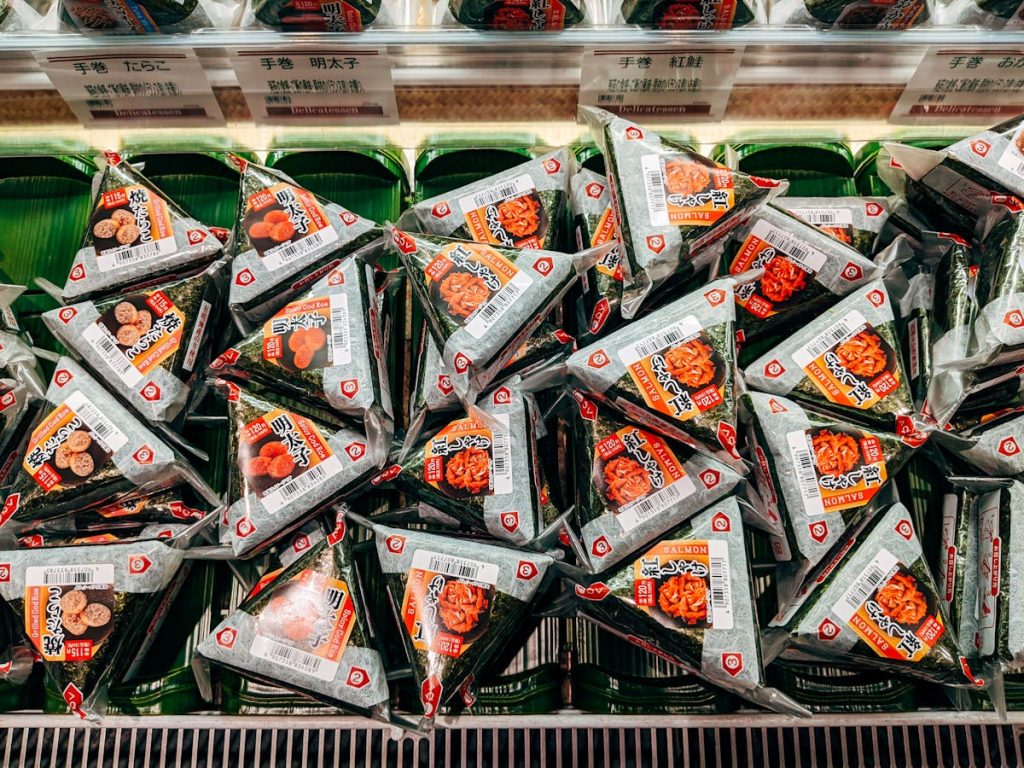
Every day in Japan, approximately 40 million onigiri — triangular rice balls wrapped in crisp nori seaweed — are sold across 56,000 convenience stores. At roughly ¥130 ($0.90) each, the humble onigiri represents the pinnacle of Japanese convenience food engineering: affordable, portable, nutritionally balanced, and manufactured with a precision that most food companies in the world cannot replicate. The question now is whether this perfection can travel.
Japan’s Konbini: Not Your Average Convenience Store
The Japanese konbini (コンビニ, convenience store) is a fundamentally different proposition from its counterparts elsewhere in the world. While American or European convenience stores are primarily snack-and-beverage shops, Japanese konbini are comprehensive food retailers where millions of people eat one or more meals daily. The food is not an afterthought — it is the core product, developed by dedicated teams of food scientists, chefs, and product developers who reformulate and launch new items on weekly cycles.
Japan’s three major konbini chains — 7-Eleven Japan (approximately 21,500 stores), FamilyMart (approximately 16,500 stores), and Lawson (approximately 14,600 stores) — operate a combined network exceeding 56,000 locations. That is roughly one konbini for every 2,200 people in Japan. Each store receives fresh food deliveries 2-3 times daily, and unsold items are removed from shelves well before their expiration dates to maintain quality perception.
The food development process at major konbini chains resembles that of a premium food manufacturer more than a retailer. 7-Eleven Japan, for example, operates a dedicated product development center where teams continuously test new items, refine existing recipes, and work with suppliers to improve ingredients and production processes. The company launches hundreds of new food products annually, with each item undergoing rigorous taste testing and quality evaluation before hitting shelves.
Onigiri: The Six Billion Dollar Rice Ball
The onigiri is Japan’s single most important convenience food. Annual domestic sales are estimated at ¥600-700 billion ($4-5 billion at retail), with konbini channels accounting for the majority. To put this in perspective: Japan’s onigiri market alone is larger than many countries’ entire convenience food sectors.
Onigiri’s enduring popularity rests on several factors. It is affordable (¥110-¥250 per unit, or roughly $0.75-$1.70). It is portable and mess-free. It provides a satisfying combination of carbohydrates (rice), protein (filling), and minerals (nori seaweed). And it offers enormous variety — konbini stores typically stock 20-30 onigiri varieties at any given time, rotating seasonally and regionally.
The Engineering Behind Konbini Onigiri
What appears to be a simple product is in fact an engineering marvel. The central challenge of konbini onigiri is keeping the nori (seaweed) crisp and separate from the moist rice until the moment of consumption. This is solved by the iconic “nori separation packaging” system — a plastic film that wraps the nori in a separate layer around the rice, with a pull-tab opening mechanism that removes the film and brings nori and rice together when the consumer is ready to eat.
This packaging system, developed in the 1970s and continuously refined since, requires precision manufacturing. The film must be food-safe, easy to open, and perfectly sealed to prevent moisture transfer. The opening mechanism must work smoothly — consumers have about 3 seconds of patience with packaging. The entire system adds cost and complexity that would be difficult to justify for a $1 product in most markets, but in Japan’s hyper-competitive konbini environment, the quality of the eating experience is paramount.
Beyond packaging, the rice itself is a science. Konbini onigiri rice must meet specific parameters for moisture content, grain firmness, and stickiness. It must taste good at room temperature — not cold from refrigeration and not warm from heating. Japanese rice varieties (particularly Koshihikari blends) are selected and processed to optimize these qualities. The rice is cooked, seasoned, cooled, and formed by automated systems that replicate the gentle hand-pressing technique of traditional onigiri — too much pressure and the rice becomes dense and unpleasant; too little and it falls apart.
Popular Onigiri Fillings: A Market Within a Market
The filling (gu) is where onigiri variety and innovation happen. Each konbini chain treats its filling lineup as a competitive weapon, with seasonal limited editions, regional specialties, and premium lines constantly in rotation.
| Filling | Market Share (est.) | Description | Price Range |
|---|---|---|---|
| Sake (salmon) | ~25% | Grilled or raw salmon flakes; perennial #1 | ¥130-¥180 |
| Mentaiko (spicy cod roe) | ~15% | Spicy marinated pollock roe | ¥140-¥200 |
| Tuna mayo | ~15% | Canned tuna mixed with Japanese mayonnaise | ¥120-¥160 |
| Umeboshi (pickled plum) | ~10% | Traditional sour-salty pickled plum | ¥110-¥140 |
| Kombu (kelp) | ~8% | Simmered kelp strips in soy-based sauce | ¥110-¥140 |
| Ebi mayo (shrimp mayo) | ~5% | Cooked shrimp in mayonnaise sauce | ¥140-¥180 |
| Premium/seasonal | ~22% | Ikura, wagyu, regional specialties | ¥180-¥300 |
Sources: 7-Eleven Japan product data, Lawson sales reports, industry estimates
The trend toward premium onigiri has accelerated in recent years. All three major chains have launched “premium” onigiri lines priced at ¥180-¥300 — featuring ingredients like grilled salmon with dashi-infused rice, hand-formed styles with visible filling, and collaborations with famous restaurants. 7-Eleven’s “Onigiri Gourmet” line and Lawson’s “Akuma no Onigiri” (Devil’s Onigiri, a hit product featuring mentsuyu-flavored rice with tempura bits) have demonstrated that consumers will pay premium prices for innovative onigiri concepts.
Beyond Onigiri: Japan’s Konbini Food Innovation Engine
While onigiri is the flagship, Japanese konbini food innovation extends across dozens of categories, each executed at a level of quality that surprises first-time visitors.
The Egg Sandwich (Tamago Sando)
Japan’s konbini egg sandwich has achieved cult status among international food media and tourists. Unlike Western egg salad sandwiches, the Japanese version features impossibly fluffy, creamy egg salad — made with Japanese mayonnaise (Kewpie brand, which uses only egg yolks and rice vinegar) — on pillowy white shokupan (milk bread) with crusts removed. Lawson’s version, in particular, has been the subject of countless social media posts and food articles. The egg sandwich illustrates the Japanese konbini philosophy: take an ordinary product and execute it so perfectly that it becomes extraordinary.
Oden
Oden — a winter comfort food of various items (boiled eggs, daikon radish, fish cakes, tofu, konnyaku) simmered in a light dashi broth — is a konbini institution from October through March. Each store maintains a self-serve oden pot near the register, and customers select items individually (¥80-¥150 each). Oden represents a unique konbini proposition: hot, comforting, customizable, and affordable. Each chain develops proprietary dashi recipes for its oden broth, and regional variations (Kansai-style lighter broth vs. Kanto-style darker broth) add complexity.
Karaage (Fried Chicken)
Japanese konbini fried chicken has become a competitive battleground. Lawson’s “Karaage-Kun” (a branded fried chicken nugget product launched in 1986) sells approximately 200 million units annually. FamilyMart’s “Famichiki” and 7-Eleven’s fried chicken range compete fiercely. These products are cooked in-store (or finished in-store from par-cooked state) and displayed in heated cases near the register. The quality — juicy interior, crispy coating, well-seasoned — consistently impresses visitors accustomed to convenience store hot food in other countries.
Bento and Ready Meals
Konbini bento (boxed meals) range from simple rice-and-side combinations at ¥400 to elaborate multi-compartment meals at ¥800+. The variety is staggering — Chinese-style, Western-style, traditional Japanese, seasonal specials, and calorie-controlled options all compete for shelf space. Pasta, gratin, curry rice, and hamburg steak (Japanese-style hamburger patties) are perennial favorites. New items launch weekly, and underperformers are removed within days.
Overseas Konbini Expansion: The Story So Far
Japan’s konbini operators have been expanding internationally for decades, but replicating the Japanese konbini food experience abroad has proven extraordinarily challenging.
7-Eleven: Global Presence, Local Adaptation
7-Eleven is the world’s largest convenience store chain by store count, with over 83,000 locations globally. However, the food quality and selection vary enormously by market. 7-Eleven Japan — which is actually the parent company of the global 7-Eleven system through Seven & i Holdings — operates at a level far above its international counterparts. In the US, 7-Eleven stores are primarily known for Slurpees and Big Gulp drinks; in Japan, they are known for gourmet-quality onigiri and fresh bento.
Efforts to elevate 7-Eleven’s food offering in international markets have had mixed results. In Thailand and Taiwan, 7-Eleven food quality is notably higher than in Western markets, reflecting closer cultural and operational connections to the Japanese model. In the US and Australia, improvements are underway but progress is slow — the supply chain infrastructure, food safety systems, and consumer expectations required for Japanese-quality konbini food are difficult to build from scratch.
Lawson: Asia-Focused Strategy
Lawson has focused its international expansion primarily on China, where it operates over 6,000 stores (as of 2025), and Southeast Asia (Indonesia, Thailand, Philippines). In China, Lawson has achieved notable success in cities like Shanghai, where the format’s food quality resonates with affluent urban consumers. Lawson’s strategy emphasizes localizing food offerings while maintaining the Japanese quality standard — Chinese Lawson stores feature onigiri alongside local favorites like baozi and tea eggs.
FamilyMart: Southeast Asian Presence
FamilyMart operates in Taiwan (where it has deep penetration and strong food quality), Thailand, Vietnam, Malaysia, and other Asian markets. Taiwan’s FamilyMart stores, in particular, have achieved food quality approaching Japanese levels — a testament to Taiwan’s strong cultural connection to Japanese food culture and the maturity of the Taiwanese convenience store market.
Challenges for International Expansion of Konbini Food
Why can’t the rest of the world have konbini food as good as Japan’s? The answer involves several interconnected challenges.
Supply Chain Precision
Japanese konbini food relies on a supply chain of extraordinary precision. Dedicated food factories produce items to exact specifications, with delivery trucks arriving at stores 2-3 times daily on schedules accurate to the minute. The entire system is optimized for freshness — most konbini food items have shelf lives measured in hours, not days. Replicating this infrastructure in a new market requires massive capital investment and operational expertise.
Rice Quality and Handling
For onigiri specifically, the rice is everything. Japanese short-grain rice, cooked to precise specifications and handled with equipment calibrated for Japanese rice characteristics, produces a result that is difficult to replicate with other rice varieties or less specialized equipment. Importers in markets like the US and Europe who have attempted to produce Japanese-style onigiri frequently cite rice quality and handling as the single biggest challenge.
Consumer Expectations and Pricing
In Japan, consumers accept and expect high-quality convenience store food — there is no stigma attached to eating konbini meals daily. In many Western markets, convenience store food carries negative associations with low quality and unhealthiness. Overcoming this perception requires sustained investment in quality, marketing, and consumer education. Pricing is also challenging: Japanese konbini food is profitable at ¥130-¥500 per item because of enormous volume and an efficient supply chain. Lower volumes in new markets may require higher prices, which conflicts with the “convenience” positioning.
Food Safety Regulations
Different markets have different food safety requirements that can affect konbini food formats. Rice-based products, in particular, face scrutiny in some jurisdictions regarding temperature control and shelf life. The short shelf lives that ensure quality in Japan may not align with food safety frameworks in other markets that require longer validated shelf lives.
Business Opportunities: Bringing Konbini Food to the World
Despite the challenges, several business models are emerging for internationalizing Japanese konbini food concepts.
| Business Model | Description | Examples | Investment Level |
|---|---|---|---|
| Licensed onigiri production | Local manufacturing using Japanese technology and recipes | Onigiri specialists in US, UK, France | Medium-High |
| Frozen onigiri import | Frozen onigiri from Japan, reheated at point of sale | Asian grocery chains, food service | Low-Medium |
| Konbini-style food retail | Standalone shops replicating konbini food experience | Japanese-style delis in London, NYC | High |
| B2B ingredient supply | Supplying onigiri rice seasoning, nori, fillings to local producers | Food ingredient distributors | Medium |
| Packaging technology licensing | Licensing nori-separation packaging for overseas onigiri production | Packaging manufacturers | Medium |
Sources: Industry analysis, JETRO reports, company interviews
The Onigiri Startup Wave
A notable trend is the emergence of dedicated onigiri businesses in Western cities. In London, New York, Los Angeles, Paris, and Sydney, entrepreneurs — often with Japanese food industry experience — have launched onigiri-focused restaurants and takeaway shops. These operations hand-form onigiri on-site (solving the freshness challenge), use imported Japanese rice and nori, and price products at $3-$5 per unit — a significant premium over Japanese konbini prices but competitive with other premium fast-casual options.
These businesses are proving that onigiri can work as a standalone food category outside Japan when executed properly. They are also creating consumer awareness and demand that could eventually support larger-scale konbini-style food retail.
Food Service and Hotel Channels
Hotels, airlines, and corporate catering represent promising channels for Japanese konbini-style food internationally. High-end hotels in Asian cities are already incorporating Japanese onigiri into breakfast buffets and room service menus. Airlines serving Japan routes have featured onigiri as a snack option. These channels value the product’s quality, portability, and cultural appeal, and are willing to pay premium prices.
The Future: Can Perfection Scale?
The ultimate question for Japanese konbini food is whether the extraordinary quality that defines it in Japan can survive the compromises inherent in international expansion. History suggests that some dilution is inevitable — no international 7-Eleven will match its Japanese counterpart in the near term. But the gap is narrowing, driven by improving supply chains, growing consumer sophistication, and the sheer appeal of products that are, by any objective measure, among the best convenience foods ever created.
For food industry professionals, the Japanese konbini represents a masterclass in food product development, supply chain management, and retail execution. Whether you are looking to import specific products, license production technology, or simply learn from the model, Japan’s convenience store food industry has lessons for the global food business.
Interested in sourcing Japanese convenience food products or connecting with Japanese food manufacturers? Contact Japonity — we connect global buyers with Japan’s finest food and beverage companies.
Interested in Japanese business opportunities?
Whether you're looking for technology partners, engineering talent, or market insights — we can help connect you with the right Japanese organizations.
Get in Touch →