Japan’s ramen industry is no longer just a domestic comfort food story. With global instant noodle demand surpassing 123 billion servings in 2024 and Japan’s overall food exports climbing to a record ¥1.7 trillion ($11 billion) in 2025, Japanese noodle makers are executing an aggressive international expansion playbook. From Nissin’s $228 million U.S. factory investment to Toyo Suisan‘s California production line expansion, the numbers tell a clear story: Japanese ramen companies are building a global supply infrastructure to capture a market projected to reach $90 billion by 2030.
The Global Instant Noodle Market: Scale and Opportunity
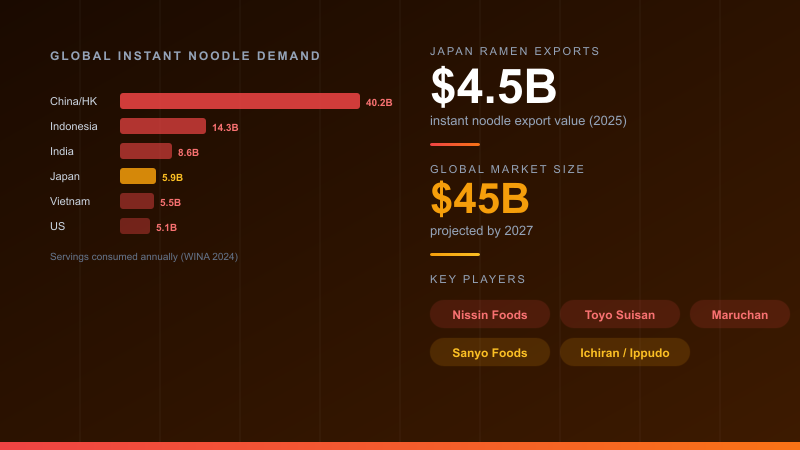
To understand the ramen export wave, start with the demand side. According to the World Instant Noodles Association (WINA), global consumption hit 123.2 billion servings in 2024, a record high. The top consuming markets paint a picture of where demand is concentrated:
- China/Hong Kong: 43.8 billion servings
- Indonesia: 14.7 billion servings
- India: 8.3 billion servings
- Vietnam: 8.1 billion servings
- Japan: 5.9 billion servings
- Philippines: 4.5 billion servings
- South Korea: 4.1 billion servings
- Thailand: 4.1 billion servings
While Asia accounts for roughly 80% of global consumption, the growth story is increasingly about Western markets. The United States, Europe, and Latin America are showing sustained demand increases, driven by urbanization, convenience-seeking consumers, and a growing appreciation for Asian cuisine. The North American instant ramen market alone is projected to grow at a compound annual rate of 6–8% through the end of the decade.
Japan’s Ramen Export Engine: Who’s Driving It
Japan’s ramen industry is dominated by a handful of companies with deep manufacturing expertise and growing international ambitions. Here are the key players shaping the export landscape:
Nissin Foods Holdings: The Category Creator Goes Global
Nissin, the company that invented instant ramen in 1958 and Cup Noodles in 1971, generated ¥733 billion in revenue in fiscal 2024. The company’s international segment has become a strategic priority, with operations spanning the Americas, Europe, and Asia.
The most significant recent move: Nissin is investing $228 million in a new manufacturing facility in Greenville County, South Carolina, expected to be operational by August 2025. The 640,000-square-foot plant will create over 300 jobs and dramatically expand Nissin’s U.S. production capacity. This investment signals a shift from export-based distribution to localized manufacturing—a model that reduces shipping costs, improves freshness, and allows faster response to regional taste preferences.
Nissin also maintains significant manufacturing operations in Brazil, Mexico, India, Vietnam, and Hungary, giving it one of the most geographically diversified production networks in the industry.
Toyo Suisan (Maruchan): The Quiet American Dominance
While Nissin gets more headlines, Toyo Suisan‘s Maruchan brand is arguably the most consumed instant ramen in the United States. Operating from its massive facility in Irvine, California, the company is doubling down on American production. Toyo Suisan is expanding its California plant by 227,000 square feet, adding three new production lines and 191 employees. The expansion, which will increase capacity by approximately 20%, is scheduled for completion in early 2026.
Maruchan’s strategy has been to dominate the value segment with aggressive pricing and deep retail penetration. The brand is ubiquitous in U.S. grocery stores, convenience chains, and even college campus stores. Its parent company, publicly listed in Tokyo, reported consolidated revenue exceeding ¥500 billion, with the Americas segment contributing an increasingly significant share.
Sanyo Foods and Other Mid-Tier Exporters
Sanyo Foods, maker of Sapporo Ichiban, has steadily grown its export footprint across North America and Southeast Asia. Unlike Nissin and Toyo Suisan, Sanyo has largely maintained a Japan-manufactured export model rather than building overseas factories, making it a key player in the actual cross-border trade of Japanese-made ramen products. Other notable exporters include Myojo (a subsidiary of Nissin), Hikari Menyu, and a growing number of premium craft ramen producers targeting the high-end import segment.
Beyond Instant: Restaurant Chain Expansion
The ramen export wave extends well beyond packaged noodles. Japanese ramen restaurant chains are aggressively expanding internationally, building brand equity that creates a halo effect for Japanese ramen products broadly.
Ippudo (Chikaranomoto Holdings) set an ambitious target of 300 international locations by 2025, operating across more than 15 countries including the U.S., UK, France, Australia, Singapore, and the Philippines. The chain has adapted its model for each market while maintaining its signature Hakata-style tonkotsu broth.
Ichiran, the Fukuoka-based tonkotsu specialist known for its individual booth dining concept, operates 80 locations in Japan and eight overseas. Notably, Ichiran refuses to localize its flavors—serving identical recipes worldwide. The company has reported a “steady stream of requests” for new international locations, suggesting significant untapped demand.
Dosanko, with roughly 300 locations including franchises, has pushed into Europe, North America, and Oceania, opening in Paris, Los Angeles, and Melbourne. The franchise model offers a lower-risk path to international expansion and creates opportunities for local food service operators.
These restaurant chains matter to the B2B equation because they drive ingredient imports: specialty noodles, tare (sauce concentrates), chashu pork preparations, and branded toppings that flow through international food supply chains.
Japan’s Food Export Policy: Government Tailwinds
The Japanese government is actively supporting food exports as a national economic strategy. Key data points:
- Japan’s agricultural, forestry, fishery, and food exports reached ¥1.7 trillion (~$11 billion) in 2025, up 12.8% year-on-year
- The government’s target is ¥5 trillion in food exports by 2030—roughly a 3x increase from current levels
- MAFF (Ministry of Agriculture, Forestry and Fisheries) and JETRO are implementing a three-tiered policy framework focused on traceability, organic certification, and food safety compliance with EU and U.S. standards
- Processed foods, including instant ramen, are a priority category because they offer higher margins and longer shelf life than fresh products
For international buyers and distributors, this government push translates to practical benefits: subsidized trade show participation, export documentation support, and co-marketing programs through JETRO‘s global office network.
B2B Supply Chain Opportunities
The ramen export wave creates opportunities across multiple segments of the B2B food supply chain. Here’s where international partners can plug in:
Distribution and Wholesale
As Japanese ramen makers expand production, they need distribution partners who understand local retail landscapes. Key opportunities include:
- Specialty Asian grocery distribution: Premium Japanese ramen brands (Ichiran instant packs, premium Nissin lines, craft ramen kits) command 3–5x price premiums over mass-market products
- Mainstream retail placement: Helping Japanese brands navigate category management and shelf placement in Western supermarket chains
- E-commerce fulfillment: Japanese ramen subscription boxes and direct-to-consumer channels are growing rapidly, requiring local warehousing and last-mile logistics
Food Service and Ingredient Supply
The restaurant expansion creates demand for:
- Noodle manufacturing equipment: Japanese noodle-making machines (from companies like Yamato Manufacturing) are in demand from non-Japanese restaurants adding ramen to their menus
- Broth concentrates and tare: Commercial-grade ramen bases that allow restaurants to serve authentic-tasting ramen without in-house broth production
- Specialty toppings: Nori, menma (bamboo shoots), narutomaki (fish cake), and ajitsuke tamago (seasoned eggs) all represent niche import opportunities
Co-Manufacturing and OEM
Some Japanese companies are seeking overseas co-manufacturing partners to produce region-specific products. This includes private-label ramen for local retailers and co-branded products that combine Japanese ramen expertise with local flavor profiles. Nissin’s collaboration with Bachan’s Japanese Barbecue sauce for a co-branded Top Ramen product in the U.S. illustrates this trend.
What International Buyers Should Know
If you’re considering entering the Japanese ramen supply chain as a buyer, distributor, or partner, here are the critical considerations:
- Quality standards are non-negotiable: Japanese manufacturers maintain extremely strict quality control. Expect detailed specifications on storage temperature, shelf life management, and handling requirements. Deviation tolerance is minimal.
- Regulatory compliance varies by market: Instant ramen formulations often require adjustment for different markets due to food additive regulations. MSG labeling, sodium content disclosure, and allergen declarations differ significantly between the U.S., EU, and ASEAN markets.
- Long-term relationships matter: Japanese business culture favors long-term partnerships over transactional relationships. Initial orders may be small as manufacturers assess reliability and market commitment.
- Pricing structures reflect quality tiers: The market segments into value (Maruchan-style, $0.25–0.50/pack), mid-range ($1–3/pack), and premium ($4–8/pack). The premium segment is growing fastest but requires different distribution channels.
- Seasonality affects production: Ramen consumption peaks in colder months in most markets. Plan inventory and ordering cycles accordingly, especially for imported products with longer lead times.
- Halal certification is increasingly important: For Southeast Asian and Middle Eastern markets, halal-certified ramen products are essential. Several Japanese manufacturers now offer halal lines, but certification adds lead time to new product introductions.
Market Outlook: Where the Growth Is Headed
Several structural trends point to continued acceleration of Japanese ramen exports:
Premiumization: The fastest-growing segment is premium and super-premium instant ramen, priced at $3–8 per serving. Products like Nissin’s RAOH line, Ippudo’s retail ramen kits, and craft ramen brands from smaller Japanese producers are capturing consumers willing to pay more for restaurant-quality home preparation. This segment offers significantly better margins for distributors and retailers.
Health-conscious reformulation: Japanese manufacturers are developing lower-sodium, whole-grain, and plant-based ramen products to address Western health concerns. Nissin has introduced reduced-salt versions across multiple markets, while newer entrants are experimenting with gluten-free rice noodle alternatives.
Geographic diversification: While the U.S. and China remain the largest targets, Japanese companies are increasingly focused on Southeast Asia (where per-capita consumption is high), the Middle East (driven by halal product development), and Africa (where instant noodle consumption is growing at double-digit rates, particularly in Nigeria and Egypt).
Direct-to-consumer channels: E-commerce has opened a new route for Japanese ramen exports, bypassing traditional wholesale distribution. Japanese ramen subscription services and specialty online retailers are growing rapidly, particularly in North America and Europe.
The Bottom Line for Business
The Japanese ramen export wave is not a trend—it’s a structural shift. Backed by $228 million factory investments, government export targets of ¥5 trillion, and a global market consuming 123 billion servings annually, Japanese noodle makers are building the infrastructure for sustained international growth. For food industry professionals, the question isn’t whether to engage with this market—it’s where in the value chain to position yourself.
Whether you’re a food distributor evaluating Japanese product lines, a restaurant operator considering ramen menu additions, or an equipment supplier targeting the expanding noodle manufacturing sector, the data points in one direction: the world’s appetite for Japanese ramen is growing, and the companies supplying it are investing at unprecedented scale to meet that demand.
Interested in Japanese business opportunities?
Whether you're looking for technology partners, engineering talent, or market insights — we can help connect you with the right Japanese organizations.
Get in Touch →