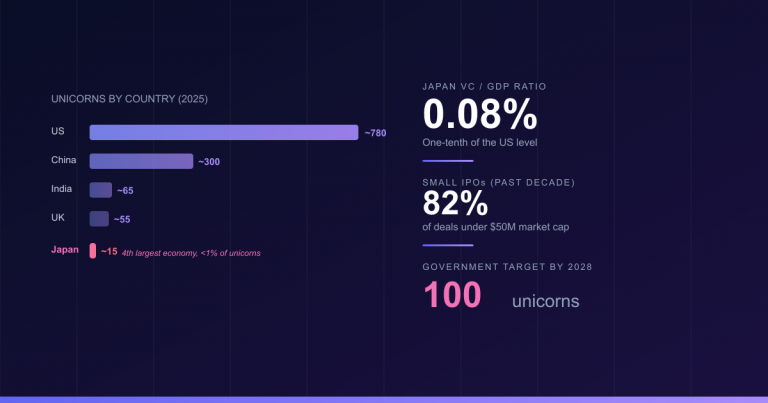
Japan has fewer than 15 unicorns today — a fraction of what the world’s fourth-largest economy should produce. But behind the headline number, a new generation of startups is raising larger rounds, attracting global investors, and building technology that scales far beyond the domestic market. Here are the Japanese startups most likely to cross the billion-dollar threshold by 2027.
How We Selected These Companies
We focused on private Japanese startups that are not yet confirmed unicorns, evaluating them on total capital raised, recent funding momentum, investor quality, market size, and international expansion potential. Companies that have already gone public (Astroscale, Synspective, ispace) or been acquired (FLYWHEEL) were excluded, even if their valuations approach the billion-dollar mark.
1. Mujin — Physical AI for Warehouses and Factories
- Founded — 2011, Tokyo
- Total raised — $411 million
- Latest round — $233 million Series D (December 2025)
- Key investors — NTT Group, Qatar Investment Authority, Mitsubishi HC Capital, Salesforce Ventures
Mujin topped Japan’s 2025 startup funding leaderboard with its massive Series D — the largest for a Japanese robotics company. The company’s MujinOS platform enables industrial robots to make real-time decisions without manual programming, eliminating the need for specialized coding in warehouse and factory automation. With over 300 employees and aggressive expansion into US and European markets, Mujin is the closest to confirmed unicorn status on this list. The combination of NTT and Qatar Investment Authority as co-leads signals institutional confidence at the highest level.
2. LayerX — AI-Powered Back-Office Automation
- Founded — 2018, Tokyo
- Total raised — $192 million
- Latest round — $100 million Series B (September 2025)
- Key investors — TCV, MUFG Innovation Partners, JAFCO, Keyrock Capital Management
LayerX’s $100 million Series B was led by TCV — the Silicon Valley firm behind Netflix, Spotify, and Nubank — in their first-ever investment in a Japanese company. That alone is a signal worth noting. Founded by Yoshinori Fukushima, who previously built and listed Gunosy on the TSE, LayerX is on track to reach $68 million in annual recurring revenue faster than any SaaS company in Japan’s history. Over 15,000 corporate customers use its AI tools for invoice processing, expense management, and corporate card services. The back-office digitization market in Japan — where paper and manual processes still dominate — is enormous and barely penetrated.
3. Tier IV — Open-Source Autonomous Driving
- Founded — 2015, Nagoya
- Total raised — $339 million
- Latest round — $54 million Series B extension (June 2024)
- Key investors — SOMPO Holdings, Yamaha Motor, Aisan Technology, JAFCO
Tier IV created Autoware, the world’s first open-source autonomous driving software stack. It’s now installed in over 30 vehicle models across 20+ countries, with more than 500 companies adopting the platform. The company launched robotaxi services in Tokyo in November 2025 and has been selected by Japan’s Ministry of Defense and NEDO for major autonomous systems projects. At a reported valuation of $654 million in 2023, Tier IV likely needs just one more significant funding round to cross the unicorn threshold. Its open-source strategy — unusual for a Japanese company — gives it a global distribution advantage that proprietary competitors cannot match.
4. Turing — End-to-End Autonomous Driving AI
- Founded — 2021, Tokyo
- Total raised — $160 million (24 billion yen)
- Latest round — $99 million Series A (November 2025)
- Key investors — JIC Venture Growth Investments, Global Brain, GMO Internet Group, Denso
Turing is the youngest company on this list and the fastest-growing by valuation. Founded just four years ago, it quadrupled its valuation to $388 million in a single year. The company is developing end-to-end autonomous driving AI — a fundamentally different approach from Tier IV’s modular stack — betting that large neural networks trained on driving data can outperform hand-engineered systems. Backing from JIC (government-affiliated) and Denso (Toyota’s key supplier) gives Turing both credibility and access to the automotive ecosystem. At its current trajectory, unicorn status by 2027 is well within reach.
5. SkyDrive — Flying Cars for the Real World
- Founded — 2018, Aichi Prefecture
- Total raised — $290 million (43 billion yen)
- Latest round — $56 million Pre-Series D (July 2025)
- Key investors — MUFG Bank, Suzuki Motor, JR East, NEC
SkyDrive received G-1 certification basis from Japan’s Civil Aviation Bureau for its SD-05 electric vertical takeoff and landing (eVTOL) aircraft in February 2025 — a critical regulatory milestone. The company showcased its first public flight at Expo 2025 Osaka and plans to launch commercial air taxi services. The investor roster reads like a who’s who of Japanese corporate power: a megabank, an automaker, a railway operator, and a tech conglomerate. eVTOL is a capital-intensive category, but SkyDrive’s regulatory progress and deep corporate relationships position it as the frontrunner in Japan’s urban air mobility market.
6. Ubie — AI Healthcare at Scale
- Founded — 2017, Tokyo
- Total raised — $125 million+
- Latest notable funding — Google/Alphabet investment (October 2024)
- Key investors — Google, Mayo Clinic Platform Accelerate, Japan Post Capital, NTT DoCoMo
Ubie’s AI Symptom Checker is used by over 13 million people monthly worldwide, and 1,800+ medical institutions in Japan rely on its platform. Perhaps most impressively, 90% of the world’s top pharmaceutical companies use Ubie’s services. The Google investment and partnership with Mayo Clinic — arguably the most prestigious medical institution in the world — provide both capital and credibility for international expansion. With 4 million+ monthly users already in the US, Ubie is one of the rare Japanese startups that has achieved meaningful traction outside its home market before reaching unicorn status.
7. TBM — Turning Limestone into a Global Materials Platform
- Founded — 2011, Tokyo
- Total raised — $308 million+
- Latest major funding — Goldman Sachs and SK Group participation
- Key investors — Goldman Sachs, SK Group, ITOCHU, Dai Nippon Printing, Toppan Printing
TBM’s LIMEX material — made primarily from limestone rather than petroleum or wood pulp — has been adopted by over 10,000 companies and municipalities worldwide. The company is already valued at approximately 130 billion yen (~$870 million), placing it at the doorstep of unicorn status. With offices in Vietnam and the US, and Goldman Sachs among its backers, TBM combines a compelling sustainability story with genuine commercial scale. An IPO in 2027 would almost certainly price above $1 billion, making TBM’s formal unicorn status more a matter of timing than uncertainty.
The Common Thread
Several patterns emerge from this list. First, the strongest unicorn candidates are overwhelmingly in deep tech — robotics, autonomous driving, aerospace, advanced materials, and AI-powered healthcare. Japan’s next unicorn class looks fundamentally different from the consumer internet companies that dominate unicorn lists in other countries.
Second, corporate investors play a much larger role in Japan than elsewhere. Every company on this list has at least one major Japanese corporation among its backers. This is both a strength (deep industry relationships, pilot customers) and a constraint (potential conflicts with independent growth).
Third, government backing is pervasive. From JIC investments to NEDO contracts to regulatory fast-tracking, Japan’s government is actively trying to manufacture unicorn outcomes. Whether this top-down approach produces durable, globally competitive companies — or merely inflates valuations — remains the central question.
What International Partners Should Watch
For foreign investors, the opportunity is in the valuation gap. These companies would command significantly higher valuations in the US market. Mujin’s robotics platform, LayerX’s SaaS metrics, and Ubie’s global user base would each attract larger rounds at higher multiples in Silicon Valley. For corporate partners, the opportunity is in technology licensing and joint ventures — particularly in autonomous driving (Tier IV’s open-source Autoware) and advanced materials (TBM’s LIMEX).
Japan’s government target of 100 unicorns by 2027–2028 remains aspirational. But the companies on this list don’t need a government target to justify their trajectories. They need what every ambitious startup needs: larger markets, better exits, and investors willing to let them grow before going public. On all three fronts, the environment is improving.
Interested in Japanese business opportunities?
Whether you're looking for technology partners, engineering talent, or market insights — we can help connect you with the right Japanese organizations.
Get in Touch →