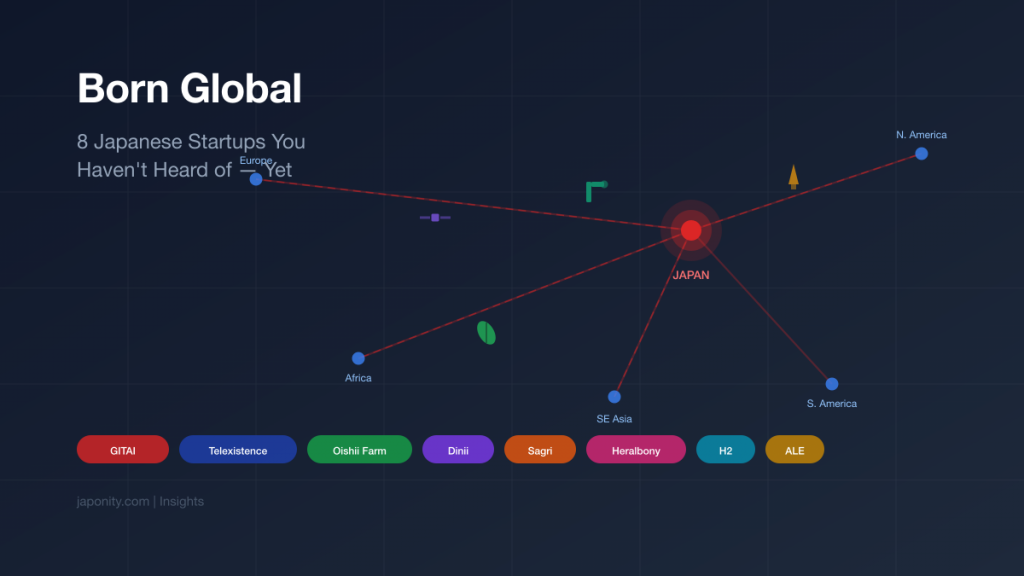
Born Global: 8 Japanese Startups You Haven’t Heard of — Yet
Japan’s startup scene has a reputation problem. The narrative says Japanese founders build for the domestic market first, go global later — if ever. With a ¥550 trillion home economy and 125 million consumers, why bother with the complexity of overseas expansion?
That narrative is now outdated. A new generation of Japanese startups is flipping the script — building for global markets from day one, raising capital from Silicon Valley VCs, relocating headquarters abroad, and deploying products across multiple continents before most people in Japan have even heard of them.
These aren’t unicorns yet. They’re the companies before they become household names. Here are 8 Japanese-founded startups that are quietly building global businesses — and why smart investors and partners should be paying attention now.
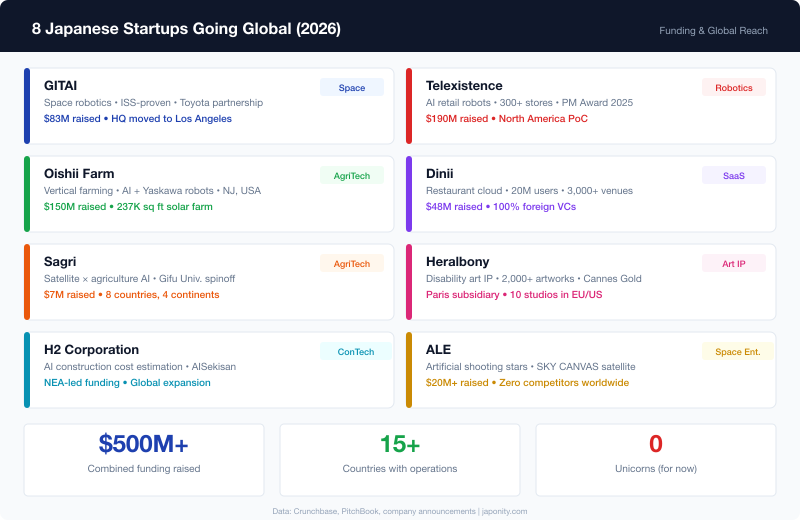
1. GITAI — Building the Robots That Will Work in Space
Sector: Space Robotics
Founded: 2016 | HQ: Los Angeles (moved from Tokyo in 2023)
Funding: ~$83M (Series B)
Global footprint: US headquarters, NASA partnership, Toyota R&D collaboration
GITAI builds autonomous robotic arms designed to replace human labor in space — satellite maintenance, assembly, inspection, and eventually construction. Think of it as the “hands” of the space economy.
The company achieved a major milestone when its S2 dual robotic arm system completed a fully successful demonstration outside the International Space Station, earning NASA Technology Readiness Level 7 — meaning the technology is proven to work in actual space conditions. GITAI also holds a joint R&D contract with Toyota for a robotic arm for the LUNAR CRUISER lunar exploration vehicle.
In a bold move that signals its global ambitions, GITAI relocated its headquarters from Tokyo to Los Angeles in late 2023 to access the US space and defense market — the world’s largest. The company is now developing a robotic satellite for on-orbit servicing and plans to begin commercial operations in 2026, with Japanese billionaire Yusaku Maezawa’s VC fund among its latest investors.
Why it matters: The in-orbit servicing market is projected to reach $4.4 billion by 2030. GITAI is one of very few companies worldwide with flight-proven space robotics — and the only Japanese-founded one.
2. Telexistence — The Robot That Stocks Your Convenience Store
Sector: Retail Automation / Robotics
Founded: 2017 | HQ: Tokyo
Funding: ~$190M (Series B) — backed by SoftBank, Foxconn
Global footprint: 300+ stores in Japan, North America expansion in progress
Japan has over 56,000 convenience stores — and not enough people to staff them. Telexistence is solving this with AI-powered robots that autonomously restock shelves, starting with the highest-volume task: beverage restocking.
Its TX GHOST robot is already deployed in approximately 300 FamilyMart stores, with pilot operations expanding into 7-Eleven locations. In September 2025, Telexistence and Seven-Eleven Japan announced a partnership to jointly develop “Astra,” a next-generation humanoid robot powered by generative AI using a Vision-Language-Action (VLA) foundation model — targeted for deployment by 2029.
The company won the Prime Minister’s Award at the Japan Startup Awards 2025 and has partnered with SoftBank Robotics Group to bring its technology to North American convenience store chains, with proof-of-concept discussions already underway.
Why it matters: Labor shortages in retail are a global problem. Telexistence’s approach — working alongside humans, not replacing them — is uniquely suited for the $3 trillion global convenience store industry. If the North America expansion succeeds, this company will be very well known very soon.
3. Oishii Farm — Japanese Strawberries, Grown by Robots in New Jersey
Sector: Vertical Farming / AgriTech
Founded: 2016 | HQ: New York
Funding: ~$150M (Series B) — led by NTT
Global footprint: Two farms in New Jersey, Tokyo R&D hub opening
Oishii Farm was founded by Hiroki Koga, who brought Japanese strawberry cultivation techniques to the US and combined them with AI, robotics, and vertical farming technology. The result: premium strawberries that sell for $6–$10 per box at Whole Foods, with a taste profile that rivals the $50 Japanese department store varieties.
In 2024, Oishii opened Amatelas Farm — a 237,000-square-foot solar-powered facility in Phillipsburg, NJ, designed to produce 20 times more berries than its previous farm. The operation uses proprietary AI models for environmental control, bee pollination optimization, and harvesting robots developed in partnership with Yaskawa Electric — one of the world’s leading industrial robot manufacturers.
The company has expanded beyond strawberries into tomatoes (the Rubī Tomato) and plans to open a Tokyo R&D center by the end of 2025 to explore new crops. It now operates across major US retailers including Harris Teeter and Whole Foods.
Why it matters: Most vertical farming companies are struggling or going bankrupt. Oishii is thriving because it targets the premium segment where unit economics actually work — a distinctly Japanese approach to quality over volume.
4. Dinii — The Restaurant OS Funded Entirely by Foreign VCs
Sector: Restaurant Tech / SaaS
Founded: 2018 | HQ: Tokyo
Funding: ¥7.46B (~$48M, Series B) — 100% from overseas investors
Global footprint: Southeast Asia expansion planned for 2025–2026
Dinii is a cloud-based restaurant management platform that unifies mobile ordering, POS, customer management, marketing, and staff training into a single system. What makes Dinii remarkable isn’t just the product — it’s the funding story.
Its entire ¥7.46 billion Series B was raised from foreign investors only — Bessemer Venture Partners and Hillhouse Investment Management co-led the round, with Flight Deck Capital and Eclectic Management participating. For a Japanese startup targeting Japanese restaurants, raising exclusively from overseas VCs is virtually unprecedented.
The numbers speak for themselves: 20 million registered users across 3,000+ restaurants, ARR tripling since 2023, and a churn rate below 0.5%. Founded by two University of Tokyo students who worked part-time in restaurants and saw firsthand how outdated the systems were.
Dinii plans to expand to Indonesia, Malaysia, Singapore, and Thailand — markets where Japan’s food service culture has significant influence and where restaurant digitization is still in its early stages.
Why it matters: When Bessemer (early backers of Shopify, Twilio, Toast) puts money into a Japanese restaurant tech startup, the global ambition is real. Dinii could become the Toast of Asia.
5. Sagri — Satellite Eyes on the World’s Farms
Sector: Satellite Data × Agriculture AI
Founded: 2018 | HQ: Hyogo (Gifu University origin)
Funding: ~¥1B (~$7M, Series A)
Global footprint: India, Vietnam, Thailand, Bangladesh, Kenya, Tanzania, Peru, Brazil
Sagri uses satellite imagery and AI to solve agricultural problems — identifying abandoned farmland, optimizing crop management, and measuring carbon sequestration for decarbonization credits. The company is a Gifu University spinoff, but its ambitions are anything but local.
Sagri already operates in 8 countries across 4 continents, with local subsidiaries in Singapore and India. Its products include “Actaba” (abandoned farmland mapping for local governments), “Sagri” (farming support app), and “Ninataba” (agricultural land matching). The company has raised from angel investors including Mercari founder Akira Ishizuka and SmartHR founder Shoji Miyata.
CEO Toshisuke Tsuboi has stated the goal is to become “Asia’s number one in agriculture × decarbonization within 3 years.” The company plans to double overseas personnel to 20–30 people and deepen operations across Southeast Asia and India.
Why it matters: Agriculture is the world’s largest industry by employment, and satellite-based farm management is still nascent in developing markets. Sagri’s early-mover advantage in 8 countries gives it a data moat that will be hard to replicate.
6. Heralbony — Turning Disability Art Into a Global Luxury Brand
Sector: Art IP Licensing / Social Enterprise
Founded: 2018 | HQ: Morioka, Iwate
Funding: Multiple rounds (WiL, M Power Partners, Dentsu Ventures)
Global footprint: Paris subsidiary (HERALBONY EUROPE), partnerships in 10 studios across Europe and US
Heralbony is one of the most original business models to emerge from Japan in years. The company licenses artwork created by artists with intellectual disabilities — managing over 2,000 art pieces from 243 artists across 54 facilities — and turns them into products, fashion collaborations, and B2B licensing deals.
The art is striking, bold, and commercially valuable. Heralbony has collaborated with ANREALAGE at Paris Fashion Week (SS 2026 collection, with Kyocera providing sustainable fabric printing), and won a Gold Lion at Cannes Lions 2025 — beating major creative agencies. The HERALBONY Art Prize attracted 2,650 submissions from 65 countries.
In 2025, former COO Marie Oshioka relocated to Paris to lead HERALBONY EUROPE, based at Station F. The company has already signed contracts with welfare facilities in France, Belgium, and Germany to represent local artists, and expanded studio partnerships to 10 locations across Europe and the US.
Why it matters: Heralbony is building a new category — disability art as premium IP. It’s simultaneously a social enterprise, a luxury brand, and a licensing platform. There is no equivalent anywhere in the world.
7. H2 Corporation — AI That Estimates Construction Costs Globally
Sector: Construction Tech / AI
Founded: 2019 | HQ: Tokyo
Funding: Pre-Series A Extension (led by NEA)
Global footprint: US expansion underway, international VC backing
Construction cost estimation is one of the most manual, time-consuming processes in a $13 trillion global industry. H2 Corporation is automating it with AI. Its AISekisan Platform uses proprietary AI models to analyze construction drawings and generate accurate cost estimates in a fraction of the time.
What’s notable about H2 is its investor profile: the Pre-Series A extension was led by New Enterprise Associates (NEA) — one of the largest venture capital firms in the world — alongside Spiral Capital, JAFCO, and MetaProp (the leading proptech VC). The funding will accelerate global expansion, enhance R&D, and hire go-to-market talent for international markets.
Why it matters: Construction is ripe for AI disruption globally, and cost estimation is a universal pain point. H2’s early backing from NEA signals that the technology has cross-border potential — the same drawings, the same math, different markets.
8. ALE — Shooting Stars on Demand
Sector: Space Entertainment / Atmospheric Science
Founded: 2011 | HQ: Tokyo
Funding: ~$20M+
Global footprint: Worldwide service potential, JAXA partnership
ALE is building something that sounds like science fiction: artificial meteor showers delivered from space, on demand, anywhere on Earth.
Founded by Lena Okajima, who holds a PhD in astronomy from the University of Tokyo and previously worked at Goldman Sachs, ALE has developed satellites that release specially engineered 1cm pellets from orbit. As the pellets re-enter Earth’s atmosphere, they burn up and create bright, colorful streaks visible across a 200km diameter — essentially fireworks from space, visible to millions of people simultaneously.
ALE has successfully launched two satellites (ALE-1 and ALE-2) and completed the engineering model for its third satellite. The company’s SKY CANVAS service is targeting commercial operations, with potential applications spanning city-scale entertainment events, Olympic ceremonies, and national celebrations. Beyond entertainment, the artificial meteors provide valuable scientific data about the mesosphere — one of the least-studied layers of Earth’s atmosphere.
Why it matters: There is no competitor. ALE has created an entirely new market category with inherently global demand. Every country that has hosted a major event — Olympics, World Cup, national celebrations — is a potential customer.
The Pattern: What These 8 Startups Have in Common
These companies span robotics, agriculture, food, art, construction, and space. But they share four characteristics that mark them as a new breed of Japanese startup:
1. Global-First Architecture
Unlike previous generations of Japanese startups that went global as an afterthought, these companies designed their products, teams, and capital structures for international markets from early stages. GITAI moved its HQ to LA. Oishii built its first farm in New Jersey, not Tokyo. Dinii raised exclusively from foreign VCs.
2. Deep Tech Moats
Every company on this list has proprietary technology that takes years to replicate — space-qualified robotics, vertical farming IP, satellite AI models, generative-AI-powered robots. They’re not building apps; they’re building hard things.
3. Japan’s Structural Advantages
Each startup leverages something Japan does uniquely well: precision manufacturing (GITAI, Telexistence), agricultural science (Oishii, Sagri), cultural IP (Heralbony), or the world’s most demanding domestic customers as a proving ground (Dinii, Telexistence).
4. Solving Universal Problems
Labor shortages, food security, construction costs, space infrastructure — these aren’t Japanese problems. They’re global problems that Japan happens to face first or most acutely, giving these startups a head start on solutions the world will need.
For Investors and Partners: The Window Is Open
Japan’s government has committed to producing 100 unicorns by 2027 and is deploying ¥761 billion ($5 billion) annually in VC funding to make it happen. Regulatory barriers are being dismantled, stock option rules relaxed, and startup visas expanded.
But the real signal is market-driven: when Bessemer, NEA, Hillhouse, and SoftBank are all writing checks into Japanese startups, the ecosystem has passed a credibility threshold that government policy alone couldn’t achieve.
These 8 companies are still early enough that partnership, investment, and collaboration opportunities remain accessible. In two to three years, several of them won’t be on “startups to watch” lists — they’ll be on unicorn lists.
The question for global investors and business leaders isn’t whether to engage with Japan’s startup ecosystem. It’s which of these companies to bet on before everyone else does.
Interested in Japanese business opportunities?
Whether you're looking for technology partners, engineering talent, or market insights — we can help connect you with the right Japanese organizations.
Get in Touch →