
Japan Has Only 15 Unicorns — Here’s Why That Number Is About to Explode
Japan is the world’s third-largest economy, yet it ranks just 15th globally in unicorn startups. With only 15 companies valued at $1 billion or more, Japan trails far behind the United States (853), China (330), and even smaller economies like the UK (53) and India (56). But this gap is closing — fast.
The Japanese government has set an ambitious target of 100 unicorns by 2027, backed by ¥761 billion ($5 billion) in VC funding deployed in 2025 alone. Regulatory reforms, a weaker yen attracting foreign investment, and a new generation of founders are reshaping Japan’s startup landscape.
This is the definitive guide to Japan’s unicorn ecosystem in 2026 — every company, the structural reasons behind the gap, the soonicorns poised to break through, and why smart investors are paying attention now.
Japan vs. the World: The Unicorn Gap
The numbers tell a stark story. Despite contributing roughly 4% of global GDP, Japan produces less than 1% of the world’s unicorns. The US alone has 57 times more unicorns than Japan.
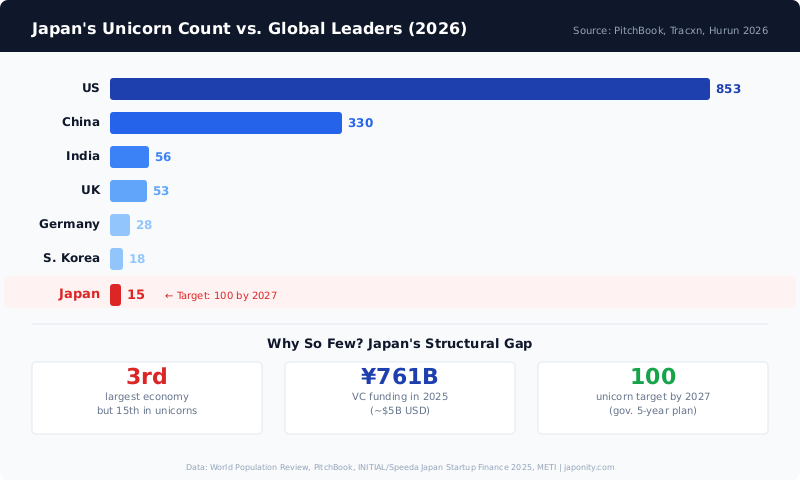
But raw numbers don’t capture the full picture. Japan’s startup ecosystem has been accelerating dramatically since 2020:
- VC funding tripled from ¥247B (2019) to ¥761B (2025)
- Sakana AI reached unicorn status in just 13 months — the fastest in Japanese history
- 4 former unicorns (Mercari, Astroscale, Visional, ispace) have already gone public, proving the exit path works
- Government deregulation (Startup Development Five-Year Plan) is removing structural barriers
The Complete List: All 15 Japanese Unicorns in 2026
Here is every Japanese unicorn as of 2026, ranked by valuation. The total combined valuation exceeds $38 billion.
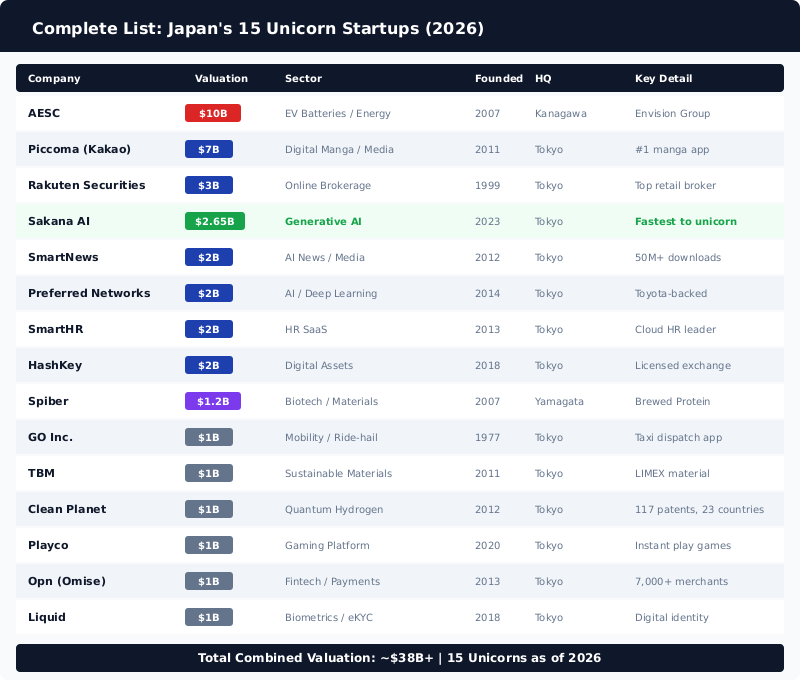
1. AESC — $10 Billion
Sector: EV Batteries / Clean Energy
Founded: 2007 | HQ: Kanagawa
Originally Nissan’s battery division, now owned by China’s Envision Group. AESC manufactures lithium-ion batteries for EVs and energy storage, with factories in Japan, the UK, China, and a new US plant in Kentucky. Their next-generation cells target 30% higher energy density by 2028.
2. Piccoma (Kakao Japan) — $7 Billion
Sector: Digital Manga / Media
Founded: 2011 | HQ: Tokyo
Piccoma dominates Japan’s digital manga market with its “wait-or-pay” freemium model. Backed by Korea’s Kakao, the platform generates over ¥100 billion annually and has expanded into France and other markets. It consistently ranks as the #1 non-game app by revenue in Japan.
3. Rakuten Securities — $3 Billion
Sector: Online Brokerage
Founded: 1999 | HQ: Tokyo
Japan’s largest online broker by trading volume, part of the Rakuten Group ecosystem. It handles over 8 million accounts and benefits from Japan’s push toward NISA (tax-free investment accounts), which has driven a surge in retail investing.
4. Sakana AI — $2.65 Billion
Sector: Generative AI
Founded: 2023 | HQ: Tokyo
Founded by former Google Brain researchers David Ha and Llion Jones (co-author of the “Attention Is All You Need” Transformer paper), Sakana AI reached unicorn status in just 13 months — the fastest in Japanese history. Their approach combines smaller, specialized AI models inspired by nature’s collective intelligence, rather than pursuing ever-larger foundation models.
5. SmartNews — $2 Billion
Sector: AI News / Media
Founded: 2012 | HQ: Tokyo
An AI-powered news aggregation app with over 50 million downloads across Japan and the US. SmartNews uses machine learning to curate personalized news feeds and has built a significant advertising business targeting both markets.
6. Preferred Networks (PFN) — $2 Billion
Sector: AI / Deep Learning
Founded: 2014 | HQ: Tokyo
Japan’s pioneering deep learning company, backed by Toyota and Fanuc. PFN builds AI for industrial applications: autonomous driving, robotics, drug discovery, and materials science. They developed MN-Core, a custom AI chip optimized for deep learning workloads, and operate one of Japan’s fastest supercomputers.
7. SmartHR — $2 Billion
Sector: HR SaaS
Founded: 2013 | HQ: Tokyo
Cloud-based HR and labor management platform used by over 60,000 companies. SmartHR automates Japan’s notoriously paperwork-heavy HR processes — social insurance, year-end adjustments, and employee onboarding. It leads the Japanese HR Tech market by a wide margin.
8. HashKey — $2 Billion
Sector: Digital Assets / Crypto
Founded: 2018 | HQ: Tokyo
A licensed digital asset exchange operating in Japan and Hong Kong. HashKey holds one of the few crypto exchange licenses in both jurisdictions, positioning it as a regulated gateway for institutional investors entering digital assets in Asia.
9. Spiber — $1.2 Billion
Sector: Biotech / Advanced Materials
Founded: 2007 | HQ: Yamagata
Spiber produces Brewed Protein — structural protein materials made through microbial fermentation as sustainable alternatives to animal-derived and petroleum-based materials. Partners include The North Face (Goldwin) and Pangaia. Their Thai mass-production facility came online in 2023.
10. GO Inc. — $1 Billion
Sector: Mobility / Ride-hail
Founded: 1977 (as Nihon Kotsu) | HQ: Tokyo
Japan’s dominant taxi dispatch platform, the “GO” app connects passengers with over 100,000 taxis nationwide. Unlike Uber, GO works with existing taxi operators rather than disrupting them — a distinctly Japanese approach. Expanding into autonomous mobility-as-a-service.
11. TBM — $1 Billion
Sector: Sustainable Materials
Founded: 2011 | HQ: Tokyo
Creator of LIMEX, a limestone-based material that replaces plastic and paper without using water or wood pulp. TBM’s circular economy model has attracted partnerships with major Japanese corporations and government agencies. Over 10,000 companies use LIMEX products.
12. Clean Planet — $1 Billion
Sector: Quantum Hydrogen Energy
Founded: 2012 | HQ: Tokyo
Developing quantum hydrogen energy (condensed matter nuclear science) in partnership with Mitsubishi Heavy Industries. Clean Planet holds 117 patents across 23 countries and aims to commercialize a revolutionary clean energy source by 2028. If successful, this could be transformative.
13. Playco — $1 Billion
Sector: Gaming Platform
Founded: 2020 | HQ: Tokyo
An instant-play gaming platform that lets users play games directly in messaging apps and social media without downloads. Founded by serial entrepreneurs, Playco reached unicorn status within months of founding, though it has since maintained a relatively low profile.
14. Opn (formerly Omise) — $1 Billion
Sector: Fintech / Payments
Founded: 2013 | HQ: Tokyo
A payment infrastructure company serving over 7,000 merchants across Japan and Southeast Asia. Opn provides payment processing, point-of-sale solutions, and financial APIs, bridging Japan’s still cash-heavy economy with digital payment rails.
15. Liquid — $1 Billion
Sector: Biometrics / Digital Identity
Founded: 2018 | HQ: Tokyo
Provides biometric authentication and eKYC (electronic Know Your Customer) solutions used by major Japanese banks, telecoms, and government agencies. As Japan digitizes its identity infrastructure (MyNumber card integration), Liquid is positioned at the center of this transformation.
Why Japan Has So Few Unicorns: 5 Structural Reasons
Japan’s unicorn shortage isn’t about lack of talent or capital — it’s structural. Understanding these barriers explains both the current gap and why it’s narrowing.
1. Risk-Averse Culture and Career Norms
Lifetime employment at large corporations remains the aspirational career path. Starting a company is seen as risky, and failure carries significant social stigma. Only 5.4% of working-age Japanese are involved in early-stage entrepreneurship (GEM 2024), compared to 17.4% in the US.
2. Domestic Market Comfort
Japan’s ¥550 trillion ($3.7T) domestic economy is large enough that many startups can build profitable businesses without going global. But $1B+ valuations typically require global TAM. Most Japanese startups build in Japanese, for Japanese customers, creating a natural ceiling.
3. Conservative VC Ecosystem
Japanese VCs have historically written smaller checks and favored later-stage, lower-risk investments. Average Series A in Japan is roughly $3-5M versus $10-15M in the US. Corporate venture capital (CVC) dominates, often prioritizing strategic fit over growth potential.
4. IPO-First Exit Culture
Japan’s TSE Mothers (now Growth Market) allows IPOs at valuations far below $1B — sometimes under $100M. This creates an incentive to go public early rather than staying private and growing to unicorn scale. In 2024, the median IPO market cap on TSE Growth was approximately ¥10 billion (~$67M).
5. Regulatory and Language Barriers
Complex regulations in sectors like fintech, healthcare, and mobility slow innovation. The Japanese language and unique business practices (nemawashi, hanko, etc.) create friction for global expansion and for foreign talent joining Japanese startups.
The Next Wave: 10 Soonicorns to Watch
These companies are the most likely to reach unicorn status in the next 1-3 years. Several have already crossed $500M+ valuations.
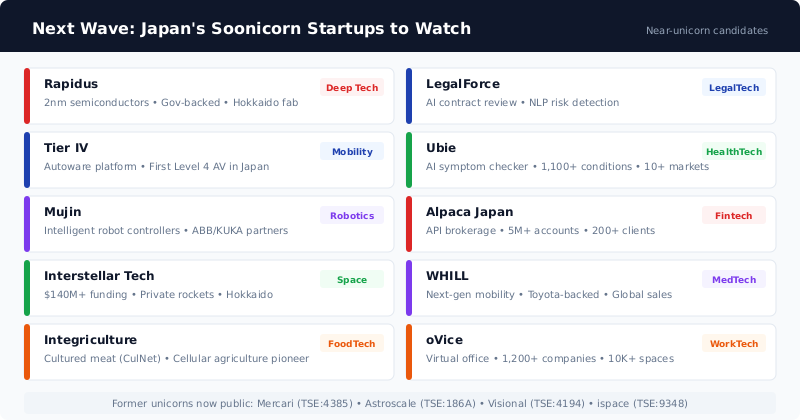
Rapidus — Semiconductors
Government-backed consortium aiming to manufacture cutting-edge 2nm chips in Hokkaido by 2027. With over $5B in public-private funding and technology licensed from IBM, Rapidus represents Japan’s bid to re-enter leading-edge semiconductor manufacturing. If successful, this could be Japan’s most valuable startup.
Tier IV — Autonomous Vehicles
Developer of Autoware, the world’s first open-source autonomous driving platform. Tier IV achieved Japan’s first Level 4 autonomous vehicle permit and is deploying self-driving buses and delivery vehicles across multiple Japanese cities.
Mujin — Industrial Robotics
Creates intelligent controllers that give industrial robots the ability to “see” and adapt in real-time — no pre-programming needed. Partners include ABB, KUKA, and major logistics companies. Mujin’s technology is deployed in warehouses and factories across Japan, the US, and China.
Interstellar Technologies — Space
Japan’s leading private rocket company, founded by Takafumi Horie. With $140M+ in funding, Interstellar is developing the ZERO small orbital launch vehicle at its Hokkaido spaceport. They successfully launched a sounding rocket in 2019 and target orbital capability by 2026.
Ubie — HealthTech
AI-powered symptom checker covering 1,100+ conditions, used by patients and doctors. Ubie has expanded to 10+ countries and partners with hospitals across Japan to improve diagnostic accuracy and reduce unnecessary visits.
LegalForce — LegalTech
AI-powered contract review platform using NLP to detect risks and suggest improvements. Dominant in Japan’s legal tech market with thousands of corporate clients, including major law firms and enterprises.
Alpaca Japan — Fintech
API-first brokerage platform enabling fintechs and financial institutions to offer stock trading. Over 5 million accounts and 200+ clients globally. Alpaca’s infrastructure powers trading for apps worldwide.
WHILL — MedTech / Mobility
Next-generation personal mobility devices (power wheelchairs) that combine sleek design with advanced technology. Toyota-backed with global sales across Japan, the US, and Europe. WHILL also deploys autonomous mobility services at airports.
Integriculture — FoodTech
Pioneer of cellular agriculture in Japan with its proprietary CulNet system for producing cultured meat. If regulatory approval follows Singapore and Israel’s lead, Japan’s cultured meat market could unlock a massive opportunity.
oVice — WorkTech
Virtual office platform used by 1,200+ companies with over 10,000 virtual spaces created. oVice capitalizes on Japan’s rapid shift toward remote and hybrid work models post-pandemic.
Former Unicorns Now Public
Four Japanese unicorns have successfully transitioned to public markets, proving the ecosystem can produce not just billion-dollar startups but viable public companies:
- Mercari (TSE: 4385) — Japan’s largest C2C marketplace, IPO’d in 2018 at $7B+ market cap
- Astroscale (TSE: 186A) — Space debris removal, IPO’d in 2024
- Visional (TSE: 4194) — BizReach professional recruitment platform, IPO’d in 2021
- ispace (TSE: 9348) — Lunar exploration company, IPO’d in 2023
What’s Changing: Japan’s Startup Renaissance
Several macro trends suggest Japan’s unicorn count could accelerate significantly:
Government Intervention at Scale
METI’s “Startup Development Five-Year Plan” (2022-2027) commits to 10x growth in startup investment and targets 100 unicorns. Concrete measures include tax incentives for angel investors, relaxed stock option regulations, and a startup visa program.
Generative AI Catalyst
Japan is emerging as an AI hub, with Sakana AI’s record-breaking growth as proof. The combination of strong engineering talent, manufacturing expertise (edge AI/robotics), and government AI investment ($1.5B+ allocated) positions Japan uniquely in applied AI.
Weak Yen, Strong Opportunity
The yen’s depreciation (¥150+ per dollar) makes Japanese startups relatively cheap for foreign investors, while making Japanese exports and services more competitive globally. Cross-border VC investment into Japan has surged.
Demographic Necessity
Japan’s aging population and labor shortage are forcing innovation in robotics, AI, healthcare, and automation — exactly the sectors where unicorns emerge. Necessity is driving both demand for solutions and government willingness to deregulate.
Global-First Founders
A new generation of Japanese founders (and foreign founders choosing Tokyo) are building for global markets from day one. English-first products, international teams, and Silicon Valley-style ambition are becoming more common.
The Bottom Line
Japan’s 15 unicorns represent just the beginning. The structural barriers that held back Japanese entrepreneurship for decades are being dismantled — through government policy, cultural shifts, and market forces. With over $5 billion in annual VC deployment, a pipeline of 50+ soonicorns, and the tailwinds of AI, robotics, and clean energy, Japan is positioned for a startup breakout.
The question isn’t whether Japan will produce more unicorns. It’s how many and how fast. For global investors, partners, and entrepreneurs, the window to engage with Japan’s startup ecosystem is wide open — and getting more competitive by the month.
Interested in Japanese business opportunities?
Whether you're looking for technology partners, engineering talent, or market insights — we can help connect you with the right Japanese organizations.
Get in Touch →