Japan builds some of the most resilient infrastructure on Earth — skyscrapers that sway through magnitude-9 earthquakes, tunnels bored through active volcanic zones, bridges engineered to withstand typhoons that would flatten structures elsewhere. But the hands that build these marvels are disappearing. The construction industry is short hundreds of thousands of workers, and the gap is widening every year. The answer, Japan’s largest contractors believe, lies in robots, drones, and artificial intelligence.
A Workforce in Freefall
Japan’s construction industry employed approximately 4.8 million workers in 2024, down from 6.8 million at its peak in 1997. The Ministry of Land, Infrastructure, Transport and Tourism (MLIT) projects the industry will be short 340,000 workers by 2030 — a conservative estimate that many industry executives consider optimistic.
The demographic profile of the remaining workforce tells an even more troubling story. Over 35% of construction workers are aged 55 or older, while workers under 30 account for barely 12% of the total. The 3K reputation of construction work — kitsui (hard), kitanai (dirty), kiken (dangerous) — continues to repel young Japanese who have ample alternatives in a tight labor market.
This shortage hits at a particularly painful moment. Japan faces an enormous infrastructure renewal challenge. Bridges, tunnels, highways, and water systems built during the high-growth era of the 1960s-1980s are reaching the end of their design lives simultaneously. The Osaka Expo 2025 and the ongoing Linear Chuo Shinkansen project add further pressure to an already strained labor pool. And Japan’s relentless exposure to earthquakes, typhoons, and flooding means that disaster reconstruction work is a permanent, unpredictable demand on the industry.
The government and major contractors have concluded that incremental improvements — slightly higher wages, modestly better working conditions — cannot solve a problem of this magnitude. Only a fundamental transformation of how construction work is performed can bridge the gap between shrinking labor supply and growing infrastructure demand.
The i-Construction Revolution
In 2016, MLIT launched the i-Construction initiative, a comprehensive program to modernize every phase of the construction process through information and communication technology (ICT). The initiative’s stated goal is to improve construction productivity by 20% by 2025 — a target that has been partially achieved and subsequently extended with more ambitious benchmarks.
i-Construction operates on three principles. First, full use of ICT in earthwork and civil engineering — replacing manual surveying, staking, and measurement with GPS, drones, and 3D data. Second, standardization of construction specifications around ICT workflows, so that government-contracted projects require digital processes by default. Third, modernization of construction site management through building information modeling (BIM), IoT sensors, and cloud-based project coordination platforms.
The impact on public works projects has been significant. As of fiscal year 2025, MLIT requires ICT-based methods for all major national government earthwork projects. The mandate has expanded from initial soil-moving work to include paving, dredging, and structural concrete operations. Prefectural governments have followed suit, creating a cascading adoption effect that is reshaping industry practices from the top down.
The economic argument is compelling. ICT earthwork projects have demonstrated an average 33% reduction in on-site labor requirements compared to conventional methods. Survey time for a typical road construction project drops from days to hours when drone photogrammetry replaces manual total-station surveying. Machine guidance systems allow less experienced operators to achieve the same precision as veterans, directly addressing the loss of skilled workers to retirement.
Robot Builders: Japan’s Super General Contractors Lead the Way
Shimizu Corporation: Building with Robots Since the 1990s
Shimizu Corporation, one of Japan’s five super general contractors, has been developing construction robots longer than almost any company in the world. Its Shimz Smart Site system deploys multiple robot types on building construction sites — welding robots, material transport robots, concrete finishing robots, and column-erecting robots — coordinated by a central AI management platform.
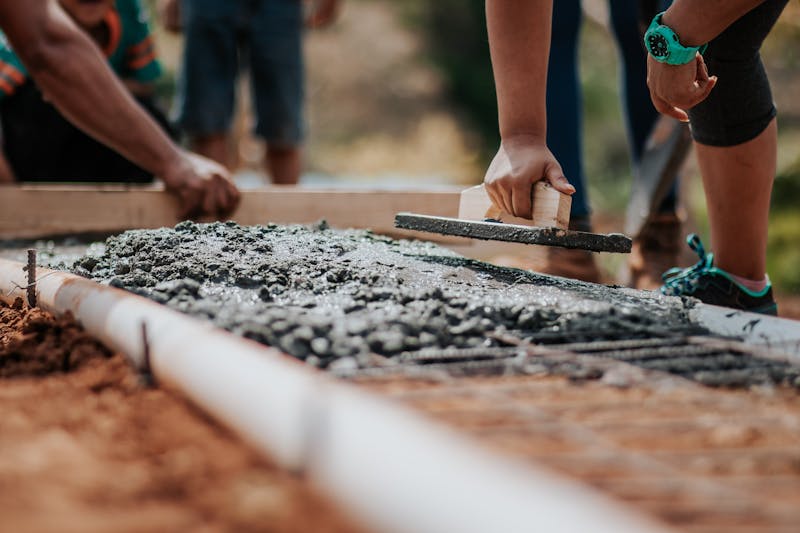
Shimizu’s autonomous floor-finishing robot can smooth concrete surfaces with a consistency that matches or exceeds skilled human workers, operating through the night when the building site would otherwise be idle. The company’s steel column welding robot performs multi-pass welds on structural beams at height, eliminating one of the most dangerous tasks in high-rise construction. During the construction of high-rise buildings in Tokyo and Osaka, Shimizu has demonstrated labor savings of 30% on specific tasks using its robot fleet.
Obayashi Corporation: The Automated Building Site
Obayashi Corporation has developed its own integrated construction robot system that it calls the Next-Generation Construction System. The company’s approach emphasizes automated material handling — one of the most labor-intensive aspects of building construction. Robotic transporters move materials from staging areas to installation points, following optimal routes calculated by AI scheduling algorithms.
Obayashi has also invested heavily in autonomous heavy equipment. The company’s remote-controlled and semi-autonomous excavators and dump trucks can operate in hazardous environments — including disaster zones and contaminated sites — where human workers would face unacceptable risks. This capability proved particularly valuable during ongoing decommissioning work at the Fukushima Daiichi nuclear power plant, where Obayashi has deployed remotely operated equipment in areas with high radiation levels.
Kajima Corporation: The A4CSEL System
Kajima Corporation has taken autonomous construction equipment further than perhaps any other company with its A4CSEL (Automated Autonomous Advanced Accelerated Construction System for Safety, Efficiency, and Liability) system. A4CSEL enables fleets of autonomous dump trucks, bulldozers, and vibrating rollers to perform earthwork operations with a single human supervisor monitoring multiple machines from a remote control room.
The system was deployed at the Naruse Dam construction site in Akita Prefecture, where a fleet of autonomous vehicles performed earth-moving and compaction work around the clock. Kajima reported productivity improvements of over 30% compared to conventional manned operations, with the added benefit of 24-hour construction capability — autonomous machines operate through the night, in rain, and in conditions that would stop human crews.
Komatsu: Smart Construction from the Ground Up
Komatsu Ltd., the world’s second-largest construction equipment manufacturer, has built an entire digital construction ecosystem called Smart Construction. The platform integrates drone surveying, 3D terrain modeling, intelligent machine control, and cloud-based project management into a seamless workflow that transforms how earthwork is planned and executed.
Smart Construction begins with a drone survey that creates a precise 3D model of the construction site. Engineers design the finished terrain in 3D, and the system automatically calculates the optimal earth-moving plan — which soil to cut, where to fill, and the most efficient routes for hauling material. This plan is uploaded directly to Komatsu’s intelligent machine control (iMC) excavators and bulldozers, which automatically control blade and bucket positions to match the 3D design.
The result is a construction process where the machine — guided by GPS and the 3D model — ensures accurate grading without the need for manual staking, grade checking, or the constant presence of a survey crew. Less experienced operators can achieve results that previously required years of skill development. Komatsu has deployed Smart Construction on over 15,000 sites across Japan and expanded the platform internationally.
Drones: The Surveyor’s Replacement
Drone technology has become the most widely adopted digital tool in Japanese construction. A survey that might take a four-person crew three days using conventional total-station methods can be completed by a single drone operator in 30 minutes, generating a 3D point cloud with comparable accuracy.
Major drone service providers in the Japanese construction market include Terra Drone, SenseFly (Parrot Group), and specialized divisions within Japan’s major contractors. Applications extend well beyond basic surveying to include progress monitoring, volumetric measurement of stockpiles, infrastructure inspection, and safety surveillance.
| Application | Conventional Method | Drone-Based Method | Time Savings |
|---|---|---|---|
| Site survey (10 ha) | 3-4 days, 4 workers | 30-60 min, 1 operator | ~95% |
| Bridge inspection | 2-3 days with scaffolding | 2-4 hours, no scaffolding | ~85% |
| Stockpile volume | Half day, 2 surveyors | 15 min, 1 operator | ~95% |
| Progress monitoring | Manual photo documentation | Automated scheduled flights | ~80% |
Sources: MLIT i-Construction Progress Report (2025), Japan Construction Machinery and Construction Association
Infrastructure inspection is a particularly high-value drone application. Japan has over 730,000 bridges, 11,000 tunnels, and countless kilometers of retaining walls and embankments that require periodic safety inspections. The traditional inspection of a highway bridge involves lane closures, bucket trucks or scaffolding, and days of manual visual inspection. Drones equipped with high-resolution cameras and AI-powered crack detection software can complete the same inspection in a fraction of the time, with quantified measurements that improve tracking of deterioration over time.
3D Printing and Prefabrication
Concrete 3D printing is an emerging technology that several Japanese companies are developing for construction applications. Maeda Corporation, in partnership with startup Polyuse, has demonstrated 3D-printed concrete structures including walls, benches, and small buildings. The technology is particularly promising for custom-shaped elements that would be expensive and time-consuming to form using traditional formwork.
Japan’s 3D printing construction efforts are still in the early stages compared to projects in Dubai, China, and the Netherlands. Regulatory challenges — Japan’s stringent building codes, developed in response to seismic risk, do not yet fully accommodate 3D-printed structural elements — are a significant factor. However, MLIT has established a working group to develop performance-based standards that could allow 3D-printed construction for approved applications.
Prefabrication and modular construction, while not new, are experiencing a resurgence driven by the labor shortage. Companies like Sekisui House and Daiwa House have expanded their factory-built housing operations, where controlled manufacturing environments allow higher quality with fewer workers. The approach is extending to commercial and infrastructure construction, with precast concrete segments and steel modules fabricated off-site and assembled rapidly on location.
BIM: The Digital Backbone
Building Information Modeling (BIM) has become a central element of Japan’s construction digitization strategy. MLIT mandated the use of BIM for government building projects starting in 2023 and has progressively expanded the requirement to include civil engineering infrastructure projects.
Japanese adoption of BIM has historically lagged behind countries like the UK, Singapore, and the Nordic nations. The complexity of Japanese building codes, the fragmented structure of the construction industry (with layers of subcontractors), and resistance to process change all contributed to slow uptake. The government mandate has accelerated adoption, but the deeper transformation — using BIM not just for design documentation but as a living digital twin that informs construction sequencing, facility management, and lifecycle maintenance — is still in progress.
The major contractors have invested heavily in BIM capabilities. Shimizu, Obayashi, Kajima, Taisei, and Takenaka all maintain dedicated BIM departments and have developed proprietary tools and workflows that integrate BIM with their robotics and automation systems. The convergence of BIM data with autonomous machine control is a key enabler for the next generation of construction automation.
Disaster Resilience: Building for Survival
Japan’s unique exposure to natural disasters adds urgency and complexity to its construction technology efforts. The country experiences roughly 1,500 earthquakes per year that are strong enough to be felt, regular typhoon landfalls, and increasingly severe flooding events linked to climate change.
| Disaster Type | Annual Frequency | Construction Industry Impact |
|---|---|---|
| Earthquakes (M5+) | ~100/year | Emergency repairs, seismic retrofitting demand |
| Typhoons (landfall) | 2-4/year | Flood control, slope stabilization |
| Heavy rainfall events | Increasing trend | Levee reconstruction, drainage upgrades |
| Volcanic activity | Intermittent | Erosion control, evacuation infrastructure |
Sources: Japan Meteorological Agency, Cabinet Office Disaster Management White Paper (2025)
Disaster reconstruction requires rapid mobilization of construction capacity — exactly the resource that is becoming scarce. The 2024 Noto Peninsula earthquake highlighted this challenge, as reconstruction efforts faced delays due to labor shortages and the difficulty of deploying workers to remote, damaged areas. Autonomous construction equipment that can operate in hazardous post-disaster environments with minimal human presence is not a theoretical benefit — it is an operational necessity.
Japan’s national resilience investment plan allocates approximately 15 trillion yen over five years for infrastructure hardening and disaster preparedness. Much of this spending flows through the construction industry, creating sustained demand for both traditional and technology-augmented construction services.
The Foreign Worker Question
Japan has partially addressed its construction labor shortage through immigration. The Specified Skilled Worker visa program, introduced in 2019, allows construction workers from countries like Vietnam, the Philippines, Indonesia, and Myanmar to work in Japan. The construction sector is the single largest category within this program, with approximately 100,000 foreign workers in construction as of 2025.
However, immigration alone cannot solve the problem. Foreign workers face language barriers, cultural adjustment challenges, and often work for wages below those of Japanese workers. The program has also drawn criticism for labor rights concerns. More fundamentally, the scale of the projected shortage — 340,000 workers by 2030 — exceeds what immigration programs are likely to deliver, particularly as competing countries like South Korea and Taiwan have launched their own skilled worker recruitment programs targeting the same source countries.
This reality reinforces the imperative for technology. Even with expanded immigration and improved working conditions to attract more Japanese workers, the construction industry will need to do significantly more work with fewer people. Technology is not an alternative to human workers — it is a multiplier that makes each worker more productive.
Business Opportunities
Japan’s construction technology market represents a substantial opportunity for international companies. The total addressable market for construction ICT, robotics, and digital services in Japan is estimated at 1.5-2.0 trillion yen and growing at double-digit rates.
Several areas offer particularly strong prospects. AI-powered construction management software that can optimize scheduling, resource allocation, and risk management is in high demand. Computer vision systems for safety monitoring — detecting workers without helmets, identifying unsafe conditions, tracking equipment movements — are being adopted across major construction sites. Sensor technology for structural health monitoring of aging infrastructure has a massive installed base to serve.
The BIM ecosystem remains relatively fragmented in Japan, creating opportunities for specialized software providers. Interoperability tools that bridge different BIM platforms, AI-powered design optimization, and cloud-based collaboration solutions for the multi-tiered subcontractor structure of Japanese construction projects are all areas where foreign technology is actively sought.
Partnerships are essential. The major contractors and equipment manufacturers control the technology adoption pipeline and prefer to work with established partners rather than evaluate cold approaches. Trade organizations like the Japan Federation of Construction Contractors (Nikkenren) and industry events like the Construction Technology Exhibition serve as important networking platforms.
Japan’s construction technology innovations also have export potential. The lessons learned in building earthquake-resistant structures, managing construction in extreme weather, and operating autonomous equipment in complex environments are directly applicable to markets throughout Asia, the Middle East, and other seismically active regions.
Looking Forward
The transformation of Japan’s construction industry is not optional — it is a matter of national survival. The country cannot maintain its infrastructure, rebuild after disasters, or construct the facilities its economy needs without fundamentally changing how construction work is performed. The next five years will likely see autonomous equipment become standard on major project sites, BIM workflows become universal, and robot-assisted building construction move from demonstration to mainstream.
For international companies with relevant technology, Japan offers a rare combination: a wealthy market with urgent demand, strong government support, and sophisticated customers willing to invest in solutions that demonstrably improve productivity. The construction industry that emerges from this transformation will look very different from the one that exists today — and the companies that help build it will find a partner in Japan’s construction sector for decades to come.
Interested in Japan’s construction technology market? Contact Japonity — we connect global businesses with Japan’s most innovative companies.
Interested in Japanese business opportunities?
Whether you're looking for technology partners, engineering talent, or market insights — we can help connect you with the right Japanese organizations.
Get in Touch →