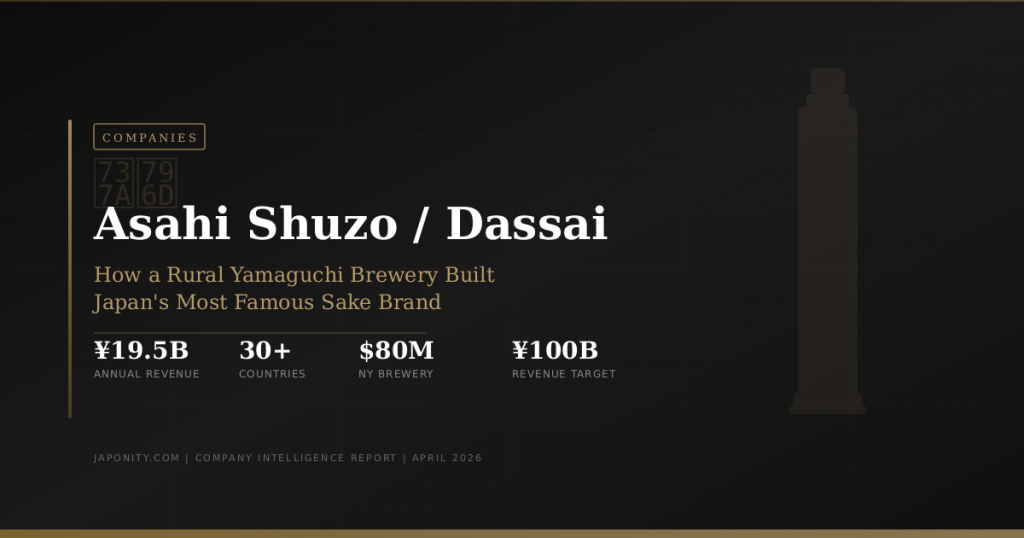
Asahi Shuzo (旭酒造), maker of the iconic Dassai (獺祭) brand, has transformed from a struggling rural brewery in Yamaguchi Prefecture into Japan’s most recognized sake brand worldwide. With ¥19.5 billion ($125M) in annual revenue, exports to 30+ countries, an $80 million brewery in New York’s Hudson Valley, and an audacious ¥100 billion revenue target, Dassai represents the most ambitious global expansion in sake history. The company’s radical strategy — producing exclusively Junmai Daiginjo, the highest-grade sake — has rewritten industry rules and positioned Japanese sake as a luxury category on par with fine wine and premium spirits. This intelligence report examines every dimension of the Dassai phenomenon.
Company Overview
| Item | Details |
|---|---|
| Company Name | Dassai Inc. (株式会社獺祭) — formerly Asahi Shuzo Co., Ltd. (旭酒造株式会社) |
| Name Change | June 1, 2025 — rebranded from Asahi Shuzo to Dassai Inc. for global brand recognition |
| Founded | 1948 — Iwakuni City, Yamaguchi Prefecture |
| Headquarters | 2167-4 Shuto, Iwakuni City, Yamaguchi Prefecture, Japan |
| Chairman | Hiroshi Sakurai (桜井博志) — 3rd generation; EY Entrepreneur of the Year Japan |
| President & CEO | Kazuhiro Sakurai (桜井一宏) — 4th generation; CEO since 2015 |
| Annual Revenue | ¥19.5 billion (~$125M USD) as of FY2024/9 |
| Revenue incl. Dassai Blue | >¥20 billion (~$129M USD) |
| Export Markets | 30+ countries across Asia, North America, Europe, and Oceania |
| Overseas Revenue Share | ~47% of sake revenue (¥87 billion of ¥187 billion sake sales) |
| Core Product | 100% Junmai Daiginjo — exclusively premium-grade sake |
| Rice Used | Yamada Nishiki (山田錦) only — Japan’s finest sake rice |
| Revenue Target | ¥100 billion ($639M) — ¥30B domestic + ¥70B overseas |
Corporate History: From Near-Bankruptcy to Global Icon
| Year | Milestone |
|---|---|
| 1948 | Asahi Shuzo founded in rural Iwakuni, Yamaguchi Prefecture |
| 1984 | Hiroshi Sakurai becomes 3rd generation CEO; inherits a nearly bankrupt brewery with declining sales |
| 1990 | Launches the first Dassai Junmai Daiginjo — a radical pivot from cheap table sake to premium-only production |
| 1999 | Abolishes the traditional Toji (杜氏) master brewer system; shifts to year-round data-driven brewing with salaried employees |
| 2006 | Kazuhiro Sakurai joins the company after working in an unrelated industry in Tokyo |
| 2013 | Opens the massive 12-story Iwakuni headquarters brewery with state-of-the-art automation |
| 2015 | Kazuhiro Sakurai succeeds his father as 4th generation President & CEO |
| 2018 | Opens Dassaï Joël Robuchon restaurant in Paris — collaboration with legendary French chef |
| 2023 | Grand opening of $80M Dassai Blue Sake Brewery in Hyde Park, New York |
| 2024 | Revenue hits ¥19.5B; overseas share reaches 47%; Dassai Blue sales reach ¥660M ($4.24M) |
| 2025 | Company renamed to Dassai Inc. (effective June 1); sponsors Academy Awards with sake served at ceremony |
| 2025 | Opens L’IZAKAYA DASSAI Yannick Alléno in Paris with Michelin 3-star chef |
| 2025 | Collaborates with Austria on “DASSAI Composing the Future” for Osaka-Kansai Expo |
The trajectory is remarkable: a 165-fold increase in revenue since Hiroshi Sakurai took over in 1984. From a rural brewery producing generic sake with annual revenue of roughly ¥100 million, Asahi Shuzo has become Japan’s most internationally recognized sake producer.
The Dassai Philosophy: Junmai Daiginjo or Nothing
What makes Dassai extraordinary in the sake industry is its refusal to produce anything other than Junmai Daiginjo — the highest classification of sake, which requires rice to be polished to at least 50% of its original size. While most sake breweries produce a range from basic Futsushu (table sake) to premium Daiginjo, Dassai eliminated everything below the premium tier. This is equivalent to a Bordeaux winery deciding to produce only Grand Cru.
Product Lineup
| Product | Rice Polishing Ratio | Character | Price Range (720ml) |
|---|---|---|---|
| Dassai 45 | 45% | Clean, fruity, accessible entry point; elegant aromatics | $20–$30 |
| Dassai 39 | 39% | Refined complexity; balanced sweetness and acidity | $35–$50 |
| Dassai 23 | 23% | Dense aroma, tropical fruit notes; long, lingering finish | $80–$120 |
| Dassai Beyond | Undisclosed (below 23%) | Ultra-premium; 10 years of R&D; limited annual production | $400–$700+ |
| Dassai Nigori | 45% | Unfiltered, creamy texture; approachable for newcomers | $25–$35 |
Why 23%?
The story behind Dassai 23 reveals the competitive spirit driving the brand. Originally planned at a 25% polishing ratio to be “Japan’s most polished sake,” Hiroshi Sakurai discovered a Nada producer already selling sake polished to 24%. He immediately pushed to 23% — and that number became the brand’s most iconic product. Yet the company insists: “We do not believe the sake is great simply because it has the best polishing ratio. We are striving for Japan’s best, most delicious sake.” Not all sake brewed with 23% polished rice meets quality standards — batches that fall short are downgraded and never bottled as Dassai 23.
Data-Driven Brewing: Replacing the Toji System
In 1999, Dassai made a radical break with tradition by abolishing the Toji (杜氏) master brewer system — a centuries-old practice where an itinerant master brewer would come to the brewery during winter months. Instead, Dassai implemented:
- Year-round brewing with full-time salaried employees (not seasonal workers)
- Data-driven quality control using temperature sensors, fermentation monitoring, and standardized processes
- Centrifuge separation instead of traditional pressing, enabling gentler extraction
- 12-story vertical brewery in Iwakuni using gravity flow for gentle rice handling
This approach was initially controversial but proved essential for consistent quality at scale — something traditional Toji-dependent breweries struggle to achieve.
Global Expansion: 30+ Countries and Counting
Dassai’s international strategy is the most aggressive in the Japanese sake industry. With nearly half of revenue coming from overseas and a long-term target of 70% international sales, the company is building sake into a global luxury beverage category.
Key International Markets
| Region | Key Markets | Strategy |
|---|---|---|
| North America | United States, Canada | Dassai Blue local production in New York; premium positioning in fine dining; Academy Awards sponsorship |
| Europe | France, UK, Germany, Italy, Austria | Paris restaurant partnerships (Joël Robuchon, Yannick Alléno); Michelin-starred dining integration |
| Asia | China, Hong Kong, Taiwan, Singapore, South Korea | Premium gifting culture; high-end restaurant distribution; growing wine-alternative positioning |
| Oceania | Australia | Premium hospitality channels; Japanese restaurant networks |
| Middle East | UAE, others | Luxury hotel and restaurant distribution |
International Restaurant Ventures
| Venue | Location | Partner | Opened |
|---|---|---|---|
| Dassaï Joël Robuchon | Paris, France | Late Joël Robuchon (Michelin 3-star) | April 2018 |
| L’IZAKAYA DASSAI Yannick Alléno | Paris, France | Yannick Alléno (Michelin 3-star) | November 2024 |
| Dassai Blue Tasting Room | Hyde Park, New York | Culinary Institute of America (CIA) | September 2023 |
The New York Brewery: Dassai Blue
The Dassai Blue Sake Brewery in Hyde Park, New York, represents the boldest bet in modern sake history — and the first major Japanese sake brewery built in the United States designed to produce ultra-premium Junmai Daiginjo.
Dassai Blue Facility Overview
| Specification | Details |
|---|---|
| Location | 5 St Andrew Road, Hyde Park, Dutchess County, New York |
| Investment | $80 million |
| Facility Size | 55,000 sq ft (brewery + tasting room) across two buildings |
| Annual Capacity | 140,000 nine-liter cases (~1.26 million liters) |
| Production Volume (2024) | ~110,000 liters |
| Revenue (2024) | ¥660 million (~$4.24M USD) |
| Staff | 32+ employees (veteran Iwakuni brewers + local recruits) |
| Architect | Pelli Clarke & Partners |
| Opened | September 2023 (Grand Opening December 2023) |
| Product | Dassai Blue — three expressions of Junmai Daiginjo |
Strategic Rationale
The Hyde Park location was chosen for its proximity to the Culinary Institute of America (CIA), America’s most prestigious culinary school, located just a five-minute walk away. This allows Dassai to:
- Train the next generation of American chefs and sommeliers on sake culture
- Position sake as a food-pairing beverage alongside wine in culinary education
- Leverage Hudson Valley’s reputation as a food and beverage destination
- Reduce shipping costs and carbon footprint vs. importing from Japan
- Use local New York water to create a distinct terroir-based product (hence “Blue”)
CEO Kazuhiro Sakurai has stated the company’s ambition to “step into areas other than Japanese cuisine” — making sake a universal dining companion rather than a niche ethnic beverage.
Japanese Sake Export Market
Dassai’s global ambitions are riding a broader wave of Japanese sake export growth. The latest trade data confirms sake’s rising international profile.
Sake Export Performance (2020–2025)
| Year | Export Value (JPY) | Export Volume (Liters) | Markets Reached | Avg. Price/Liter |
|---|---|---|---|---|
| 2020 | ¥24.1B | ~23M | ~70 | ¥1,048 |
| 2021 | ¥40.2B | ~27M | ~73 | ¥1,489 |
| 2022 | ¥47.5B | ~31M | ~76 | ¥1,532 |
| 2023 | ¥41.1B | ~30M | ~78 | ¥1,370 |
| 2024 | ¥43.3B | ~31M | ~79 | ¥1,397 |
| 2025 | ¥45.9B | 33.55M | 81 (record) | ¥1,368 |
Top Sake Export Destinations (2025)
| Rank | Country | Value (JPY) | Volume (kL) | YoY Change (Value) |
|---|---|---|---|---|
| 1 | China | ¥13.3B | 6,660 kL | +13.9% |
| 2 | United States | ¥11.0B | 7,720 kL | -3.5% |
| 3 | Hong Kong | ¥4.5B | 2,100 kL | +5.2% |
| 4 | South Korea | ¥2.8B | 1,800 kL | +8.1% |
| 5 | Taiwan | ¥2.4B | 1,500 kL | +4.7% |
Source: Japan Customs / Nippon.com. Asia accounts for 63% of total sake export value (¥28.8B). The average export price per liter has increased 1.8x over 10 years, reflecting premiumization — a trend Dassai has both driven and benefited from.
Financial Analysis
Revenue Growth Trajectory
| Period | Revenue | Notes |
|---|---|---|
| 1984 | ~¥100M | Hiroshi Sakurai takes over near-bankrupt brewery |
| 2000 | ~¥1B | Dassai brand gaining domestic traction |
| 2010 | ~¥5B | Rapid growth in premium sake market |
| 2018 | ~¥13B | International expansion accelerating |
| 2022 | ¥16.5B | Record high; 165x increase since 1984 |
| FY2024/9 | ¥19.5B | Overseas revenue reaches ¥8.7B (47% of sake sales) |
| Target | ¥100B | ¥30B domestic + ¥70B overseas (90% overseas long-term) |
Revenue Breakdown (FY2024/9)
| Segment | Revenue | Share |
|---|---|---|
| Domestic Sake Sales | ~¥100B | ~53% |
| Overseas Exports | ~¥87B | ~47% |
| Dassai Blue (NY) | ¥660M | ~3.4% (separate entity) |
| Total (incl. Blue) | >¥20B | 100% |
Key Financial Characteristics
- Premium pricing power: Dassai commands 3–5x the price of standard sake, reflecting the brand premium and Junmai Daiginjo exclusivity
- Yamada Nishiki dependence: Exclusive use of Japan’s most expensive sake rice increases COGS but supports quality narrative
- Capital intensity: The Iwakuni 12-story brewery and $80M New York facility represent significant fixed asset investment
- Private company: As a family-owned company, detailed profitability data is not publicly disclosed
- Growth focus: CEO Kazuhiro Sakurai has stated overseas sales will eventually comprise ~90% of total revenue
Competitive Landscape
Dassai operates in a fragmented Japanese sake industry with approximately 1,400 active breweries. However, in the premium international segment, it faces competition from a select group of high-profile brands.
Premium Sake Brand Comparison
| Brand | Brewery | Prefecture | Positioning | Global Reach | Key Differentiator |
|---|---|---|---|---|---|
| Dassai | Dassai Inc. | Yamaguchi | 100% Junmai Daiginjo; data-driven brewing at scale | 30+ countries; NY brewery | Only Junmai Daiginjo; global brand recognition |
| Kubota | Asahi Shuzo (Niigata) | Niigata | Clean, dry, food-friendly; 193-year heritage | Moderate international | Seasonality-driven; balanced dry style |
| Hakkaisan | Hakkaisan Brewery | Niigata | Crisp, clean; quality at all tiers | Growing international | Even Futsushu at 60% polishing; shochu diversification |
| Juyondai | Takagi Shuzo | Yamagata | Ultra-premium; cult following; extreme scarcity | Very limited | Near-impossible to find; bottles exceed $1,000 |
| Kokuryu | Kokuryu Sake Brewing | Fukui | Premium Daiginjo; traditional craftsmanship | Moderate | Ryu (Dragon) series; consistent award winner |
| Dewazakura | Dewazakura Sake Brewery | Yamagata | Ginjo pioneer; fruit-forward profile | Growing | Credited with popularizing Ginjo-style sake |
Dassai’s Competitive Advantages
| Advantage | Details |
|---|---|
| Brand Recognition | Far and away the most recognized Japanese sake brand internationally; “the Dom Pérignon of sake” |
| Scale + Quality | Unique ability to produce premium Junmai Daiginjo at industrial scale without quality compromise |
| Global Infrastructure | Only major sake brand with a U.S. production facility; Paris restaurants; Academy Awards presence |
| Data-Driven Brewing | Year-round production with precise digital monitoring; not dependent on seasonal Toji masters |
| Premium-Only Strategy | 100% Junmai Daiginjo focus creates clear brand positioning that competitors with mixed portfolios cannot replicate |
Business Opportunities
The Dassai story illuminates several significant business opportunities in the Japanese sake sector:
Opportunities for International Partners
| Opportunity | Description | Potential Partners |
|---|---|---|
| Premium Sake Distribution | As Dassai targets ¥70B in overseas revenue, distribution partnerships in underserved markets (Latin America, Africa, Eastern Europe) are opening up | Beverage distributors, wine importers, luxury goods retailers |
| Restaurant & Hospitality Integration | Dassai’s Paris model (partnering with Michelin chefs) can be replicated in London, New York, Singapore, Dubai | Fine dining groups, hotel chains, chef partnerships |
| Sake Education & Tourism | The CIA partnership model creates opportunities for culinary schools worldwide to integrate sake programs | Culinary institutes, sommelier associations, tourism boards |
| Sake Brewing Technology | Dassai’s data-driven brewing approach creates demand for IoT sensors, fermentation analytics, and quality control technology | AgTech / FoodTech companies, automation providers |
| Yamada Nishiki Supply Chain | As premium sake demand grows, Yamada Nishiki rice cultivation and supply chain optimization present agricultural opportunities | Agricultural cooperatives, precision farming companies |
| Local Craft Sake Production | The Dassai Blue model proves premium sake can be brewed outside Japan, opening doors for local production in other countries | Craft beverage entrepreneurs, investors |
Outlook & Strategic Assessment
Growth Drivers
- Global premiumization trend: Consumers worldwide are trading up to premium spirits and craft beverages, creating a natural market for ultra-premium sake
- Sake export momentum: Record 81 export markets in 2025 with 6% value growth; the global sake market is projected to reach $10.5B+ by 2032
- Cultural capital: Japanese food culture (washoku) achieved UNESCO Intangible Heritage status in 2013, driving interest in authentic Japanese beverages
- Dassai Blue ramp-up: The New York brewery is still in early production (<10% of capacity); full utilization could add ¥5–10B in revenue
- Name change to Dassai Inc.: Signals all-in commitment to the Dassai brand as a global luxury label
Key Risks & Challenges
| Risk | Severity | Mitigation |
|---|---|---|
| Yamada Nishiki supply constraints | High | Long-term contract farming; potential organic rice expansion |
| Brand dilution from mass availability | Medium | Dassai Beyond maintains ultra-premium tier; rigorous quality control |
| Currency volatility (JPY/USD) | Medium | NY local production hedges U.S. market; diversified export markets |
| Competition from local craft sake | Low-Medium | Brand heritage and scale create significant moat |
| Generational succession risk | Low | Successful CEO transition already completed (Hiroshi → Kazuhiro) |
| Japanese domestic sake market decline | Medium | Aggressive overseas expansion targets (90% overseas long-term) |
Strategic Assessment
Dassai Inc. is executing what may be the most ambitious internationalization strategy in Japanese food and beverage history. The company’s ¥100 billion revenue target — a 5x increase from current levels — requires Dassai to transform sake from a niche category into a mainstream global luxury beverage. With the Dassai Blue production facility ramping up in the U.S., strategic partnerships with world-class chefs in Paris, an Academy Awards sponsorship, and the brand simplification of renaming the entire company after its flagship product, the pieces are in place for the next phase of growth.
The biggest question is not whether Dassai can grow — it is whether sake as a category can follow the path of Japanese whisky and achieve mainstream global recognition. If it can, Dassai is positioned to be the Yamazaki of sake: the breakout brand that defines the category for international consumers.
This report was researched and produced by Japonity.com — Japan Discovery & Business Intelligence Platform.
Need a custom market research report on Japanese industries, companies, or products? We accept commissioned research projects (調査代行). Contact us to discuss your specific intelligence needs.
Published: April 2026
Interested in Japanese business opportunities?
Whether you're looking for technology partners, engineering talent, or market insights — we can help connect you with the right Japanese organizations.
Get in Touch →