
TYO:6954
Walk into almost any modern factory — cars in Germany, phones in China, packaged food in the US — and you’ll find a robot arm doing the work. There’s a good chance it’s painted bright yellow, and an even better chance it was made by one of two Japanese companies. Fanuc and Yaskawa are not household names, yet between them they form one of the most dominant duopolies in global manufacturing.
Two companies, much of the world’s factory automation
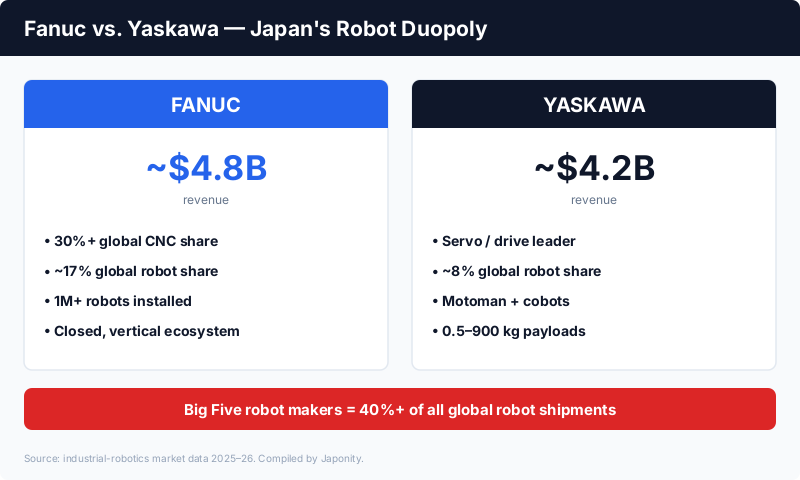
Industrial robotics is led by a “Big Five” — Japan’s Fanuc and Yaskawa, Switzerland’s ABB, Germany’s KUKA (now Chinese-owned), and Mitsubishi Electric — that together account for over 40% of global industrial-robot shipments. The two Japanese firms anchor that group: Fanuc holds roughly 17% of the global robot market and Yaskawa around 8%, and both are foundational suppliers to the automakers and electronics giants that define modern industry.
Japan’s lead here is not incidental. The country is the world’s largest exporter of industrial robots and consistently ranks at or near the top in robot density — robots per worker — making it both the leading producer and one of the most automated economies on Earth.
Fanuc: the secretive yellow giant
Fanuc is one of the most quietly extraordinary companies in the world. With roughly $4.8 billion in revenue, it dominates two markets at once: it holds 30%+ of the global market for CNC controllers — the “brains” inside metal-cutting machine tools — and is the single largest industrial-robot maker, with its signature yellow arms.
The scale is hard to overstate. Fanuc has over one million robots installed worldwide, produces 100,000+ robots a year, sells more than 100 robot models (welding, assembly, material handling, painting, palletising), and operates 260+ subsidiaries globally. Its products run across automotive, electronics, logistics, food and beverage, cosmetics, and pharmaceuticals.
Famously, Fanuc is also intensely private — headquartered in a forested complex near Mount Fuji, dressing its staff and even its buildings in yellow, and running highly automated factories where robots build robots. That obsessive focus has produced some of the best operating margins in all of manufacturing.
Yaskawa: the motion-control pioneer
Yaskawa Electric, with around $4.2 billion in revenue, comes at automation from a different heritage: motion control. It is one of the world’s leading makers of servo motors and inverter drives — the precision components that make any robot or automated machine move accurately — and a top supplier of those parts to the entire industry, not just its own robots.
Its Motoman robot brand is a global staple, especially in welding and handling, and its range now spans collaborative robots (“cobots”) and articulated and parallel arms with payloads from 0.5 kg up to 900 kg. Where Fanuc’s edge is its closed, vertically integrated ecosystem of controllers and robots, Yaskawa’s is deep mastery of the underlying motion technology that the rest of the automation world also relies on.
How they differ
| Fanuc | Yaskawa | |
|---|---|---|
| Revenue | ~$4.8B | ~$4.2B |
| Core strength | CNC controllers (30%+ share) + robots | Servo motors / drives + Motoman robots |
| Global robot share | ~17% | ~8% |
| Signature | Yellow arms; robots building robots | Motion-control components for the whole industry |
| Edge | Closed, vertically integrated ecosystem | Underlying motion technology mastery |
The tailwind: a world running out of workers
The duopoly’s biggest growth driver is demographic. Japan pioneered factory automation partly out of necessity — a shrinking, ageing workforce — and that necessity is now going global. Ageing populations and labour shortages across the US, Europe, China, and Southeast Asia are pushing manufacturers to automate work that humans are no longer available to do.
That makes Fanuc and Yaskawa structural beneficiaries of one of the century’s defining trends. Add the rise of cobots — robots safe enough to work beside people, opening automation to smaller firms that could never justify a caged production line — and the addressable market expands well beyond the big automakers.
The real bottleneck — and the opportunity
Here’s the catch that creates the opening for international operators: a robot arm is only useful once it’s integrated. Programming, tooling, vision systems, safety, and line design are done by system integrators, and skilled integrators are in chronic short supply worldwide. The hardware is abundant; the expertise to deploy it is not.
For global partners, that points to concrete plays:
- System integration and services — the highest-demand, highest-margin layer sitting on top of Japanese hardware, and the most accessible to enter.
- Cobot deployment for SMEs — bringing automation to the millions of small manufacturers that the Big Five’s traditional sales motion underserves.
- Distribution and aftermarket — parts, retrofits, training, and uptime services around a vast installed base of over a million Fanuc robots alone.
- Vertical solutions — pre-packaged automation for specific industries (food, logistics, pharma) built on Fanuc or Yaskawa platforms.
Frequently asked questions
Who are the biggest industrial robot makers in the world?
The “Big Five” — Fanuc and Yaskawa (Japan), ABB (Switzerland), KUKA (Germany, Chinese-owned), and Mitsubishi Electric — together account for over 40% of global industrial-robot shipments. Fanuc leads with roughly 17% market share.
What’s the difference between Fanuc and Yaskawa?
Fanuc dominates CNC controllers (30%+ share) and integrates them with its own yellow robots in a closed ecosystem with very high margins. Yaskawa’s heritage is motion control — servo motors and drives it supplies to the whole industry — alongside its Motoman robot brand and a strong cobot lineup.
Where is the opportunity for foreign businesses?
Not in competing on hardware, but in the deployment layer: system integration, cobot solutions for small manufacturers, and aftermarket services. Skilled integrators are in short supply globally, making services the most accessible and fastest-growing opportunity around Japanese robot hardware.
Looking to deploy, distribute, or build on Japanese automation technology? Contact Japonity — we connect international businesses with Japan’s best companies, products, and technologies.
Interested in Japanese business opportunities?
Whether you're looking for technology partners, engineering talent, or market insights — we can help connect you with the right Japanese organizations.
Get in Touch →