Executive Summary
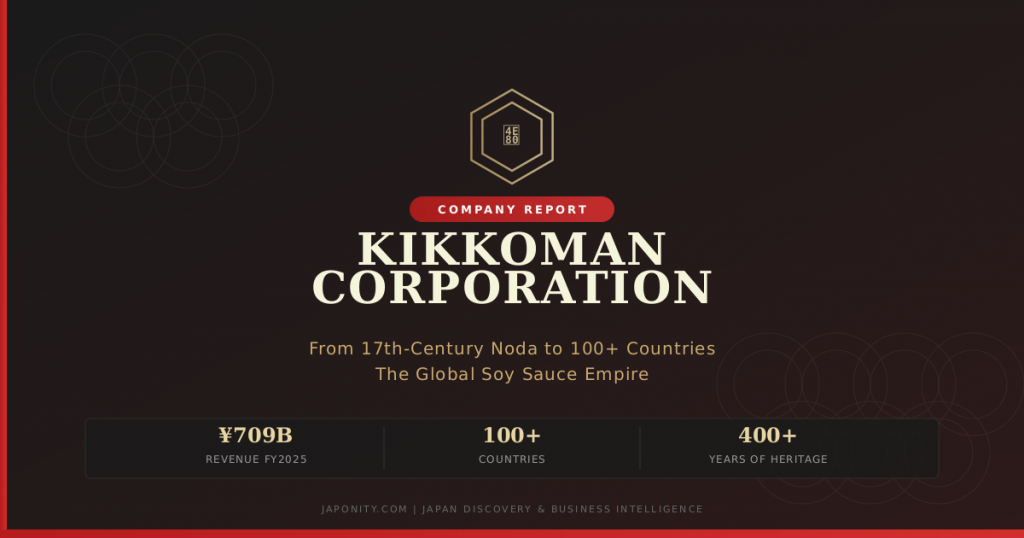
Kikkoman Corporation (TSE: 2801) is the world’s most recognized soy sauce brand and one of Japan’s most successful global food companies. With roots stretching back over 400 years to 17th-century Noda, Japan, Kikkoman has transformed from a regional condiment maker into a multinational corporation with ¥709 billion ($4.75 billion) in revenue for FY2025 and operations spanning more than 100 countries.
The company’s overseas business now accounts for over 75% of total revenue, driven by a localization strategy that began with its pioneering Wisconsin plant in 1973. Kikkoman commands the #1 position in the home-use soy sauce market across North America and Europe, and continues to expand into emerging markets in the Middle East, Africa, and Latin America.
For international businesses, Kikkoman represents a compelling case study in cross-cultural product adaptation, patient market development, and the commercial power of Japanese food heritage.
| Key Metric | Value |
|---|---|
| Revenue (FY2025) | ¥709.0 billion (~$4.75 billion) |
| Business Profit (FY2025) | ¥77.3 billion (10.9% margin) |
| Net Profit (FY2025) | ¥61.7 billion (record high) |
| Market Capitalization | ~$8.57 billion (Dec 2025) |
| Employees | ~7,700 (consolidated) |
| Overseas Revenue Share | 75%+ of consolidated revenue |
| Global Presence | 100+ countries |
| Stock Listing | Tokyo Stock Exchange (2801) |
Company Overview: A 400+ Year Legacy
Origins in Noda
Kikkoman’s story begins in the early 17th century, when the Mogi and Takanashi families began brewing soy sauce in Noda, a city strategically located on the banks of the Edo River in Chiba Prefecture. The river provided convenient access to raw materials — soybeans, wheat, and salt — and enabled efficient deliveries to the rapidly growing city of Edo (modern-day Tokyo).
The earliest family soy sauce operations can be traced to 1630, making the enterprise over 390 years old — one of the oldest continuously operating food businesses in the world.
Corporate Formation and Evolution
| Year | Milestone |
|---|---|
| 1630 | Mogi family begins soy sauce production in Noda |
| 1917 | Eight family companies merge to form Noda Shoyu Co., Ltd. |
| 1949 | Listed on the Tokyo Stock Exchange |
| 1957 | First overseas sales office opens in San Francisco |
| 1961 | Teriyaki Sauce launched in the US market |
| 1964 | Renamed to Kikkoman Shoyu Co., Ltd. |
| 1973 | First US plant opens in Walworth, Wisconsin |
| 1980 | Renamed to Kikkoman Corporation |
| 1997 | European plant opens in Sappemeer, Netherlands |
| 2024 | Breaks ground on $560M third US plant in Jefferson, Wisconsin |
Family Governance: A Model for Multi-Generational Business
Kikkoman’s founding families — primarily the Mogi and Takanashi clans — have maintained involvement across 16 generations. Their governance model is notable: each of the eight family branches may designate only one member per generation to work in the business, and board membership is not guaranteed by birth alone. This structure has helped Kikkoman avoid the succession conflicts that plague many family enterprises.
Yuzaburo Mogi, a Columbia Business School graduate who served as CEO from 1995 to 2004 and later as Chairman, is widely credited with accelerating Kikkoman’s global expansion. Current leadership includes CEO Shozaburo Nakano and Chairman Noriaki Horikiri, reflecting the company’s evolution toward professional management while retaining family oversight.
The Soy Sauce Empire
The Product
Kikkoman’s flagship product is naturally brewed soy sauce (醤油 / shōyu), made through a traditional fermentation process using just four ingredients: soybeans, wheat, salt, and water. The brewing process takes approximately six months, during which Aspergillus mold cultures (koji) break down proteins and starches to create the sauce’s characteristic umami flavor.
This “honjozo” (本醸造) method distinguishes Kikkoman from cheaper chemically hydrolyzed alternatives, and has become a key brand differentiator in markets worldwide.
Production Scale
Kikkoman manufactures over 1.4 million tons of soy sauce annually, making it the largest producer of naturally brewed soy sauce in the world. The company operates 8 overseas production plants in addition to its domestic Japanese facilities.
| Plant Location | Country | Year Opened | Notes |
|---|---|---|---|
| Noda, Chiba | Japan | 1630s | Headquarters & original production site |
| Walworth, Wisconsin | USA | 1973 | Highest-producing soy sauce facility in the Western world |
| Singapore | Singapore | 1984 | Hub for Southeast Asia & Oceania |
| Folsom, California | USA | 1998 | Second US production facility |
| Sappemeer | Netherlands | 1997 | European hub; 400M+ litres/year capacity |
| China / Taiwan | China / Taiwan | Various | Asian market production |
| Jefferson, Wisconsin | USA | 2024 (groundbreaking) | $560M investment; third US plant |
Global Market Position
Soy Sauce Market Overview
The global soy sauce market is valued at approximately $59 billion (2025) and is growing at a CAGR of 4.7-5.2%. While the market remains fragmented — with global leaders controlling less than 20% of total revenue — Kikkoman holds a dominant position in the premium naturally brewed segment.
| Company | HQ | Est. Global Share | Strength |
|---|---|---|---|
| Foshan Haitian | China | ~6.2% | Largest by volume; dominates Chinese market (13.2% share) |
| Kikkoman | Japan | ~11% | #1 in premium brewed; dominant in West |
| Lee Kum Kee | Hong Kong | ~3-5% | 300+ products; strong in Chinese cuisine |
| Yamasa | Japan | ~2-3% | Premium Japanese market; US plant in Oregon |
While Foshan Haitian leads by overall volume (driven by China’s massive domestic market with ¥26.9 billion RMB / $3.7 billion in 2024 revenue), Kikkoman dominates international markets outside Asia — the more accessible and higher-margin segments for foreign businesses.
100+ Country Footprint
Kikkoman soy sauce is available in over 100 countries, with particularly strong penetration in:
- North America: #1 home-use soy sauce brand; three production facilities
- Europe: Leading brand with Netherlands-based production hub
- Southeast Asia & Oceania: Singapore plant serving regional demand
- Emerging markets: Active expansion in India (dark soy sauce launched Feb 2024), Middle East, Africa, and Latin America
Financial Analysis
Revenue Growth Trajectory
| Fiscal Year (ending March) | Revenue (¥B) | YoY Growth | Net Profit (¥B) |
|---|---|---|---|
| FY2023 (Mar 2023) | 618.8 | — | — |
| FY2024 (Mar 2024) | 660.8 | +6.8% | — |
| FY2025 (Mar 2025) | 709.0 | +7.3% | 61.7 (record) |
Business Structure
Kikkoman’s overseas segment achieved revenue of ¥552.1 billion in FY2025 with a business profit margin of 12.7%, underscoring the profitability of its international operations. Overseas soy sauce revenue specifically reached ¥156.2 billion, growing 12.0% year-over-year (6.4% on a constant-currency basis).
| Segment | Revenue (FY2025) | Key Products |
|---|---|---|
| Overseas Soy Sauce & Seasonings | ¥156.2B | Soy sauce, teriyaki, ponzu, cooking wines |
| Overseas Wholesale (Oriental Foods) | Majority of overseas rev. | Distribution of Asian food products |
| Domestic Soy Sauce & Food | ~¥157B (est.) | Soy sauce, soy milk, Del Monte beverages |
| Biotechnology & Others | Small | Diagnostic enzymes, biochemicals |
Regional Strategy
North America: The Crown Jewel
North America is Kikkoman’s largest and most profitable overseas market. The US expansion story is one of the most celebrated in Japanese corporate history:
- 1957: First overseas sales office opens in San Francisco
- 1961: Teriyaki Sauce — essentially a BBQ sauce flavored with soy sauce and spices — is launched, introducing Americans to Japanese flavors through a familiar cooking format
- 1973: Kikkoman Foods, Inc. (KFI) opens in Walworth, Wisconsin — one of the first Japanese companies to build a major US manufacturing plant. The move converted Midwest farm fields into the highest-producing soy sauce facility in the Western world
- 1998: Second plant opens in Folsom, California
- 2024: Ground broken on a $560 million third plant in Jefferson, Wisconsin — the largest single investment in company history
Kikkoman holds the #1 position in the US home-use soy sauce market. The company’s strategy of local production using American-grown soybeans and wheat was crucial to gaining acceptance and reducing costs.
Europe
Kikkoman’s European operations are centered on its Sappemeer, Netherlands plant, which began operations in 1997 and now produces over 400 million litres of soy sauce per year. The company has successfully positioned soy sauce as a universal seasoning rather than an exclusively Asian condiment across European markets.
Asia-Pacific
In 1983, Kikkoman established Kikkoman (S) Pte Ltd in Singapore, with the plant beginning operations the following year. The company adapted its brewing technology to work in Singapore’s hotter and more humid climate — a significant technical achievement. The Singapore facility serves as the production and distribution hub for Southeast Asia and Oceania.
Emerging Markets
Kikkoman is actively pursuing growth in high-potential emerging regions:
| Region | Growth Rate | Key Drivers |
|---|---|---|
| Middle East & Africa | 6.4% CAGR (through 2030) | Expanding food manufacturing; restaurant growth |
| Latin America | 6.2% CAGR | Urbanization; global culinary trends; Kikkoman do Brasil obtained vegan certification (2025) |
| India | High (base low) | Dark soy sauce launched Feb 2024; tailored to Indian market |
Product Diversification
While soy sauce remains the core, Kikkoman has strategically diversified across multiple product categories:
| Category | Products | Market Position |
|---|---|---|
| Soy Sauce Variants | Regular, Low Sodium, Gluten-Free, Organic, Tamari, Sushi & Sashimi | Full-spectrum lineup addressing dietary trends |
| Cooking Sauces | Teriyaki (since 1961), Ponzu, Stir-Fry, Katsu, Tonkatsu | Growing faster than base soy sauce |
| Soy Milk | Kikkoman Soymilk (via 2004 Kibun alliance) | Leading brand in Japan; international expansion from 2018 |
| Del Monte Products | Tomato beverages, ketchup, canned fruits (Asia/Oceania rights) | Significant revenue contributor in domestic market |
| Wine & Spirits | Manns Wines brand | Niche domestic position |
| Biotechnology | Diagnostic enzymes, biochemicals, industrial enzymes | High-margin niche leveraging fermentation expertise |
Kikkoman’s 2025 launch of a global soymilk website signals accelerated international expansion of this health-conscious beverage line, building on synergies with the core soy sauce business.
Competitive Landscape
Kikkoman vs. Key Competitors
| Factor | Kikkoman | Foshan Haitian | Lee Kum Kee | Yamasa |
|---|---|---|---|---|
| Founded | 1630 / 1917 | 1955 | 1888 | 1645 |
| Revenue | $4.75B | $3.7B | Private (est. $4B+) | ~$500M |
| Global Reach | 100+ countries | China-centric | 100+ countries | Limited international |
| Key Markets | Americas, Europe, Asia | China (90%+ domestic) | Chinese diaspora markets | Japan, US (Oregon) |
| Brewing Method | Naturally brewed (honjozo) | Mix of brewed & blended | Various methods | Naturally brewed |
| Positioning | Universal seasoning | Chinese condiments leader | Chinese sauce specialist | Premium Japanese |
Kikkoman’s Competitive Moats
- Brand Heritage: 400+ years of continuous operation creates unmatched authenticity
- Global Production Network: Local manufacturing in key markets reduces costs and supply chain risk
- “Universal Seasoning” Positioning: Kikkoman has successfully marketed soy sauce as a complement to all cuisines — not just Asian — expanding its addressable market far beyond ethnic food aisles
- Naturally Brewed Quality: The honjozo method provides a flavor profile that chemical alternatives cannot replicate
- First-Mover Advantage in the West: Decades of presence in North America and Europe have built deep retail relationships and consumer habits
Business Opportunities
For International Businesses
| Opportunity | Description | Target Audience |
|---|---|---|
| Distribution Partnership | Kikkoman actively seeks local distributors in emerging markets where it lacks direct presence | Food distributors in Africa, Middle East, South Asia |
| Private Label / Co-Manufacturing | Kikkoman’s overseas plants have capacity for contract manufacturing | Retail chains, foodservice companies |
| Ingredient Supply | Soy sauce as an ingredient for processed foods, snacks, and ready meals | Food manufacturers globally |
| Foodservice Collaboration | Kikkoman supplies professional-grade products and recipes for restaurants and food chains | Restaurant chains, catering companies |
| Biotechnology Licensing | Kikkoman’s enzyme and fermentation technology has applications in diagnostics and food processing | Biotech firms, food tech startups |
Investment Considerations
- Strengths: Defensive consumer staple with pricing power; 75%+ overseas revenue provides natural FX diversification; record profitability trajectory
- Risks: Declining per-capita soy sauce consumption in Japan; potential trade policy disruptions (tariff impacts on Canadian exports); premium valuation on TSE
- ESG Profile: Kikkoman emphasizes sustainable sourcing, water conservation in brewing, and responsible supply chain practices — increasingly important for institutional investors
Outlook
Kikkoman enters its next era from a position of unprecedented strength. With FY2025 revenue and profit at record highs, a $560 million US plant expansion underway, and emerging markets from India to Brazil opening new growth frontiers, the company’s trajectory remains firmly upward.
Key factors to watch:
- Third US Plant (Jefferson, WI): Expected to significantly expand North American production capacity, reinforcing supply chain resilience in Kikkoman’s largest overseas market
- Emerging Market Penetration: India, Middle East, Africa, and Latin America represent the next wave of growth — regions where soy sauce consumption is growing at 6%+ annually
- Soymilk Internationalization: The 2025 global soymilk website launch signals a push to replicate Kikkoman’s soy sauce success with plant-based beverages
- Premium Product Innovation: Organic, gluten-free, and low-sodium variants continue to outpace conventional soy sauce growth in developed markets
- Trade Policy Dynamics: US tariff environments and geopolitical shifts may impact cost structures and supply chains, though Kikkoman’s localized production model provides significant insulation
For over four centuries, the families behind Kikkoman have demonstrated an extraordinary ability to adapt — from regional Edo-era brewers to global food industry leaders. As international cuisines continue to converge and Asian flavors gain mainstream adoption worldwide, Kikkoman is positioned not merely to participate in this trend, but to define it.
This report was researched and produced by Japonity.com — Japan Discovery & Business Intelligence Platform.
Need a custom market research report on Japanese industries, companies, or products? We accept commissioned research projects (調査代行). Contact us to discuss your specific intelligence needs.
Published: April 2026
Interested in Japanese business opportunities?
Whether you're looking for technology partners, engineering talent, or market insights — we can help connect you with the right Japanese organizations.
Get in Touch →