TYO:8035
Everyone knows TSMC makes the chips and NVIDIA designs them. Far fewer know that no advanced chip on Earth can be built without a handful of Japanese companies most people have never heard of. They don’t make processors — they make the machines, materials, and masks that make processors possible, and in several cases they hold near-monopolies.
The choke-point map
A modern semiconductor passes through hundreds of process steps, and at several of them the world depends on one or two Japanese suppliers. These aren’t commodity vendors; they are single points of leverage in the most strategically contested supply chain on the planet. Four companies stand out — and all of them are riding the AI capital-spending wave directly.
Tokyo Electron: the process-tool giant
Tokyo Electron (TEL) is Japan’s largest semiconductor-equipment maker and one of the three or four most important wafer-fabrication-equipment companies in the world, alongside ASML, Applied Materials, and Lam Research.
TEL is the global leader in coater/developer (“track”) systems — the tools that apply and develop photoresist around every lithography step, including EUV. It is also indispensable in plasma etch, where its multi-chamber modules are essential for the sub-5-nanometer flows used in the most advanced chips, as well as in deposition and wafer cleaning. When a leading-edge fab is built, TEL tools are unavoidable — which is precisely why the company’s order book swells with every new AI-driven fab announcement.
Advantest: the AI test bottleneck
Advantest makes automated test equipment (ATE) — the machines that verify chips actually work before they ship — and it commands roughly 58% of the test-equipment market.
This is where AI hits the bottom line. AI accelerators and high-bandwidth memory (HBM) are enormous, complex, and expensive, and they require far more — and far more sophisticated — testing than ordinary chips. As the industry ships more AI silicon, demand for Advantest’s testers rises disproportionately. That dynamic is exactly why Advantest shares rallied alongside the broader AI trade in 2026. In a world racing to produce AI chips, Advantest is a quiet toll-collector on nearly every one.
Shin-Etsu Chemical: where every chip begins
Before any chip is etched or printed, it starts as a polished silicon wafer — and here Japan’s dominance is staggering. Shin-Etsu Chemical and fellow Japanese firm SUMCO together supply roughly 90% of the world’s silicon wafers. Shin-Etsu is the single largest player.
Shin-Etsu’s leverage doesn’t stop at wafers. It is also a major force in photoresist and the immersion fluids used in advanced lithography, deepening its hold over leading-edge customers. One of Japan’s most valuable chemical companies, Shin-Etsu sits at the literal foundation of the entire industry: no wafers, no chips.
Hoya: the EUV gatekeeper
Hoya is the least famous name here and arguably the most irreplaceable. It is the dominant supplier of EUV mask blanks — the ultra-flat, defect-free substrates from which the photomasks for extreme-ultraviolet lithography are made. Every chip patterned on an ASML EUV machine traces back to a mask built on a blank, and that blank almost certainly came from Hoya.
It is a near-monopoly in one of the most exacting manufacturing tasks in existence, where a single atomic-scale defect ruins the part. Hoya’s other businesses — eyeglass lenses, endoscope components, hard-disk glass substrates — are substantial in their own right, but its grip on EUV mask blanks makes it a silent gatekeeper of the leading edge.
The choke points at a glance
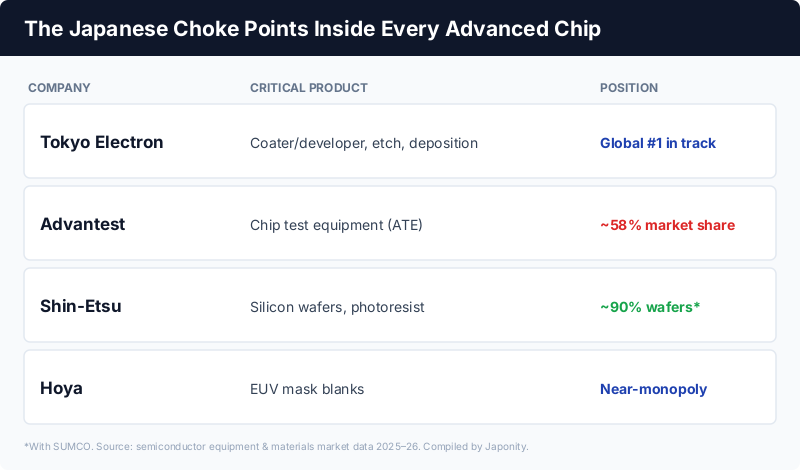
| Company | Critical product | Position |
|---|---|---|
| Tokyo Electron | Coater/developer, etch, deposition, cleaning | Global #1 in track; top-tier in etch |
| Advantest | Chip test equipment (ATE) | ~58% global market share |
| Shin-Etsu | Silicon wafers, photoresist, immersion fluids | ~90% wafer share (with SUMCO) |
| Hoya | EUV mask blanks | Near-monopoly |
(Japan’s strength runs deeper still: DISCO dominates wafer dicing, Lasertec controls EUV mask inspection, SCREEN leads in cleaning, and JSR and Tokyo Ohka Kogyo are giants in photoresist — a supply chain no rival region can replicate quickly.)
Why it matters for global partners
These companies explain why the semiconductor supply chain is so hard to “re-shore,” and why they sit at the center of export-control politics: control of a single Japanese choke point can shape the entire industry.
For international readers, the takeaways are concrete:
- Investors get exposure to AI’s growth without betting on which chip designer wins. Whether NVIDIA, AMD, or a hyperscaler’s in-house silicon prevails, all of them flow through TEL tools, Shin-Etsu wafers, Hoya blanks, and Advantest testers.
- Supply-chain and corporate-development teams should map dependencies on these single points of failure — and the ecosystems of smaller Japanese subcontractors, parts makers, and materials specialists that surround them, many of which are far easier to partner with.
- Partners and distributors will find a dense web of second- and third-tier Japanese suppliers feeding these champions — precision components, specialty chemicals, ultra-clean handling — exactly the kind of “hidden champion” firms that are world-class but invisible internationally.
Frequently asked questions
Which Japanese companies are essential to making advanced chips?
Tokyo Electron (process tools), Advantest (chip testing), Shin-Etsu Chemical (silicon wafers and photoresist), and Hoya (EUV mask blanks) each hold dominant or near-monopoly positions at critical steps — supported by DISCO, Lasertec, SCREEN, JSR, and others.
Why do these companies benefit from the AI boom?
Every AI chip is built on their wafers, patterned with masks on their blanks, processed by their tools, and verified by their testers. AI silicon is also larger and harder to test, which raises demand for Advantest’s equipment disproportionately.
Why are they strategically important?
They are single points of leverage in the global chip supply chain. A handful of Japanese choke points — especially Hoya’s EUV mask blanks and Shin-Etsu’s wafers — cannot be quickly replicated elsewhere, which puts them at the heart of semiconductor geopolitics and export controls.
Looking to source from, partner with, or invest in Japan’s semiconductor supply chain? Contact Japonity — we connect international businesses with Japan’s best companies, products, and technologies.
Interested in Japanese business opportunities?
Whether you're looking for technology partners, engineering talent, or market insights — we can help connect you with the right Japanese organizations.
Get in Touch →