TSE:4502
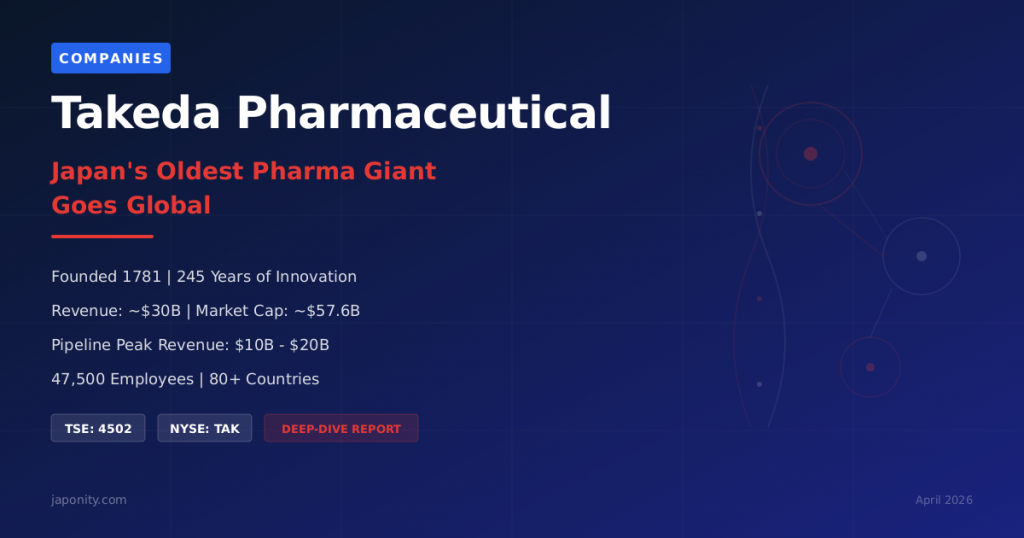
Takeda Pharmaceutical Company (TSE: 4502 / NYSE: TAK) is Japan’s largest and oldest pharmaceutical company, with a 245-year history dating back to 1781. Following its transformative $62 billion acquisition of Shire in 2019, Takeda has cemented its position as a top-10 global biopharma player, generating approximately JPY 4.5 trillion (~$30 billion) in annual revenue. This comprehensive report examines Takeda’s financial performance, strategic transformation, product portfolio, and pipeline outlook heading into 2026.
Executive Summary
| Metric | Value |
|---|---|
| Founded | 1781 (Osaka, Japan) |
| Headquarters | Tokyo & Osaka, Japan |
| CEO | Christophe Weber (transitioning to Julie Kim, June 2026) |
| Employees | ~47,500 across 80 countries |
| FY2025 Revenue Forecast | JPY 4,530 billion (~$30.2B) |
| Market Capitalization | ~$57.6 billion (March 2026) |
| Stock Listings | TSE: 4502 / NYSE: TAK |
| Core Therapeutic Areas | GI, Rare Diseases, PDT, Oncology, Neuroscience, Vaccines |
| Late-Stage Pipeline Peak Revenue | $10B – $20B potential |
Company Overview: 245 Years of Pharmaceutical Innovation
In 1781, 32-year-old Chobei Takeda I opened a small shop in Doshomachi, Osaka’s historic medicine district, selling traditional Japanese and Chinese medicines. He quickly earned a reputation for integrity and quality that would define the company for centuries.
Key milestones in Takeda’s evolution:
| Year | Milestone |
|---|---|
| 1781 | Chobei Takeda I establishes medicine trading business in Osaka |
| 1895 | Acquires Uchibayashi Drug Works; becomes a pharmaceutical manufacturer |
| 1914 | Establishes dedicated research division |
| 1925 | Incorporated as Chobei Takeda & Co., Ltd. (capital: JPY 5.3M) |
| 2014 | Christophe Weber joins as COO; first non-Japanese CEO in 2015 |
| 2019 | Completes $62B acquisition of Shire plc, becoming a top-10 global pharma |
| 2025 | Julie Kim appointed as successor CEO (effective June 2026) |
Today, Takeda operates in over 80 countries with approximately 47,500 employees. The company is dual-listed on the Tokyo Stock Exchange (TSE: 4502) and the New York Stock Exchange (NYSE: TAK), with a market capitalization exceeding $57 billion as of early 2026.
The Shire Acquisition: A $62 Billion Transformation
Takeda’s 2019 acquisition of Dublin-based Shire plc for approximately $62 billion was one of the largest pharmaceutical deals in history. The transaction fundamentally reshaped the company.
Strategic Rationale
- Geographic Expansion — Shire’s dominant U.S. and European presence transformed Takeda from a Japan-centric company into a truly global player, with over 50% of revenue now generated in the United States
- Therapeutic Portfolio — Added world-class franchises in rare diseases, plasma-derived therapies (PDT), and neuroscience
- Scale & R&D — Nearly doubled R&D investment capacity and provided a platform for global clinical development
Debt Management & Synergies
The acquisition initially pushed Takeda’s net debt-to-EBITDA ratio to approximately 5x. Through aggressive deleveraging, including strategic divestitures (notably Shire’s Xiidra eye drug to Novartis for $3.4 billion) and operational efficiencies, the company has steadily reduced leverage. Cost synergies exceeded the original $1.4 billion target, reaching approximately $2 billion annually.
Mixed Shareholder Returns
While the deal successfully transformed Takeda’s global footprint and pipeline, some analysts have questioned shareholder value creation. However, with market capitalization growing from ~$42 billion in January 2025 to ~$57.6 billion by March 2026 (a 37% increase), and with the late-stage pipeline maturing, the strategic benefits are becoming increasingly visible.
Product Portfolio: Six Therapeutic Pillars
Takeda’s diversified revenue is anchored by six core therapeutic areas. Growth and launch products contributed 52% of total revenue in the first nine months of FY2025, totaling JPY 1.8 trillion (~$11.3 billion).
| Therapeutic Area | Key Products | FY2025 9M Revenue | YoY Growth |
|---|---|---|---|
| Gastroenterology (GI) | ENTYVIO (vedolizumab) | JPY 744.5B (~$4.9B) | +7.4% |
| Plasma-Derived Therapies | GAMMAGARD, CUVITRU, HYQVIA | JPY 784.2B (~$5.2B) | +16.3% |
| Rare Diseases | TAKHZYRO, ADZYNMA, LIVTENCITY | Included in growth products | Strong growth |
| Oncology | NINLARO, ALUNBRIG, ADCETRIS | Included in growth products | Growing |
| Neuroscience | VYVANSE/ELVANSE (generic impact) | Declining | Negative |
| Vaccines | QDENGA (dengue vaccine) | Included in growth products | Strong ramp |
Spotlight: ENTYVIO — The Crown Jewel
ENTYVIO (vedolizumab) is Takeda’s single largest revenue contributor, generating nearly $5 billion in the first nine months of FY2025. This gut-selective biologic treats ulcerative colitis and Crohn’s disease, with a recently launched subcutaneous (SC) formulation driving continued growth of +5.1% at constant exchange rates. ENTYVIO’s differentiated mechanism of action and strong efficacy data position it as a cornerstone of Takeda’s GI franchise for years to come.
Spotlight: Plasma-Derived Therapies
Takeda’s PDT division, inherited from Shire, is one of the largest plasma-derived therapy businesses globally. Immunoglobulin products alone generated ~$5 billion in FY2024 revenue. The FDA’s 2025 approval of GAMMAGARD LIQUID ERC — the only ready-to-use liquid immunoglobulin therapy with low IgA content — opens a new patient segment, with U.S. commercialization expected in 2026 and EU launch in 2027.
Pipeline Analysis: $10B-$20B Peak Revenue Potential
Takeda has nearly doubled its R&D investment over the past decade, and the results are materializing in a robust late-stage pipeline. The company projects three regulatory filings in FY2025-2026 and five more in FY2027-2029.
| Candidate | Indication | Phase | Expected Filing | Notes |
|---|---|---|---|---|
| Oveporexton (TAK-861) | Narcolepsy Type 1 | Phase 3 | FY2025-2026 | Orexin receptor agonist; potential blockbuster |
| Zasocitinib (TAK-279) | Psoriasis | Phase 3 | FY2026-2027 | TYK2 inhibitor; large market opportunity |
| Rusfertide (TAK-121) | Polycythemia Vera | Phase 3 | FY2025-2026 | Hepcidin mimetic; positive Phase 3 data March 2025 |
| Mezagitamab (TAK-079) | IgA Nephropathy | Phase 3 | FY2027-2029 | Anti-CD38 monoclonal antibody |
| Fazirsiran (TAK-999) | Alpha-1 Antitrypsin Deficiency | Phase 3 | FY2027-2029 | RNA interference therapy |
| Elritercept (TAK-226) | Undisclosed | Late-stage | FY2027-2029 | Bispecific approach |
Oncology Expansion: The Innovent Partnership
In 2025, Takeda significantly bolstered its oncology pipeline through a major collaboration with China-based Innovent Biologics, reportedly valued at ~$1.2 billion. The deal adds several next-generation antibody-drug conjugates (ADCs) and bispecific antibodies to Takeda’s portfolio:
- IBI363 — PD-1/IL-2 alpha-bias bispecific antibody for immuno-oncology
- IBI343 — CLDN18.2-targeting ADC for solid tumors
- IBI3001 — EGFR/B7H3 bispecific ADC (early-stage option)
This partnership positions Takeda to compete in the rapidly growing ADC market, which is expected to exceed $30 billion globally by 2030.
Financial Analysis
Revenue Trends
| Fiscal Year | Revenue (JPY) | Revenue (USD) | YoY Change |
|---|---|---|---|
| FY2022 | JPY 4,027B | ~$30.1B | +11.6% |
| FY2023 | JPY 4,264B | ~$28.5B | +5.9% |
| FY2024 | JPY 4,468B | ~$30.6B | +7.5% |
| FY2025 (Forecast) | JPY 4,530B | ~$30.2B | +1.4% |
Key Financial Metrics (FY2025 Forecast)
| Metric | FY2025 Guidance |
|---|---|
| Revenue | JPY 4,530B (~$30.2B) |
| Core Operating Profit | JPY 1,150B (~$7.7B) |
| Net Profit | JPY 154B (~$1.0B) |
| Core EPS | JPY 486 |
| Adjusted Free Cash Flow | JPY 650-750B (~$4.3-5.0B) |
| Dividend per Share | JPY 200 (up from JPY 196) |
FY2025 represents a transitional year as Takeda absorbs the final impact of VYVANSE generic erosion while investing in upcoming launches. The company is targeting an additional $1.3 billion in cost savings through further restructuring to improve margins.
Regional Revenue Breakdown
| Region | Revenue (JPY) | Share | YoY Change |
|---|---|---|---|
| United States | JPY ~1,841B | ~50% | +9.3% |
| Europe & Canada | JPY ~796B | ~20% | +10.3% |
| Japan | JPY ~325B | ~8% | -5.2% |
| Rest of World | JPY ~568B | ~22% | Varies |
The U.S. remains Takeda’s largest market by a wide margin, a direct result of the Shire acquisition. Japan, the company’s home market, now represents only ~8% of total revenue, reflecting both global expansion and domestic pricing pressures.
Regional Strategy
United States
The U.S. is Takeda’s growth engine, driven by ENTYVIO, PDT products, and rare disease therapies. Julie Kim, the incoming CEO, currently leads the U.S. Business Unit, signaling continued strategic emphasis on this market.
Europe & Canada
Strong double-digit growth (+10.3%) reflects successful commercialization of key products and favorable market access across the EU. The upcoming launch of GAMMAGARD LIQUID ERC in the EU (expected 2027) will further strengthen this region.
Japan
While revenue in Japan has been declining due to generic competition and government-mandated price reductions, the domestic market remains strategically important. Takeda maintains a strong brand presence and leverages Japan as a key R&D hub.
Emerging Markets
Takeda’s QDENGA dengue vaccine has significant growth potential in tropical regions, particularly Southeast Asia and Latin America, where dengue represents a major public health challenge.
Competitive Landscape
Takeda competes with both global mega-pharma companies and Japanese rivals. Here is how it compares:
| Company | HQ | Revenue (Latest FY) | Key Strengths |
|---|---|---|---|
| Pfizer | USA | ~$63.6B | Vaccines, oncology, rare disease |
| Roche | Switzerland | ~$57.2B | Oncology, diagnostics, personalized medicine |
| Novartis | Switzerland | ~$50.3B | Innovative medicines, gene therapy |
| Takeda | Japan | ~$30.2B | GI, rare diseases, PDT, pipeline depth |
| Daiichi Sankyo | Japan | ~$12-15B | ADC oncology (Enhertu), cardiology |
Takeda’s Competitive Advantages
- GI Leadership — ENTYVIO’s ~$7B annual run rate makes Takeda the dominant player in inflammatory bowel disease
- PDT Scale — One of only a few companies with a fully integrated plasma collection and manufacturing infrastructure globally
- Pipeline Diversification — Late-stage assets span neuroscience, immunology, hematology, and oncology, reducing single-product dependence
- Japan Heritage + Global Reach — 245 years of trust and quality combined with operations in 80+ countries
Key Risks
- VYVANSE Generic Erosion — ADHD blockbuster VYVANSE continues to lose market share to generics, pressuring near-term revenue
- Debt Levels — While significantly reduced, post-Shire debt remains a factor in financial flexibility
- Pipeline Execution — The $10-20B peak revenue estimate depends on successful Phase 3 readouts and regulatory approvals
- Japanese Market Headwinds — Government price cuts and generic substitution policies continue to erode domestic revenue
Business Opportunities for Global Partners
For Investors
- Valuation Gap — At ~$57.6B market cap against ~$30B revenue, Takeda trades at a significant discount to Western peers. The maturing pipeline could close this gap
- Dividend Growth — Consistent dividend increases (JPY 196 to 200 in FY2025) with strong free cash flow generation of JPY 650-750B
- CEO Transition Catalyst — Julie Kim’s appointment as CEO (June 2026) may bring fresh strategic direction and attract new investor attention
For Pharmaceutical Partners
- Licensing & Co-Development — Takeda actively seeks partnerships in oncology (ADCs, bispecifics), neuroscience, and rare diseases. The Innovent deal demonstrates willingness to invest in external innovation
- Japan Market Access — For companies seeking to enter or expand in Japan, Takeda offers unmatched regulatory expertise, commercial infrastructure, and prescriber relationships built over 245 years
For Healthcare Providers
- Expanding Treatment Options — Oveporexton (narcolepsy), zasocitinib (psoriasis), and rusfertide (polycythemia vera) represent meaningful advances in areas with significant unmet need
- PDT Innovation — GAMMAGARD LIQUID ERC addresses the needs of IgA-deficient patients previously underserved by existing immunoglobulin therapies
Outlook: FY2026 and Beyond
Takeda stands at an inflection point. The VYVANSE headwind is tapering, the late-stage pipeline is maturing, and new product launches are imminent. Key catalysts to watch:
- H2 2026 — Expected launches of oveporexton (narcolepsy) and rusfertide (polycythemia vera)
- 2027 — Anticipated launch of zasocitinib (psoriasis), a multi-billion-dollar market opportunity
- June 2026 — CEO transition from Christophe Weber to Julie Kim
- FY2027-2029 — Five additional regulatory filings expected from the late-stage pipeline
- Ongoing — Continued debt reduction and potential return to organic revenue growth
With $10-20 billion in peak revenue potential from its pipeline, a dominant position in GI and plasma therapies, and 245 years of pharmaceutical heritage, Takeda is uniquely positioned among global pharma companies as a bridge between Japanese innovation tradition and modern global biopharmaceutical leadership.
This report was researched and produced by Japonity.com — Japan Discovery & Business Intelligence Platform.
Need a custom market research report on Japanese industries, companies, or products? We accept commissioned research projects (調査代行). Contact us to discuss your specific intelligence needs.
Published: April 2026
Interested in Japanese business opportunities?
Whether you're looking for technology partners, engineering talent, or market insights — we can help connect you with the right Japanese organizations.
Get in Touch →