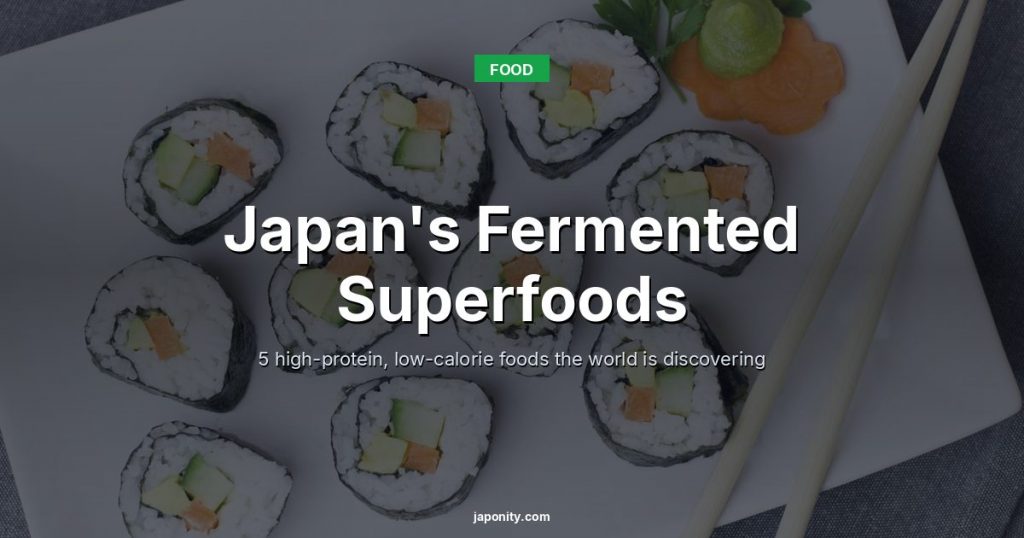
Japan’s centuries-old tradition of fermentation has produced some of the world’s most nutrient-dense foods. High in protein, low in calories, and packed with probiotics — these five fermented superfoods are now going global, backed by a record 1.7 trillion yen food export boom.
Why Japanese Fermented Foods Are Having a Moment
Three forces are converging: the global health food boom (the fermented food market is projected to reach $1.2 trillion by 2032), Japan’s government pushing food exports as a national strategy, and the weak yen making Japanese products more price-competitive than ever.
The Nutritional Edge: High Protein, Low Calories, Maximum Benefit
1. Natto — The Sticky Superfood Going Global
19g of protein per 100g. Rich in nattokinase (a blood-clot dissolving enzyme found nowhere else in nature), vitamin K2 (542% DV), and probiotics. Japan’s natto exports doubled in 6 years to 3,300 tons (2023). The biggest innovation: freeze-dried natto powder by sonomono Inc., solving the cold-chain logistics barrier that has limited exports for decades.
→ Read full article: Natto Goes Global
2. Miso — Organic Umami Conquering 55+ Countries
12.8g protein per 100g. Exports quadrupled from 4,243 tons (1997) to 16,017 tons (2017) and continue surging. Marukome, Japan’s #1 miso maker (¥50B revenue), operates a factory in California. Hikari Miso dominates the organic segment with 70% market share and exports to 55+ countries with halal, kosher, and vegan certifications.
→ Read full article: The Global Miso Boom
3. Soy Sauce — A ¥701B Global Empire and the Craft Revolution
Kikkoman ships to 100+ countries from 8 overseas factories, generating ¥701B in revenue. But beyond the household name, a new wave of craft soy sauce makers — artisanal producers using traditional wooden-barrel fermentation (kioke) — is emerging. Yamasa, founded in 1645, bridges heritage and scale with a US factory in Oregon.
→ Read full article: Beyond Kikkoman
4. Koji — The 1,000-Year-Old Secret Western Chefs Love
Koji (Aspergillus oryzae) is the mold behind sake, miso, soy sauce, and mirin — designated Japan’s “national mold” (kokkin). Since Noma’s René Redzepi published “The Noma Guide to Fermentation” (2018), Western chefs have embraced koji for aging meats, making garum, and creating new umami flavors. Hishiroku, a 300-year-old Kyoto seed koji maker, now ships to chefs across the US and Europe.
5. The ¥1.7 Trillion Export Strategy Behind It All
Japan’s food exports hit a record ¥1.7 trillion in 2025. The government has designated fermented foods as priority export items, with JETRO providing logistics support, trade fair access, and market intelligence. For international buyers, distributors, and investors, the opportunity is clear: Japan’s fermented food sector is scaling up, backed by government policy, weak yen pricing, and surging global demand.
→ Read full article: Inside Japan’s Food Export Boom
For International Buyers and Partners
Whether you are a food distributor looking for new product lines, a restaurant chain exploring authentic Japanese ingredients, or an investor evaluating the Japanese food sector — these companies are actively seeking international partners. The weak yen makes 2026 an especially attractive time to engage.
Japonity connects international businesses with Japanese food producers. Contact us to explore partnership opportunities.
Interested in Japanese business opportunities?
Whether you're looking for technology partners, engineering talent, or market insights — we can help connect you with the right Japanese organizations.
Get in Touch →