TYO:7951
From the concert grand piano on a Vienna stage to the beginner flute in a school classroom, the world makes music on instruments built by one Japanese company more than any other. Yamaha is the largest musical-instrument maker on Earth — a 130-year-old craftsman that quietly dominates an industry built on art.
The world’s number-one instrument maker
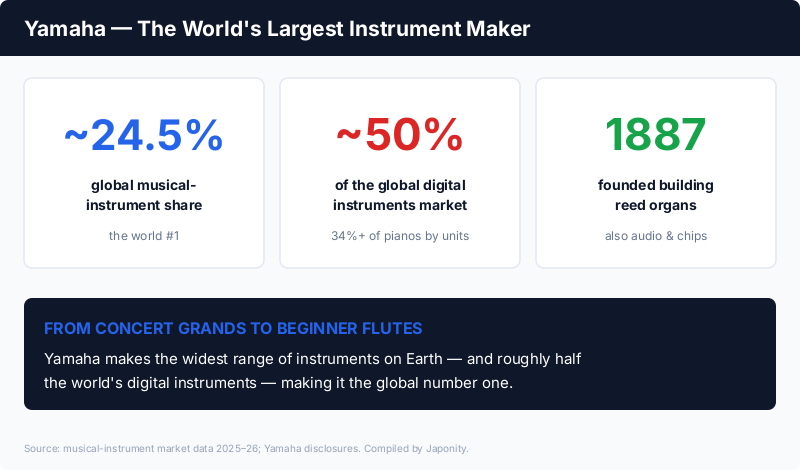
Yamaha holds the top global share of the musical-instrument market — roughly 24.5% — across an unrivalled breadth of products, from pianos and wind instruments to guitars, drums, and strings. In pianos it commands more than 34% of global unit sales, and in digital musical instruments its lead is even more striking: around 50% of the world market. No competitor spans the range, from professional concert instruments to mass-market beginner models, the way Yamaha does.
From reed organs to a sound empire
Yamaha began in 1887 when Torakusu Yamaha repaired and then built reed organs in Hamamatsu. That craft expanded into pianos, then the full orchestra of instruments, and then into sound itself: professional audio and mixing consoles, home AV equipment, and even the semiconductors and sound chips that generate audio in countless devices. (Its motorcycle business, Yamaha Motor, was spun off into a separate company in 1955.) The brand’s reputation rests on a rare blend of craftsmanship and engineering — acoustic artistry backed by industrial precision.
The digital pivot
The instrument market is shifting. Acoustic piano demand has softened in some markets, but digital instruments — where Yamaha holds around half the world market — keep growing, broadening access and lowering the barrier to learning music. Yamaha’s strength across both acoustic and digital, plus professional audio, gives it multiple ways to win as the way people make and experience music evolves.
Why it matters for global partners and investors
- Investors get exposure to a globally trusted consumer and professional brand with durable share, recurring demand from music education, and growth in digital instruments and audio.
- Retail, education, and content partners benefit from one of the world’s most recognised music brands, with reach from classrooms to concert halls.
- The watch item is the balance between softening acoustic-piano demand (notably in China) and the steady growth of digital instruments and pro audio.
Frequently asked questions
Is Yamaha the world’s largest instrument maker?
Yes. Yamaha holds the top global share of the musical-instrument market — around 24.5% — with leading positions in pianos (34%+ of unit sales) and digital instruments (around 50% of the world market).
Is Yamaha the same company as Yamaha motorcycles?
They share a heritage but are separate companies. Yamaha Corporation makes musical instruments and audio equipment; Yamaha Motor, spun off in 1955, makes motorcycles and marine products.
How is Yamaha adapting to changing music habits?
By leaning into digital instruments — where it holds roughly half the global market — and professional audio, offsetting softer acoustic-piano demand and broadening access to music-making.
Looking to partner with, or distribute for, a globally trusted Japanese brand? Contact Japonity — we connect international businesses with Japan’s best companies, products, and technologies.
Interested in Japanese business opportunities?
Whether you're looking for technology partners, engineering talent, or market insights — we can help connect you with the right Japanese organizations.
Get in Touch →