In April 2013, the first season of Shingeki no Kyojin — Attack on Titan — aired in Japan, adapted from a manga that had been running in Kodansha’s monthly Bessatsu Shonen Magazine since 2009. Within five years the franchise had moved more than 100 million volumes worldwide, become a fixture on Crunchyroll and Netflix, generated several feature films, and produced a final season whose simulcast was followed week-by-week across more than 200 countries. The financial beneficiary was Kodansha Ltd. — Kabushiki Kaisha Kodansha — Japan’s largest publishing house by group revenue at approximately ¥170 billion in its most recent full year, and the one Big-3 publisher whose flagship export, alongside Tokyo Revengers and Hajime no Ippo, has been built primarily by long-form seinen and shonen properties rather than by Shueisha’s Weekly Shonen Jump franchise machine. Founded in Tokyo in 1909 by Seiji Noma, still privately owned and editorially directed by the Noma family more than a century later, headquartered in Bunkyo Ward, Kodansha is the most internationally active of the Japanese publishing majors — and the one whose family-continuity editorial model most clearly distinguishes it from the corporate boards of its closest peers.
From a 1909 oratory society to Japan’s largest general publisher
Kodansha was founded in Tokyo on 1 November 1909 by Seiji Noma, a former secondary-school teacher and university administrator who launched the company as Dai Nippon Yubenkai — the Greater Japan Oratorical Society — to publish a magazine called Yuben aimed at the late-Meiji intellectual and political-debate market. The name Kodansha followed in 1911 with the launch of Kodan Club, a popular-storytelling monthly that gave the company the brand it has carried for more than a century. In 1958 the two corporate identities were merged formally under the Kodansha name, and the company has operated under that single brand since.
Over the inter-war and early post-war decades, Kodansha built itself into Japan’s broadest-base general publisher — a house that simultaneously carried literary fiction, academic series, business and self-improvement titles, women’s magazines, men’s general-interest magazines, children’s books, and, from the late 1950s onwards, manga magazines. The breadth is structural rather than incidental. Where Shueisha is identified above all with Weekly Shonen Jump and the manga-export machine that Jump supports, and where Shogakukan is most closely identified with educational and children’s publishing alongside its own manga line, Kodansha has always presented itself as Japan’s general publisher — a company whose Kodansha Bunko paperback imprint, Gendai Shinsho academic-pocketbook series, and Kodansha Gakujutsu Bunko humanities line sit alongside, rather than below, the manga revenue.
The Noma family and the editorial-continuity model
What most clearly distinguishes Kodansha from its Big-3 peers is the persistence of the founding Noma family at the centre of its editorial direction. Seiji Noma served as president from the founding in 1909 until his death in 1938. The presidency has since passed through six further generations of the Noma family, with the current incumbent — Yoshinobu Noma, widely identified as the seventh-generation family president — having taken the role in 2011. The corporate parent is a private joint-stock company whose shares are not listed on any exchange and are concentrated in the hands of the Noma family, the Noma Cultural Foundation, and senior management.
The continuity has structural consequences. Shueisha, although it is also unlisted and is part of the broader Hitotsubashi Group alongside Shogakukan, operates with a corporate-board structure in which family lineage is less visible at the head of the masthead. Kodansha’s Noma model, by contrast, places editorial direction in the hands of a family figure whose decisions, public statements, and prize patronage — the Noma Literary Prize, founded 1941, is among Japan’s most prestigious — visibly carry the family imprimatur. The result is an editorial culture that prizes long horizons over quarterly cycles, that has been willing to back literary and academic titles whose returns measure in decades rather than seasons, and whose strategic capital-allocation decisions are made by a small number of people answerable principally to the family and the cultural foundation rather than to external shareholders.
The model is not without critics. The publishing-industry view in Tokyo has long held that family-directed houses can be slower to restructure underperforming titles and less aggressive in pruning portfolios than corporate-board peers. Kodansha’s defenders argue that the editorial range of the house — and the willingness to carry difficult literary projects through years of modest sales — is precisely what the family model uniquely sustains.
The Big-3 map of Japanese publishing
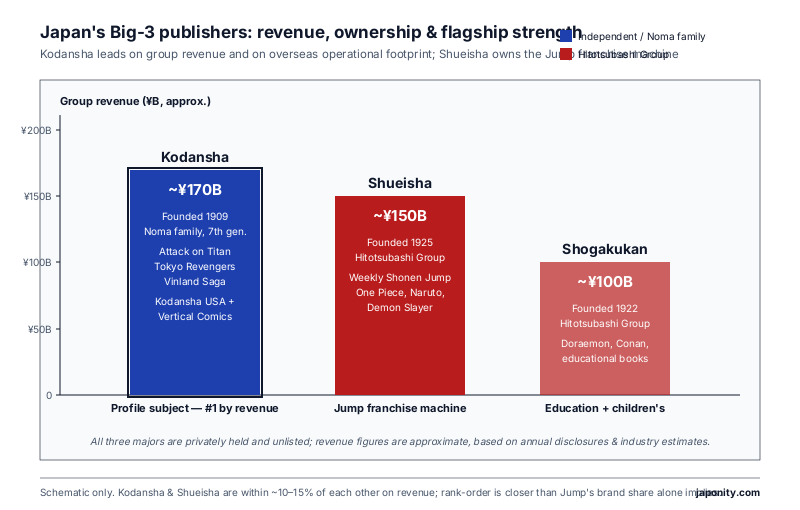
To understand Kodansha’s position, it is useful to set the three majors side by side. The Japanese trade-publishing market is dominated by three privately owned Tokyo houses — Kodansha, Shueisha, and Shogakukan — whose combined market share in the major manga, magazine, and trade-book segments is the overwhelming majority of the national total. Shueisha and Shogakukan share common roots in the pre-war Hitotsubashi group; Kodansha sits outside that grouping.
| Publisher | Founded | Ownership | Revenue (approx.) | Flagship strength |
|---|---|---|---|---|
| Kodansha | 1909 (Tokyo) | Noma family + Noma Cultural Foundation, unlisted | ~¥170B group revenue (largest) | Broadest portfolio: literary, academic, women’s magazines, shonen + seinen manga |
| Shueisha | 1925 (Tokyo, spun off from Shogakukan) | Hitotsubashi Group, unlisted | ~¥150B+ (slightly behind Kodansha) | Weekly Shonen Jump franchise machine (One Piece, Naruto, Dragon Ball, Demon Slayer) |
| Shogakukan | 1922 (Tokyo) | Hitotsubashi Group, unlisted | ~¥100B | Educational publishing, children’s titles, Doraemon, Detective Conan, Inuyasha |
Three features of this map are worth flagging. All three majors are private and unlisted, which insulates them from the quarterly-earnings pressure that has reshaped most Western trade publishers, but which also makes their financial disclosures comparatively sparse — published revenue figures rest on annual disclosures and trade-industry estimates rather than the audited filings a listed peer would produce. The rank-order at the top — Kodansha first, Shueisha a close second — is closer than the strength of the Weekly Shonen Jump franchise alone would suggest, because Kodansha’s spread across magazines, books, and academic publishing produces a deeper revenue base even though no single Kodansha property approaches the scale of the Jump brand. And on international licensing and overseas operations, Kodansha is meaningfully ahead of both Shueisha and Shogakukan — a feature explored in more detail below.
Weekly Shonen Magazine and the Kodansha manga line
Kodansha’s manga business is anchored on a small number of long-running weekly and monthly magazines whose serialisations have produced most of the house’s globally recognised franchises. Weekly Shonen Magazine launched in March 1959 — the same week as Shogakukan’s Weekly Shonen Sunday, and seven years ahead of Shueisha’s Weekly Shonen Jump — and is, alongside Jump, one of the two oldest weekly shonen titles in Japan. It carries Hajime no Ippo (in serialisation since 1989), among many other long-running properties, and at its commercial peak in the mid-1990s posted weekly circulation figures comfortably above four million copies, briefly overtaking Jump as the best-selling weekly manga magazine in the world. Circulation has declined sharply across the manga-magazine industry over the past two decades; Weekly Shonen Magazine’s current paid weekly circulation is well below its peak but remains among the larger weekly manga properties in print.
| Magazine | Demographic / category | Launched | Signature titles |
|---|---|---|---|
| Weekly Shonen Magazine | Shonen weekly (boys, ~13–18) | 1959 | Hajime no Ippo, Tokyo Revengers (concluded), Fairy Tail (concluded), Edens Zero |
| Bessatsu Shonen Magazine | Shonen monthly | 2009 | Attack on Titan (concluded), Blue Lock (transferred) |
| Young Magazine | Seinen weekly (young adult men) | 1980 | Ghost in the Shell (historical), Initial D, Akira (historical) |
| Morning | Seinen weekly | 1982 | Vagabond (Inoue Takehiko), Vinland Saga, Giant Killing |
| Afternoon | Seinen monthly | 1986 | Blame!, Mushishi (concluded), Vinland Saga (historical) |
| Kiss | Josei (young women) | 1992 | Nodame Cantabile (concluded), Chihayafuru |
| FRaU | Women’s lifestyle monthly | 1991 | Fashion, sustainability, social-issues coverage |
| MORE | Women’s fashion monthly (20s–30s) | 1977 | Mainstream fashion + lifestyle |
| ViVi | Women’s fashion monthly (younger) | 1983 | Trend fashion, beauty, influencer-driven covers |
| BE-PAL | Outdoor / lifestyle monthly | 1981 | Camping, outdoor gear, nature |
The signature export franchises sit across two main pillars. The shonen pillar produces Attack on Titan (originally serialised in Bessatsu Shonen Magazine 2009–2021), Tokyo Revengers (Weekly Shonen Magazine 2017–2022), Hajime no Ippo (in serialisation since 1989), Fairy Tail, and Blue Lock. The seinen pillar produces Vagabond and Real (Inoue Takehiko, Morning), Vinland Saga (Makoto Yukimura, Afternoon and Monthly Afternoon), Ghost in the Shell (Masamune Shirow, Young Magazine), and Akira (Katsuhiro Otomo, Young Magazine) — a body of work whose international critical reception within manga and animation circles is comparable to anything in the Jump catalogue, even where the unit volumes are smaller. Historically the house also carried Sailor Moon (Naoko Takeuchi, Nakayoshi) and was a substantial player in shojo and children’s manga, segments where its current position is more modest.
Kodansha overseas: Kodansha USA, Vertical Comics, and the bilingual line
Where Kodansha most clearly differentiates itself from Shueisha and Shogakukan is in its overseas operational footprint. Kodansha USA Publishing, headquartered in New York, is the Big-3 publisher’s most established directly owned North American operation, handling English-language translation, licensing, and distribution of Kodansha’s manga and book catalogue. It is a wholly owned subsidiary rather than a licensing partnership of the kind that Shueisha has historically maintained with Viz Media (jointly owned with Shogakukan), and it gives Kodansha an unusual degree of direct control over the English-language pipeline for its franchises.
Vertical Inc., founded in 2001 in New York as an English-language Japanese-literature and manga imprint, was acquired by Kodansha USA in 2011 and re-branded as Vertical Comics. The combined Kodansha USA / Vertical Comics operation is by some distance the most direct foreign-market footprint of any Japanese trade publisher, giving Kodansha the ability to commission, edit, and bring to market English-language manga titles without the licensing intermediation that defines most peer arrangements. Kodansha’s older Kodansha International imprint published English-language editions of Japanese literary, art, and historical books from the 1960s until its closure in 2011; the Kodansha Bilingual Books line, which continues, produces parallel-text Japanese–English editions of cultural and language-learning titles aimed at international and bilingual readers.
The overall posture is meaningfully more international than that of Shueisha or Shogakukan: Kodansha is the one Big-3 publisher whose strategic stance treats foreign-language publication as a directly operated business rather than a third-party licensing relationship, and the result is visible in the speed and scale at which Attack on Titan, Vinland Saga, and Tokyo Revengers have penetrated English-language markets.

Literary fiction, academic series, and the breadth of the trade-book line
The manga business has come to dominate the international perception of Kodansha, but the company’s domestic identity rests on a wider trade-book operation that Shueisha and Shogakukan match only partially. Kodansha Bunko, the company’s flagship paperback fiction imprint, is among the three or four largest literary paperback lines in Japan. Kodansha Gendai Shinsho, founded 1964, is one of the most influential mass-market academic pocketbook series in the country, carrying contemporary social science, philosophy, history, and economics for a general readership. Kodansha Gakujutsu Bunko extends the academic line into longer-form humanities and translated classical works.
The Noma Literary Prize, founded by the Noma family in 1941 and administered by the Noma Cultural Foundation, is one of Japan’s most prestigious literary awards. Its prize-giving function — alongside the Kodansha Manga Award, Kodansha Children’s Book Award, and Kodansha Essay Prize — places the publisher at the centre of the country’s literary award infrastructure in a way that is unusual even by the standards of the Japanese majors and that reinforces the editorial-prestige half of the company’s revenue mix.
The strategic horizon: streaming demand, manga-app competition, and the next franchise
Three questions define Kodansha’s strategic horizon over the next decade. The first is whether the streaming-driven surge in international manga and anime demand — a surge from which Kodansha has been a principal beneficiary through Attack on Titan, Tokyo Revengers, and Vinland Saga — can be sustained at the rate of the past five years, or whether the most explosive growth has now passed and a more normalised pattern of mid-single-digit annual growth lies ahead. The second is whether the manga-app channel, dominated by competitors including Shueisha’s Manga Plus and a wave of independent apps including LINE Manga and Piccoma (operated by Kakao Piccoma in Japan), will reshape the economics of weekly serialisation in ways that disadvantage the magazine-anchored model on which Kodansha’s franchise pipeline still depends. The third is whether the Noma family model can continue to attract, retain, and back the editorial talent on whom long-form serialisation depends, given that the long-horizon editorial culture is the family’s principal competitive asset and is also, almost by definition, the part of the company hardest to compress for short-term performance.
None of these questions has a settled answer. What is clear is that the institutional identity of Kodansha — the broadest Japanese trade publisher, the most internationally active of the Big-3, the one with the most visible family-direction continuity — is the most distinct strategic profile of any major Japanese publishing house. Shueisha will continue to define the global manga conversation through Weekly Shonen Jump; Shogakukan will continue to anchor educational and children’s publishing; and Kodansha will continue to be the house that does everything else, at scale, with the editorial breadth that more than a century of family direction has been deliberately constructed to sustain.
FAQ
When was Kodansha founded, and who owns the company today?
Kodansha was founded in Tokyo on 1 November 1909 by Seiji Noma as Dai Nippon Yubenkai, an oratory-society publisher; the Kodansha brand was added in 1911 with the launch of Kodan Club, and the two corporate identities merged formally under the Kodansha name in 1958. The corporate parent, Kabushiki Kaisha Kodansha, is a private joint-stock company headquartered in Bunkyo Ward, Tokyo, with no listed shares; ownership is concentrated in the founding Noma family, the Noma Cultural Foundation, and senior management. The current president, widely identified as seventh-generation family head Yoshinobu Noma, took the role in 2011. The exact ownership percentages are not publicly disclosed.
What is Kodansha’s revenue, and how does it compare with Shueisha and Shogakukan?
Kodansha’s most recent disclosed group revenue is approximately ¥170 billion, making it the largest Japanese trade publisher by total revenue. Shueisha follows at approximately ¥150 billion and Shogakukan at approximately ¥100 billion. The rank-order at the top is closer than the strength of Shueisha’s Weekly Shonen Jump franchise alone would suggest, because Kodansha’s spread across literary fiction, academic publishing, women’s magazines, and both shonen and seinen manga produces a deeper revenue base than any single-franchise comparison captures. All three publishers are privately held and unlisted, so revenue figures are taken from annual disclosures and trade-industry estimates rather than from audited public filings.
What are Kodansha’s signature manga properties, and where are they serialised?
Kodansha’s signature manga franchises sit across two pillars. The shonen pillar includes Attack on Titan (Hajime Isayama, Bessatsu Shonen Magazine, 2009–2021), Tokyo Revengers (Ken Wakui, Weekly Shonen Magazine, 2017–2022), Hajime no Ippo (George Morikawa, Weekly Shonen Magazine, in serialisation since 1989), and Fairy Tail (Hiro Mashima, Weekly Shonen Magazine, concluded). The seinen pillar includes Vagabond (Takehiko Inoue, Morning), Vinland Saga (Makoto Yukimura, Afternoon), Ghost in the Shell (Masamune Shirow, Young Magazine), and Akira (Katsuhiro Otomo, Young Magazine, historical). Historically the house has also carried Sailor Moon (Naoko Takeuchi, Nakayoshi) and Cardcaptor Sakura (CLAMP).
What are Kodansha USA and Vertical Comics?
Kodansha USA Publishing, headquartered in New York, is a wholly owned subsidiary handling English-language translation, licensing, editing, and distribution of Kodansha’s manga and book catalogue. It is the most established directly operated North American operation of any Japanese trade publisher. Vertical Inc., founded in 2001 in New York as an English-language Japanese-literature and manga imprint, was acquired by Kodansha USA in 2011 and integrated as Vertical Comics. The combined operation gives Kodansha an unusual degree of direct control over the English-language pipeline for its franchises — by some distance the most direct foreign-market footprint of any Big-3 Japanese publisher, in contrast to the licensing arrangements through Viz Media (jointly owned by Shueisha and Shogakukan) that define most peer arrangements.
How does Kodansha’s ownership model differ from Shueisha’s?
Both Kodansha and Shueisha are private, unlisted joint-stock companies, but the ownership-and-direction model differs in a structurally meaningful way. Kodansha is owned and editorially directed by the Noma family — a continuity that has run from founder Seiji Noma in 1909 to the current seventh-generation incumbent — with the Noma Cultural Foundation as a major institutional shareholder. Shueisha is part of the broader Hitotsubashi Group alongside its sister company Shogakukan, with a corporate-board structure in which family lineage is less visibly at the head of the masthead. The editorial consequence is that Kodansha is more willing to back long-horizon literary and academic titles over multiple decades, while Shueisha is more clearly organised around the franchise-engine logic of Weekly Shonen Jump.
Working with Kodansha
Looking to license a Kodansha manga or literary title for foreign-language publication, scope a co-publication deal across Kodansha USA or Vertical Comics, partner with FRaU, MORE, or ViVi on a women’s-market campaign in Japan, or explore advertising and content collaborations across Kodansha’s magazine and digital portfolio? Get in touch via Japonity’s business-matching service — we connect foreign publishers, licensors, advertisers, and content partners with the right counterparties inside Japan’s largest and most internationally active general publishing house.
Related from Japonity — Japan’s publishers (manga & general)
- Shueisha — Japan’s manga superpower — Weekly Shonen Jump’s One Piece, Demon Slayer, JJK
Want to source Japanese products beyond these company profiles? Japonity also runs a Japan Sourcing Hub — a research-grade catalogue of 1,185 verified Japanese food products and 200+ overseas EC stores, ready for B2B procurement.
Interested in Japanese business opportunities?
Whether you're looking for technology partners, engineering talent, or market insights — we can help connect you with the right Japanese organizations.
Get in Touch →