Walk into a supermarket in London, New York, or Singapore and you’ll find a Japanese pantry on the shelves: Kikkoman soy sauce, Kewpie mayonnaise, S&B curry, Glico’s Pocky, Mizkan vinegar. How did Japanese food brands get there? This report maps the eight brands defining the global Japanese pantry — and the two routes they took to reach it.
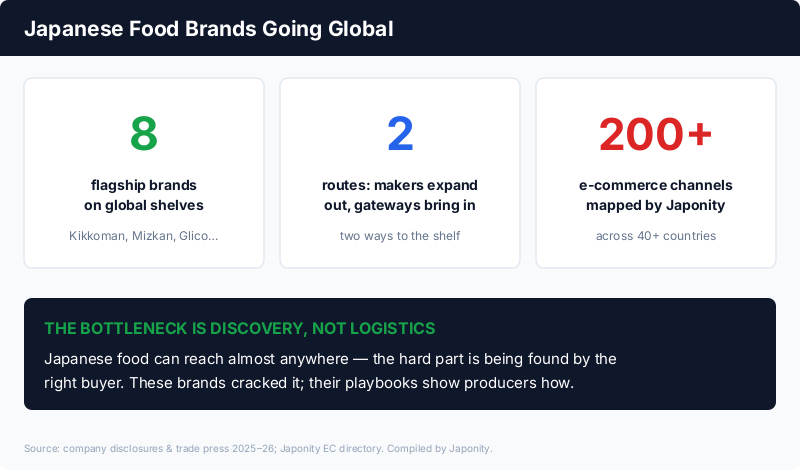
The bottleneck is discovery, not logistics
Japonity’s Japanese Food E-Commerce Directory maps more than 200 services across 40+ countries that sell Japanese food, on a simple premise: for Japanese producers, the hard part of going global isn’t shipping — it’s being discovered and distributed. The eight brands below cracked that problem. Their playbooks are a guide for any producer or buyer.
Route A — Japanese makers expanding outward
- Kikkoman (soy sauce) — the template: local US production since 1973 and a European plant, plus decades teaching Western cooks to use soy sauce as an all-purpose seasoning.
- Mizkan (vinegar, sauces) — growth by acquisition: it bought Ragú and Bertolli in the US ($2.15bn) and Branston and Sarson’s in the UK, lifting overseas sales to roughly half the total.
- Kewpie (mayonnaise) — patient consumer education, especially in China (since 1993, three factories), teaching new markets how to use its products.
- S&B (spices, curry) — now stocked in Walmart and Kroger, with five overseas offices, exporting Japanese curry as a whole category.
- Glico (Pocky) — moving Pocky from the “ethnic aisle” to mainstream retail, backed by new plants in Vietnam, India, and Poland.
- Ozeki (sake) — the original localizer: the first Japanese brewer to make sake inside the US, in California since 1979.
Route B — Western gateway brands bringing Japan in
- Clearspring — a UK family business (since 1993) that pioneered authentic, organic Japanese food in Europe, now in ~60 countries. The curator that earns Western trust for Japanese ingredients.
- Yutaka — a UK market brand of accessible Japanese staples built for European supermarkets and home cooks. The everyday on-ramp to Japanese cooking.
Five lessons from the playbooks
- Local production beats shipping for category-defining brands (Kikkoman, Ozeki) — it builds freshness, trust, and supply security.
- M&A buys distribution instantly (Mizkan) — owning a Western brand is a shortcut to the Western pantry.
- Education creates the category (Kewpie, S&B) — new consumers must be taught how to use a product before they buy it again.
- Escape the “ethnic aisle” (Glico) — mainstream placement multiplies the addressable market.
- Gateways de-risk discovery (Clearspring, Yutaka) — Western curators lower the barrier for buyers and producers alike.
Why it matters for partners
For Japanese producers, the path abroad is now well-paved — by local production, acquirable Western brands, curators like Clearspring, and the 200+ channels Japonity maps. The remaining challenge is discovery: being found by the right importer or buyer. For international buyers and investors, these eight brands are proof of demand — and a shortlist of partners and acquisition targets shaping the global Japanese-food market.
Frequently asked questions
Which Japanese food brands are biggest overseas?
Kikkoman (soy sauce), Mizkan (vinegar and Western sauce brands like Ragú), Kewpie (mayonnaise), S&B (curry and spices), Glico (Pocky), and Ozeki (sake) are among the most successful Japanese food brands abroad, alongside Western gateway brands like Clearspring and Yutaka.
How do Japanese food brands expand overseas?
Mainly two ways: Japanese makers expand outward through local production, acquisitions, and consumer education; and Western “gateway” importer-brands bring authentic Japanese food into their home markets.
What’s the hardest part of exporting Japanese food?
Discovery and distribution — being found by the right importer or buyer — more than logistics. Directories and curators that connect producers to channels are key.
Explore the live sales channels in the Japanese Food E-Commerce Directory, or contact Japonity to connect with Japanese food producers and brands.
Interested in Japanese business opportunities?
Whether you're looking for technology partners, engineering talent, or market insights — we can help connect you with the right Japanese organizations.
Get in Touch →