TYO:6645
One Japanese company both helps run the world’s factories and sits on millions of bathroom shelves measuring blood pressure. Omron’s mastery of “sensing and control” spans an unusually wide arc — from industrial automation to home healthcare — making it one of Japan’s most quietly versatile hidden champions.
A company built on sensing and control
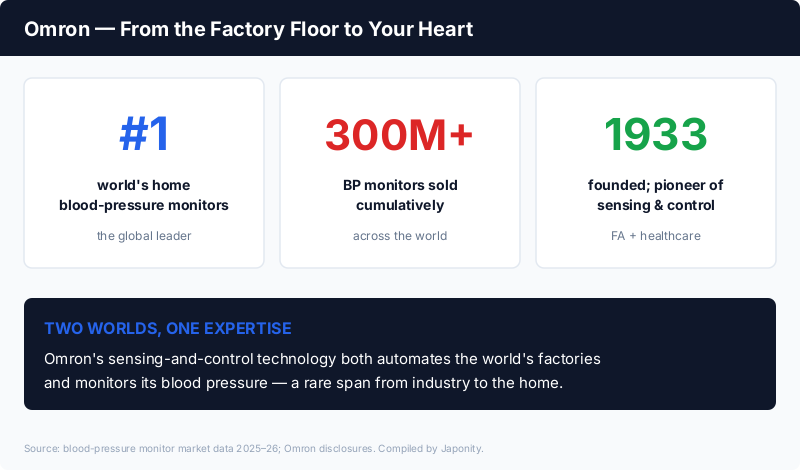
Founded in 1933 by Kazuma Tateishi, Omron has spent nine decades turning a single core competency — detecting a condition and acting on it automatically — into business after business. It pioneered automated traffic signals, contactless switches, one of the world’s first online cash dispensers, and the automated train-ticket gates still used across Japan. That same sensing-and-control DNA now drives two very different global franchises.
The world’s blood-pressure monitor
Omron Healthcare is the global number one in home blood-pressure monitors, having sold more than 300 million units cumulatively worldwide. In a world facing an epidemic of hypertension and ageing populations, that installed base is enormous — and it positions Omron at the centre of the shift toward continuous, at-home heart-health monitoring. The company is now layering on EKG-capable devices, AI-driven hypertension management, and remote patient monitoring.
The other Omron: running the factory
The larger business is industrial. Omron is a major global player in factory automation (FA) — sensors, programmable controllers, vision systems, safety equipment, and increasingly robotics. Its components inspect chips, detect defects at high speed, and coordinate production lines for electronics, EVs, and pharmaceuticals. As manufacturers everywhere automate to cope with labour shortages, Omron sells the eyes and reflexes of the modern factory.
One expertise, two worlds
What unites a blood-pressure cuff and a factory sensor is the same engineering: measure something precisely, then control a response. Few companies apply one core capability across such different markets, and that breadth gives Omron resilience — when one cycle softens, the other often holds.
Why it matters for global partners and investors
- Investors get a rare two-in-one: exposure to the structural automation boom and to ageing-driven home healthcare, through a single profitable franchise.
- Healthcare and digital-health partners have an obvious platform — Omron’s vast installed base of home monitors is fertile ground for connected services and AI.
- Manufacturers automating their lines will encounter Omron as a core supplier of sensing, control, and safety.
Frequently asked questions
What is Omron best known for?
Two things: it is the world’s leading maker of home blood-pressure monitors, having sold over 300 million units, and a major supplier of factory-automation equipment such as sensors, controllers, and vision systems.
How can a company do both healthcare and factory automation?
Both rest on the same core skill — “sensing and control,” or measuring a condition precisely and acting on it. Omron has applied that capability across industry, healthcare, and social infrastructure for decades.
Why does Omron matter now?
It sits at the intersection of two megatrends: factories automating to offset labour shortages, and ageing societies shifting health monitoring into the home.
Looking to partner with, or invest in, a Japanese leader in automation and health tech? Contact Japonity — we connect international businesses with Japan’s best companies, products, and technologies.
Interested in Japanese business opportunities?
Whether you're looking for technology partners, engineering talent, or market insights — we can help connect you with the right Japanese organizations.
Get in Touch →