TYO:7965
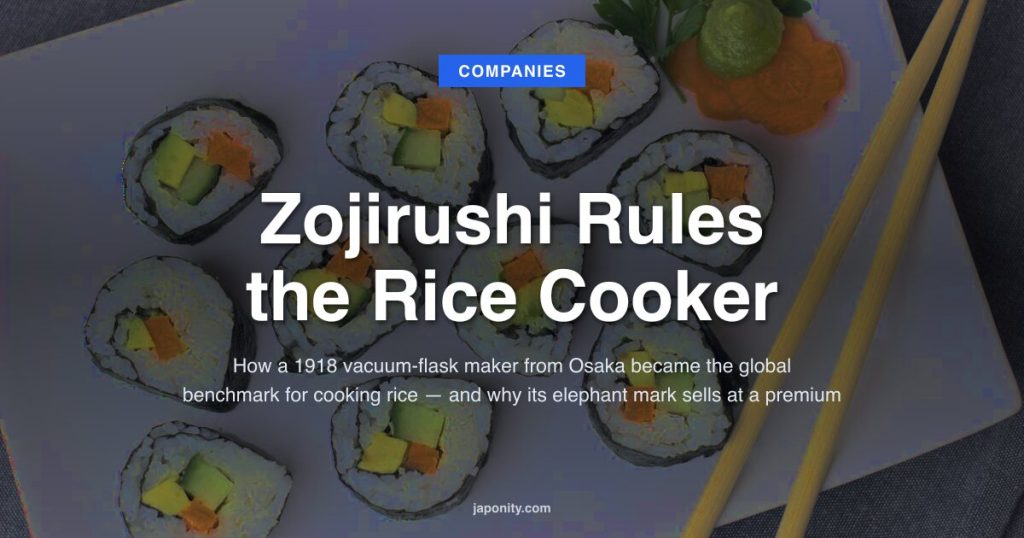
Zojirushi does not make cars, chips or robots. It makes the machine that cooks rice — and in doing so it became one of the most recognisable Japanese brands inside kitchens from Los Angeles to Shanghai. The Osaka company started in 1918 with glass vacuum flask liners, and a century later its elephant mark still commands a price premium that most home appliance makers can only envy.
From vacuum flasks to the rice bowl
Zojirushi Mahobin Ltd. (TSE: 7965) was founded in Osaka in 1918 by the Ichikawa brothers, making the glass inner liners for vacuum flasks — mahobin, literally “magic bottle.” That word is still in the company’s legal name today, long after the product line outgrew it. The elephant trademark was adopted in 1948: a symbol chosen for durability and long life, and one that turned out to travel across languages far better than a Japanese word would have.
The pivot that defined the company came with household electrification. Japan’s first automatic electric rice cooker was a Toshiba product in the 1950s, but the category only matured when makers started competing on how the rice actually tasted rather than on whether the machine switched itself off. Zojirushi entered electric rice cookers in 1970 and has spent the five decades since layering technology onto a deceptively simple task: heat water and grain to the point where starch gelatinises evenly, then hold it there.
Why a rice cooker costs $400
Outside Japan, the sticker shock is real. A supermarket rice cooker costs $30; Zojirushi’s flagship models sell for ten times that. The gap is engineering, and it is worth understanding because it explains the brand’s export economics.
- Induction heating (IH) — instead of a hotplate under the pot, an electromagnetic field heats the inner pan itself, so the whole vessel becomes the heating element. Heat reaches the grain from the sides and top, not just the base.
- Pressure cooking — raising internal pressure lifts the boiling point above 100°C, which changes how starch breaks down and gives the firmer, glossier finish premium models are sold on.
- Micom control — a microcomputer runs a heating curve rather than a single on/off switch, adjusting soak, boil, steam and hold phases to the rice variety selected.
- The inner pan — multi-layer platinum-infused or carbon-coated pans, often thick-walled and individually finished, are where a surprising share of the bill of materials sits.
- Grain-specific programmes — white, brown, mixed, sushi, porridge, GABA brown rice and quick modes, each a different thermal profile.
The result is a product that behaves less like a kettle and more like a small dedicated oven. It is also a product that is genuinely hard to copy at the top end, which is why the premium tier of the global market is still dominated by a handful of Japanese names.
The competitive set
Japan’s rice cooker market is unusually concentrated among domestic specialists and electronics conglomerates. Zojirushi’s closest rival, Tiger Corporation, is headquartered a short distance away in Osaka and was founded five years later — the two have been trading blows over vacuum flasks and rice cookers for the better part of a century.
| Company | Base | Position | Notes |
|---|---|---|---|
| Zojirushi | Osaka | Premium specialist | Rice cookers, vacuum flasks, water boilers, bread makers |
| Tiger | Osaka | Premium specialist | Direct rival across nearly the same product set |
| Panasonic | Osaka | Conglomerate | Broad appliance range; strong in China |
| Toshiba / Hitachi | Tokyo | Conglomerate | Category originators, now one line among many |
| Balmuda | Tokyo | Design challenger | Small volume, high design premium |
Zojirushi’s financial profile reflects the specialist position: annual net sales in the ¥80–90 billion range (roughly $550–600 million), a fiscal year that closes in November, and a listing on the Tokyo Stock Exchange. That is small next to Panasonic, but it is a focused business with pricing power in a category where the buyer replaces the product perhaps once a decade and remembers the brand when they do.
The export problem — and the export opportunity
Selling Japanese kitchen appliances abroad runs into a physical constraint before it runs into a marketing one. Japan runs on 100V; North America on 120V; most of Europe and Asia on 220–240V. A rice cooker’s heating profile is tuned to its supply voltage, so overseas sales require dedicated models rather than re-boxed domestic stock. Zojirushi runs Zojirushi America Corporation out of California precisely to manage that split, alongside operations serving China and Southeast Asia.
Three demand streams have carried the brand outside Japan:
- Diaspora and rice-eating households — the durable base. East and Southeast Asian households in North America have bought Japanese rice cookers as a default upgrade for decades.
- Tourist purchasing — the mid-2010s bakugai wave, when Chinese visitors bought Japanese rice cookers by the suitcase, put the category in front of a market that had not previously paid premium prices for one.
- Western food culture — the spread of Japanese and Korean home cooking has pulled rice cookers into kitchens that had never owned one, where they are increasingly bought as a design object as much as an appliance.
Beyond rice
The rice cooker is the halo product, but the vacuum-insulation business it grew out of never went away. Stainless steel mugs and bottles, electric water boilers that hold water at a set temperature for tea, humidifiers and bread makers all run on the same core competence: controlling heat over time inside a sealed vessel. The water boiler line in particular has an unusual second life — Zojirushi has marketed connected models that send a notification when an elderly relative uses the pot, turning a kettle into a low-friction check-in device for Japan’s ageing households.
What this means for overseas partners
For buyers, distributors and investors looking at Japanese consumer hardware, Zojirushi is a useful case study in a specific strategy: stay narrow, go deep, and defend the premium tier rather than chase volume.
- For retailers and distributors — the brand carries pull demand in Asian-American and Asian-European channels without local marketing spend. The constraint is model availability by voltage, not consumer awareness.
- For food and hospitality operators — commercial-grade Japanese rice equipment is a quiet differentiator for restaurants where rice quality is the product, not the side dish.
- For investors — a mid-cap specialist with a defended niche, a replacement cycle measured in years and exposure to inbound tourism and overseas Japanese-food demand, rather than to the appliance price war.
- For product companies — proof that a hundred-year-old mechanical competence, in this case insulation and controlled heating, can be re-expressed in category after category without diluting the brand.
The takeaway
Zojirushi’s achievement is that it made an ordinary daily act — cooking rice — into something worth engineering seriously, and then convinced buyers on three continents to pay for the difference. That is a harder trick than it looks. Most appliance categories race to the bottom on price; this one did not, because the people who eat rice every day can taste the result. The elephant mark has lasted since 1948 for exactly that reason.
Interested in Japanese business opportunities?
Whether you're looking for technology partners, engineering talent, or market insights — we can help connect you with the right Japanese organizations.
Get in Touch →