For nearly two decades after the Cold War, Japan’s defence-industrial base was a quiet backwater. Pacifist constitution, a self-imposed one-percent-of-GDP ceiling on the defence budget, and an export ban that all but barred Japanese contractors from the global arms market combined to keep capacity flat and margins thin. That era is over. Tokyo has committed to roughly doubling defence spending toward two percent of GDP by the late 2020s, has relaxed equipment-export rules to enable co-development with allies, and has signed onto the Global Combat Air Programme (GCAP) — a tripartite next-generation fighter project with the United Kingdom and Italy. At the centre of all of this sits Mitsubishi Heavy Industries (MHI), once again, and unambiguously, Japan’s largest defence contractor.
From Iwasaki’s shipping line to Japan’s defence prime
The Mitsubishi lineage traces to 1870, when Iwasaki Yatarō founded a small shipping concern that would grow into one of imperial Japan’s two great zaibatsu. Mitsubishi Shipbuilding spun off in 1917, became Mitsubishi Heavy Industries in 1934, and during the Second World War produced the Zero fighter and the battleship Musashi. Broken up by Occupation authorities in 1950 into three regional companies, the group reunified in 1964 as the modern Mitsubishi Heavy Industries, Ltd., headquartered in Marunouchi, Tokyo.
What emerged was a diversified heavy-engineering conglomerate of unusual breadth: gas turbines and steam plants, commercial ships, forklifts, air-conditioning systems, machine tools, rockets, and — quietly, persistently — almost every major weapons platform fielded by the Japan Self-Defense Forces (JSDF). MHI builds Japan’s main battle tanks, its destroyers and submarines, its surface-to-ship and surface-to-air missiles, and its licence-produced F-15J and F-2 fighters. When Japanese defence spending was capped, this portfolio kept revenue diversified; now that the cap is lifting, the same portfolio positions MHI as the indispensable industrial partner of Japan’s rearmament.
Segment portfolio: how the conglomerate is actually structured
MHI’s financial reporting groups its sprawling operations into four principal business segments, each anchored by a different end-market. The defence renaissance is most visible in the aircraft, defence and space line, but the cross-subsidies and shared engineering between segments are part of what makes MHI difficult to replicate.
| Segment | Approximate revenue share | Representative products |
|---|---|---|
| Energy Systems | ~35% | Gas turbines (M501JAC, H-class), steam turbines, nuclear plants, decarbonisation tech |
| Plants & Infrastructure Systems | ~20% | Chemical plants, environmental systems, metals machinery, commercial ships |
| Logistics, Thermal & Drive Systems | ~25% | Forklifts (Mitsubishi Logisnext), engines, turbochargers, air conditioning |
| Aircraft, Defence & Space | ~15% | Type 10/12 systems, Mogami-class frigates, Taigei-class submarines, H3 rocket, GCAP |
| Other / Corporate | ~5% | Machine tools, MHI Solution Technologies, Aero Engines (P&W MRO) |
The 2014 merger that absorbed Mitsubishi Hitachi Power Systems — later rebranded Mitsubishi Power and fully consolidated under MHI in 2020 — made the company a genuine top-three global gas-turbine vendor, alongside GE Vernova and Siemens Energy. That matters for defence too: gas-turbine combustion engineering, materials science and supply-chain depth carry over directly into the propulsion technology MHI brings to GCAP.
The Type 12 missile upgrade: from coastal defence to stand-off strike
If GCAP is the headline programme, the Type 12 surface-to-ship missile upgrade is where the defence renaissance is biting first. The original Type 12 is a truck-launched anti-ship missile with a range of roughly 200 kilometres. Under contracts awarded by Japan’s Acquisition, Technology & Logistics Agency (ATLA), MHI is extending the missile’s range in stages — first to roughly 900 kilometres, then beyond 1,000 kilometres — and adapting variants for ship-launch and air-launch from F-2 fighters.
This is the centrepiece of Japan’s “stand-off defence” doctrine: the ability to strike adversary launchers and ships from outside their effective engagement envelope. Politically and industrially, it represents the largest single missile production ramp in Japanese postwar history. MHI is investing in new production lines at its Nagoya Guidance & Propulsion Systems Works, and ATLA has signalled that production volumes for guided munitions will rise several-fold over the medium term.
Beyond the Type 12, MHI is also Japan’s prime contractor for the Type 03 medium-range surface-to-air missile, the Patriot PAC-3 missile (licence-produced from Lockheed Martin), and the new hypersonic glide vehicle and high-velocity gliding projectile programmes that ATLA has funded as part of the stand-off layer. For foreign suppliers of seekers, propellants, electronic-warfare subsystems and rocket-motor casings, the cumulative demand signal across these programmes is the most attractive long-cycle defence opportunity in Japan in a generation.
GCAP: a fighter programme that breaks every old rule
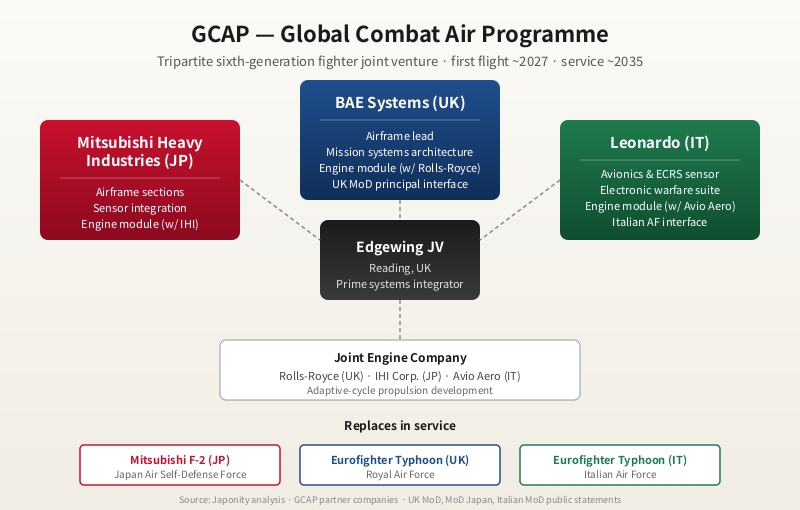
The Global Combat Air Programme, formalised in December 2022 and consolidated under a treaty-based joint venture headquartered in Reading, UK, is a sixth-generation fighter project bringing together MHI, BAE Systems and Leonardo, with engine work led by Rolls-Royce, IHI and Avio Aero. First flight is targeted for around 2027, with operational service planned for 2035. The fighter will replace Japan’s F-2s, the UK’s Typhoons and Italy’s Typhoons in their respective fleets.
For MHI, GCAP marks three firsts in modern Japanese defence procurement. It is the first time Japan has co-led a major combat-aircraft development with non-American partners. It is the first programme to operate under Japan’s relaxed defence-equipment transfer rules, which now permit export of jointly developed lethal systems under specific conditions. And it is the first programme in which Japanese industrial work-share, technology IP and export rights are negotiated as equal partners rather than as a licensee — a status MHI accepted on the F-15J and F-2, and a status it is determined not to repeat.
The industrial implications are substantial. GCAP is structured around a roughly tripartite work-share, with each national champion taking lead responsibility for systems where they hold comparative advantage. For MHI specifically, key responsibilities are expected to include airframe sections, radar and sensor integration through a Japan-UK-Italy avionics subsystem, and engine modules through the IHI-Rolls-Royce-Avio Aero joint engine company.
Shipbuilding: from industry consolidation to frigates and submarines
Japanese commercial shipbuilding has struggled for two decades against Korean and Chinese yards. MHI’s response has been to consolidate civilian shipbuilding into a joint venture (Mitsubishi Shipbuilding) and refocus heavy-yard capacity on defence and complex specialty vessels. The strategic payoff is now visible.

The Mogami-class multi-mission frigate (FFM), built jointly with Mitsui E&S at MHI’s Nagasaki yard, is a stealthy 5,500-tonne vessel designed with a crew of roughly 90 — about half a conventional destroyer of equivalent capability — through extensive automation. Japan has selected the upgraded Mogami design as the basis for its New FFM programme, and in 2025 the Mogami variant was selected by Australia for the country’s next-generation general-purpose frigate, a deal worth on the order of A$10 billion that represents the largest defence export Japan has ever undertaken.
On the submarine side, MHI co-builds the Taigei-class diesel-electric submarines with Kawasaki Heavy Industries, alternating lead-builder roles. These are among the world’s most capable conventional submarines, featuring lithium-ion battery propulsion (a Japanese-led innovation) and serving as a benchmark for several allied nations evaluating non-nuclear submarine options. Industry discussions around AUKUS Pillar II and the wider Indo-Pacific underwater-domain debate increasingly cite the Taigei design as a reference point for what a high-end conventional boat can achieve when paired with modern battery chemistry and Japanese-grade industrial quality control.
The Australian Mogami selection in 2025 is a particularly meaningful proof point. For decades, Japan’s defence-export track record had been close to a blank slate; an earlier attempt in the 2010s to sell the Sōryū-class submarine to Australia ended in failure, with Canberra selecting the French Shortfin Barracuda design before that programme too was later cancelled and replaced by AUKUS. Winning the Australian frigate competition against a German MEKO A-200 design suggests that MHI, working alongside Japan’s Ministry of Defense and the trading houses, has rebuilt the institutional capability to compete and deliver on major foreign defence contracts. Several other allied navies are now reportedly studying Japanese frigate, submarine and patrol-vessel options as part of broader fleet-recapitalisation plans.
Gas turbines, space and the civil dual-use base
Outside defence, MHI’s largest single profit centre remains gas-turbine power generation, where it competes head-to-head with GE Vernova and Siemens Energy. The flagship M501JAC and the newer H-class turbines deliver among the highest combined-cycle efficiencies in commercial service, and demand has surged with the global build-out of gas-fired peaking and baseload capacity to support data-centre load growth and the firming of intermittent renewables.
In space, MHI is prime contractor for the H3 launch vehicle — Japan’s medium-lift workhorse rocket, which entered operational service in 2024 after a difficult development cycle and a maiden-flight failure in 2023. H3 is targeted at roughly half the per-launch cost of its predecessor H-IIA and competes for commercial and government payloads against SpaceX Falcon 9, Arianespace Ariane 6 and emerging Chinese launchers.
MHI Aero Engines, meanwhile, is the principal Asian MRO partner for Pratt & Whitney’s PW1100G geared turbofan, which powers the Airbus A320neo family. That business has expanded sharply since 2023 amid the well-publicised industry-wide PW1100G inspection and repair campaign — an awkward windfall, but one that has reinforced MHI’s position in commercial-engine aftermarket services even after the company’s own commercial regional jet ambition ended.
The MRJ/MSJ wind-down and the lesson MHI took from it
Any honest profile of MHI has to address the SpaceJet. Originally launched in 2008 as the Mitsubishi Regional Jet (MRJ) and rebranded the Mitsubishi SpaceJet (MSJ), the programme aimed to make Japan a player in the 70-90 seat regional-jet market. After more than a decade of delays, ballooning costs and a failure to clear US Federal Aviation Administration type certification, MHI formally cancelled the programme in February 2023 and dissolved Mitsubishi Aircraft Corporation. Total losses across the programme exceeded ¥1 trillion.
The MSJ failure is widely understood inside MHI as a lesson about systems-integration discipline, certification-authority engagement and the limits of trying to build a clean-sheet civil airliner without the deep institutional muscle memory that Boeing, Airbus and Embraer have accumulated over decades. The lessons are visible in how MHI is approaching GCAP: the programme is structured around a multinational joint venture with two highly experienced fighter-programme partners, with technology-development risk shared rather than concentrated in Nagoya. It is also visible in how MHI now talks about commercial aviation — Aero Engines MRO, structures supply to Boeing and Airbus, and aerostructures partnerships, rather than another attempted clean-sheet airframe.
Leadership, governance and what to watch
MHI is led by President and CEO Seiji Izumisawa, who has held the top role since 2019 and has overseen the SpaceJet wind-down, the consolidation of Mitsubishi Power, and the strategic pivot back into defence. The company’s medium-term plan emphasises decarbonisation technology (carbon capture, hydrogen-ready gas turbines, ammonia co-firing), defence growth, and selective civilian-engineering exposure rather than horizontal diversification.
For foreign defence partners, aerospace suppliers and energy buyers, three threads are worth watching closely over the next 24 months. First, the GCAP work-share definition and the eventual export framework agreed among the UK, Japan and Italy will determine which third-country sales the programme can pursue — a non-trivial question for partners eyeing Asia-Pacific. Second, the pace at which ATLA scales guided-munitions production will signal whether Japan’s defence-industrial base can absorb the procurement surge without bottlenecks at the missile, propellant and electronics levels. Third, MHI’s gas-turbine order book — particularly hydrogen-ready and combined-cycle wins tied to AI data-centre demand — will determine how much non-defence cash flow underwrites the defence growth.
FAQ
What exactly is GCAP and how is it different from the FCAS programme led by France, Germany and Spain?
GCAP is a treaty-based trilateral joint venture between the UK, Japan and Italy to develop a sixth-generation fighter aircraft, with industrial leads BAE Systems, Mitsubishi Heavy Industries and Leonardo, and a joint engine company led by Rolls-Royce, IHI and Avio Aero. First flight is targeted around 2027 and operational service around 2035. FCAS is a separate, parallel sixth-generation programme led by France, Germany and Spain, with Dassault, Airbus and Indra as principal industrial partners. The two programmes have distinct industrial structures, partner nations and operational requirements, and are not currently coordinated.
How do ITAR and Japan’s export-control rules affect partners doing business with MHI on defence programmes?
Japanese defence equipment historically faced near-total export restrictions, but the “Three Principles on Transfer of Defence Equipment and Technology” framework, revised again in 2023-2024, now permits export of jointly developed lethal equipment under specific conditions, including the GCAP fighter. Many MHI defence platforms also contain US-origin components subject to US International Traffic in Arms Regulations (ITAR), meaning third-country resale typically requires both Japanese government approval and US State Department approval. Foreign partners should expect a dual-jurisdictional licensing review on most cooperative work.
How does MHI’s gas-turbine business compare with GE Vernova and Siemens Energy?
MHI is one of three global heavy-duty gas-turbine vendors capable of supplying the largest-frame, highest-efficiency machines used in baseload combined-cycle plants. Its M501JAC series competes directly with GE Vernova’s 7HA/9HA and Siemens Energy’s SGT-9000HL. Industry observers generally view the three as broadly comparable in performance, with differentiation increasingly driven by hydrogen co-firing capability, service-network density and combined-cycle plant integration. MHI has been particularly active in marketing hydrogen-ready turbines to Japanese and South-East Asian utilities pursuing co-firing decarbonisation pathways.
What is MHI’s role in Japan’s space programme, including H3?
MHI is the prime contractor for the H3 launch vehicle, developed jointly with the Japan Aerospace Exploration Agency (JAXA). H3 is targeted at roughly half the launch cost of its predecessor H-IIA and is intended to compete in the commercial launch market as well as serve Japanese government missions. After a failed maiden flight in 2023, H3 entered operational service in 2024 and has flown successive missions since. MHI also produces components for the H-IIA, the SS-520 sounding rocket and contributes to international space programmes including elements of the Lunar Gateway.
What happened to Mitsubishi Aircraft Corporation and the SpaceJet, and what does it mean for MHI’s civil-aviation strategy now?
Mitsubishi Aircraft Corporation, the MHI subsidiary developing the SpaceJet (formerly MRJ), was wound down in 2023 after the regional-jet programme was cancelled in February 2023 following more than a decade of delays and an inability to secure FAA type certification. Cumulative programme losses are estimated at over ¥1 trillion. MHI’s current civil-aviation strategy focuses on aerostructures supply to Boeing and Airbus, Pratt & Whitney PW1100G engine MRO through MHI Aero Engines, and selective component-level participation in international programmes — rather than another attempt at a clean-sheet airliner.
Working with Mitsubishi Heavy Industries
For defence ministries evaluating Japanese frigates or submarines, aerospace suppliers seeking work-share on GCAP, utilities specifying hydrogen-ready gas turbines, or industrial buyers sourcing forklifts, turbochargers or carbon-capture systems, MHI sits at a uniquely broad intersection of Japan’s heavy-engineering capacity. Japonity’s business matching service helps foreign organisations identify the right MHI business unit, navigate ATLA and METI export-licensing processes for defence and dual-use technology, and structure introductions through appropriate Japanese commercial and government channels. Contact us via the business matching page to begin a structured engagement.
Related from Japonity — Japan’s industrial conglomerates & machine tools
- DMG Mori — The Japan-Germany machine-tool union that quietly became #2 globally
Want to source Japanese products beyond these company profiles? Japonity also runs a Japan Sourcing Hub — a research-grade catalogue of 1,185 verified Japanese food products and 200+ overseas EC stores, ready for B2B procurement.
Interested in Japanese business opportunities?
Whether you're looking for technology partners, engineering talent, or market insights — we can help connect you with the right Japanese organizations.
Get in Touch →