TYO:6951
To design a better drug, a stronger material, or a smaller chip, scientists first need to see it — at the scale of individual atoms. The instruments that make that possible are electron microscopes, and a Japanese company called JEOL is one of the two global leaders in building them. It is a quiet enabler of discovery across science and industry.
Seeing the invisible
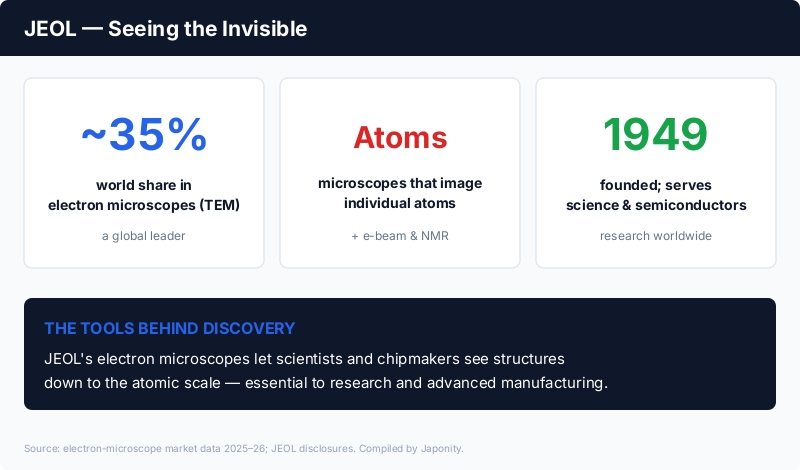
Founded in 1949 as the Japan Electron Optics Laboratory, JEOL builds electron microscopes that use beams of electrons, rather than light, to image matter at resolutions far beyond any optical microscope — down to individual atoms. It holds roughly 35% of the global transmission electron microscope (TEM) market, making it a clear leader alongside America’s Thermo Fisher Scientific, and a major maker of scanning electron microscopes too.
From the lab to the fab
JEOL’s instruments are everywhere serious analysis happens: university and corporate research labs, pharmaceutical and materials companies, and increasingly semiconductor fabs, where seeing nanoscale structures is essential to developing and inspecting advanced chips. The company also makes electron-beam lithography systems (used to write the masks for chipmaking), NMR spectrometers, mass spectrometers, and medical and semiconductor equipment — a portfolio united by precision instrumentation.
Why it matters for global partners and investors
- Investors get exposure to the long-term growth of scientific research, life sciences, materials, and semiconductors through a leader in essential analytical tools.
- Researchers and chipmakers worldwide depend on JEOL instruments; its installed base anchors deep, recurring relationships and service revenue.
- The growth to watch is semiconductors and life sciences, where demand for atomic-scale imaging keeps rising.
Frequently asked questions
What does JEOL make?
JEOL is a Japanese maker of scientific and industrial instruments, best known for electron microscopes. It also makes electron-beam lithography systems, NMR and mass spectrometers, and medical and semiconductor equipment.
How significant is JEOL in electron microscopes?
JEOL holds around 35% of the global transmission electron microscope market, making it one of the two world leaders alongside Thermo Fisher Scientific.
Why do electron microscopes matter?
They let scientists and engineers see structures down to the atomic scale, which is essential to research in biology, materials, and the development and inspection of advanced semiconductors.
Looking to source scientific instruments from, or partner with, a Japanese leader? Contact Japonity — we connect international businesses with Japan’s best companies, products, and technologies.
Interested in Japanese business opportunities?
Whether you're looking for technology partners, engineering talent, or market insights — we can help connect you with the right Japanese organizations.
Get in Touch →