Founded in 1804 as a carpenter’s shop on the streets of Edo by Kisuke Shimizu I — a craftsman who had traveled south from Echigo Province in present-day Niigata — Shimizu Corporation is the oldest continuously operating company among Japan’s “super-general-contractors,” the elite tier of construction firms known as super-zenecon. More than two centuries later, the same lineage that once built timber storefronts now erects the country’s defining skylines: Shimizu was a joint principal contractor on the Tokyo Sky Tree (2012), built approach structures for the Akashi-Kaikyo Bridge (1998), delivered the Yokohama Landmark Tower (1993), and is presently constructing semiconductor fabrication plants for TSMC’s Japan subsidiary, JASM, in Kumamoto. It is also the only super-zenecon to publish a serious engineering concept for a 11,000-kilometer ring solar power station encircling the Moon — the Lunar Ring, unveiled by its in-house research institute in 2014. With approximately ¥2 trillion in annual revenue and a Tokyo Stock Exchange listing under code 1803, Shimizu sits at the intersection of Edo-period craftsmanship and twenty-second-century planetary engineering.
From a carpenter’s shop in Kanda to Tokyo Stock Exchange code 1803
Shimizu’s origin story is unusually well documented for a Japanese construction firm of its vintage. In the second year of the Bunka era — 1804 in the Gregorian calendar — a carpenter named Kisuke Shimizu opened a workshop in Kanda, a craftsman’s quarter on the north side of Edo. He had been trained in Echigo, the snowy province on the Sea of Japan coast that today corresponds roughly to Niigata Prefecture, a region famed for its heavy-timber housing and its disciplined carpentry guilds.
The workshop’s early commissions were modest — townhouses, shop facades, a handful of small temples. But by the third generation, the firm had become a contractor of choice for the new Meiji government’s modernization projects: brick-and-stone office buildings in the Ginza district, foreign legations, and several of the first Western-style banks. The transition from daiku (traditional master carpenter) to general contractor was largely complete by 1900.
In 1937, the family-run partnership was reorganized as a joint-stock company under the name Shimizu Construction Company, the direct legal ancestor of today’s listed entity. Headquartered in Kyobashi, in Tokyo’s Chuo Ward, it now trades on the Tokyo Stock Exchange Prime Market under code 1803. Tatsuya Shinmura took over as president on April 1, 2025, succeeding Kazuyuki Inoue, who moved up to Chairman of the Board. Annual consolidated revenue runs at approximately ¥2 trillion, placing Shimizu comfortably inside Japan’s super-zenecon big-five.
The super-zenecon big-five: a 400-year industrial oligopoly
Japan’s construction industry is famously fragmented at the bottom — hundreds of thousands of small contractors and sub-sub-subcontractors — but at the top it is dominated by five firms collectively known as the super-zenecon (the prefix zene being a Japanese contraction of “general”). Together they capture the largest infrastructure tenders, the most prestigious skyscraper commissions, and almost all of the country’s overseas megaprojects.
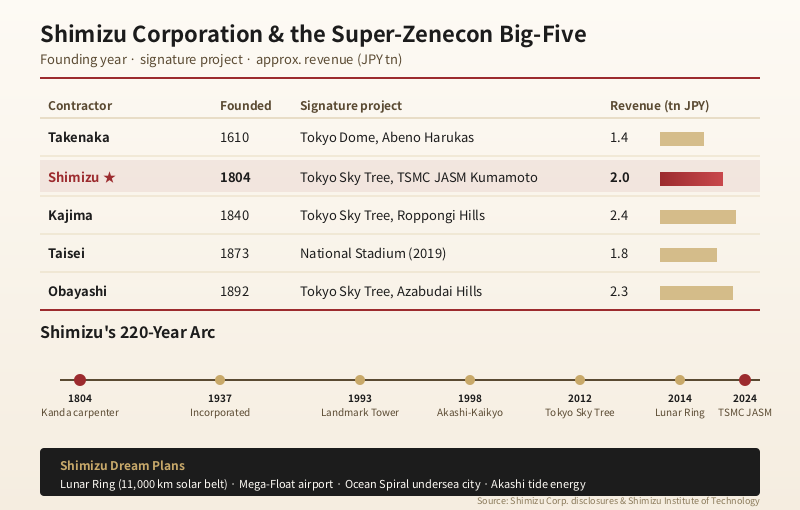
| Super-zenecon | Founded | HQ | Signature recent project | Approx. revenue |
|---|---|---|---|---|
| Takenaka Corporation | 1610 | Osaka | Tokyo Dome, Abeno Harukas | ¥1.4 tn (unlisted) |
| Shimizu Corporation | 1804 | Tokyo (Kyobashi) | Tokyo Sky Tree, TSMC JASM Kumamoto | ~¥2.0 tn |
| Kajima Corporation | 1840 | Tokyo (Motoakasaka) | Tokyo Sky Tree, Roppongi Hills | ~¥2.4 tn |
| Taisei Corporation | 1873 | Tokyo (Shinjuku) | National Stadium (2019) | ~¥1.8 tn |
| Obayashi Corporation | 1892 | Tokyo (Minato) | Tokyo Sky Tree, Azabudai Hills | ~¥2.3 tn |
Takenaka is older by nearly two centuries — it traces its founding to 1610 — but Takenaka remains privately held, which makes Shimizu, with its 1804 origin and Tokyo Stock Exchange listing, the oldest continuously listed contractor in Japan. The distinction matters: among the four super-zenecons that disclose audited results to public markets, none has a longer unbroken corporate lineage.
Building the skyline: Sky Tree, Akashi-Kaikyo, Landmark Tower
Shimizu’s signature works trace a map of post-war Japanese ambition. In 1993 the firm completed the Yokohama Landmark Tower, then the tallest building in Japan at 296 meters and home to what was, for a time, the world’s tallest hotel. In 1998 it delivered the approach viaducts of the Akashi-Kaikyo Bridge, the suspension bridge across the Akashi Strait that for a quarter-century held the world record for the longest central span — 1,991 meters between its two main towers.
In 2012 came the project that Tokyo residents now use as a directional landmark from any point in the city: the Tokyo Sky Tree, a 634-meter broadcasting tower in Sumida Ward, built as a joint venture among Shimizu, Obayashi, and Kajima — three of the five super-zenecons working in concert. The Sky Tree remains the tallest tower (as distinct from “building”) on the planet. Closer to ground level, Shimizu was the principal contractor on the Shibuya Hikarie complex (2012) and a joint contractor on the original Roppongi Hills development.
The TSMC era: semiconductor fabs as the new megaproject
If twentieth-century megaprojects in Japan meant bridges, dams, and broadcast towers, the early twenty-first century has redefined what counts as a flagship build. Since 2022 the most strategically important construction site in the country has been a 21-hectare field outside the town of Kikuyo in Kumamoto Prefecture, where Taiwan Semiconductor Manufacturing Company is building, through its Japan subsidiary JASM, a cluster of advanced logic semiconductor fabrication plants.
Shimizu is the primary contractor on JASM Phase 1, which began mass production of 12-, 16-, 22-, and 28-nanometer chips in late 2024, and is part of the contractor pool for Phase 2, scheduled to begin operations by 2027. Semiconductor fabs are technically among the most demanding structures in the world: vibration tolerances measured in nanometers, ultra-low-particulate clean rooms covering thousands of square meters, and dedicated chemical, water, and gas delivery systems that consume more piping than a small city. The fact that Shimizu was chosen for the Phase 1 fab — over equally credentialed domestic and international rivals — reflects its long internal investment in cleanroom engineering, dating back to its earliest semiconductor work for Japanese chip champions in the 1980s.
Five business segments, one balance sheet
Shimizu’s revenue is reported across five primary segments. The Building Construction segment — high-rises, hospitals, factories, hotels, the bulk of urban Japan — accounts for the largest share of revenue. Civil Engineering covers tunnels, dams, bridges, rail, and the kind of public infrastructure that put the firm on the Akashi-Kaikyo Bridge. Real Estate Development holds the firm’s own development portfolio, including office buildings it owns and operates. Engineering covers process plants and clean-room intensive facilities — the segment under which most TSMC-related work is booked. The final segment, abbreviated LCV (Life Cycle Value), provides post-handover maintenance, renovation, and energy management services, a deliberate bet on the long tail of a building’s economic life.
The mix is significant. Many of Shimizu’s competitors derive close to 70 percent of revenue from the Building segment alone, leaving them exposed to Tokyo’s notoriously cyclical office market. Shimizu’s deliberate cultivation of the Civil, Engineering, and LCV segments — each less correlated to commercial-property cycles — has made its earnings notably steadier than the super-zenecon average over the past decade.
Shimizu’s research institute and the Lunar Ring
The most extraordinary thing about Shimizu is not on the balance sheet at all. It is the Shimizu Institute of Technology, the firm’s in-house research laboratory in the western Tokyo suburb of Koto, and in particular the institute’s habit of publishing — in serious technical detail — what it calls its “Dream Plans”: engineering concepts for projects so large and so distant that no business case yet exists for them.
The most famous of these is the Lunar Ring, announced in 2014. The plan, as published in the institute’s white papers, calls for a continuous belt of photovoltaic panels installed along the Moon’s equator, approximately 11,000 kilometers in circumference. Power generated on the sunlit side of the ring would be routed via superconducting cables to transmission antennae on the lunar surface, which would beam the energy to Earth as microwaves and laser beams to receiving stations on the ground. The figures involved — gigawatts of continuous baseload power, robotic construction crews built and maintained on the lunar regolith, in-situ resource utilization of moon dust to manufacture the panels themselves — sit somewhere between speculative science fiction and an engineering thought experiment of unusual rigor.
It is not the only such concept. Other Shimizu Dream Plans include the Mega-Float, a fully floating airport designed to sit on the open ocean as an alternative to coastal land reclamation; an undersea city called Ocean Spiral, descending two kilometers into the sea floor; and a tide-energy concept proposed for the Akashi Strait. Critics may scoff. But the act of publishing such concepts — in detailed engineering pamphlets, with verified physics and credible cost-of-energy tables — is itself a strategic move. It signals to the engineering talent pool that Shimizu is a place where ambitious minds are allowed to think at planetary scale.

The international portfolio: from Bosphorus to Singapore
For most of the post-war period, the super-zenecon’s overseas business was a relatively small share of total revenue, dwarfed by the domestic megaproject pipeline. That balance is now shifting. Shimizu’s international portfolio today spans the Marmaray rail tunnel under the Bosphorus in Istanbul, the Singapore Mass Rapid Transit Thomson-East Coast Line, Vietnamese metro lines in Hanoi, hospital complexes across South-East Asia, and engineering work for several US-based semiconductor and pharmaceutical clients.
The international segment now contributes a meaningfully larger share of revenue than it did a decade ago — driven partly by structural softness in Japan’s domestic public-works budget, partly by the firm’s deliberate expansion into the South and South-East Asian infrastructure markets, where Japanese ODA financing remains an unusually durable competitive advantage.
The Marmaray project in particular is worth dwelling on. The undersea immersed-tube section of the rail tunnel runs beneath one of the most seismically active straits in the world, in a regulatory environment that is unforgiving of cost overruns and a logistical one in which the project’s two construction sites — Asian Istanbul and European Istanbul — could not be connected by road across the construction zone. Shimizu’s solution involved purpose-built barges, bespoke earthquake-isolation joints, and a project management cadence borrowed almost line-for-line from the firm’s domestic experience on the Akashi Strait. The Marmaray is now used as a case study at the firm’s training centre in Yokohama for new engineers being inducted into international project delivery.
Decarbonizing concrete: the next twenty years
Beyond the megaproject pipeline lies an existential challenge facing all of Shimizu’s peers — and indeed the global construction industry. Concrete production accounts for approximately eight percent of global CO2 emissions, the bulk of it from the calcination reaction at the heart of Portland cement manufacture. The super-zenecons are accordingly under sustained pressure from regulators, lenders, and corporate clients to deliver lower-carbon alternatives.
Shimizu’s research institute has invested heavily in CO2-absorbing concrete formulations — concretes that capture carbon dioxide from the air or from industrial flue gases and lock it permanently into the aggregate. The firm has also published trial results for hydrogen-powered construction equipment on its job sites, and is among the principal Japanese partners in a national working group on net-zero high-rise construction. None of these initiatives is yet at the scale of a Tokyo Sky Tree. But each represents the kind of long-horizon investment that has historically defined Shimizu’s strategic posture — the same posture that, two centuries ago, took a carpenter’s shop in Kanda and turned it into a 1.8-trillion-yen general contractor.
FAQ
When was Shimizu Corporation founded?
Shimizu was founded in 1804 by Kisuke Shimizu I as a carpenter’s shop in Kanda, Edo (today’s Tokyo). The carpenter himself had trained in Echigo Province, present-day Niigata Prefecture. The family business was incorporated as a joint-stock company in 1937 under the name Shimizu Construction Company, and today trades on the Tokyo Stock Exchange Prime Market under code 1803.
What is a “super-zenecon”?
Super-zenecon is a Japanese industry term — a contraction of “super general contractor” — referring to the five largest general contractors in Japan: Takenaka, Shimizu, Kajima, Taisei, and Obayashi. Together they dominate the country’s largest infrastructure and skyscraper projects. Shimizu, founded in 1804, is the oldest listed company among them.
What are Shimizu’s signature projects?
Shimizu has been a principal contractor on the Tokyo Sky Tree (2012, joint with Obayashi and Kajima), the Yokohama Landmark Tower (1993), the approach structures of the Akashi-Kaikyo Bridge (1998), the Shibuya Hikarie complex, parts of Roppongi Hills, and currently the TSMC JASM semiconductor fabrication plants in Kumamoto Prefecture.
What is the Lunar Ring?
The Lunar Ring is a concept published in 2014 by the Shimizu Institute of Technology. The plan envisions a continuous belt of photovoltaic panels approximately 11,000 kilometers in circumference, installed along the Moon’s equator, with the generated power beamed to Earth as microwaves and laser beams. It is presented as a long-horizon engineering thought experiment rather than a near-term construction project.
How big is Shimizu Corporation?
Shimizu reports approximately ¥2 trillion in consolidated annual revenue. It employs more than 19,000 people in five business segments — Building, Civil Engineering, Real Estate, Engineering, and Life Cycle Value services — and operates across Japan, South-East Asia, the Middle East, Europe, and North America.
Working with Shimizu
Japonity introduces foreign companies, investors, and infrastructure developers to Shimizu Corporation and the other super-zenecons for joint ventures, large-scale construction tenders, semiconductor and clean-room facility builds, and supplier partnerships. If you are evaluating partnership or procurement opportunities with a Japanese super-general-contractor, contact our business matching team for a structured introduction.
Related from Japonity — Japan’s super-general contractors (zenecon)
- Kajima Corporation — Japan’s super-zenecon — Tokyo Sky Tree, Azabudai Hills, TSMC Kumamoto
- Obayashi Corporation — The 1892 super-zenecon — Tokyo Sky Tree, Marina Bay Sands, Burj Khalifa
- Taisei Corporation — Employee-owned super-zenecon — Tokyo Olympic Stadium, Esconfield
- Takenaka Corporation — The 1610 super-zenecon — Tokyo Tower, Tokyo Dome, Roppongi Hills (unlisted)
Want to source Japanese products beyond these company profiles? Japonity also runs a Japan Sourcing Hub — a research-grade catalogue of 1,185 verified Japanese food products and 200+ overseas EC stores, ready for B2B procurement.
Interested in Japanese business opportunities?
Whether you're looking for technology partners, engineering talent, or market insights — we can help connect you with the right Japanese organizations.
Get in Touch →