Obayashi Corporation (株式会社大林組) is the oldest of Japan’s listed super-general-contractors — the so-called super-zenecon — and the only one of the big five whose corporate centre of gravity still tilts toward Osaka rather than Tokyo. Founded in 1892 by Yoshigoro Obayashi as Obayashigumi in the merchant city of Osaka, the company built much of the visible silhouette of modern Japan and a meaningful share of the world’s most photographed infrastructure: Tokyo Sky Tree (jointly with Kajima), the Yokohama Bay Bridge, the Tokyo Aqua Line tunnel, the Dubai Burj Khalifa as a consortium partner with Samsung C&T, the Marina Bay Sands integrated resort in Singapore, and segments of London’s Crossrail (Elizabeth Line). It also publishes — semi-seriously and semi-as-a-statement — a long-horizon concept study for a 96,000-kilometre space elevator targeted at the 2050 timeframe. Few construction companies anywhere in the world combine that volume of finished landmarks with that kind of moonshot R&D culture.
The 1892 super-zenecon: why Obayashi’s Osaka roots still matter
The Japanese construction industry’s top tier is small and unusually stable. Five listed firms — Obayashi, Kajima, Taisei, Shimizu, and Takenaka (the last of which is privately held) — collectively dominate the largest, most technically complex civil and building projects domestically, with combined annual revenues in the ¥7-8 trillion range and a near-monopoly on first-tier government infrastructure tenders. Among these, Obayashi is the only one whose founding city is Osaka, and the only one whose corporate history runs continuously from a single 19th-century founder’s name to the present listed entity without a major postwar reconstruction discontinuity.
Yoshigoro Obayashi started the firm in 1892 as a builder of mills, warehouses, and merchant buildings in the booming Meiji-era Kansai economy. By the 1900s the company was already winning prefectural and national-government infrastructure contracts; by the 1920s and 1930s it had built railway stations, government offices, and university buildings across western Japan. The Osaka origin shows up today in two ways. First, the company retains a dual-headquarters structure: the Osaka head office (in the central business district near Osaka Station) is the original and constitutionally registered headquarters, while the Tokyo main office in Minato handles the bulk of national-government, infrastructure, and overseas business. Second, Obayashi has been the contractor of choice for the largest Osaka redevelopment programmes for more than a century — most recently the multi-phase Osaka Umeda Sakura Stage complex, a more than ¥250 billion mixed-use redevelopment that became one of the largest single private construction projects in Kansai history.
The “super-zenecon” label itself deserves a moment. Zenecon is a Japanese contraction of “general contractor”. Super-zenecon narrows the term to the handful of firms with the capital, technical capacity, and licensed engineer headcount to undertake the largest civil and building projects — high-rise towers above 200 metres, long-span bridges, large-diameter tunnels, nuclear-related civil work, and major airport, port, and station redevelopments. The barrier to entry at this tier is not pricing but qualification.
How Obayashi compares to the rest of the big five
The five super-zenecon are not identical in scale, segment mix, or overseas exposure. The shape below is approximate and varies year to year with project mix and FX, but the relative ordering has been stable for a long time.
| Group | HQ | Founded | Approx. revenue rank | Notable strength |
|---|---|---|---|---|
| Kajima Corporation | Tokyo (TSE 1812) | 1840 | #1 | Civil engineering, nuclear, Tokyo Sky Tree (joint) |
| Obayashi Corporation | Osaka / Tokyo (TSE 1802) | 1892 | #2 | Bridges, tunnels, overseas signature projects |
| Taisei Corporation | Tokyo (TSE 1801) | 1873 | #3 | Tokyo Olympic Stadium, urban redevelopment |
| Shimizu Corporation | Tokyo (TSE 1803) | 1804 | #4 | Building works, ecological & lunar concepts |
| Takenaka Corporation | Osaka (private) | 1610 | #5 | Premium architecture, museums, stadiums |
Two observations are worth surfacing. First, the listed big four (Obayashi, Kajima, Taisei, Shimizu) report group revenues in the ¥1.6-2.4 trillion range; Obayashi’s recent reporting puts it consistently at approximately ¥2 trillion, making it the closest competitor to Kajima at the top. Second, Obayashi is more overseas-exposed than its peers on signature projects (Burj Khalifa, Marina Bay Sands, Crossrail) but not necessarily on aggregate overseas revenue, where Kajima’s US homebuilding subsidiary historically gives Kajima a larger absolute non-Japan revenue base. Obayashi’s overseas business is concentrated in landmark projects and selected geographies — the United States, Singapore, Vietnam, Indonesia, the Middle East, Australia — rather than spread thinly across many markets.
Signature domestic projects: Sky Tree, Aqua Line, Yokohama Bay Bridge
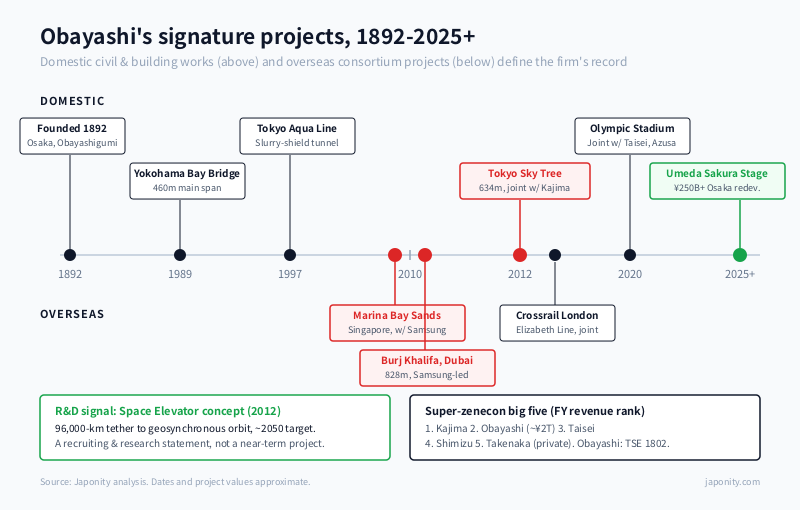
Three projects in particular anchor Obayashi’s domestic profile in the public imagination. Tokyo Sky Tree, completed in 2012 at 634 metres tall, was built by Obayashi as joint lead contractor with Kajima Corporation. At the time of completion it was the tallest tower (as distinct from the tallest building) in the world, and it remains the centerpiece of the Tobu Skytree Town redevelopment in Sumida. The Sky Tree engineering — a centre-column tuned mass damper, a steel exoskeleton designed for typhoon and earthquake loads at altitudes where Tokyo’s wind regime is materially different from street level, and a foundation system threaded between existing Tobu rail viaducts — sits in the small set of late-2000s tower engineering benchmarks worldwide.
The Yokohama Bay Bridge, completed in 1989, was for two decades the visual icon of the Yokohama waterfront and remains the principal vehicular link between the Honmoku container terminals and the Bayshore Route. Its 460-metre main span and twin H-shaped towers were a 1980s civil engineering showcase. The Tokyo Aqua Line, completed in 1997, combines an undersea tunnel and a bridge across Tokyo Bay; Obayashi led key tunnelling segments using large-diameter slurry shield machines that were among the world’s largest at the time. Together with later projects — the Tokyo Gate Bridge, sections of the Tokyo Outer Ring Road, and large-diameter sewer and metro tunnels — these define Obayashi’s domestic civil-engineering profile.
The overseas strategy: how Marina Bay Sands broke ground for the rest
Obayashi’s overseas business has a different shape from a typical multinational construction firm. Rather than building a continuous regional presence in dozens of countries, the company has selected a smaller number of geographies — North America, Singapore, Vietnam, Indonesia, Australia, and the Middle East in consortium roles — and pursued signature projects within them. The pivotal entry was the Marina Bay Sands integrated resort in Singapore, completed in 2010 in joint venture with Samsung C&T. The MBS project — three hotel towers connected by the SkyPark cantilever, an opening-roof event space, a 2,500-room hotel, casino, and convention centre, all built on reclaimed land — was technically one of the most complex hospitality projects of its era, and its successful delivery gave Obayashi a Southeast Asian reference that opened doors across the region.
The Singapore consortium with Samsung extended directly to Dubai, where Obayashi participated in the Burj Khalifa as a consortium partner with Samsung C&T (lead) and Belgium’s BESIX, completed in 2010. Obayashi’s contribution covered specialist concrete and structural work on a tower that, at 828 metres, redefined what reinforced concrete could do at altitude. Beyond Burj Khalifa, Obayashi has had ongoing presence in the Middle East in airport, metro, and water-infrastructure consortia, generally as a technical partner rather than as lead contractor.
In the United Kingdom, Obayashi was a joint contractor on segments of Crossrail (now operated as the Elizabeth Line), one of the largest urban rail projects in Europe — an engagement that reflects Obayashi’s tunnelling and station-construction depth as much as commercial appetite for the UK market. In the United States, Obayashi USA operates from a Boston-area base and has built selectively in commercial and institutional construction, with a more cautious posture than Kajima’s larger US footprint. In Southeast Asia, Obayashi Singapore, Obayashi Vietnam, and Obayashi Indonesia handle local execution for both Japanese client follow-on work — factories, plants, mixed-use buildings for Japanese corporates expanding in ASEAN — and selected local public infrastructure.
Osaka Umeda Sakura Stage and the next-decade domestic pipeline
Domestically, the largest current project in Obayashi’s portfolio is the Osaka Umeda Sakura Stage, a multi-tower mixed-use redevelopment immediately north of Osaka Station that integrates office space, retail, hotel, residential, and a substantial new urban park. The total project value exceeds ¥250 billion and represents the most consequential single redevelopment in central Osaka for more than two decades. For Obayashi, the project is both commercially meaningful and symbolically important: it reaffirms the Osaka headquarters tradition at exactly the moment that Osaka itself is staging Expo 2025 and pursuing an integrated-resort designation for Yumeshima.
Around Umeda Sakura Stage sit a number of other Obayashi-led or Obayashi-participating Kansai projects — Osaka metro extensions, redevelopment around Shin-Osaka, hospital and university buildings, and the construction support for Expo 2025-related pavilions. The pipeline is meaningfully different in composition from Tokyo, where Obayashi competes head-to-head with Kajima, Taisei, and Shimizu for the largest CBD redevelopments. In Kansai it has a structural home-court advantage that the other big-five firms do not match.
The Space Elevator: a window into Obayashi’s R&D culture
In 2012 Obayashi’s Technology Research Institute published a concept study for a space elevator — a 96,000-kilometre tether anchored to a marine equatorial platform and counterweighted in geosynchronous orbit, with climber cars carrying cargo and ultimately passengers from sea level to GEO. The published vision targeted operational capability by approximately 2050, contingent on advances in carbon-nanotube cable strength, climber engineering, and orbital-debris management that are not yet at production-ready maturity. The study has been updated and republished multiple times since, with associated academic collaborations and partnerships with universities, JAXA, and material scientists.
Reading the space elevator literally as a near-term project misses the point. Read it instead as a deliberate signal about Obayashi’s research culture and a tool for recruiting structural and materials engineers in an industry where graduate-level talent is otherwise drawn to electronics, software, and semiconductor firms. The Obayashi Technology Research Institute publishes peer-reviewed work on tunnelling, seismic isolation, concrete chemistry, large-span structures, and lunar-base concepts, much of which feeds back into the company’s everyday civil and building projects — including the dampers in Tokyo Sky Tree, the slurry-shield improvements that enabled Aqua Line and metro tunnels, and the high-performance concretes used in the Burj Khalifa work. The space elevator is the visible tip of a substantially larger research operation that other super-zenecon firms also run but communicate less publicly about.
The risks worth pricing
Three structural risks frame the medium-term view. First, the Japanese domestic construction market is structurally shaped by demographic decline — fewer new houses, lower greenfield demand — and by intensifying competition for a shrinking pool of skilled construction workers. The 2024 imposition of the overtime cap on construction labour (the so-called “2024 problem”) has tightened project schedules across the industry and pushed unit costs higher. Obayashi, like its peers, has responded with prefabrication, BIM-led productivity programmes, and robotics R&D, but the cost-pressure dynamic is industry-wide and unlikely to ease quickly.
Second, overseas signature projects carry concentrated execution risk. Burj Khalifa and Marina Bay Sands were commercial and technical successes, but the broader history of Japanese contractors in the Middle East and South Asia includes loss-making projects where currency, design-change, and local-partner risk combined to wipe out years of margin. Obayashi has been more disciplined than some peers in declining bids that look attractive on top-line revenue but priced inadequately for tail risk; the trade-off is a smaller overseas revenue line than what a more aggressive bidding posture could produce.
Third, the industry is mid-way through a slow transition from cost-plus public-works economics to value-based design-and-build contracting. This favours firms — including Obayashi — with strong design and R&D capabilities relative to those competing primarily on price, but the transition is uneven across procurement authorities and the timing of the payoff is hard to forecast.
What this means for foreign clients, partners, and suppliers
For foreign property developers, sovereign infrastructure clients, and large industrial operators choosing a Japanese contractor for a complex project — a high-rise hotel, a long-span bridge, a large-diameter tunnel, a stadium, a chemical or semiconductor plant — Obayashi warrants direct evaluation alongside Kajima, Taisei, Shimizu, and Takenaka rather than being treated as a generic Japanese alternative. The differentiators are the depth of overseas reference projects (Burj Khalifa, Marina Bay Sands, Crossrail), the Kansai redevelopment depth that no other listed super-zenecon can match, and a research culture that materially influences project-specific engineering rather than sitting in a separate corporate-marketing silo.
For component and material suppliers — high-performance concrete admixtures, structural steel, post-tensioning systems, seismic isolators and dampers, formwork, geotechnical instrumentation, BIM and construction-tech software, prefabrication machinery — Obayashi sources from a global supplier base that includes both Japanese majors (Nippon Steel, JFE, Sumitomo Osaka Cement) and international specialists. Qualification typically begins through a specific project’s technical procurement team rather than through corporate purchasing, with relationships built up across multiple projects translating over time into framework agreements.
FAQ
Is Obayashi Japan’s largest construction company?
Obayashi is consistently ranked second among the listed super-general-contractors (super-zenecon) by revenue, behind Kajima and ahead of Taisei and Shimizu, with annual group revenue of approximately ¥2 trillion. Takenaka Corporation, which is privately held and specialises in premium architecture, sits separately in the same tier. The relative ordering between Kajima and Obayashi has been stable for years, though Obayashi has occasionally led on specific revenue lines such as overseas signature projects.
Why does Obayashi have headquarters in both Osaka and Tokyo?
Yoshigoro Obayashi founded the company in Osaka in 1892, and the Osaka head office in the central business district remains the constitutionally registered headquarters and the centre of gravity for Kansai projects — most recently the ¥250 billion-plus Osaka Umeda Sakura Stage redevelopment. The Tokyo main office in Minato handles the majority of national-government infrastructure, large CBD redevelopment, and overseas business, reflecting Tokyo’s role as Japan’s administrative and corporate capital. The dual structure is functional, not historical residue: Obayashi remains structurally the most Kansai-oriented of the listed big-five super-zenecon.
What was Obayashi’s role on Burj Khalifa and Marina Bay Sands?
Both projects were delivered by a consortium led by Samsung C&T of South Korea. Marina Bay Sands in Singapore, completed in 2010, was a direct Samsung-Obayashi joint venture covering the three hotel towers, the SkyPark cantilever, and the casino, retail, and convention spaces. Burj Khalifa in Dubai, completed in 2010, was a Samsung-Obayashi-BESIX consortium where Obayashi contributed specialist concrete and structural work on the supertall tower. The MBS engagement is what opened the Southeast Asian and Middle Eastern doors that subsequently led to other consortium roles.
What is the Obayashi Space Elevator and is it real?
It is a published concept study from Obayashi’s Technology Research Institute, first released in 2012 and updated since, describing a 96,000-kilometre cable anchored to an equatorial marine platform with a counterweight in geosynchronous orbit, capable of moving cargo and eventually passengers from Earth to GEO without rockets. The study targets an approximately 2050 operational horizon, contingent on advances in carbon-nanotube cables and other technologies not yet at production maturity. It is best read as a serious long-range research signal and recruiting statement, not as a near-term project. The R&D infrastructure behind it produces practical outputs — seismic dampers, tunnelling systems, high-performance concrete — that show up in Obayashi’s everyday projects.
How do foreign suppliers qualify into Obayashi’s supply chain?
Qualification typically begins at the project level, through technical procurement on a specific signature project — a tunnel, a high-rise, a long-span bridge — rather than at corporate-purchasing level. Suppliers with differentiated technology in seismic isolation and dampers, high-performance concrete admixtures, advanced formwork, geotechnical instrumentation, BIM and construction-tech software, or prefabrication automation have viable paths through Obayashi’s Technology Research Institute and through the relevant project engineering team. Relationships that perform well across multiple projects translate over time into framework agreements that apply at corporate level.
Working with Obayashi
For overseas property developers, infrastructure clients, and large industrial operators choosing a Japanese contractor for a complex civil or building project, Obayashi warrants direct comparison with Kajima, Taisei, Shimizu, and Takenaka. The differentiated value sits in three places: the volume of completed overseas signature projects (Burj Khalifa, Marina Bay Sands, Crossrail) that few other Japanese contractors can match; the unmatched depth of Kansai redevelopment experience anchored by the 1892 Osaka origin; and a research culture, visible through the Space Elevator concept and the broader Technology Research Institute output, that materially feeds back into project engineering. The procurement entry points differ by geography: Kansai redevelopment and Osaka-related projects engage through the Osaka head office; national infrastructure and overseas business engage through the Tokyo main office; regional execution flows through Obayashi USA, Obayashi Singapore, Obayashi Vietnam, and Obayashi Indonesia.
For component and material suppliers — concrete admixtures, structural steel, post-tensioning, seismic isolators, formwork, BIM software, construction-tech automation — Obayashi sources from a global supplier base that includes both Japanese majors and international specialists. Qualification typically begins at the project level through technical procurement, with multi-project performance translating over time into framework agreements.
If your company is selecting a Japanese super-general-contractor for a complex project, supplies specialised construction materials or software relevant to Obayashi’s project pipeline, or is exploring a joint-venture or licensing arrangement around Japanese civil-engineering technology, Japonity’s business matching service can help structure a credible first conversation with the right counterparty inside the company.
Related from Japonity — Japan’s super-general contractors (zenecon)
- Kajima Corporation — Japan’s super-zenecon — Tokyo Sky Tree, Azabudai Hills, TSMC Kumamoto
- Taisei Corporation — Employee-owned super-zenecon — Tokyo Olympic Stadium, Esconfield
- Shimizu Corporation — The 1804 super-zenecon — Tokyo Sky Tree, Akashi-Kaikyo, Lunar Ring
- Takenaka Corporation — The 1610 super-zenecon — Tokyo Tower, Tokyo Dome, Roppongi Hills (unlisted)
Want to source Japanese products beyond these company profiles? Japonity also runs a Japan Sourcing Hub — a research-grade catalogue of 1,185 verified Japanese food products and 200+ overseas EC stores, ready for B2B procurement.
Interested in Japanese business opportunities?
Whether you're looking for technology partners, engineering talent, or market insights — we can help connect you with the right Japanese organizations.
Get in Touch →