Oriental Land Co., Ltd. is, on paper, a Tokyo-listed real-estate and leisure operator anchored by Mitsui Fudosan and Keisei Electric Railway. In substance it is something far stranger and, for the global theme-park industry, far more interesting: the only company in the world that owns and operates a major Disney resort under a pure licensing arrangement, paying royalties of roughly seven to ten percent of revenue to The Walt Disney Company in exchange for the rights to the Disney intellectual property, and keeping almost everything else. Tokyo Disneyland — the first Disney park outside the United States, opened in April 1983 — was built and is run by Oriental Land. Tokyo DisneySea, the only park of its kind anywhere, opened in September 2001 on the same footprint. In June 2024 the resort cleared its largest single investment in history with Fantasy Springs, a roughly three hundred and twenty billion yen expansion of DisneySea themed around Frozen, Tangled and Peter Pan. Visitor numbers have already surpassed the pre-Covid peak. For overseas theme-park investors, hospitality groups, retail and merchandising suppliers, and inbound-tourism financiers, Oriental Land is one of the most distinctive licensee economics in global entertainment.
From reclaimed Tokyo Bay seabed to the first Disney park outside America
Oriental Land Co., Ltd. was incorporated in July 1960 by Mitsui Fudosan, the real-estate arm of the Mitsui group, and Keisei Electric Railway, the private railway operating the Tokyo-to-Narita corridor. The purpose was to acquire and develop reclaimed land along Tokyo Bay in Urayasu, on the Chiba prefecture side of the metropolis. Initial concepts ran the gamut: housing, an industrial park, a horse-racing track, a marine recreation zone. The site was vast — eventually more than two square kilometres of reclaimed seabed — and the development thesis was, at that early stage, undefined.
What anchored the project was a 1979 licensing agreement with Walt Disney Productions. The terms agreed then were unusual then and remain unusual now. Disney would license the brand, characters, attractions and design know-how. Oriental Land would finance, build, own and operate the park. Disney would receive royalties — historically reported at around five to ten percent of merchandise and admissions revenue — and would have a strong voice in creative and operational standards, but would take no equity stake, assume no construction risk, and share no operating profit beyond the royalty stream.
Tokyo Disneyland opened on the 15th of April 1983 — the first Disney park outside the United States and, four decades later, one of the most consistently profitable theme parks in the world. The economics of that 1979 deal, born of a moment in which Disney was capital-constrained, foreign-venture-averse and unsure how its content would translate to the Japanese market, became for Oriental Land a structural windfall that compounds every year the resort grows.
Why the licensing structure matters more than the parks themselves
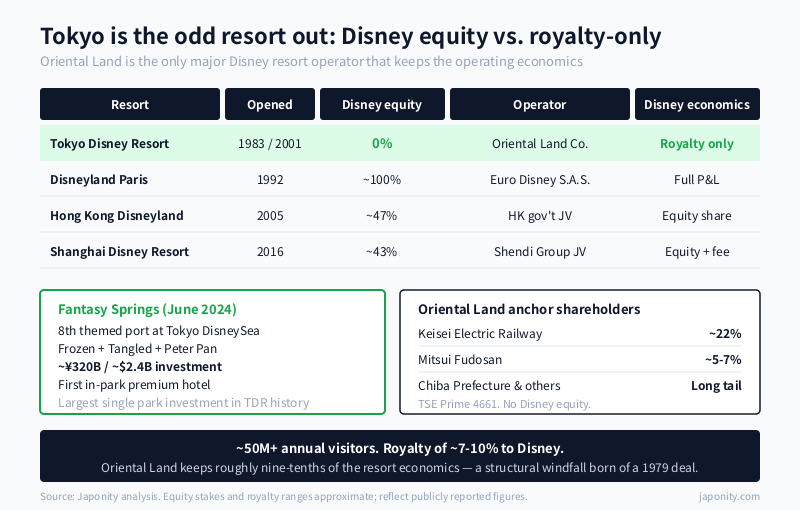
Most of what makes Oriental Land an unusual investment is contained in the difference between a licensing structure and an equity structure. The table below sketches the four Disney resorts outside the United States and how each is owned.
| Resort | Opened | Disney equity stake | Operator | Disney economic exposure |
|---|---|---|---|---|
| Tokyo Disney Resort | 1983 / 2001 | 0% | Oriental Land Co., Ltd. | Royalties only (~7-10% of revenue) |
| Disneyland Paris | 1992 | ~100% (after 2017 buyout) | Euro Disney S.A.S. | Full P&L, full capex, full risk |
| Hong Kong Disneyland | 2005 | ~47% | Hong Kong Int’l Theme Parks Ltd. | Equity profits and losses |
| Shanghai Disney Resort | 2016 | ~43% | Shanghai Shendi Group JV | Equity profits plus management fee |
The implication is straightforward. At Tokyo, Disney earns a royalty regardless of whether the park is profitable; Oriental Land takes the operating risk and the operating upside. At Paris, Disney owns nearly all of the company outright after a series of consolidations culminating in a 2017 buyout, and absorbs the full P&L, including the periodic losses that have characterised that resort. At Hong Kong and Shanghai, Disney shares both the upside and the downside with a government-linked Chinese joint-venture partner — and at Shanghai, also collects a management fee on top. Tokyo is the only Disney resort in the world where the operator is a wholly Japanese-owned, separately listed public company that keeps roughly nine-tenths or more of the economic value the resort generates.
That difference is the single most important fact about Oriental Land. Every other strategic question — how aggressively to invest in expansion, how to price tickets, when to add hotel inventory, how to handle a pandemic — flows downstream from the structural decision made in 1979 that Disney would license rather than own.
Tokyo DisneySea and the architecture of a two-park resort
The original Tokyo Disneyland was a single-park resort for its first eighteen years. Through the 1980s and 1990s the operator added hotel inventory, expanded merchandising, and built up the surrounding Maihama district with parking, a monorail loop, retail, and a Cirque du Soleil-anchored theatre venue that ran from 2008 until 2011 before closing.
The second park, Tokyo DisneySea, opened on the 4th of September 2001 immediately adjacent to Tokyo Disneyland. DisneySea was — and remains — a one-of-a-kind park in the global Disney portfolio. There is no DisneySea in Anaheim, Orlando, Paris, Hong Kong or Shanghai. Themed around seven nautically-inflected ports of call (now eight with Fantasy Springs), it was developed jointly by Walt Disney Imagineering and Oriental Land specifically for the Japanese market, and consistently ranks among the highest-rated Disney parks in the world by visitor satisfaction surveys. The two-park resort is anchored by a portfolio of Oriental Land hotels in the Maihama zone, served by the Disney Resort Line monorail and the Maihama JR station that connects the resort to central Tokyo in roughly fifteen minutes.
Fantasy Springs: the largest single park investment in Tokyo Disney history
Fantasy Springs opened on the 6th of June 2024 as the eighth themed port at Tokyo DisneySea. The investment was reported at approximately three hundred and twenty billion yen, equivalent to roughly two point four billion U.S. dollars — the single largest park-side investment Oriental Land has made since the original 1983 build, and one of the largest individual theme-park capital projects globally in the post-pandemic period.
The themed area is organised around three Disney film franchises: Frozen Kingdom, Rapunzel’s Forest (Tangled), and Peter Pan’s Never Land. A new luxury hotel — Tokyo DisneySea Fantasy Springs Hotel, the resort’s first inside-park premium hotel — was built into the themed land and opened simultaneously, offering rooms with views into the new area and bundled park-access packages.
Two things make Fantasy Springs strategically important beyond its scale. First, it added meaningful incremental capacity at a moment when the resort was already operating near its pre-Covid peak, letting Oriental Land absorb the inbound rebound without queue times becoming a customer-experience problem. Second, the integrated luxury-hotel component shifts the revenue mix toward higher-yield accommodation — a structural change in how the resort monetises the highest-spending tier of its guest base.
The shareholder base: Mitsui Fudosan, Keisei, and a long institutional tail
Oriental Land has been a listed company on the Tokyo Stock Exchange since December 1996, trading today under ticker 4661 on the Prime Market. Keisei Electric Railway holds the largest single block at approximately twenty-two percent and is the anchor strategic shareholder. Mitsui Fudosan holds a smaller but still meaningful stake, typically reported at around five to seven percent. Chiba Prefecture, where the resort is physically located, has been a longstanding holder. The remainder is held by Japanese trust banks, global asset managers including the major U.S. index funds, and individual Japanese shareholders, with no controlling block beyond Keisei’s.
The Keisei stake has drawn periodic activist attention. A U.S.-based fund publicly campaigned in 2023-2024 for Keisei to spin off or distribute its Oriental Land holding, arguing that the railway’s market capitalisation was effectively a function of its Oriental Land stake rather than its core rail business. Keisei has resisted, characterising the holding as strategic — a useful reminder that significant accumulated value sits at the parent-shareholder level, only loosely correlated with the operating performance of the railway itself.
Business segments: theme parks, hotels, and the rest
Oriental Land reports in three primary segments. The dominant Theme Park Business encompasses admissions, in-park food and merchandise, and licensing of the Disney brand to selected Japanese partners. It typically accounts for roughly four-fifths of consolidated revenue and a higher share of operating profit, reflecting the operating leverage of the parks once they are running near capacity.
The Hotel Business segment covers the resort’s owned hotels — Tokyo Disneyland Hotel, Disney Ambassador Hotel, Tokyo DisneySea Hotel MiraCosta, Tokyo Disney Celebration Hotel, Tokyo Disney Resort Toy Story Hotel, and from 2024 the Tokyo DisneySea Fantasy Springs Hotel. It generates roughly ten to fifteen percent of consolidated revenue and is growing as a share of the mix after Fantasy Springs.
The remainder, grouped as Other Business, covers the Disney Resort Line monorail, the Ikspiari retail and entertainment complex, and related leisure and real-estate operations — small in revenue terms but important for monetising the surrounding Maihama footprint.
Visitor recovery: from pandemic trough to the post-Covid inbound surge
The resort has long operated near a steady-state ceiling of approximately fifty million annual visitors across both parks combined — roughly thirty million at Disneyland and twenty million at DisneySea in a typical pre-pandemic year. The Covid-19 pandemic produced the deepest demand shock in the resort’s history: both parks were closed entirely from late February through June 2020, then operated under capacity caps through 2020 and 2021 and reduced operations into early 2022.
The recovery arrived faster than most operators expected. Domestic demand normalised through 2022-2023. Inbound tourism, supported by the weak yen and the removal of remaining border controls in April 2023, surged through 2023 and 2024 and pushed attendance back to pre-Covid levels by mid-2023 and to new highs after Fantasy Springs opened. Per-capita guest spending also rose materially through price increases, the mix shift toward higher-spending inbound visitors, and premium-tier products including Premier Access (paid line-skip, introduced 2022) and Fantasy Springs packages. The combined effect — volume normalisation plus yield growth — has driven record consolidated revenue and operating profit.

Governance: Kagami, Takahashi, and the long bench
Toshio Kagami, who joined the company in 1972 and was instrumental in the DisneySea launch, has served in senior executive roles for decades and continues in a chairman-level capacity. Wataru Takahashi serves as president and representative director, with day-to-day responsibility for the resort, the hotel business, and the broader group. The board includes representatives of the anchor shareholders, independent outside directors, and senior operating executives.
The governance temperament is conservative and long-cycle. Capital projects at Fantasy Springs scale are years in development; pricing decisions are reviewed against multi-year demand and brand-equity considerations; new themed lands are sequenced against existing capacity and the broader hotel and transport infrastructure. Decisions at Oriental Land tend to be measured rather than aggressive — which, given the licensee structure and the irreplaceability of the Disney relationship, is the correct posture.
What is — and is not — replicable about the Oriental Land model
The temptation is to ask whether Oriental Land’s economics could be replicated elsewhere. The honest answer is: probably not. The 1979 agreement reflected a specific moment in Disney’s history — capital-constrained, foreign-venture-averse, untested in Asia — that has not recurred. Every Disney park built since has involved Disney equity, Disney management control, or both. What is replicable is the underlying insight: the most valuable position in entertainment real-estate is often not the IP itself but the integrated operator wrapped around it — provided that operator owns the surrounding land, the hotel inventory, the transport access, and a long-tenor licence. Mitsui Fudosan and Keisei happened to own all four when they negotiated in 1979.
Why Oriental Land matters to overseas counterparties
For overseas hospitality groups, Oriental Land is the operator of the largest integrated resort hotel cluster in the Tokyo metropolitan area and a credible counterparty for management agreements, design partnerships, and adjacent-zone development. For retail and merchandise suppliers, the in-park and Ikspiari retail footprint is one of the highest-traffic premium consumer venues in Japan. For theme-park attractions and technology suppliers — ride systems, show control, ticketing, lighting and effects — Oriental Land is one of the largest single buyers in Asia, with procurement cycles aligned to the multi-year cadence of new attraction development. For inbound-tourism investors, it is one of the cleanest pure-play exposures to the structural growth of Japan as a tourist destination.
What ultimately makes Oriental Land distinctive is not the parks. It is the contract. A wholly Japanese-owned operator that built and ran the first Disney park outside the United States, kept the operating economics, and has compounded that position for four decades is — in global entertainment terms — almost without parallel.
FAQ
Who owns Oriental Land Co., Ltd.?
Oriental Land is a publicly listed company on the Tokyo Stock Exchange Prime Market (ticker 4661). The largest single shareholder is Keisei Electric Railway, with a stake of approximately twenty-two percent, followed by Mitsui Fudosan with a smaller but strategically important stake typically around five to seven percent. Chiba Prefecture has also been a longstanding holder reflecting the original land-development partnership. The remainder is broadly distributed across Japanese trust banks acting for institutional clients, global asset managers, and individual shareholders. The Walt Disney Company holds no equity stake in Oriental Land; the commercial relationship is structured as a long-tenor licensing agreement.
How does Oriental Land’s relationship with Disney differ from other international Disney resorts?
Tokyo Disney Resort is the only major Disney resort in the world where Disney holds no equity stake. Oriental Land owns and operates Tokyo Disneyland and Tokyo DisneySea under a licensing agreement that pays Disney royalties — historically reported at approximately seven to ten percent of revenue — in exchange for the rights to the Disney intellectual property and creative oversight. By contrast, Disney owns close to one hundred percent of Disneyland Paris following a 2017 buyout, holds approximately forty-seven percent of Hong Kong Disneyland with the Hong Kong government, and holds approximately forty-three percent of Shanghai Disney Resort with the Shanghai Shendi joint-venture partner. Tokyo is the only resort where the operator is a separately listed Japanese company.
What is Fantasy Springs and why is it significant?
Fantasy Springs is the eighth themed port at Tokyo DisneySea, opened on the 6th of June 2024. It comprises three film-franchise themed areas (Frozen, Tangled and Peter Pan) and the new Tokyo DisneySea Fantasy Springs Hotel, the resort’s first in-park premium hotel. The investment was reported at approximately three hundred and twenty billion yen, equivalent to roughly two point four billion U.S. dollars, making it the single largest park investment in Tokyo Disney Resort history and one of the largest theme-park capital projects globally in the post-pandemic period. Strategically, Fantasy Springs added capacity at a moment of surging inbound demand and shifted the resort’s revenue mix toward higher-yield premium accommodation.
How has Tokyo Disney Resort recovered from the Covid-19 pandemic?
Both parks were closed entirely from late February 2020 through June 2020 and operated under capacity caps through 2020 and 2021. Domestic demand normalised through 2022 and into 2023. Inbound tourism, supported by the weak yen and the removal of remaining border controls in April 2023, surged through 2023 and 2024 and helped push the resort back to pre-Covid attendance levels by mid-2023 and to new highs after Fantasy Springs opened in June 2024. Per-capita guest spending also rose materially through a combination of price increases, mix shift toward higher-spending inbound visitors, and premium-tier products including Premier Access and Fantasy Springs hotel-and-attraction packages. By fiscal 2024, consolidated revenue and operating profit were at or above record levels.
What other businesses does Oriental Land operate beyond the parks?
Beyond the Theme Park Business segment, Oriental Land operates a Hotel Business segment that includes the Tokyo Disneyland Hotel, the Disney Ambassador Hotel, the Tokyo DisneySea Hotel MiraCosta, the Tokyo Disney Celebration Hotel, the Tokyo Disney Resort Toy Story Hotel, and the new Tokyo DisneySea Fantasy Springs Hotel opened in 2024. An Other Business segment covers the Disney Resort Line monorail, the Ikspiari retail and entertainment complex outside the park gates, and selected adjacent leisure and real-estate operations. The Theme Park Business accounts for roughly four-fifths of consolidated revenue; the Hotel Business is growing as a share of the mix following the Fantasy Springs Hotel opening.
Working with Oriental Land
For overseas hospitality groups and resort operators, the practical entry point to Oriental Land is through its hotel and integrated-resort development organisation, which manages design and operating partnerships across the Tokyo Disney Resort hotel cluster and the broader Maihama footprint. For retail, merchandise and food-and-beverage suppliers, the resort’s procurement organisation handles sourcing across in-park retail, Ikspiari, and the hotel inventory, with category-specific qualification cycles that vary by product type.
For theme-park attractions and technology suppliers — ride systems, show control, ticketing and queue-management technology, lighting and special-effects systems, theming and fabrication — Oriental Land is one of the largest individual buyers in Asia, with procurement cadences aligned to the multi-year cycle of new attraction and themed-land development. For inbound-tourism technology, hospitality SaaS, and guest-experience product suppliers, the resort’s scale and brand sensitivity make it both a demanding and a reference customer.
If your company provides resort hospitality services, theme-park attractions and technology, retail and merchandise supply, food and beverage capability, inbound-tourism technology, or partnership opportunities relevant to Tokyo Disney Resort and the broader Oriental Land group — or if you are evaluating Japanese inbound-tourism exposure as part of a regional investment thesis — Japonity’s business matching service can help structure a credible first conversation with the right counterparty inside Oriental Land.
Related from Japonity — Japan’s gaming, theme parks & entertainment
- Sega Sammy Holdings — Pachinko cash funding Sonic, Persona and Like a Dragon
- Konami Group — The IP factory behind Metal Gear, Silent Hill, Yu-Gi-Oh and eFootball
Want to source Japanese products beyond these company profiles? Japonity also runs a Japan Sourcing Hub — a research-grade catalogue of 1,185 verified Japanese food products and 200+ overseas EC stores, ready for B2B procurement.
Interested in Japanese business opportunities?
Whether you're looking for technology partners, engineering talent, or market insights — we can help connect you with the right Japanese organizations.
Get in Touch →