Fujitsu Limited is the cleanest test case in Japanese industry of a deliberate, decade-long pivot from selling hardware to selling services. The same company that once put a Fujitsu-badged FM Towns on Japanese desks, that designed the Fugaku supercomputer that topped the global TOP500 list four times running from 2020 to 2021, and that quietly sold its consumer PC business to Lenovo in 2017-2018 — is now best described as Japan’s answer to IBM circa 2005. It is also the same company at the centre of one of the most damaging public-sector IT scandals in modern British history: the UK Post Office Horizon affair, which has consumed a public inquiry through 2024 and 2025 and left Fujitsu’s UK services arm under sustained political and legal pressure. The contrast between these stories — engineering brilliance at Kobe’s RIKEN data centre, institutional failure in a London courtroom — is, in many ways, the company itself.
From Furukawa’s electronics arm to Japan’s IBM
Fujitsu was spun out of Furukawa Electric in June 1935 as Fuji Tsushinki Seizo K.K. (“Fuji Communications Equipment Manufacturing”), originally a joint venture between Furukawa and the German firm Siemens to build telephone exchange switches for Japan’s expanding telecoms network. The Furukawa zaibatsu connection mattered: it gave the new firm access to copper, capital, and a customer in NTT’s predecessors that would anchor decades of growth.
The post-war pivot from telecoms gear into computing was decisive. By the 1960s Fujitsu was building IBM-compatible mainframes, by the 1980s it was the largest computer company in Japan by revenue, and by the early 1990s — through ICL in the UK and Amdahl in the U.S. — it had a global hardware footprint briefly making it the world’s second-largest IT firm after IBM. That hardware empire is no longer the business. What remains is a Japan-anchored systems-integration and managed-services franchise, a smaller global services business, and selective engineering assets — HPC, networking silicon, quantum — that the company still funds in-house.
The PC divestment that nobody outside Japan noticed
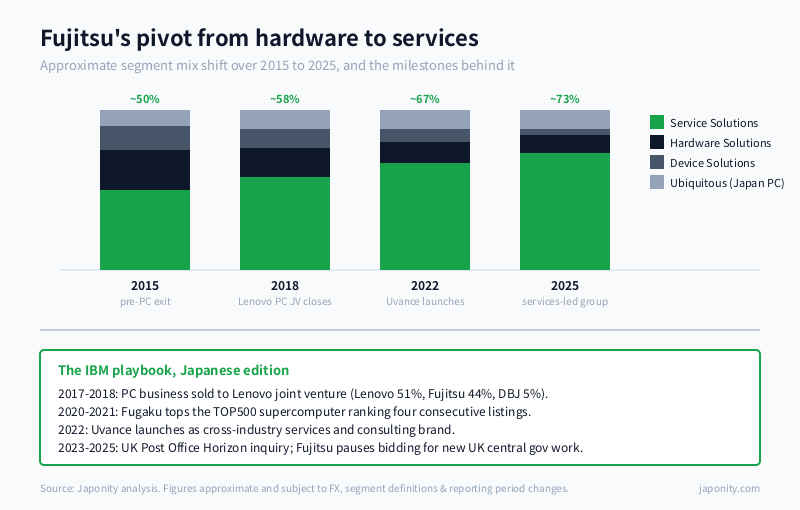
Fujitsu’s exit from consumer PCs is the cleanest signal of the pivot. The company was an early and serious player in Japanese personal computing — the FM-7 home computer of 1982 and the FM Towns multimedia machine of 1989 were domestically iconic, and Fujitsu’s FMV-branded notebooks dominated Japanese retail through the 1990s and 2000s. In November 2017 Fujitsu and Lenovo agreed to fold Fujitsu Client Computing Limited into a joint venture in which Lenovo took 51%, Fujitsu retained 44%, and the Development Bank of Japan held 5%; the deal closed in May 2018. Fujitsu’s stake was subsequently reduced further as Lenovo consolidated control. The Japanese FMV brand survives at retail, but the underlying engineering, supply chain, and balance-sheet exposure now sit with Lenovo.
The transaction was nearly invisible in Western coverage — Lenovo had already absorbed IBM’s ThinkPad in 2005 and NEC’s PC business in 2011, so the Fujitsu deal looked like a third instalment of the same pattern. Inside Japan it read differently: the last large domestic-brand PC maker had conceded that hardware-led consumer computing was no longer a defensible base for a Japanese systems company. The capital and management bandwidth freed up flowed into services, cloud, and the Uvance brand.
The segment mix today: a services company with hardware history
Fujitsu now reports under a simplified structure built around three customer-facing pillars: Service Solutions (consulting, system integration, managed services, the Uvance vertical offerings), Hardware Solutions (servers, storage, network products, and the HPC line that produced Fugaku), and Ubiquitous Solutions (PCs in Japan, mobile, and consumer-adjacent). A separate Device Solutions arm historically housed the semiconductor and electronic-components business; most of that has been divested. The table below summarises the rough shape of the consolidated group as it has settled in the post-divestment era.
| Segment | Approx. share of group revenue | Strategic role | Geographic centre of gravity |
|---|---|---|---|
| Service Solutions (Technology Solutions, consulting, Uvance) | ~70-75% | Growth engine, margin lever | Japan + UK/EMEA + APAC |
| Hardware Solutions (servers, storage, networking, HPC) | ~10-12% | Anchors HPC and supercomputing brand | Japan + selective global |
| Ubiquitous Solutions (Japan PC, mobile, retail-adjacent) | ~10-12% | Shrinking; Japan-only | Japan |
| Device Solutions and other | ~3-5% | Residual; semiconductor manufacturing largely exited | Japan |
The headline shift is the dominance of Service Solutions. A decade earlier, hardware and devices together accounted for closer to a third of revenue; today services have absorbed almost all of the growth and most of the margin. Within services, two sub-stories matter: the Japan domestic systems-integration business, which is the most stable but slowest-growing piece, and the international services franchise centred in the UK through Fujitsu Services Holdings, which is faster-moving but more politically exposed.
Fugaku and the case for keeping HPC in-house
The Fugaku supercomputer, jointly developed by Fujitsu and Japan’s RIKEN national research institute and deployed in Kobe between 2020 and 2021, was the world’s fastest supercomputer for four consecutive TOP500 rankings from June 2020 to November 2021, before being displaced by Oak Ridge National Laboratory’s Frontier system in 2022. Fugaku ran on Fujitsu’s A64FX processor — an Arm-based, 48-core chip with high-bandwidth memory designed in-house — and remained, for several years, the only #1-class system built entirely on Arm architecture rather than x86 plus GPU.
The strategic point is not the ranking, which is transient by design, but the institutional capability that producing it required: a domestic chip design team, a packaging and interconnect competence, a national lab partnership that worked, and the willingness to commit the capital. After Fugaku, Fujitsu signalled continued investment in next-generation HPC and in quantum computing (a 2023 partnership with RIKEN delivered Japan’s first homegrown 64-qubit superconducting quantum computer), even as the company exited mainstream semiconductor manufacturing. That selectivity — exiting commodity chips while retaining design competence for HPC and quantum — is the Fujitsu version of what IBM did with Power and z-architecture: keep the strategic silicon, sell the rest.
Uvance: the consulting brand the rest of the world still has not heard of
Fujitsu Uvance, launched in 2022 under CEO Takahito Tokita (who took the role in April 2019), is the company’s attempt to repackage its services portfolio around seven cross-industry offerings — Sustainable Manufacturing, Consumer Experience, Healthy Living, Trusted Society, and three horizontal technology fabrics in Digital Shifts, Business Applications, and Hybrid IT. The architecture is recognisable to anyone who has followed Accenture’s industry-X plays or IBM Consulting’s hybrid-cloud reset: bundle the technology assets behind a consulting front door, and sell outcomes rather than systems.
Uvance’s commercial traction is real but uneven. Inside Japan, where Fujitsu’s brand and account control are dominant, Uvance has had a relatively clean run at large enterprise customers in manufacturing, healthcare, and government. Outside Japan, the brand is far less recognised than Accenture, Capgemini, or Tata Consultancy Services, and Fujitsu has been more selective about where it competes — the UK, Australia, parts of continental Europe, and selective ASEAN markets. Headcount investment in consulting, including the 2023 acquisition of Australian consultancy Versor and the build-out of Ridgeline International (Fujitsu’s Asia-Pacific consulting arm), is steady but cautious by global-systems-integrator standards.
The Horizon scandal: the cost of running other countries’ public-sector IT
The UK Post Office Horizon IT system, built and maintained by Fujitsu’s UK subsidiary (now Fujitsu Services Limited, part of Fujitsu Services Holdings PLC) since 1999, is at the centre of what UK media and Parliament have called one of the worst miscarriages of justice in modern British history. Hundreds of sub-postmasters and sub-postmistresses were prosecuted, fined, bankrupted, or imprisoned between 1999 and 2015 on the basis of Horizon-generated accounting shortfalls that were, in many cases, the product of software defects rather than fraud. The public inquiry into the affair, chaired by Sir Wyn Williams, took extensive evidence through 2023 and 2024 from Fujitsu engineers, Post Office executives, and affected sub-postmasters; the final report is expected to set out findings on corporate responsibility and the conduct of named individuals.
For Fujitsu, the consequences are commercial, reputational, and political. The company has stated publicly that it has a “moral obligation” to contribute to compensation; the exact financial provision will depend on inquiry findings and on negotiations with the UK government, which has paid out substantial sums to victims under successive compensation schemes. Fujitsu has also committed not to bid for new UK central government work while the inquiry is live, a self-imposed restriction that has materially affected the UK pipeline. The episode is the clearest illustration of why the services pivot is harder than the hardware exit was: hardware businesses fail loudly but rarely produce decades-long political controversies; outsourced public-sector services do exactly the opposite.
The semiconductor exit and what Fujitsu kept
Fujitsu’s semiconductor history is long and largely concluded. The main manufacturing business was spun off in 2008 into Fujitsu Microelectronics, later merged with Panasonic’s semiconductor unit into Socionext in 2015 — a fabless design house in which Fujitsu held a minority stake before further divestment. The microcontroller and analog business went to Spansion (now Cypress, now Infineon) in 2013, and fabs in Iwate and elsewhere were transferred to On Semiconductor and others over the same period.
What Fujitsu retained is narrow and deliberate: HPC processor design (the A64FX line and its successors), networking silicon for its own switches and routers, and quantum hardware in partnership with RIKEN. Everything else — commodity logic, memory, foundry capacity, consumer-electronics analog — has been sold. The contrast with Toshiba (which exited memory through the Kioxia spin-off but kept other silicon) and with Sony (which doubled down on image sensors) is instructive: Fujitsu chose to be a systems and services company that designs strategic silicon when it needs to, not a silicon company that also does systems.

The Tokita era: a CEO running a 90-year-old company like a turnaround
Takahito Tokita became president of Fujitsu in April 2019 and chief executive in the same year, succeeding Tatsuya Tanaka. Tokita’s tenure has been defined by speed of structural action rather than by a single signature product: the consolidation of group subsidiaries (Fujitsu absorbed several listed group companies including Fujitsu General, Fujitsu Leasing, and others in successive waves), the launch of Uvance, the formal divestment of legacy hardware lines, and an aggressive internal restructuring around a smaller number of “Business Groups” replacing the old segmented division structure.
The internal language Tokita and his team have used — “DX company,” “purpose-driven management,” shareholder-return discipline alongside services investment — is recognisable to anyone who has read IBM, SAP, or Accenture investor decks. The substantive difference is that Fujitsu is doing the pivot from a far heavier Japanese-domestic base than any of those peers, with a customer book dominated by Japanese government agencies, NTT-group companies, large manufacturers, and major banks. The advantage is account stickiness; the constraint is that the same customer book is comparatively slow-moving, conservative on cloud, and disinclined to pay premium consulting rates.
Global services and the UK question
Fujitsu’s largest international services business is in the United Kingdom, where Fujitsu Services Holdings is the legal entity housing the inherited ICL franchise and successive acquisitions. Beyond Horizon, the UK arm has historically run desktop and infrastructure services for HMRC, the Ministry of Defence, the NHS in parts of England, and a range of local authorities and large enterprises. The German services business, anchored in Munich, is the second European hub; Spain and the Nordics are smaller but live. In Asia-Pacific outside Japan, Australia is the strongest non-Japan market, with substantial public-sector and financial-services accounts.
The strategic question for the next five years is whether Fujitsu’s international services business can grow against Accenture, Capgemini, TCS, Infosys, and the hyperscaler professional-services arms — or whether it consolidates around a smaller number of geographies where Fujitsu has structural advantages. The Horizon overhang in the UK makes this question more urgent than it would otherwise be. The current direction of travel appears to be selective focus: deepen Australia and parts of Europe, defend Japan, and use Uvance branding to lift average deal size rather than chase share at the low end.
Why Fujitsu still warrants its own thesis
Most narratives about Japanese technology companies are either spectacular success (Sony image sensors, Keyence, TSMC’s Kumamoto fab) or spectacular failure (Sharp, Toshiba, the long retreat from consumer electronics). Fujitsu fits neither. It is a 90-year-old company that has executed a structurally difficult pivot — out of consumer hardware, out of commodity semiconductors, into services and consulting — without either spectacular failure or success. The PC exit was clean. The semiconductor exit was clean. Fugaku worked. Uvance is a credible-if-unproven brand. Horizon is a real and ongoing liability.
For foreign companies and investors, the practical implication is that Fujitsu is the most direct route into Japanese enterprise IT outside the keiretsu-aligned systems integrators (NTT Data, NEC, Hitachi). Its customer book is unusually concentrated in the parts of the Japanese economy — large manufacturers, central government, megabanks, regional governments — that are slowest to buy from hyperscalers directly and that often require a Japan-based prime contractor. That is a structurally valuable position. The question is whether services revenue growth can outpace the decline of legacy lines and the cost of Horizon-related remediation. The evidence through 2025 suggests it can, but the margin of safety is narrower than the headline narrative implies.
FAQ
Who owns Fujitsu Limited?
Fujitsu is listed on the Tokyo Stock Exchange (ticker 6702). There is no single controlling shareholder. The largest holders are typically Japanese trust banks acting for institutional investors (the Master Trust Bank of Japan, Custody Bank of Japan, etc.), alongside Furukawa Electric and other historical cross-shareholders, plus global asset managers. The Furukawa connection is now ceremonial rather than operational; Fujitsu has been functionally independent for decades. The company has been an active buyer of its own shares as part of capital-return discipline under the current management.
Did Fujitsu really sell its PC business to Lenovo?
Yes. In November 2017 Fujitsu and Lenovo announced a joint venture in which Lenovo took a 51% controlling stake in Fujitsu Client Computing Limited, Fujitsu retained 44%, and the Development Bank of Japan held 5%. The deal closed in May 2018. Fujitsu’s residual stake has subsequently been reduced. The FMV brand still appears on PCs sold in Japanese retail, but the underlying engineering, manufacturing, and economics now sit with Lenovo. This was the third major acquisition by Lenovo of a legacy Japanese or US PC business after IBM ThinkPad (2005) and NEC (2011).
What is Fugaku and is Fujitsu still in the supercomputer business?
Fugaku is the supercomputer jointly developed by Fujitsu and RIKEN, deployed at the RIKEN Center for Computational Science in Kobe between 2020 and 2021. It topped the TOP500 ranking for four consecutive listings from June 2020 to November 2021 before Oak Ridge National Laboratory’s Frontier system displaced it in June 2022. Fujitsu remains an active player in HPC and is investing in next-generation systems and in quantum computing, including a 64-qubit superconducting quantum computer delivered with RIKEN in 2023. Fujitsu has not exited supercomputing; it has exited commodity semiconductors while retaining HPC and quantum design capability.
What is Uvance, and how does it compare to Accenture or IBM Consulting?
Uvance is Fujitsu’s cross-industry digital-services and consulting brand, launched in 2022. It is structured around four vertical “Key Focus Areas” (Sustainable Manufacturing, Consumer Experience, Healthy Living, Trusted Society) and three horizontal technology fabrics (Digital Shifts, Business Applications, Hybrid IT). The framing is recognisable to anyone familiar with Accenture’s industry-X plays or IBM Consulting. The differences are scale (Uvance is a fraction of Accenture’s consulting headcount), geography (Uvance is heavily Japan-weighted), and brand recognition (Uvance is largely unknown outside Japan, the UK, Australia, and parts of Europe). It is a credible Japanese answer to global consulting but not yet a global competitor.
What is the UK Post Office Horizon scandal and what does it mean for Fujitsu?
The Horizon IT system, built and maintained by Fujitsu’s UK arm since 1999, was at the centre of what UK media and Parliament have described as one of the most extensive miscarriages of justice in modern British history. Hundreds of sub-postmasters were prosecuted between 1999 and 2015 on the basis of Horizon-generated shortfalls that were, in many cases, software-defect artifacts rather than fraud. The Sir Wyn Williams public inquiry took evidence through 2023 and 2024, with findings expected to inform compensation, criminal exposure of individuals, and Fujitsu’s commercial standing in the UK. Fujitsu has acknowledged a “moral obligation” to contribute to compensation, has paused bidding for new UK central government work, and faces ongoing political pressure. The financial provision is material but not existential for a group of Fujitsu’s size; the reputational damage in the UK is more durable and is the constraint on growth in that market.
Working with Fujitsu
For overseas software vendors, consulting firms, cloud providers, and component suppliers, Fujitsu is the most direct route into the parts of the Japanese enterprise IT market that hyperscalers and pure-play global SIs do not reach efficiently. Fujitsu’s customer book in Japan — central government, major manufacturers, megabanks, large utilities, NTT-group companies, regional governments — is unusually concentrated in accounts that prefer a Japan-based prime contractor and that move on multi-year procurement cycles. Engagement points include Uvance’s vertical practices for industry-specific software partners, the HPC and quantum lines for specialist hardware and software collaboration, the global services arm in the UK and Australia for outsourced infrastructure and applications work, and the Hardware Solutions group for storage, networking, and server partnerships.
Beyond Fujitsu itself, the broader Japanese systems-integration ecosystem — NTT Data, NEC, Hitachi, TIS, NRI, Otsuka Corporation — is a substantial parallel market with its own engagement logics, but Fujitsu’s customer overlap with these firms is more limited than the league tables suggest. Many of the most strategically important accounts in Japan are single-prime relationships that Fujitsu has held for decades.
If your company offers enterprise software, vertical SaaS, cloud and AI services, specialist consulting, HPC hardware or software, or technology that fits into Uvance’s industry offerings — or if you are looking to license technology into Fujitsu’s customer base in Japan, the UK, or Australia — Japonity’s business matching service can help structure a credible first conversation with the right counterparty inside Fujitsu or its ecosystem.
Related from Japonity — Japan’s electronics & IT services
- Panasonic Holdings — Tesla batteries, airline IFE and consumer appliances under one holdco
- Sharp Corporation — The Foxconn rescue eight years on — pivot from large-TV LCDs
- NEC Corporation — Defence, biometrics, undersea cable — Japan’s under-appreciated tech infra
- Seiko Epson — From watches to printers and 3LCD projectors — Japan’s quiet B2B compounder
Want to source Japanese products beyond these company profiles? Japonity also runs a Japan Sourcing Hub — a research-grade catalogue of 1,185 verified Japanese food products and 200+ overseas EC stores, ready for B2B procurement.
Interested in Japanese business opportunities?
Whether you're looking for technology partners, engineering talent, or market insights — we can help connect you with the right Japanese organizations.
Get in Touch →