In the quiet corner of a Nagano office tower, beneath the Yatsugatake mountains where alpine springs once cooled the watch movements that became Seiko’s pride, sits the headquarters of one of the most consequential and least recognised technology companies in Japan. Seiko Epson Corporation — Tokyo Stock Exchange code 6724 — is a global leader hidden in plain sight: the world’s number-one maker of high-brightness 3LCD projectors with approximately 40 percent market share for more than two decades, one of the world’s top three inkjet printer makers, an industrial-robotics player whose SCARA arms quietly populate the world’s factories, and a precision-engineering compounder whose roots reach back to the watch division of the Seiko Group in 1942. With approximately 75,000 employees and operations spanning printing, visual communication, wearable devices, and industrial automation, Seiko Epson is, by almost any reasonable definition, the most under-appreciated B2B technology compounder Japan has produced. To understand it is to understand how a watch movement becomes a printhead becomes a robot — and why the Japanese mid-cap technology landscape rewards the patient.
From Daiwa Kogyo to the world: the Suwa origin story
The Seiko Epson story begins not in Tokyo but in Suwa, a lakeside town in Nagano Prefecture whose cold, clean alpine water gave it an unlikely industrial destiny. In 1942, in the midst of war, the Hattori family — founders of K. Hattori & Co., the parent of the Seiko watch group — relocated a portion of their precision-watch manufacturing capacity from Tokyo to Suwa to escape Allied bombing. The new operation was incorporated as Daiwa Kogyo, a watch-parts subsidiary of Suwa Seikosha, itself the watch-manufacturing arm of the broader Seiko Group.
For nearly two decades the Suwa operation remained a quiet supplier of mechanical watch components. The break came in 1959, when Daiwa Kogyo was reorganised and spun off as an independent operating entity — the predecessor of today’s Seiko Epson Corporation. The timing was prescient. Within five years the Suwa works would build the world’s first quartz-crystal stopwatch for the 1964 Tokyo Olympics, and within ten the world’s first commercial quartz wristwatch (the Astron, 1969) — both engineered in the same factory complex where the Hattori family had hidden from the war.
The name “Epson” itself is a piece of corporate history that explains everything about the company’s pivot. In 1968, Suwa Seikosha launched the EP-101 — the world’s first compact electronic printer, originally designed as a timing-data printer for the Olympics. The “EP” stood for Electronic Printer; “son” was added when the company decided that its printer business deserved a descendant of its own. Epson — “son of EP” — was born. By 1975 it was a brand. By 1985, after the merger of Suwa Seikosha and the sales subsidiary Shinshu Seiki, Seiko Epson Corporation was the formal corporate entity. And in 2014 came the final separation: management split between Seiko Holdings (which retained the Seiko watch business) and Seiko Epson, which now operates as an independent public company under its own board and strategy.
The four-segment empire
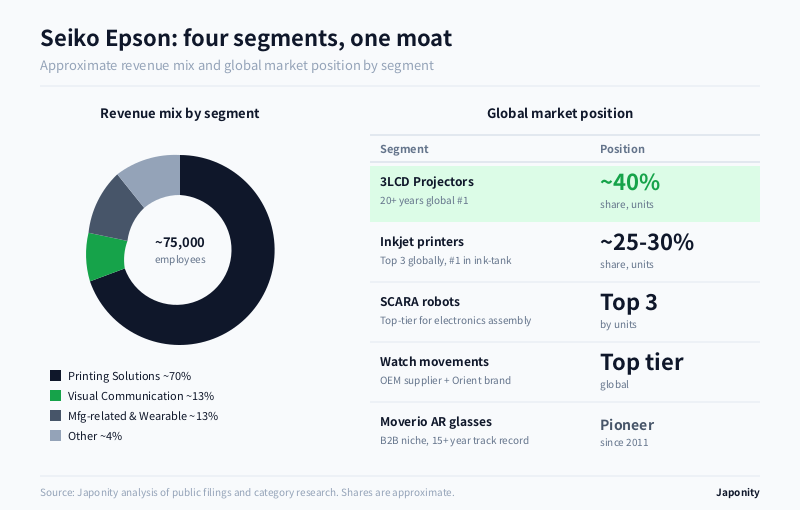
Today’s Seiko Epson is organised around four operating segments that, taken together, reveal a coherent thesis: precision micro-mechanical engineering applied wherever ink, light, or movement must be controlled with sub-micron accuracy.
| Segment | Approximate share of revenue | Flagship products | Global market position |
|---|---|---|---|
| Printing Solutions | ~70% | EcoTank, WorkForce, PageWide, SureColor, commercial label presses | Top 3 globally in inkjet; #1 in ink-tank category |
| Visual Communication | ~13% | 3LCD projectors, Moverio smart glasses | #1 globally in projectors (~40% share by units) |
| Manufacturing-related & Wearable | ~13% | SCARA & 6-axis robots, watch movements, quartz crystals, semiconductors | Top-tier in SCARA robots; legacy leadership in quartz |
| Other | ~4% | IC test handlers, factory automation services | Niche but high-margin |
What stitches these segments together is a single underlying capability — piezoelectric micro-actuation. The piezo crystal that vibrated at 32,768 hertz to make the Astron tick is the conceptual ancestor of the piezo element that fires a sub-picolitre droplet of ink in a PrecisionCore printhead, the same family of technology that drives the precision-positioning servos in a SCARA robot. This is not marketing convenience; it is genuine engineering lineage, and it is the moat.
The inkjet revolution
For the better part of three decades, office printing was a duopoly: Hewlett-Packard at the top, Canon close behind, with thermal-inkjet technology firing droplets by boiling ink against a resistor. Seiko Epson, locked out of the thermal-inkjet patent thicket, took a different road. From its earliest dot-matrix days the company had bet on the piezo principle — using a vibrating crystal to physically push ink, rather than heat to boil it. For years that bet looked like a stranded asset. By the late 2010s it had become a strategic moat.
PrecisionCore, launched in 2013 and refined relentlessly thereafter, is the printhead architecture that finally let Seiko Epson take piezo from a consumer curiosity into the enterprise. A single PrecisionCore chip combines tens of thousands of micro-nozzles, fires ink at frequencies above 50 kilohertz, and — crucially — does so without heat, which means longer printhead life, cooler operation, and dramatically lower energy consumption than the thermal alternative. The WorkForce and PageWide enterprise families wrap that printhead in office-printer chassis priced to compete with laser; the EcoTank family wraps it in consumer printers with refillable ink tanks that famously cost a fraction of cartridge prices over a printer’s lifetime.
The market consequence has been visible. In the global inkjet category, Seiko Epson has moved from challenger to co-leader, and in the ink-tank sub-category — the single fastest-growing slice of the printer market in emerging economies — it is the undisputed leader. The competitive picture below is a snapshot of the global inkjet landscape; the precise rankings rotate by quarter and region.
| Inkjet printer manufacturer | Approximate global share | Core technology | Strategic posture |
|---|---|---|---|
| HP Inc. | ~35-40% | Thermal inkjet | Cartridge subscription, enterprise managed services |
| Seiko Epson | ~25-30% | Piezo (PrecisionCore) | EcoTank ink-tank, PageWide enterprise, energy efficiency |
| Canon | ~20-25% | Thermal inkjet (Bubble Jet) | Photo & consumer focus, MegaTank tank refill |
| Brother | ~8-10% | Piezo | SMB workgroup focus, INKvestment refill ecosystem |
| Others (Kyocera, Ricoh, etc.) | ~5-10% | Various | Vertical / industrial niches |
The deeper point is sustainability. Independent life-cycle analyses have consistently shown PrecisionCore-based office printers consuming a fraction — typically between one-tenth and one-third — of the electricity of comparable laser printers. In a corporate world increasingly required to report Scope 2 emissions, that is no longer an engineering curiosity but a procurement criterion. The “heat-free” marketing line that has accompanied Epson’s enterprise push is, beneath the slogan, a measurable energy-policy argument.
The projector that nobody noticed
If Seiko Epson’s inkjet position is famous, its projector position is famously invisible. For more than twenty consecutive years — a streak almost without parallel in consumer electronics — Seiko Epson has been the global number-one maker of front projectors by unit shipments, with a market share that has hovered around 40 percent and at times approached half of the entire global market.
The technology behind that dominance is 3LCD, a Seiko Epson-developed architecture that splits a lamp’s white light into red, green, and blue beams, drives each through a dedicated LCD panel, and recombines them through a dichroic prism. Compared with the DLP (Digital Light Processing) technology that dominates the cinema-projector market and is licensed by Texas Instruments to competitors such as BenQ and Optoma, 3LCD delivers brighter colour at lower lumen counts, no rainbow artefact, and — for the boardroom, classroom, and home-theatre use cases that dominate the front-projector market — measurably better colour fidelity at any given price point.
It is a market that has been written off repeatedly. Flat-panel televisions were supposed to kill front projection in the home. Wall-sized LED displays were supposed to kill it in the boardroom. Neither has happened, because the economics of projection at scale — a hundred-inch image for the price of a fifty-inch panel — remain unbeatable. Seiko Epson’s projector business is the quiet beneficiary, generating consistent margin from education, signage, corporate AV, and an increasingly serious laser-projection upgrade cycle.
Robots, wearables, and the long tail of precision
The third leg of the Seiko Epson stool is the easiest to underestimate. The company is one of the world’s leading makers of SCARA (Selective Compliance Assembly Robot Arm) robots — the four-axis arms that dominate small-parts assembly in electronics, medical devices, and consumer goods. It is also a serious player in six-axis articulated robots and in the high-precision controllers that drive both. Seiko Epson’s robot heritage is not an acquisition but an internal capability built originally to automate the company’s own watch and printer assembly lines, and then commercialised for the wider factory automation market.
The wearable business — the direct corporate descendant of the original Suwa watch operation — continues as a manufacturer of high-end mechanical and quartz movements (sold both under Epson’s own Orient brand, acquired in 2009, and as an OEM supplier) and of quartz-crystal devices, sensors, and semiconductor timing components. It is the smallest of the segments but the one that connects the company most directly to its 1942 origin.
And then there is Moverio, the AR smart-glasses platform that Seiko Epson launched in 2011, years before Apple, Meta, or Magic Leap turned the category into headline news. Moverio remains a deliberately niche, B2B-focused product family — used in drone piloting, surgical assistance, industrial maintenance, and museum guides — but its quiet persistence over more than a decade is a useful reminder of how Seiko Epson operates: it picks a hard problem, develops the underlying optics in-house, ships a product, and then waits.

The 2014 split — and the financial case
For non-Japanese investors the single most important corporate fact about Seiko Epson is the 2014 management separation from Seiko Holdings. Until that point Seiko Epson and Seiko Watch (the original Seiko-branded watch business, today operated by Seiko Watch Corporation under Seiko Holdings, Tokyo Stock Exchange code 8050) shared significant cross-ownership and were frequently confused by foreign analysts as the same company. They are not. Since 2014 they have been separately managed and separately listed, with their own boards, strategies, and capital allocation. Seiko Epson today retains the “Seiko” prefix as a matter of heritage, but its commercial destiny is independent.
That independence has allowed Seiko Epson to do something Japanese corporations have historically struggled with: simplify. Under president Yasunori Ogawa the company has explicitly pivoted away from low-margin commodity printing toward enterprise inkjet, sustainable office hardware, projector services, and factory automation — and has demonstrated a willingness to exit businesses that do not earn their capital. The company’s medium-term plan, “Epson 25 Renewed,” targets revenue growth driven by office inkjet replacement of laser, expansion of high-brightness laser projectors, and growth in industrial robotics.
Why it matters
Strip away the catalogue and Seiko Epson stands for a specific Japanese industrial idea: that an unbroken chain of precision micro-engineering, applied patiently across changing product categories, compounds into a durable competitive position. The piezo crystal that drove a 1969 wristwatch drives a 2026 office printhead. The optical engineering that allowed a Suwa craftsman to align a watch escapement with sub-micron tolerance is the same engineering that aligns the dichroic prisms of a 3LCD projector. The factory automation that originally assembled tiny watch parts now sells as a SCARA robot. This is the kind of company that does not generate headlines but does generate cash flow.
For investors, partners, and policymakers thinking about how Japan competes globally over the next decade, Seiko Epson is a case study worth more attention than it receives. It is not a chip designer, not a content company, not an AI lab. It is something arguably rarer: a precision-manufacturing compounder, with a moat measured in micrometres, operating in B2B markets that almost no consumer notices but every enterprise pays for. That, in the Japanese mid-cap landscape, is a strikingly under-appreciated proposition.
FAQ
Is Seiko Epson the same company as Seiko?
No. Although Seiko Epson originated in 1942 as a wartime watch-parts operation of the Seiko Group, and the two companies shared management until 2014, they have been separately operated ever since. Seiko Watch Corporation (under Seiko Holdings, TSE 8050) makes Seiko-branded watches. Seiko Epson Corporation (TSE 6724) makes printers, projectors, robots, and movements for third-party watch brands.
How dominant is Seiko Epson in the projector market?
Seiko Epson has been the global number-one maker of front projectors by unit shipments for more than twenty consecutive years, with market share consistently around 40 percent — a position based on its proprietary 3LCD architecture and a vertically integrated supply of LCD panels and optics.
What is PrecisionCore and why does it matter?
PrecisionCore is Seiko Epson’s piezoelectric inkjet printhead architecture, launched in 2013. Unlike thermal inkjet technology used by HP and Canon, PrecisionCore fires ink mechanically without heat, allowing higher firing frequencies, longer printhead life, and dramatically lower energy consumption than competing laser and thermal-inkjet office printers — a key reason the technology has gained share in enterprise procurement.
Where is Seiko Epson headquartered?
The company is headquartered in Suwa, Nagano Prefecture, on the site of the original 1942 wartime watch-parts operation. It is one of the largest private employers in the Nagano region and retains a deep relationship with the Suwa engineering ecosystem.
What is the company’s strategic priority for the next decade?
Under the “Epson 25 Renewed” medium-term plan, Seiko Epson’s stated priorities are accelerating the replacement of laser printers with energy-efficient enterprise inkjet (PageWide, WorkForce), expanding high-brightness laser projector adoption in education and signage, growing factory automation and robotics revenue, and reducing the company’s own environmental footprint through “heat-free” manufacturing.
Working with Seiko Epson
Japonity supports international businesses, distributors, and procurement teams seeking to engage with Seiko Epson — whether as enterprise customers evaluating office-printer fleets, integrators specifying 3LCD projectors for education or signage, OEM watch brands sourcing movements, or industrial buyers deploying SCARA robots. To explore introductions or partnership opportunities, visit our Business Matching portal.
Related from Japonity — Japan’s electronics & IT services
- Panasonic Holdings — Tesla batteries, airline IFE and consumer appliances under one holdco
- Sharp Corporation — The Foxconn rescue eight years on — pivot from large-TV LCDs
- Fujitsu — The PC giant that bet its future on services — Fugaku to Uvance
- NEC Corporation — Defence, biometrics, undersea cable — Japan’s under-appreciated tech infra
Want to source Japanese products beyond these company profiles? Japonity also runs a Japan Sourcing Hub — a research-grade catalogue of 1,185 verified Japanese food products and 200+ overseas EC stores, ready for B2B procurement.
Interested in Japanese business opportunities?
Whether you're looking for technology partners, engineering talent, or market insights — we can help connect you with the right Japanese organizations.
Get in Touch →