Japan has nine regional power monopolies, but only one of them generates roughly half of its electricity from nuclear reactors. Kansai Electric Power Company — known almost everywhere except in its own annual reports as KEPCO — is the utility that serves Osaka, Kyoto, Kobe and the rest of western Japan’s industrial heartland, and it is the country’s most nuclear-dependent grid operator by a distance. In the years before the 2011 Fukushima disaster, approximately 50% of its electricity came from atomic fission. After Fukushima, when every reactor in Japan went dark, KEPCO led the restart queue: seven of its eleven reactors are now operating again, more than the rest of the country combined. That technical achievement sits awkwardly alongside the 2019 revelation that senior executives had accepted approximately ¥320 million in cash and gold from a contractor in Fukui Prefecture, where most of KEPCO’s reactors are located. The scandal forced out the chairman, the president and most of the board, and reshaped Japan’s conversation about how a regulated monopoly should be governed. Six years on, KEPCO is simultaneously the most operationally capable nuclear utility in the country and its most politically scrutinised — a contradiction that defines the next decade of Japanese energy policy.
The Kansai grid and why it matters
KEPCO was incorporated in May 1951, when General Headquarters of the Allied Occupation broke up the wartime power monopoly Nippon Hassoden and parcelled out generation and distribution to nine regional companies. The Kansai franchise covers Osaka, Kyoto, Hyogo, Nara, Shiga, Wakayama and parts of Fukui and Mie prefectures — approximately 28,000 square kilometres of territory housing 22 million residents and an industrial base that includes Panasonic, Daikin, Murata, Nidec, Shimano and the Sharp campus in Sakai. The company serves approximately 12 million electricity customers and another seven million through its gas, telecoms and overseas businesses. Headquartered in Nakanoshima, Osaka, the group employs approximately 32,000 staff and trades in Tokyo under the code 9503.
Kansai’s industrial mix has always made it more electricity-hungry per capita than Tokyo’s. Heavy chemicals, precision components, steel at the old Sumitomo Kinzoku works and a dense rail network all draw continuous baseload power. That demand profile, combined with the absence of large domestic coal or gas reserves anywhere near Osaka, is the historical reason KEPCO bet so heavily on nuclear: by the late 1990s the company operated eleven reactors across three sites in Fukui Prefecture, more than any other Japanese utility, and was producing approximately half of its electricity from them.
Why nuclear became KEPCO’s identity
The decision to concentrate eleven reactors in a single prefecture — all of them along a stretch of the Sea of Japan coast — was deliberate. Fukui’s bays were geologically suitable, sparsely populated, and politically receptive after the 1970s oil shocks made the central government desperate for indigenous energy. KEPCO secured host community agreements with the towns of Mihama, Ohi and Takahama, and built out three plants in sequence between 1970 and 1993. The combined nameplate capacity reached approximately 9.8 gigawatts, equivalent to roughly a third of the company’s entire generating fleet on paper, and a much higher share in practice because nuclear plants run at capacity factors of 80 to 90 percent compared with 40 to 60 percent for thermal stations.
Before Fukushima, KEPCO’s nuclear share peaked at approximately 55% of generated electricity in fiscal 2010 — the highest of any major Japanese utility. The figure for Tokyo Electric Power was approximately 28%, and for Kyushu Electric approximately 39%. KEPCO’s fuel cost per kilowatt-hour was correspondingly the lowest of the nine regionals, and its industrial tariffs were the most competitive in Japan, which is one reason so much precision manufacturing clustered in the Kansai corridor in the first place.
March 2011 and the long shutdown
The Tohoku earthquake and the Fukushima Daiichi meltdowns 600 kilometres to the northeast did not damage any KEPCO reactor, but they did terminate, almost overnight, the political consensus that had underpinned Japanese nuclear power since the 1970s. Within fourteen months every reactor in Japan was offline. KEPCO’s Ohi 3 and Ohi 4 briefly restarted in 2012 under emergency provisions, but the new Nuclear Regulation Authority — created in 2012 specifically to break the cosy relationship between the old Nuclear and Industrial Safety Agency and the utilities — shut them again in September 2013 and required all operators to re-license each unit against post-Fukushima standards.
The cost to KEPCO was enormous. The company reported approximately ¥250 billion of net losses in fiscal 2012 and again in fiscal 2013 as it burned imported liquefied natural gas to replace lost nuclear output. It cut its dividend, sold non-core property, and raised industrial tariffs by approximately 17%. By 2014 the share price had fallen to less than half of its pre-Fukushima level. The trauma of those years explains, in part, why the company pushed so hard to be first in the restart queue once the new safety regime stabilised — and why its relationship with Fukui Prefecture became existential rather than merely commercial.
The restart sequence — and what it cost
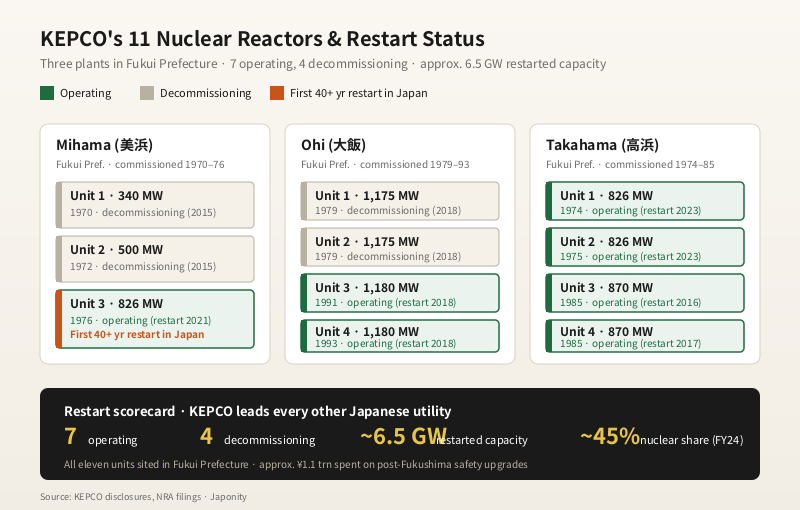
Japan’s reactor restart process under the post-2013 rules is approval one unit at a time after a multi-year safety review, a local government consent vote, and the installation of new tsunami walls, filtered venting systems, and reinforced control buildings. KEPCO’s restarted fleet is set out below.
| Reactor | Capacity (MW) | Commissioned | Restart status | Notes |
|---|---|---|---|---|
| Mihama 1 | 340 | 1970 | Decommissioning | Retired 2015 |
| Mihama 2 | 500 | 1972 | Decommissioning | Retired 2015 |
| Mihama 3 | 826 | 1976 | Operating (restarted 2021) | First 40+ year reactor restart in Japan |
| Ohi 1 | 1,175 | 1979 | Decommissioning | Retired 2018 |
| Ohi 2 | 1,175 | 1979 | Decommissioning | Retired 2018 |
| Ohi 3 | 1,180 | 1991 | Operating (restarted 2018) | — |
| Ohi 4 | 1,180 | 1993 | Operating (restarted 2018) | — |
| Takahama 1 | 826 | 1974 | Operating (restarted 2023) | — |
| Takahama 2 | 826 | 1975 | Operating (restarted 2023) | — |
| Takahama 3 | 870 | 1985 | Operating (restarted 2016) | — |
| Takahama 4 | 870 | 1985 | Operating (restarted 2017) | — |
Seven units are running. Four — Mihama 1 and 2, Ohi 1 and 2 — are being decommissioned, a process that will take into the 2040s and cost approximately ¥350 billion across the four. The seven operating units together produce approximately 6.5 gigawatts of baseload, equivalent to roughly 30% of KEPCO’s generation portfolio, and nuclear’s share of company output is now back to approximately 45% — higher than anywhere else in Japan and not far below the pre-Fukushima peak.
To get there, KEPCO spent approximately ¥1.1 trillion on post-Fukushima safety upgrades across the three sites — seismic reinforcement, taller tsunami walls, redundant cooling water sources, hardened control rooms and emergency mitigation centres. The Mihama 3 restart in 2021 was the technical milestone: it was the first time a Japanese reactor older than forty years had been brought back into commercial operation, an outcome that required a separate license-extension review that runs to twenty years beyond the original forty-year licence.
The 2019 Fukui scandal
In September 2019 the Asahi Shimbun and Kyodo News reported that approximately twenty current and former KEPCO executives had received approximately ¥320 million in cash, gold coins, gold bars, suits and luxury goods over a period of roughly seven years from Eiji Moriyama, the late deputy mayor of Takahama Town — the host community of Takahama Nuclear Plant — acting in conjunction with a local construction contractor that received KEPCO work. The chairman, Makoto Yagi, and the president, Shigeki Iwane, both resigned in October 2019. A third-party investigation chaired by former prosecutor general Akira Kohama published a report in March 2020 that confirmed the payments, found that senior management had been aware for years, and concluded that the board’s compliance culture had failed.
The Fair Trade Commission later imposed an approximately ¥70 billion fine in 2023 on KEPCO and three other major utilities for a separate cartel agreement to avoid competing in each other’s territories — the largest antitrust penalty in Japanese history. Although the cartel case was procedurally distinct from the Moriyama affair, the back-to-back scandals reinforced the political view that the regional monopoly model had bred complacency. The Diet has since debated structural separation of generation and retail more aggressively, and the Agency for Natural Resources and Energy has signalled that further consolidation among the nine regionals is on the table.
Governance reset and the Mori era
Hiroaki Mori, a career engineer who had managed the Takahama plant in the 1990s, was appointed president in June 2020 with an explicit remit to rebuild the compliance function. KEPCO created a dedicated chief compliance officer position reporting directly to the board, set up an external whistleblowing channel, and introduced cooling-off rules barring executives from contact with major contractors for two years after leaving office. The number of independent outside directors was raised to approximately a third of the board.
Hideki Mizuta succeeded Mori as president in 2024, with Mori moving to chairman. Mizuta has signalled three priorities: continuing the nuclear restart agenda (the company is still pursuing further licence extensions for the Takahama 1 and 2 units, both now over fifty years old), accelerating the build-out of an approximately 5 gigawatt renewable portfolio by 2030, and expanding the overseas independent power producer business that already operates in approximately ten countries including the United Kingdom, Indonesia and the United States.
Comparing the majors
KEPCO’s situation is best understood in comparison with the other former regional monopolies. The table below sets out the three largest by customer base alongside a regional benchmark.
| Utility | HQ | Customers (approx.) | Nuclear share of output (FY24, approx.) | Reactors operating |
|---|---|---|---|---|
| Tokyo Electric Power (TEPCO) | Tokyo | 29 million | 0% | 0 of 17 (incl. Kashiwazaki-Kariwa) |
| Kansai Electric (KEPCO) | Osaka | 12 million | ~45% | 7 of 11 |
| Chubu Electric (CHUDEN) | Nagoya | 10 million | 0% | 0 of 3 (Hamaoka) |
| Kyushu Electric (KYUDEN) | Fukuoka | 9 million | ~36% | 4 of 6 |
The contrast with Tokyo Electric is the starkest. TEPCO is a larger company by revenue and customer count, but its nuclear fleet has been almost entirely idle since Fukushima — Kashiwazaki-Kariwa, the world’s largest nuclear plant by nameplate capacity, has been waiting for restart approval since 2017 and is held up by both regulator concerns and local political opposition. KEPCO meanwhile has used the past decade to consolidate operational expertise that no other Japanese utility can match. That expertise is now an export asset: KEPCO engineers consult on plant operations and maintenance in Saudi Arabia, the United Arab Emirates and the United Kingdom.
The next decade — and the risks
Three questions will define KEPCO over the next decade. The first is whether further licence extensions will be granted. Mihama 3, Takahama 1 and Takahama 2 are now operating under twenty-year extensions beyond the original forty-year licence, but Japanese law currently caps reactor life at sixty years total. The May 2023 GX Decarbonisation Power Supply Act amended the framework to allow extensions beyond sixty years if the time spent offline during the post-Fukushima safety review is deducted. Whether the Nuclear Regulation Authority approves such an extension for Mihama 3 — which would be the test case — will determine how much value the existing fleet ultimately delivers.
The second is renewables. KEPCO is the largest hydroelectric operator in Japan with approximately 8 gigawatts installed, but its solar and wind footprint is small relative to its generation total. The company has committed to an approximately 5 gigawatt renewable build by 2030 and is pursuing offshore wind concessions off the Hokkaido and Tohoku coasts — both outside its franchise area, which is permissible under the post-2016 retail liberalisation. Execution risk is significant: Japanese offshore wind has had a difficult first auction cycle and project IRRs are under pressure from rising steel and cable costs.
The third is the structural reform question. Japan’s electricity market was unbundled in 2020 — generation, transmission and retail are now legally separate businesses inside each former monopoly — but the Big Ten still own both the transmission grids in their regions and the largest retail customer books. The Federal Trade Commission of Japan, the Diet’s energy committee, and a growing chorus of new-entrant retailers argue that fuller separation is necessary to make the retail market genuinely competitive. KEPCO would be the most affected: its transmission subsidiary, Kansai Transmission and Distribution, was spun off in 2020 but remains a wholly owned subsidiary. Full divestment would significantly change the company’s balance sheet.
For international partners — equipment vendors, fuel suppliers, decommissioning contractors, renewables developers — KEPCO is a complicated but increasingly approachable counterparty. The procurement process has been opened up since 2020, the compliance regime is more transparent than at any time in the company’s history, and the management bandwidth that the scandal-recovery years consumed is now available for commercial conversations. Japan’s most controversial utility is also, in many respects, its most strategically interesting.
FAQ
How much of KEPCO’s electricity comes from nuclear today?
Approximately 45% in fiscal 2024, up from near zero in the years immediately after Fukushima and approaching the pre-2011 peak of approximately 55%. Seven of the company’s eleven reactors are operating; the other four are being decommissioned.
What was the 2019 Fukui scandal about?
Approximately twenty current and former KEPCO executives accepted approximately ¥320 million in cash and gifts over seven years from Eiji Moriyama, the late deputy mayor of Takahama Town, in connection with construction work at the Takahama Nuclear Plant. The chairman and president resigned in October 2019, and a third-party investigation in March 2020 confirmed governance failures across the senior leadership.
Is Mihama 3 really Japan’s first restarted 40-year-old reactor?
Yes. The unit, commissioned in 1976, returned to commercial operation in 2021 under a twenty-year licence extension granted by the Nuclear Regulation Authority. It was the first reactor in Japan to receive such an extension and operate beyond the original forty-year design life.
How does KEPCO compare with Tokyo Electric Power?
TEPCO is roughly 2.4 times larger by customer base but currently has zero operating nuclear reactors. KEPCO operates seven units. As a result, KEPCO’s generation cost per kilowatt-hour is materially lower than TEPCO’s, and its industrial tariffs in Kansai remain among the most competitive in Japan.
What does KEPCO do outside Japan?
The company operates as an independent power producer in approximately ten countries through the Kanden Power Tech and Kansai Electric International subsidiaries. Assets include gas and renewable projects in the United Kingdom, the United States, Indonesia, the Philippines, Saudi Arabia and Australia. Engineering and operations consulting services are also exported, particularly to Gulf countries building first-generation nuclear fleets.
Working with Kansai Electric
Japonity’s Business Matching programme helps international companies engage with Japanese utilities including KEPCO across nuclear services, renewables development, grid technology, decommissioning supply chains and overseas IPP partnerships. We connect foreign equipment vendors, financial sponsors and technology providers with the right counterparties inside the Big Ten regional utility groups, and we brief on the procurement, regulatory and governance context that determines whether a conversation goes anywhere. Talk to us if Kansai — or Japanese energy more broadly — is on your map.
Related from Japonity — Japan’s electric & gas utilities
- TEPCO Holdings — Japan’s largest utility, still rebuilding from Fukushima
- Chubu Electric Power — Toyota’s home-region utility and the JERA LNG empire
- Tokyo Gas — Japan’s largest gas utility — and an LNG arbitrageur
- Osaka Gas — Japan’s #2 gas utility and its US oil-and-gas pivot
Want to source Japanese products beyond these company profiles? Japonity also runs a Japan Sourcing Hub — a research-grade catalogue of 1,185 verified Japanese food products and 200+ overseas EC stores, ready for B2B procurement.
Interested in Japanese business opportunities?
Whether you're looking for technology partners, engineering talent, or market insights — we can help connect you with the right Japanese organizations.
Get in Touch →