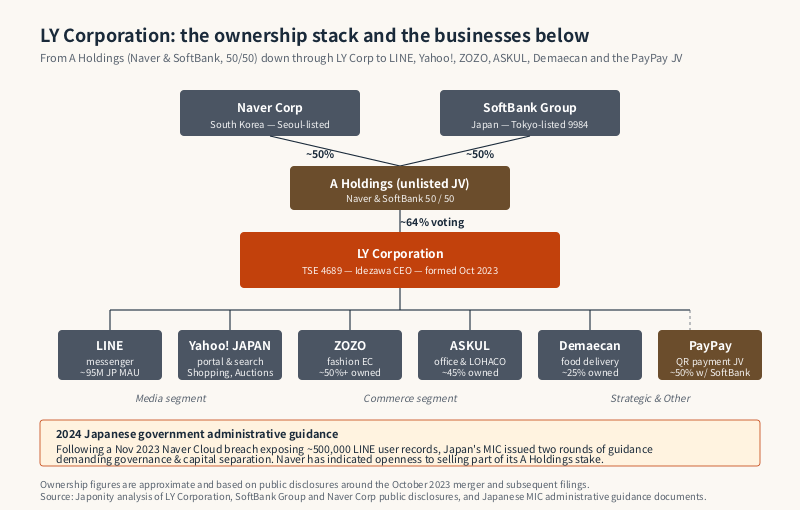
Walk into any Japanese coffee shop, train carriage or government office and watch the screens around you. The green-bubble interface that dominates almost every smartphone belongs not to WhatsApp or Messenger but to LINE, the messaging app that approximately 95 million people in Japan — close to four-fifths of the population — open on a typical month. The portal whose stock-ticker headlines, weather radars and auction listings have shaped Japanese internet behaviour since the late 1990s is Yahoo! JAPAN. The QR-code payment scanner the cashier waves at the register is, more often than not, PayPay. Behind all three sits a single Tokyo-listed holding company: LY Corporation, the entity formed in October 2023 from the merger of Yahoo Japan and LINE under the former Z Holdings umbrella, and ultimately controlled by A Holdings, a 50-50 joint venture between SoftBank Group and South Korea’s Naver. When a 2023 cyber breach traced back to Naver Cloud exposed approximately 500,000 LINE user records, Japan’s Ministry of Internal Affairs and Communications issued two rounds of administrative guidance in 2024 demanding governance and capital separation from the Korean parent — turning what looked like a corporate-IT incident into a window on Tokyo’s evolving view of foreign control over critical digital infrastructure.
From two near-monopolies to one super-app holding company
The Japanese internet that LY Corporation now anchors was built in two parallel streams that took twenty-five years to converge.
Yahoo! JAPAN was founded in January 1996 as a joint venture between SoftBank, the publishing-and-distribution company that Masayoshi Son was rapidly reorienting around the web, and Yahoo Inc. of the United States. Within a few years it had eclipsed both its American parent and every domestic search rival, becoming the country’s default portal in a way no Western analogue ever achieved. Through the 2000s Yahoo Japan layered on Yahoo! Auctions — Japan’s eBay, only larger relative to the market — Yahoo! Shopping, News, Finance and Real Estate, accumulating category-leading verticals tied together by a single login. The American Yahoo’s decline never touched the affiliate; SoftBank steadily bought down the US stake, and by 2019 Yahoo Japan rebranded its holding company as Z Holdings to signal the separation.
LINE Corporation grew from a very different impulse. After the Great East Japan Earthquake of March 2011 disrupted telephone networks, NHN Japan — a subsidiary of the Korean internet group Naver — built a smartphone messaging app whose stickers, free voice calls and group chats were designed for the post-disaster need to confirm that loved ones were safe. Launched in June 2011, LINE grew to tens of millions of users within eighteen months and dual-listed on Tokyo and New York stock exchanges in July 2016. It became dominant in Taiwan and Thailand and meaningful in Indonesia, and around the core messenger accumulated LINE News, LINE Manga, LINE Music, LINE Pay, a telecom MVNO and the LINE Sticker creator economy.
The two firms competed across news, payment and content but never quite collided in a single product. In November 2019 SoftBank and Naver announced a business integration; after antitrust review it closed in March 2021, with Yahoo Japan’s parent Z Holdings absorbing LINE Corp. The new structure placed A Holdings — owned 50 percent by SoftBank and 50 percent by Naver — at the apex, with Z Holdings as the listed operating company. In October 2023 the group simplified further: Z Holdings, LINE Corp and Yahoo Japan were merged into a single entity renamed LY Corporation, with Takeshi Idezawa, the longtime LINE chief executive, serving as president of the combined company. The Tokyo Stock Exchange ticker remained 4689.
The four segments under one roof
LY Corporation today reports its business through four segments. The composition tells the story of a holding company stitched together from very different fabrics.
| Segment | Anchor assets | Core revenue model | Strategic role |
|---|---|---|---|
| Media | LINE messenger, Yahoo! JAPAN portal, LINE News, Yahoo! News | Display and search advertising, account-based marketing | Reach engine: the surface where Japanese consumers spend daily attention |
| Commerce | Yahoo! Shopping, Yahoo! Auctions, ZOZOTOWN, ASKUL, LOHACO, LINE Gift | GMV-based commissions, fulfillment fees, paid placement | Transaction engine: monetising the audience the Media segment captures |
| Strategic | PayPay-related services, fintech, advertising-tech subsidiaries | Payment fees, financial-services interchange, ad-tech licensing | Compounding engine: high-growth bets that may become future cores |
| Other | Demaecan food delivery, IPX (sticker IP), telecom MVNO, smaller content services | Mixed transaction, subscription and licensing fees | Optionality bucket: businesses LY chooses neither to scale aggressively nor to divest |
Two structural observations follow from that table. First, the Media segment remains the engine on which everything else rides. Approximately 95 million Japanese monthly active users on LINE, layered on top of the country’s most-visited portal in Yahoo! JAPAN, produces an audience aggregation that no other Japanese platform can replicate; Rakuten reaches comparable customers through its membership scheme but does not own the daily-communication surface. Second, the Commerce segment is unusually portfolio-shaped. Rather than running a single owned-and-operated marketplace in the Amazon model, LY operates a federation of category-leading subsidiaries — ZOZO in fashion, ASKUL in office supplies, Yahoo! Shopping as a long-tail merchant marketplace — each kept under its own brand and management team. The federation approach delivers category depth at the cost of cross-platform integration that LY is still in the process of building.
The subsidiaries: ZOZO, ASKUL, Demaecan
The names attached to LY Corporation’s commerce engine are themselves household brands in Japan, and worth examining individually because they reveal how the holding company exercises control.
ZOZO operates ZOZOTOWN, Japan’s dominant fashion e-commerce marketplace, listing roughly 1,500 apparel brands and shipping from a centralised fulfilment centre in Chiba. Founded by entrepreneur Yusaku Maezawa — better known internationally for his commissioned SpaceX moon flight and his art-collecting — the company was acquired by Z Holdings in 2019, with Yahoo Japan taking just over 50 percent through a tender offer. ZOZO retains a separate Tokyo listing and operational autonomy, but its fashion-category gravity now flows into Yahoo! Shopping search results and LINE-based marketing campaigns. The strategic ambition is to make ZOZO the apparel layer of a federated commerce system rather than a standalone destination.
ASKUL is the B2B counterpart. Founded in 1993 inside paper-maker Plus Corporation to deliver office supplies the next day to small and mid-sized businesses, ASKUL grew into the leading Japanese channel for office consumables and, through its consumer-facing LOHACO joint venture with Yahoo Japan, into household goods as well. Z Holdings holds approximately 45 percent. The relationship had been turbulent — a 2019 boardroom dispute over the LOHACO joint venture briefly fractured trust — but the businesses were rewoven into the LY federation, with ASKUL’s logistics network giving Yahoo! Shopping next-day delivery capability that previously required separate carrier contracts.
Demaecan, the country’s number-two food-delivery platform behind Uber Eats, sits in the strategic-investment column at roughly 25 percent ownership through LY’s subsidiary structure. The pandemic-era food-delivery boom drew aggressive investment from LY and from Naver, and the platform has been used as a testing ground for LINE-based ordering flows and PayPay-based settlement. The economics of food delivery in Japan remain difficult, and Demaecan’s profitability has been elusive, but the strategic role — anchoring the courier-network and last-mile capability for a future super-app — is the case management makes internally.
Beyond the headline three, LY owns IPX (the sticker and IP-licensing business), various advertising-technology subsidiaries, a smartphone MVNO, and LINE Manga, which competes with Kakao Piccoma and Shueisha’s Jump Plus in Japan’s digital-comics market.
PayPay: the payment that ate Japan
The most consequential single business associated with LY is, paradoxically, not a wholly owned subsidiary. PayPay Corporation is a joint venture between SoftBank Group and LY Corporation, with each holding roughly 50 percent, launched in October 2018 as Japan’s QR-code payment system finally caught up with the Chinese and Indian markets that had pioneered the format.
The first eighteen months of PayPay were a cash-burn campaign of remarkable scale. SoftBank deployed, by some estimates, more than 200 billion yen in user incentives, including a lottery campaign that paid back 20 percent of qualifying transactions to randomly selected winners. Skeptics dismissed the spend as a doomed attempt to dislodge cash and the Suica train-card ecosystem. By 2022 the skeptics were quiet: PayPay had passed 50 million registered users, was processing several billion transactions annually, and had achieved acceptance among small merchants where rival credit-card terminals had never penetrated.
The integration with LINE Pay — historically LY’s own payment product, with strong Taiwan and Thailand bases — has been gradual. Domestic LINE Pay merchants were progressively migrated to PayPay, and in 2024 LINE Pay’s domestic service was formally wound down in favour of PayPay rails. Within LY’s reporting, PayPay sits in the Strategic segment as an equity-method investment whose profitability is now improving from the heavy-loss launch years; its share of Japan’s cashless future is the bet that arguably matters most for the group’s long-term valuation.

The Naver breach and the limits of foreign control
In November 2023, LY Corporation disclosed that systems at Naver Cloud, the South Korean cloud provider that hosted parts of LINE’s infrastructure, had been compromised through a third-party contractor and that approximately 500,000 LINE user records — including some personally identifiable information — had been exposed. The technical incident was, by international standards, neither unusually large nor unusually sophisticated. The political reaction was.
In March 2024 Japan’s Ministry of Internal Affairs and Communications issued the first of two administrative guidance documents to LY Corporation. The guidance demanded not just remediation of the specific vulnerability but a structural review of the company’s reliance on Naver-controlled infrastructure, including a request that LY “reconsider capital relationships” with its Korean parent. A second guidance in April 2024 reinforced the direction. The implicit message was unmistakable: Tokyo regarded LINE not as ordinary commercial software but as critical communications infrastructure, and it was uncomfortable with operational dependency on a foreign company beyond its regulatory perimeter.
Naver responded by stating that it would consider selling part of its A Holdings stake to SoftBank, which would tilt the 50-50 parent structure decisively toward Japanese control. Negotiations through 2024 and into 2025 were lengthy and at times public; the South Korean government expressed concern about Japanese regulatory pressure on a Korean champion, and Korean media framed the episode as economic statecraft. The formal capital structure of A Holdings remains the 50-50 arrangement, but operational separations — LINE’s user-data infrastructure has been migrated away from Naver Cloud, and joint product development curtailed — have already changed the on-the-ground reality.
For LY Corporation the episode has been costly in management attention but clarifying in strategic terms. The company now operates with a stated objective of “data sovereignty” — keeping Japanese user data within Japanese-controlled infrastructure — that is unusually explicit for a private firm. For students of Japanese internet regulation, the affair is the clearest public statement to date of how Tokyo will treat foreign technology control as questions of national security blur into questions of consumer-platform governance.
The super-app question
The strategic ambition that ties the messaging, commerce, payment and content businesses together is the super-app: a single mobile surface, anchored on LINE, that lets a Japanese consumer message friends, read news, shop on Yahoo!, pay through PayPay, order delivery from Demaecan and access government services without leaving the app. The model is borrowed from China’s WeChat and Southeast Asian operators like Grab and Gojek, and has been the explicit destination of LY’s roadmaps since before the 2021 merger closed.
Progress has been uneven. The Mini App platform within LINE has gained traction with merchants and city-government services; My Number-linked identity flows are integrating with LINE accounts; PayPay transactions can be initiated from inside LINE for many merchants. But Japanese consumer behaviour does not yield easily to super-app concentration. Rakuten’s parallel ecosystem retains loyal users; Amazon Japan dominates long-tail product search that Yahoo! Shopping never fully captured; and the cultural preference for purpose-specific apps remains stronger in Japan than in China or Southeast Asia. LY has assembled the largest available toolkit for a Japanese super-app and is still in the early innings of using it.
Why the world should pay attention
For non-Japanese executives, three facts about LY Corporation matter beyond the local market context. The first is reach: approximately 95 million Japanese on LINE makes the platform the single most efficient way to deliver a marketing message to the Japanese consumer, and for any brand planning Japan entry, LINE Official Account and LINE Ads sit near the top of the channel-strategy list. The second is the regulatory signal: the 2024 administrative guidance establishes that Japan will use soft regulatory tools to push back against foreign control of platforms it considers critical, with implications that will be felt by Chinese, Korean and American technology firms operating in or considering Japan. The third is the payment rail: PayPay’s traction has made QR-code payment, which Japan resisted for half a decade after its East Asian neighbours adopted it, the fastest-growing settlement channel in the country.
What ties the three together is the recognition that Japan’s internet, often described abroad as small or fragmented, is in fact a deeply concentrated market where one holding company touches almost every consumer journey. LY Corporation is that holding company, and the story of how it was assembled — from a SoftBank-Yahoo joint venture in 1996, a Korean-built messenger in 2011, a politically charged merger in 2021 and a reshaping under regulatory pressure from 2024 onward — is the story of how Japan ended up with the digital infrastructure it now has.
FAQ
Who owns LY Corporation?
LY Corporation is publicly listed on the Tokyo Stock Exchange (ticker 4689). Its largest shareholder is A Holdings, an unlisted joint venture owned approximately 50 percent by SoftBank Group and approximately 50 percent by South Korea’s Naver Corp. A Holdings holds approximately 64 percent of LY’s voting rights, with the remainder spread among institutional and retail investors. Following 2024 Japanese government administrative guidance, Naver has indicated it will consider reducing its stake in A Holdings.
What is the relationship between LINE, Yahoo! JAPAN and LY Corporation?
LINE and Yahoo! JAPAN are the two flagship operating brands of LY Corporation. Until October 2023 they sat under a holding company called Z Holdings, with LINE Corporation and Yahoo Japan Corporation as separate subsidiaries. In October 2023 the three entities were merged into a single legal entity named LY Corporation, while the consumer-facing LINE and Yahoo! JAPAN brands continue to operate as separate products.
How big is LINE in Japan and abroad?
LINE has approximately 95 million monthly active users in Japan, equivalent to roughly four-fifths of the country’s population aged 15 and above. Internationally it is the dominant messenger in Taiwan and Thailand and a significant player in Indonesia, with combined non-Japan monthly active users in the tens of millions. It has limited traction in the United States, China, India and Europe, where WhatsApp, WeChat and Telegram dominate respectively.
What is PayPay and how is it connected to LY Corporation?
PayPay is a QR-code mobile-payment service launched in 2018 as a joint venture between SoftBank Group and the predecessor to LY Corporation, with each side holding approximately 50 percent. LY Corporation’s PayPay-related businesses sit in the Strategic segment of its financial reporting and are accounted for largely on an equity-method basis. PayPay is Japan’s most-used QR-code payment brand by transaction count.
What was the 2024 administrative guidance about?
In March and April 2024 Japan’s Ministry of Internal Affairs and Communications issued two rounds of administrative guidance to LY Corporation following a 2023 cyber breach at Naver Cloud that exposed approximately 500,000 LINE user records. The guidance demanded improvements in information security and, controversially, a review of LY’s capital relationship with Naver. Naver subsequently indicated openness to selling part of its A Holdings stake, though as of publication the 50-50 SoftBank-Naver structure remains formally in place while operational separations have already been implemented.
Working with LY Corporation
For international brands, technology vendors and investors seeking to engage with LY Corporation — whether as a LINE Official Account partner, a Yahoo! Shopping merchant, a PayPay-integrated service provider, a ZOZOTOWN brand or a strategic investor in the wider Japanese internet ecosystem — Japonity’s business matching service can introduce you to the appropriate teams, advise on procurement and partnership processes specific to the Japanese platform context, and provide bilingual support throughout commercial discussions.
Related from Japonity — Japan’s telecom & digital ecosystems
- SoftBank Group — From PHS reseller to Arm + Stargate AI infrastructure giant
- Rakuten Group — The points-economy empire and the mobile bet that almost broke it
- DeNA — From Mobage to BayStars to Pococha to MaaS — Japan’s most under-appreciated reinvention
- NTT Corporation — Japan’s $140B telecom giant and the IOWN photonic-network bet
- KDDI Corporation — Japan’s #2 mobile carrier and the Mitsubishi-shosha-linked telco
Want to source Japanese products beyond these company profiles? Japonity also runs a Japan Sourcing Hub — a research-grade catalogue of 1,185 verified Japanese food products and 200+ overseas EC stores, ready for B2B procurement.
Interested in Japanese business opportunities?
Whether you're looking for technology partners, engineering talent, or market insights — we can help connect you with the right Japanese organizations.
Get in Touch →