Fourteen years after the Great East Japan Earthquake sent three reactors at Fukushima Daiichi into meltdown, the company that owned them is still, in essence, a ward of the Japanese state. The Nuclear Damage Compensation and Decommissioning Facilitation Corporation (NDF), a government-backed entity, holds a majority stake of roughly 50% or more in Tokyo Electric Power Company Holdings (TEPCO Holdings, TSE: 9501) — the largest electric utility in Japan and one of the largest in the world. The Nuclear Regulation Authority approved the restart of the Kashiwazaki-Kariwa Nuclear Power Plant, the world’s biggest by installed capacity, in December 2023, but local consent in Niigata Prefecture remains unresolved. Meanwhile, the decommissioning of Fukushima Daiichi — now expected to take 30 to 40 years and cost on the order of ¥8 trillion — has barely cleared its first major engineering milestones. No single Japanese company carries more political, technical, and reputational weight in the country’s energy debate.
From postwar reorganization to national grid backbone
TEPCO traces its corporate lineage to 1951, when the Allied occupation broke up Japan’s wartime electric power monopoly and reorganized the industry into nine regional utilities along the lines of US-style regulated monopolies. Tokyo Electric Power Company — Tokyo Denryoku — was assigned the Kanto region, including Tokyo, Yokohama, and the industrial belt that would, in the following decades, become the engine of Japan’s high-growth era. By the 1980s, TEPCO supplied roughly a third of Japan’s electricity and operated one of the densest, highest-frequency power grids in the world.
For half a century the company was, in the language of Japanese corporate sociology, a “salaryman aristocrat” — a regulated, predictable, dividend-paying utility with deep ties to the Ministry of Economy, Trade and Industry (METI), the construction majors, and the heavy-industry conglomerates that built its reactors. Its headquarters in Uchisaiwaicho, a short walk from the Imperial Palace, signalled its status as part of Japan Inc.’s permanent infrastructure. That status survived oil shocks, currency revaluations, and the bursting of the bubble. It did not survive 11 March 2011.
The pre-2011 TEPCO was also a cultural institution. Its sponsorship reached into local festivals, university research chairs, and the editorial pages of major newspapers. Its bond issuances were, for Japanese institutional investors, the closest thing to risk-free corporate paper. Roughly one in eight yen of Japan’s lifetime household electricity bill flowed through its meters. To understand the political weight of what happened next, it helps to start from this baseline: a quasi-public utility, woven into the country’s financial and bureaucratic fabric, suddenly transformed into a national crisis manager.
The Fukushima inflection point
The magnitude 9.0 Tohoku earthquake and the tsunami that followed knocked out cooling at the Fukushima Daiichi Nuclear Power Plant, leading to core meltdowns in Units 1, 2, and 3 — the worst civilian nuclear accident since Chernobyl. Roughly 150,000 residents were evacuated. Compensation claims, decommissioning costs, and lost generation revenue threatened TEPCO with insolvency within months.
Rather than allow the company to fail, the Japanese government created a vehicle to nationalize it in all but name. The Nuclear Damage Liability Facilitation Fund, established in 2011 and reorganized in 2014 as the Nuclear Damage Compensation and Decommissioning Facilitation Corporation (NDF), injected capital in exchange for preferred and common shares that today represent a majority economic and voting interest. TEPCO continued to trade on the Tokyo Stock Exchange, but its capital structure, business plan, and reactor restart strategy now required NDF and METI sign-off. The era of TEPCO as a private regulated utility was over.
The legal architecture matters. The NDF can convert its preferred shares into common shares at its discretion, which means the government holds a permanent option on any upside in TEPCO’s equity. The Corporation’s mandate also explicitly links compensation funding, decommissioning oversight, and the structural reform of the company itself. In effect, TEPCO’s commercial recovery is the mechanism by which the state expects to recoup, over decades, the public funds advanced for victim compensation. That is a uniquely Japanese arrangement — neither full nationalization, as the United Kingdom undertook with Royal Bank of Scotland, nor a Chapter 11-style restructuring, as American utilities have used after catastrophic events. It is, instead, a long-duration public-private workout, with TEPCO as both the patient and the means of recovery.
The 2016 holding-company restructure
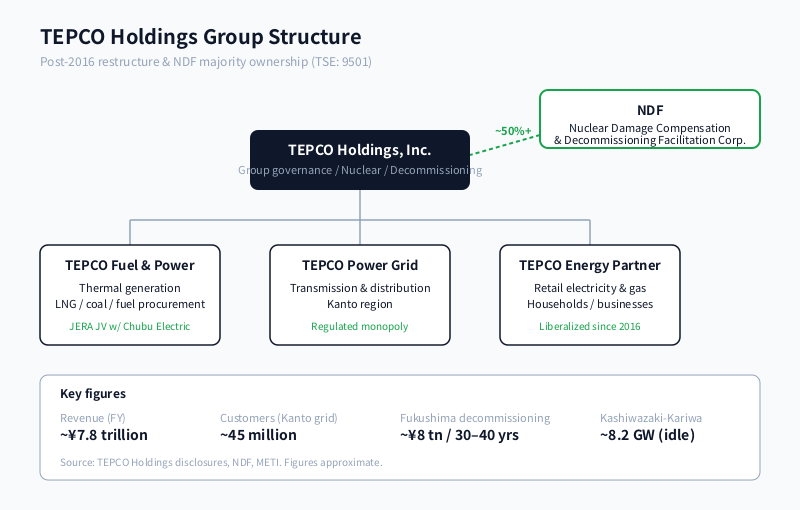
In April 2016, under pressure from regulators, creditors, and the government, TEPCO unbundled itself into a holding-company structure designed to ring-fence liabilities, separate competitive from regulated businesses, and prepare the grid for full retail electricity market liberalization. Tokyo Electric Power Company became Tokyo Electric Power Company Holdings, Inc., sitting above three principal operating subsidiaries plus the nuclear and decommissioning functions retained at the holding-company level.
| Entity | Function | Regulatory status |
|---|---|---|
| TEPCO Holdings | Group governance, nuclear operations, Fukushima Daiichi decommissioning, finance | Listed (TSE 9501); NDF majority owner |
| TEPCO Fuel & Power | Thermal power generation (LNG, coal); fuel procurement | JERA joint venture with Chubu Electric absorbs most thermal assets |
| TEPCO Power Grid | Transmission and distribution in the Kanto region | Regulated monopoly; legally unbundled |
| TEPCO Energy Partner | Retail electricity and gas sales to households and businesses | Fully liberalized market since April 2016 |
| NDF | Government-backed holding vehicle, decommissioning oversight | Special-purpose entity under METI |
The structure mirrors, on paper, the unbundling that European utilities such as E.ON and RWE went through a decade earlier. In practice, the integration runs deep: TEPCO Holdings still controls strategy, the JERA joint venture with Chubu Electric Power (now one of the world’s largest LNG buyers) absorbs much of the thermal generation business, and the Power Grid subsidiary operates under a regulated rate base that has come under repeated political scrutiny.
Decommissioning Fukushima Daiichi: the 40-year project
The single largest item on TEPCO’s balance sheet, in economic if not accounting terms, is the obligation to decommission Fukushima Daiichi. The site holds three reactors with melted fuel debris (corium), roughly 880 tonnes of which must be removed, packaged, and stored — a process for which no full-scale industrial precedent exists. TEPCO and the government have repeatedly extended both the timeline (now 30 to 40 years from the accident) and the cost estimate (now approximately ¥8 trillion when compensation, decontamination, and waste management are aggregated).
In 2023, TEPCO began the discharge of ALPS-treated water — water that had been used to cool the damaged reactors, filtered to remove most radionuclides except tritium, and diluted to well below international drinking-water standards. The International Atomic Energy Agency reviewed the discharge and found it consistent with global safety norms. China nonetheless imposed a sweeping ban on Japanese seafood imports, a diplomatic and trade shock that hit Japan’s fisheries sector hard and underlined how Fukushima decommissioning remains as much a foreign-policy file as a domestic engineering one.
Kashiwazaki-Kariwa and the restart equation
Japan’s energy security argument for restarting idled nuclear capacity has tightened sharply since 2022, when the war in Ukraine and a weaker yen pushed LNG import costs up. TEPCO’s Kashiwazaki-Kariwa Nuclear Power Plant in Niigata Prefecture — the largest nuclear plant in the world by installed capacity, with seven reactors totalling roughly 8.2 GW — has been offline since 2011. In December 2023, the Nuclear Regulation Authority (NRA) lifted the operational ban it had imposed in 2021 over security and safeguards failures at the site, clearing the regulatory path to restart.
The remaining hurdle is political. Under Japan’s de facto convention, restart requires consent from the prefectural governor, the host municipality, and neighbouring municipalities. Niigata Prefecture, under successive governors, has demanded further safety reviews and a clearer explanation of how the lessons of Fukushima have been applied. Each year of delay costs TEPCO an estimated several hundred billion yen in foregone generation and additional thermal fuel costs.
For investors, the Kashiwazaki-Kariwa restart is the single largest binary variable in the TEPCO equity story. A full restart of even one or two of the seven units would substantially reduce thermal fuel exposure, improve operating cash flow, and accelerate the timetable on which NDF preferred shares could begin to convert. A continued local impasse, by contrast, leaves the company structurally short of low-cost baseload and dependent on imported LNG at prices set by a global market it does not control. Tokyo’s energy planners are acutely aware of the asymmetry; Niigata’s electorate, fairly, asks why they should bear the host-community risk for power consumed in the capital.

The financial picture: rebuilt, not healed
TEPCO Holdings reported consolidated revenue of approximately ¥7.8 trillion in the most recent fiscal year, making it comfortably Japan’s largest utility by sales. Net income has fluctuated sharply with fuel prices and one-off Fukushima-related charges, but the underlying earnings power of the Power Grid subsidiary — a regulated, rate-based monopoly serving roughly 45 million people — remains the company’s economic anchor.
The capital structure tells the more interesting story. The NDF majority stake means that any equity issuance, dividend policy change, or major asset sale runs through a government-sponsored shareholder. Hiroshi Kobayakawa, who became president and CEO in 2024, inherited a company whose strategy is set as much in Kasumigaseki as in Uchisaiwaicho. The implicit deal: TEPCO operates as a commercial enterprise, but with the understanding that the cost of Fukushima decommissioning is, ultimately, a national balance-sheet item.
TEPCO versus its peers
Japan’s electric utility sector is dominated by three regional giants whose service territories cover the country’s main industrial corridors. The contrast in their strategies is instructive.
| Utility | Service area | Approx. customers | Nuclear status | Notable |
|---|---|---|---|---|
| TEPCO Holdings (9501) | Kanto (Tokyo, Yokohama) | ~29 million households | Kashiwazaki-Kariwa restart pending local consent | NDF majority owner; Fukushima decommissioning |
| Kansai Electric (9503) | Kansai (Osaka, Kobe, Kyoto) | ~13 million households | Multiple reactors operating since 2018 | Highest nuclear share among Japanese utilities |
| Chubu Electric (9502) | Chubu (Nagoya) | ~11 million households | Hamaoka offline; restart unlikely near-term | JERA thermal/LNG joint venture with TEPCO |
Kansai Electric, with several reactors already restarted, enjoys lower fuel costs per kilowatt-hour and stronger margins. Chubu Electric, with its Hamaoka plant sitting atop a high-seismic-risk zone, has effectively written off near-term nuclear restart. TEPCO sits between the two: the largest in scale, the most exposed to legacy liability, and the most politically constrained.
Strategic direction: grid, renewables, hydrogen
The company’s published medium-term plan emphasises three strategic axes beyond the nuclear question. The first is transmission and distribution modernization: upgrading the Kanto grid to handle bi-directional flows from distributed renewables, EV charging loads, and data-centre demand from the Tokyo metro area’s hyperscaler build-out. The second is offshore wind, where TEPCO Renewable Power has taken stakes in several Round 1 and Round 2 offshore wind auction projects along the Pacific coast. The third is hydrogen and ammonia co-firing, in partnership with JERA and trading-house consortia, as a transition pathway for the thermal fleet.
For international counterparties, the most relevant of these is the grid investment thesis. Tokyo and the broader Kanto region are experiencing the fastest data-centre load growth in Asia outside of Singapore, and TEPCO Power Grid is the gatekeeper for every megawatt of new connection. Foreign hyperscalers, equipment vendors, and grid-edge technology providers all have, in one way or another, to come to terms with the company.
A second international angle is decommissioning technology itself. The Fukushima Daiichi project has become, by default, the world’s largest live laboratory for nuclear remote handling, fuel-debris characterization, robotic inspection in extreme radiation fields, and long-term radioactive waste management. International suppliers — UK-based remote handling specialists, US robotics firms, French waste-management groups, and German engineering consultancies — have all worked on site. For foreign vendors with relevant capability, TEPCO’s procurement function and its decommissioning-focused research arms represent one of the few addressable markets where Japanese buyers are explicitly seeking imported technology rather than domestic substitutes.
FAQ
Is TEPCO state-owned?
Not formally. TEPCO Holdings remains listed on the Tokyo Stock Exchange under code 9501. However, the Nuclear Damage Compensation and Decommissioning Facilitation Corporation (NDF), a government-backed entity under METI, holds a majority stake of approximately 50% or more, giving the state effective control over major capital and strategic decisions.
What does the TEPCO group structure look like?
Since April 2016, TEPCO Holdings has operated as a holding company over three principal subsidiaries: TEPCO Fuel & Power (thermal generation, largely consolidated into the JERA joint venture with Chubu Electric), TEPCO Power Grid (regulated transmission and distribution in Kanto), and TEPCO Energy Partner (competitive retail electricity and gas). Nuclear operations and Fukushima Daiichi decommissioning are retained at the holding-company level.
When will Kashiwazaki-Kariwa restart?
The Nuclear Regulation Authority lifted its operational ban in December 2023, clearing the regulatory path. Restart still requires local consent from Niigata Prefecture and the host municipalities, which remains pending. No firm date has been set publicly.
How much will Fukushima decommissioning cost?
Aggregate costs including compensation, decontamination, decommissioning, and waste management are currently estimated at approximately ¥8 trillion, with the engineering work expected to take 30 to 40 years from the date of the accident. Both the cost and timeline have been revised upward multiple times.
How can foreign companies work with TEPCO?
TEPCO procures heavily from international suppliers in three main areas: decommissioning robotics and remote handling for Fukushima Daiichi, grid equipment and software for the Power Grid subsidiary, and offshore wind components and EPC services for its renewables business. Engagement typically runs through the relevant subsidiary’s procurement function, often in partnership with a Japanese trading house or EPC contractor.
Working with TEPCO
For foreign technology providers, infrastructure investors, and EPC contractors, TEPCO Holdings represents both the single largest electricity market in Japan and the most politically sensitive. Japonity’s business matching service helps qualified overseas counterparties identify the right entry point — Power Grid for grid technology, Energy Partner for retail and demand-response partnerships, Renewable Power for offshore wind, or the holding company directly for decommissioning-related engineering and robotics. We work with introducers, trading houses, and advisory firms to structure first conversations that align with TEPCO’s procurement and partnership norms.
Related from Japonity — Japan’s electric & gas utilities
- Kansai Electric Power — Japan’s most nuclear-dependent utility
- Chubu Electric Power — Toyota’s home-region utility and the JERA LNG empire
- Tokyo Gas — Japan’s largest gas utility — and an LNG arbitrageur
- Osaka Gas — Japan’s #2 gas utility and its US oil-and-gas pivot
Want to source Japanese products beyond these company profiles? Japonity also runs a Japan Sourcing Hub — a research-grade catalogue of 1,185 verified Japanese food products and 200+ overseas EC stores, ready for B2B procurement.
Interested in Japanese business opportunities?
Whether you're looking for technology partners, engineering talent, or market insights — we can help connect you with the right Japanese organizations.
Get in Touch →