In October 2020, the theatrical film Demon Slayer: Mugen Train opened in Japan and, within ten weeks, became the highest-grossing Japanese film of all time, eventually clearing approximately forty billion yen at the global box office. The underlying manga, Kimetsu no Yaiba by Koyoharu Gotouge, had been serialised in Weekly Shonen Jump — a four-hundred-yen weekly published since 1968 by an unlisted, family-controlled Tokyo publisher named Shueisha Inc. (株式会社集英社). Five years later, the same publisher’s Jujutsu Kaisen would headline a generational anime boom, its One Piece would cross approximately five hundred and twenty million copies sold worldwide across forty years of serialisation, and its catalogue would account for a disproportionate share of the global manga-and-anime industry’s licensing revenue. Shueisha — founded in December 1925 as an entertainment-publishing spin-off of Shogakukan, still privately held by the Otsuka and Iiura families, and operator of MangaPlus, the official simulpub translation platform launched in 2019 — is now the most internationally consequential publishing house in Japan, and arguably the single most valuable concentration of narrative intellectual property anywhere in Asia.
From a Shogakukan side-arm in 1925 to Japan’s manga superpower
Shueisha was incorporated in December 1925 as a wholly-owned subsidiary of Shogakukan, the children’s-and-education publisher founded three years earlier by Takeo Ohga. The corporate logic at the time was straightforward: Shogakukan had built its identity around school-supplementary magazines and educational titles, and a sister company was needed to absorb the more commercial, more entertainment-oriented work that did not fit that brand. The two firms were legally separated after the Second World War — Shueisha became an independent stock company — but the family and shareholding connections between them have persisted for a century, and the publishing trade still routinely refers to Shogakukan and Shueisha as ane-imouto kankei (an “older-sister and younger-sister” relationship). Hakusuisha, the literary and language-reference publisher, sits inside the same extended family network.
For its first four decades Shueisha was a respected but mid-tier general publisher — magazines for women and girls, light fiction, popular non-fiction. The transformation came with the founding of Weekly Shonen Jump in 1968. Conceived as a weekly manga magazine for boys at a moment when Kodansha’s Weekly Shonen Magazine and Shogakukan’s Weekly Shonen Sunday already dominated the category, Jump took a contrarian editorial bet: it would cultivate younger, unestablished cartoonists on a single exclusive contract, run a continuous reader-survey ranking that decided which serials lived and died, and over-index on the three editorial pillars of yuujou (friendship), doryoku (effort) and shouri (victory). The formula compounded for fifty-five years. By the mid-1990s, on the strength of Dragon Ball, Slam Dunk and Dragon Quest: The Adventure of Dai, Weekly Shonen Jump‘s circulation peaked at approximately 6.5 million copies per issue — a circulation record that no manga magazine, before or since, has come close to matching.
The Big Three and a remarkably stable oligopoly
Japanese trade publishing is dominated by three privately-held Tokyo houses — Shueisha, Kodansha and Shogakukan — whose combined market share in manga has hovered between sixty-five and seventy-five per cent for most of the past forty years. The three firms compete head-to-head in nearly every genre, but their editorial centres of gravity are distinct: Kodansha is the broadest of the three by category mix, Shogakukan retains the strongest education-and-children franchise from which Shueisha originally split, and Shueisha is the most concentrated of the three in entertainment manga and the licensing economy that flows from it.
| Publisher | Founded | Ownership | Flagship weekly manga | Annual revenue (approx.) | Editorial centre of gravity |
|---|---|---|---|---|---|
| Shueisha | 1925 (Tokyo) | Private / Otsuka & Iiura families | Weekly Shonen Jump (1968-) | ~¥210bn | Shonen manga, licensing-led IP |
| Kodansha | 1909 (Tokyo) | Private / Noma family | Weekly Shonen Magazine (1959-) | ~¥180bn | Broadest genre mix, literary fiction |
| Shogakukan | 1922 (Tokyo) | Private / Ohga & Iiura families | Weekly Shonen Sunday (1959-) | ~¥110bn | Children’s, education, reference |
Three features of this oligopoly are worth flagging. All three publishers are unlisted private stock companies, held by founding families and senior management; none has ever taken outside equity capital from a strategic or financial investor, and none has ever been a credible acquisition target. All three concentrate their commercial centre of gravity in central Tokyo within a few minutes’ walk of each other — Shueisha at Hitotsubashi, Shogakukan in the same Hitotsubashi block, Kodansha at Otowa. And the rank-order at the top of the manga business has shifted decisively in Shueisha’s favour over the past two decades: as recently as the 1990s, Shueisha and Kodansha were roughly comparable in scale, but the global-licensing revenues attaching to the Jump franchise have pulled Shueisha clear since around 2010.
The Jump franchise and the economics of a global IP catalogue
Shueisha publishes approximately twenty active magazines and roughly seven hundred new book titles each year across general fiction, non-fiction and reference. But the commercial heart of the business is the cluster of manga properties incubated through Weekly Shonen Jump and its sister titles — Jump SQ, V Jump, Saikyou Jump, the digital Shonen Jump+ — and then extended into anime, film, video games, merchandise and live events through a tightly-controlled licensing programme.
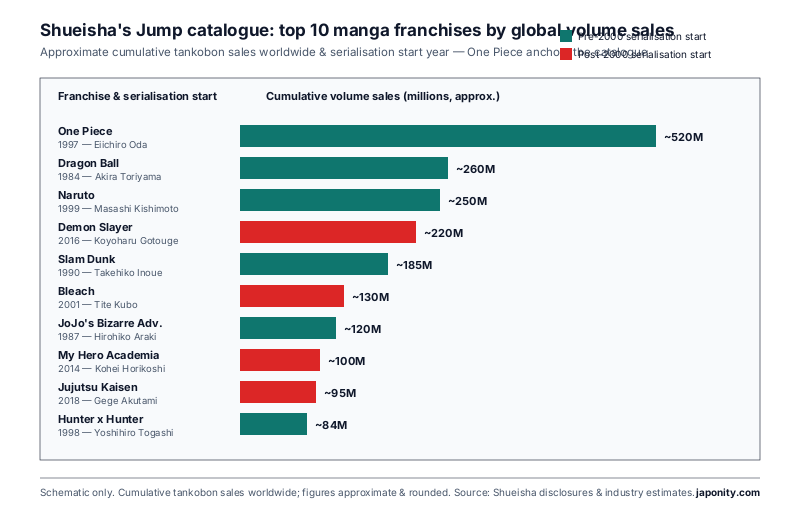
The catalogue is unusually concentrated. A relatively small number of long-running franchises generate a disproportionate share of the publishing house’s overall economics, and the top ten Jump-lineage IPs together account for the bulk of Shueisha’s downstream licensing revenue. The headline numbers are the volume-sales tallies published by the firm itself: One Piece, by Eiichiro Oda, has sold approximately five hundred and twenty million tankobon volumes worldwide since 1997 and is the best-selling manga of all time by a wide margin; Dragon Ball, by the late Akira Toriyama, has cleared approximately two hundred and sixty million; Naruto, Bleach and Slam Dunk sit in the one-hundred-to-two-hundred-fifty-million range; and the recent generation of properties — Demon Slayer, Jujutsu Kaisen, My Hero Academia, Chainsaw Man — has clocked equivalent unit sales over far shorter time-windows, suggesting that the franchise machinery has if anything accelerated.
How Shueisha owns the upside: the licensing-rights architecture
The structural feature that distinguishes Shueisha from its global publishing peers — and that explains why its commercial position has compounded so much faster than the underlying print magazine business would suggest — is the licensing architecture sitting behind the catalogue. When a cartoonist signs to Weekly Shonen Jump, the publisher does not simply acquire serialisation rights; it acquires a controlling position in the broader IP-licensing ecology that grows up around any successful serial. Anime adaptations are typically green-lit and majority-financed through production committees in which Shueisha is the lead or co-lead investor. Theatrical-film rights, video-game rights, merchandise licensing, theme-park licensing and international translation rights are routed through the publisher’s licensing arm or its majority-owned subsidiary Shueisha Creative, which handles film and games specifically.
The economic effect is that Shueisha captures a substantially higher share of downstream IP revenue per published title than a Western trade publisher would, and a meaningfully higher share than its Big-Three peers do on their respective franchises. Industry estimates suggest that on the largest Jump properties — One Piece, Demon Slayer, Jujutsu Kaisen — Shueisha and the affiliated rights-holders capture in the order of seventy to eighty per cent of total licensing-related cash flow, with the original cartoonist taking a sizeable but minority royalty share and the production-committee partners and licensees splitting the remainder. The arithmetic of why Shueisha’s revenue has held up while the magazine itself has lost circulation is straightforward: the magazine is now best understood as an incubator and signal-generator for a much larger IP-licensing business that sits on top of it.
MangaPlus and the official-translation platform play
In January 2019 Shueisha launched MangaPlus, a free, advertising-supported simulpub platform that publishes English- and Spanish-language official translations of its flagship Jump serials at the same time as the Japanese release. The strategic logic was a direct response to a problem the publisher had spent two decades losing on: international audiences were reading translated manga, but they were overwhelmingly reading scanlations — unauthorised, fan-produced translations distributed through aggregator sites that paid the publisher and the cartoonist nothing.
MangaPlus was the industry’s first credible attempt to compete with scanlation on speed and price simultaneously, and the financial logic was that the long-run economic prize was not subscription revenue on the platform itself but a defensible global readership that would convert into legitimate volume sales, merchandise demand, streaming-anime subscriptions, and licensing-rights monetisation. The platform now serves readers in over a hundred markets and, by Shueisha’s own disclosures, has materially shifted the international piracy-versus-legitimate-readership balance for the firm’s headline titles. It is the single clearest example of a Japanese trade publisher building a global direct-to-consumer digital platform in-house rather than ceding the layer to a US-domiciled aggregator.

Family ownership, Hitotsubashi, and what it means for licensors
Shueisha is a privately-held joint-stock company. Its shares are not listed on any exchange, are not traded, and are held by members of the Otsuka and Iiura founding families together with the senior employee shareholding association and operating management. There is no quarterly investor-relations disclosure cycle, no activist-shareholder pressure, no public earnings call. The firm publishes a modest annual revenue figure, in the order of two hundred and ten billion yen, but does not break it down by business line. Headquarters has been at Hitotsubashi in Chiyoda-ku, central Tokyo, for decades, sharing the same block as its corporate older sister Shogakukan.
For foreign IP licensors, three implications of this ownership structure are worth taking seriously. First, decision-making is long-horizon and relationship-led rather than quarterly-quantitative: a foreign licensee who is willing to invest in a multi-year working relationship with a particular Jump editor and the assigned licensing officer will be treated very differently from one approaching the firm as a transactional rights-buyer. Second, the editorial side of the house retains an unusual degree of influence over commercial decisions: which adaptations get green-lit, which territories get prioritised, and which licensees are renewed are decisions in which the original cartoonist’s editor and the magazine’s editor-in-chief hold real power, in ways that do not exist at a Western public-company publisher. Third, deal terms are conservative and slow-moving, and exclusivity is real: a licensee who acquires a long-form territory or category right from Shueisha will typically find it both expensive and durable.
The constellation of magazines: Shueisha beyond Jump
Although the Jump franchise generates the dominant share of Shueisha’s economics, the publisher operates a broad portfolio of approximately twenty active magazines spanning shonen, shojo, seinen, women’s fashion, men’s lifestyle and general non-fiction. The shojo and women’s lines — Ribon (founded 1955), Margaret and Bessatsu Margaret, Cookie, Cobalt — have anchored Japanese girls’ and young-women’s manga for half a century and have produced their own globally licensed IP, including Nana and Hana yori dango. The fashion titles — Non-no, More, Maquia, Lee, Spur, Men’s Non-no — anchor the consumer-advertising side of the business and remain commercially relevant even as overall print magazine circulation in Japan has fallen by approximately two-thirds since its early-2000s peak.
The publisher also operates a substantial general-trade book business — approximately seven hundred new titles per year in fiction, non-fiction, reference and literary criticism — and the literary-prize infrastructure (the Subaru Prize, the Shosetsu Subaru Award for New Writers) that supports it. The general-trade side is editorially prestigious but commercially smaller than the manga business by roughly an order of magnitude.
FAQ
Is Shueisha a subsidiary of Shogakukan?
No, not in legal or operational terms. Shueisha was founded in December 1925 as a wholly-owned subsidiary of Shogakukan to absorb its more entertainment-oriented publishing work, but the two firms were legally separated after the Second World War and Shueisha has been an independent stock company for approximately eight decades. The two firms remain connected through founding-family shareholdings and a long-standing working relationship, and are conventionally referred to in the Japanese publishing trade as having an older-sister / younger-sister relationship — but Shueisha now reports approximately twice the revenue of Shogakukan and operates fully independently.
How does Shueisha decide which manga serials get an anime adaptation?
The decisive signal is the reader-survey ranking inside Weekly Shonen Jump and its sister magazines, which has driven editorial commissioning for more than five decades. A serial that sustains a top-five ranking over the medium term will typically secure an anime adaptation green-light, normally through a production committee in which Shueisha is the lead or co-lead investor. The original editor and the magazine’s editor-in-chief retain meaningful influence over committee composition, studio selection, broadcaster slotting and international-distribution strategy.
What is MangaPlus and how does it differ from Shonen Jump+?
MangaPlus is Shueisha’s free, advertising-supported global simulpub platform, launched in January 2019, that publishes official English- and Spanish-language translations of Jump serials simultaneously with the Japanese release in over a hundred international markets. Shonen Jump+ is the Japanese-language digital app — distinct in editorial scope, including original digital-first serials — used domestically as the digital companion to the print weekly. MangaPlus exists primarily as a counter-scanlation, legitimate-readership platform; Shonen Jump+ exists as a domestic subscription-and-incubator product.
Can a foreign publisher acquire English-language print rights to a Jump title?
Yes, but the standing arrangement has been highly concentrated for two decades. VIZ Media — itself jointly owned by Shueisha, Shogakukan and Shogakukan-Shueisha Productions — holds the dominant English-language print and digital licensing position for Shueisha’s flagship catalogue across North America and the United Kingdom. New licensors approaching Shueisha for unallocated territories or for category-specific rights (audio drama, theatrical, theme-park, gaming) will typically work through the firm’s licensing-business division or through Shueisha Creative for film and games specifically.
Why is Shueisha not publicly listed?
Shueisha — like Kodansha and Shogakukan — has been a privately-held family stock company since founding, and has shown no public indication of considering a listing. The publishing-industry consensus is that the long-horizon, editorially-led, relationship-driven cartoonist-management model the firm depends on is structurally difficult to operate under a quarterly public-disclosure cycle, and that the family-shareholder block has both the cash flow and the strategic patience to absorb the cyclical swings in the print-magazine and licensing businesses without external equity capital. None of the Big-Three Japanese trade publishers is listed on a domestic or foreign exchange.
Working with Shueisha
Shueisha is the rights-holder behind some of the world’s most valuable and most-licensed entertainment IP, and its commercial activity outside Japan — anime distribution, film adaptation, merchandise licensing, theme-park integration, retail collaboration, official-translation publishing — has accelerated meaningfully over the past five years. For overseas brands, streamers, retailers, toy and apparel licensees, theatrical distributors and event organisers exploring a working relationship with the publisher or with the cartoonists in its catalogue, Japonity provides confidential introductions and structured matching support through our business-matching programme.
Related from Japonity — Japan’s publishers (manga & general)
- Kodansha — Japan’s biggest general publisher — Attack on Titan and the Noma family
Want to source Japanese products beyond these company profiles? Japonity also runs a Japan Sourcing Hub — a research-grade catalogue of 1,185 verified Japanese food products and 200+ overseas EC stores, ready for B2B procurement.
Interested in Japanese business opportunities?
Whether you're looking for technology partners, engineering talent, or market insights — we can help connect you with the right Japanese organizations.
Get in Touch →