On 5 August 2014, The Asahi Shimbun — the second-largest newspaper in Japan and the country’s most identifiably progressive national daily — published a special report retracting more than a dozen articles it had carried over three decades. The articles, stretching back to the early 1980s, had been built around the testimony of Seiji Yoshida, who claimed to have personally helped round up Korean women for the wartime Japanese military’s “comfort women” system. By 2014 his account had been independently identified as fabricated. The retraction was the most consequential editorial event in Japan’s post-war newspaper history; it cost the company’s president his job, gave the political right a generational rhetorical weapon, and crystallised a question that still defines Asahi today — whether a newspaper founded in Osaka in January 1879, still privately controlled by its founding families and employees, with approximately four million paid daily copies and an approximately thirty per cent stake in TV Asahi Holdings, can hold a distinct progressive editorial identity in a media market increasingly polarised between conservative giants and a digital long tail.
From Osaka in 1879 to a Tokyo-based national institution
The Asahi Shimbun was founded in Osaka on 25 January 1879 by Murayama Ryohei and, shortly afterwards, Ueno Riichi — two Meiji-era entrepreneurs who built a small commercial daily into one of the great Japanese newspaper franchises. By the late 1880s the paper had opened a Tokyo edition, eventually styled Tokyo Asahi Shimbun, which over the early twentieth century rose to rival its Osaka parent. In 1940, under the wartime newspaper-consolidation regime, the two editions merged into a single national title under unified management — the corporate ancestor of today’s company.
The Asahi has been headquartered for decades at Tsukiji in central Tokyo. The Osaka headquarters remains operational, and the dual-pole structure — Tokyo and Osaka, each running its own newsroom, presses, and regional editions — is a distinctive feature inherited from the pre-war merger. The corporate parent, Kabushiki Kaisha Asahi Shimbun-sha, is a private joint-stock company whose shares are not listed on any exchange and are held by the founding Murayama and Ueno families, the Asahi Shimbun employee shareholding association, and senior management.
The number-two newspaper, by design as much as by circulation
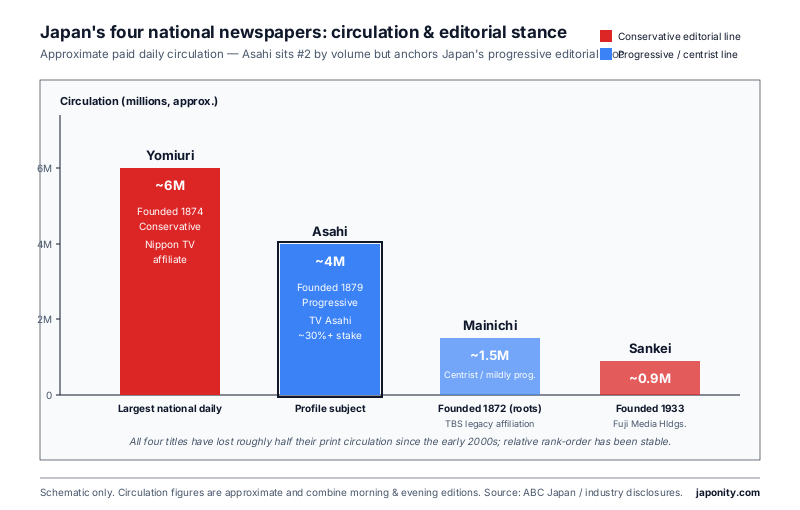
Asahi’s paid daily circulation is in the region of four million copies, combining morning and evening editions. The figure has fallen sharply from its early-2000s peak of more than eight million copies, mirroring an industry-wide decline that has been steeper and faster in Japan than in any other major newspaper market. Yomiuri Shimbun, the country’s largest daily, continues to lead Asahi by something like two to three million copies; Mainichi and Sankei, the other two national general-interest papers, trail Asahi by a substantial further margin.
What Asahi has long held that raw circulation does not capture is editorial influence within Japan’s progressive intellectual establishment. The paper has been the home title of choice for university faculty, lawyers, public-sector administrators, and a broad slice of metropolitan white-collar Japan that identifies with what in Japanese political vocabulary is called riberaru (liberal) — distinct from the conservative line of Yomiuri and the right-of-centre Sankei. Asahi’s reader base skews high-income, high-education, and metropolitan, supporting an advertising rate-card and subscription price-point that compensates for the smaller volume relative to Yomiuri.
The four-paper map of Japanese national journalism
To understand Asahi’s position, it is helpful to set the four national general-interest dailies side by side. The Japanese newspaper market is unusually concentrated by global standards: the four titles below, plus Nikkei and the sports daily Nikkan Sports, account for the overwhelming majority of paid national circulation.
| Newspaper | Founded | Editorial stance | Paid circulation (approx.) | Affiliated broadcaster |
|---|---|---|---|---|
| Yomiuri Shimbun | 1874 (Tokyo) | Conservative, pro-establishment | ~6M (down from ~10M in 2000s) | Nippon Television Holdings (~14% via group) |
| The Asahi Shimbun | 1879 (Osaka) | Left-of-centre, progressive | ~4M (down from ~8M in 2000s) | TV Asahi Holdings (~30%+ stake) |
| Mainichi Shimbun | 1872 (Osaka roots) | Centrist to mildly progressive | ~1.5M (down from ~4M in 2000s) | TBS Holdings (legacy / loose affiliation) |
| Sankei Shimbun | 1933 (Osaka) | Conservative to right-of-centre | ~0.9M (down from ~2M in 2000s) | Fuji Media Holdings (Fujisankei Communications Group) |
Three structural features of this map are worth flagging. Every one of the four nationals has paired itself with a commercial broadcaster, embedding the newspaper inside a wider media group rather than leaving it as a stand-alone publisher. The political alignment of newspaper and broadcaster is broadly congruent — Asahi sits with the progressive TV Asahi, Sankei with the more conservative Fuji News Network — producing what amounts to two loose left-right media blocs within Japanese commercial broadcasting. And every one of the four has lost roughly half of its print circulation in the past two decades, but the relative rank-order has been remarkably stable: Yomiuri first, Asahi second, Mainichi third, Sankei fourth, throughout the period.
The Yoshida testimony retraction and its long political shadow
No event has shaped Asahi’s public image over the past decade more than the 2014 Yoshida-testimony retraction. From the early 1980s, the paper published a series of articles drawing on the testimony of Seiji Yoshida, a former wartime mobilisation official who claimed to have personally coerced Korean women on Jeju Island into the Imperial Japanese military’s wartime “comfort women” system. By the 1990s independent historians had failed to corroborate any element of his account, and by the 2000s mainstream historical scholarship had effectively rejected him as a source. The Asahi continued to carry references to his testimony into the 1990s without formally retracting them.
On 5 August 2014 the paper published a special investigative report retracting more than a dozen articles based on Yoshida’s testimony, acknowledging it was fabricated. The handling of the retraction — its long delay, its placement, and the absence of an unambiguous apology — became the controversy in its own right. Within weeks, separate concerns surfaced around the paper’s 2011 coverage of the Fukushima Daiichi nuclear accident, specifically a report that workers had defied an evacuation instruction by plant manager Masao Yoshida (no relation to the comfort-women source); that article was also retracted. President Tadakazu Kimura resigned in December 2014. The retraction sequence became a generational political event: conservative politicians, talk-show hosts, and online commentators have invoked it ever since as the central exhibit in their critique of what they call the Asahi mondai — the “Asahi problem” — materially weakening the paper’s institutional moral authority on wartime-history coverage even as its broader reporting franchise has held up.
The defenders’ view is that the underlying historical reality of the comfort-women system does not stand or fall on Yoshida’s discredited testimony, that mainstream historians had moved past him decades before 2014, and that the retraction itself was a more rigorous editorial act than any other major Japanese newspaper has performed on a comparable scale. The critics’ view is that Asahi sustained a politically convenient source long after the evidence had collapsed, and that the delay reveals a structural ideological tilt incompatible with the paper’s claim to neutrality. Both views are now permanent features of the Japanese political landscape.
TV Asahi Holdings: the broadcasting complement
The Asahi Shimbun’s most commercially valuable single asset outside the newspapers themselves is its approximately thirty per cent stake in TV Asahi Holdings (TSE: 9409), the listed parent of TV Asahi, BS Asahi, and the wider All-Nippon News Network (ANN). TV Asahi is one of the five major commercial terrestrial broadcasters in Japan, alongside Nippon TV (paired with Yomiuri), TBS (legacy Mainichi affiliation), Fuji TV (paired with Sankei), and TV Tokyo (paired with Nikkei). Each of the major Tokyo broadcasters traces its origin in part to the newspaper that sponsored its founding licence, and the newspaper-broadcaster alignment has persisted in shareholding terms for more than half a century.
The Asahi/TV Asahi alignment is unusually deep relative to several of the comparable pairings: Asahi holds a substantially larger direct stake in TV Asahi Holdings than Yomiuri holds in the Nippon TV group, and the editorial cross-pollination — talent, archival material, joint election-night coverage, shared political reporting — is correspondingly more visible on air. The flagship Hodo Station evening news programme has been a defining property of progressive-leaning Japanese television news for more than two decades.
The economic significance is also material. Broadcasting holds up commercially in ways print does not, and the dividends and equity value attaching to Asahi’s TV Asahi stake are a meaningful source of cash flow and balance-sheet support for the parent newspaper at a moment when the print business is contracting fastest.
The Asahi properties: newspapers, broadcasting, books, English
The flagship daily is only one piece of a wider portfolio that defines Asahi’s commercial and editorial footprint. The table below sketches the principal Asahi Shimbun assets and operations.
| Property | What it is | Reach / role |
|---|---|---|
| The Asahi Shimbun (flagship daily) | Morning and evening Japanese-language general-interest daily | ~4M paid circulation; Japan’s leading progressive national daily |
| Asahi Shimbun Digital | Paid digital edition of the flagship daily | Subscriber base in the low to mid hundreds of thousands |
| Asahi Shimbun GLOBE | Monthly insert and standalone international affairs publication | Long-form foreign reporting; complemented by GLOBE+ digital |
| GLOBE+ (Globe Plus) | Digital expansion of the GLOBE publication | Free-and-paid mix; Asahi’s principal English-curious vehicle |
| Nikkan Sports | Sports daily affiliated with the Asahi group | Long-standing tabloid; entertainment and baseball heavy |
| Aera | Weekly news magazine | Long-form political and social reporting, progressive lean |
| Asahi Camera (historic) | Photography monthly first published 1926; print edition closed 2020 | Defining post-war Japanese photography title; brand still active in book form |
| Asahi Shimbun Publications | Books, AERA-branded mooks, photographic and historical titles | Significant Japanese-language non-fiction and reference publisher |
| TV Asahi Holdings (~30%+ stake) | Listed broadcaster (9409.T) — TV Asahi, BS Asahi, ANN affiliation | Major commercial terrestrial broadcaster; Hodo Station evening news |
The shape of the portfolio differs from Nikkei’s. Asahi has not made a Financial Times-scale foreign acquisition and does not own an English-language flagship of the FT or even the Nikkei Asia type. GLOBE+ is the closest analogue and is at least an order of magnitude smaller in paying-subscriber terms. The strategic question for Asahi is whether to attempt a Nikkei-style international platform — which requires capital and a tolerance for years of operating losses Asahi has historically not displayed — or to consolidate around its progressive domestic franchise and the broadcasting cash flows from TV Asahi.

Ownership, capital, and the limits of strategic flexibility
Like Nikkei, the Asahi Shimbun is a private joint-stock company with no listed shares, no external institutional capital, and no possibility of a hostile takeover. The shareholder register is, in headline terms, divided among the founding Murayama and Ueno families, the Asahi Shimbun employee shareholding association, and senior management — though the precise percentages and the influence of the founding families have shifted over decades and remain partially opaque to outside observers.
The structural consequences are similar to Nikkei’s, with one important divergence. Asahi is insulated from activist investors, hostile bids, and the quarterly pressure that has hollowed out comparable Western papers. But unlike Nikkei, Asahi has not used that insulation to execute a generational foreign acquisition; its capital-allocation history of the past two decades has been more cautious, focused on shoring up the domestic franchise and the TV Asahi stake rather than transformational M&A. Whether that reflects ideological coherence or strategic timidity is a matter of recurring debate in Japanese media-industry circles; the FT acquisition by Nikkei is the implicit comparator in almost every such discussion.
Leadership and the editorial-political environment
The Asahi presidency combines oversight of editorial direction with group strategic responsibility. President Tadakazu Kimura resigned in the aftermath of the 2014 retractions and was succeeded by Masataka Watanabe, with subsequent presidencies — including the current incumbent, widely identified as Masataka Nakamura (subject to verification against the latest disclosures) — operating in the long shadow of the 2014 episode. The post-2014 institutional posture has been more cautious on wartime-history coverage and more defensive against conservative criticism, even as the paper has continued to take editorial positions on the political left of the national debate.
The wider political environment is also a factor. Successive conservative LDP-led governments since 2012 have presided over a period in which the country’s media-political balance tilted notably rightwards, with online discourse, talk television, and a vocal cohort of conservative commentators systematically critical of Asahi’s coverage. The paper retains a powerful institutional position — large newsroom, deep archives, national reach, and TV Asahi as broadcasting partner — but operates in a noisier and more hostile rhetorical environment than at any earlier point in its post-war history.
The next decade: declining print, durable identity, uncertain international platform
Three questions define Asahi’s strategic horizon. How far does the print decline run, and how much of the digital flagship — Asahi Shimbun Digital — can be converted into a paying subscriber base of the scale required to compensate? Can the TV Asahi Holdings stake continue to generate cash flows that have effectively cross-subsidised the newspaper through the past decade of print decline, given that terrestrial advertising is now under pressure from streaming and online video? And will Asahi attempt a serious international English-language strategy — through GLOBE+ or an acquisition — or accept that, unlike Nikkei, it operates as a domestic-progressive newspaper-broadcaster group with no meaningful global subscriber footprint?
None of these questions has a settled answer. What is clear is that the institutional identity of The Asahi Shimbun — left-of-centre, metropolitan, intellectually serious, and now operating under the long shadow of the 2014 retraction — is the most distinct editorial identity of any major Japanese national daily. The other three general-interest nationals face the same demographic headwinds; what differs is the editorial proposition each of them brings, and on that dimension Asahi remains, by some distance, the country’s most identifiably progressive voice.
FAQ
When was The Asahi Shimbun founded, and who owns the company today?
The Asahi Shimbun was founded in Osaka on 25 January 1879 by Murayama Ryohei, with Ueno Riichi joining shortly afterwards as a co-founding partner. A Tokyo edition was launched in the late 1880s, and the Osaka and Tokyo editions merged into a unified national company in 1940 under the wartime newspaper-consolidation regime. The corporate parent, Kabushiki Kaisha Asahi Shimbun-sha, is a private joint-stock company headquartered in Tsukiji, Tokyo, with no listed shares; the shareholder register is divided among the founding Murayama and Ueno families, the Asahi Shimbun employee shareholding association, and senior management. The exact ownership percentages are not publicly disclosed and are not available on any stock exchange.
What is Asahi’s paid circulation, and how does it compare with Yomiuri, Mainichi, and Sankei?
The Asahi Shimbun’s paid daily circulation is approximately four million copies, combining morning and evening editions — down from a peak of more than eight million copies in the early 2000s. Yomiuri Shimbun remains the largest national daily at around six million copies, ahead of Asahi by roughly two to three million; Mainichi Shimbun is around 1.5 million; and Sankei Shimbun is below one million. All four nationals have lost roughly half their circulation in the past two decades, but the relative rank-order — Yomiuri, Asahi, Mainichi, Sankei — has been broadly stable.
What was the 2014 Yoshida testimony retraction, and why does it still matter?
In August 2014, The Asahi Shimbun published a special report retracting more than a dozen articles, stretching back to the early 1980s, that had been built around the testimony of Seiji Yoshida — a former wartime official who claimed to have personally helped coerce Korean women into the Imperial Japanese military’s wartime “comfort women” system. His testimony was ultimately identified as fabricated. Around the same period, the paper also retracted a 2011 report on the Fukushima Daiichi nuclear accident involving plant manager Masao Yoshida (no relation). The handling of the retractions — particularly their delay — caused President Tadakazu Kimura to resign in December 2014 and gave conservative critics a recurring rhetorical weapon against the paper that remains influential in Japanese political discourse today.
What is Asahi’s relationship with TV Asahi Holdings?
The Asahi Shimbun holds an approximately thirty per cent stake in TV Asahi Holdings (TSE: 9409), the listed parent of TV Asahi, BS Asahi, and CS One Ten, and the lead broadcaster in the All-Nippon News Network (ANN) commercial broadcasting affiliation. The newspaper-broadcaster pairing dates back more than half a century and is unusually deep relative to several other Japanese newspaper-broadcaster alignments. Hodo Station, TV Asahi’s flagship evening news programme, has been a defining property of progressive-leaning Japanese television journalism for more than two decades. The dividend and equity value of the TV Asahi stake has been a material support for the parent newspaper during the print-circulation decline.
Does Asahi have an English-language strategy, and how does it compare with Nikkei Asia?
The Asahi Shimbun’s principal English-curious vehicle is GLOBE+ (Globe Plus), the digital expansion of the long-running monthly international affairs publication Asahi Shimbun GLOBE. The paper also maintains a free-to-read English news section on its website. Neither product is at the scale of Nikkei Asia, the English-language Asia-focused platform that Nikkei built from 2013 and that is supported by Nikkei’s separate ownership of the Financial Times. Asahi has not made a comparable foreign acquisition and does not operate an English-language paying-subscriber platform of meaningful scale. Whether to invest more aggressively in such a platform is one of the defining strategic questions facing the group.
Working with Asahi Shimbun
Looking to advertise across The Asahi Shimbun’s print, digital, and AERA properties, license editorial content or photographic archives, partner on English-language reporting through GLOBE+, or scope research and broadcasting collaborations spanning Asahi Shimbun and TV Asahi Holdings? Get in touch via Japonity’s business-matching service — we connect foreign media, advertisers, and content partners with the right counterparties inside Japan’s most identifiably progressive national newspaper-broadcaster group.
Related from Japonity — Japan’s media & broadcasting
- Nikkei Inc. — Japan’s $1.3B Financial Times-owning newspaper
- The Yomiuri Shimbun — Japan’s #1 newspaper by circulation — the conservative-establishment paper
- Fuji Media Holdings — The 2025 governance reset activists forced on Japan’s Daiba broadcaster
- Nippon Television Holdings — Japan’s #1 commercial broadcaster + Studio Ghibli + Hulu Japan
Want to source Japanese products beyond these company profiles? Japonity also runs a Japan Sourcing Hub — a research-grade catalogue of 1,185 verified Japanese food products and 200+ overseas EC stores, ready for B2B procurement.
Interested in Japanese business opportunities?
Whether you're looking for technology partners, engineering talent, or market insights — we can help connect you with the right Japanese organizations.
Get in Touch →