On 1 September 2014, Nippon Television Holdings — the listed parent of Japan’s first commercial television broadcaster — completed the acquisition of Hulu Japan from Hulu LLC in the United States for a reported figure in the region of approximately 220 million US dollars, taking full ownership of the Japanese streaming service and effectively detaching it from the American parent that had launched it three years earlier. A decade on, in March 2023, the relationship reset again: a content-share agreement with the now Disney-controlled US Hulu repositioned the Japanese unit as the principal Japanese-market home of select Disney-adjacent and US streaming catalogue, even as Nippon TV continued to operate it as a wholly Japanese-owned over-the-top platform. The two transactions, bracketing a decade of Japanese-language streaming experimentation, are the clearest evidence that Nippon Television Holdings — the country’s number-one commercial broadcaster by audience share, the long-time television home of Studio Ghibli, and the broadcasting half of the Yomiuri-Nippon TV media bloc — is the most aggressive Japanese terrestrial broadcaster in foreign-content licensing, streaming, and balance-sheet diversification. That posture, anchored in a roughly twenty-two per cent cross-shareholding with the Yomiuri Shimbun and a portfolio of intellectual-property rights that includes the Friday Road Show Ghibli broadcasting franchise, the Yomiuri Giants baseball production, and the Tokyo Shiodome Nittele Tower complex, is the subject of this profile.
From August 1953 to the 2012 holding-company conversion
Nippon Television Network Corporation went on air on 28 August 1953 as Japan’s first commercial television broadcaster, predating every other private television licence in the country. The launch was driven by Matsutaro Shoriki, the founding proprietor of the Yomiuri Shimbun and a pivotal figure in twentieth-century Japanese media history, who saw commercial television as both a commercial proposition and a vehicle for the wider Yomiuri group’s editorial reach. The newspaper-broadcaster pairing dates from that founding moment and has persisted, in cross-shareholding terms, for more than seven decades.
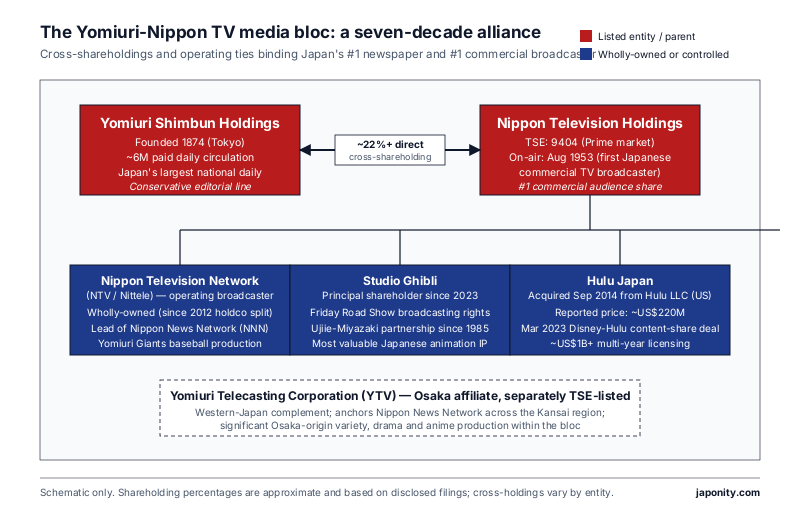
On 1 October 2012, the group converted into a holding-company structure: Nippon Television Holdings, Inc. (Tokyo Stock Exchange code 9404) became the listed parent, with the operating broadcaster Nippon Television Network Corporation — still familiarly abbreviated NTV or Nittele — moved into a wholly-owned subsidiary, alongside the streaming, real-estate, and content-production arms. The Yomiuri Telecasting Corporation (YTV), the Osaka-based broadcaster that anchors the western half of the Nippon News Network affiliation, sits separately as a Nippon TV group affiliate with its own Tokyo Stock Exchange listing. The corporate headquarters is the Tokyo Shiodome Nittele Tower in Minato Ward, completed in 2003 — itself a meaningful real-estate asset on the company’s balance sheet.
The four-way audience-share map of Japanese commercial broadcasting
To understand Nippon TV’s competitive position, it is helpful to set the four major Tokyo-key commercial broadcasters side by side. The Japanese commercial terrestrial market is, by global standards, both highly consolidated and unusually stable in rank-order: the four Tokyo-key broadcasters below, together with TV Tokyo and the public broadcaster NHK, account for the overwhelming majority of national television viewing.
| Broadcaster | Listed parent | On-air launch | Newspaper alignment | Audience share position |
|---|---|---|---|---|
| Nippon TV | Nippon Television Holdings (9404) | August 1953 | Yomiuri Shimbun (~22%+ cross-holding) | #1 commercial broadcaster (recent years) |
| TV Asahi | TV Asahi Holdings (9409) | February 1959 | The Asahi Shimbun (~30%+ stake) | #2-3 commercial, leads in older demographics |
| TBS | TBS Holdings (9401) | April 1955 | Mainichi Shimbun (legacy / loose) | #3-4 commercial, strong drama franchise |
| Fuji TV | Fuji Media Holdings (4676) | March 1959 | Sankei Shimbun (Fujisankei Group) | Former #1, recent years contested |
Three structural features are worth flagging. Nippon TV has held the leading audience-share position in recent years, displacing Fuji TV — which had held the top position through much of the 1980s and 2000s — and consolidating a lead that is meaningful in advertising-rate-card terms and in the priority it commands with sports rights-holders, talent agencies, and foreign content distributors. The newspaper-broadcaster pairing is broadly congruent in editorial alignment: the Yomiuri-Nippon TV bloc sits on the conservative-to-centrist side, the Asahi-TV Asahi bloc on the progressive side, with TBS and Fuji TV occupying less defined intermediate positions. And each of the four listed parents has confronted the same structural pressures over the past decade — terrestrial-advertising stagnation, streaming competition, talent-agency turmoil, demographic ageing — but they have responded with very different postures, of which Nippon TV’s combination of Hulu Japan ownership and Ghibli rights consolidation is the most distinctive.
The Yomiuri Shimbun alliance: the deepest newspaper-broadcaster pairing
The Yomiuri Shimbun Holdings, parent of Japan’s largest national daily at approximately six million paid copies, holds an approximately twenty-two per cent direct stake in Nippon Television Holdings, together with additional indirect holdings through affiliated entities. The reverse direction also matters: Nippon Television Holdings holds shares in the Yomiuri Shimbun-affiliated companies, and the senior executives of the two groups have for decades moved between them in ways that make the editorial and commercial alignment unusually tight by Japanese newspaper-broadcaster standards. The Yomiuri-Nippon TV cross-shareholding is materially larger and operationally deeper than the comparable Mainichi-TBS pairing and is broadly comparable in depth — though structured differently — to the Asahi-TV Asahi pairing.
The practical consequences run across editorial product, sports rights, and political reporting. The Yomiuri Giants, the Tokyo-based baseball franchise owned by the Yomiuri group and the most commercially valuable property in Japanese baseball, is produced and broadcast principally through Nippon TV’s sports operation. Election-night coverage and Sunday-morning political talk programming have leaned on Yomiuri reporting and editorial framing in ways that distinguish the Nittele product from its competitors. The broader political alignment — broadly supportive of the conservative LDP establishment — is a visible feature of the bloc’s news output, though Nippon TV’s flagship evening news has historically positioned itself slightly closer to the centre than the Yomiuri editorial page itself. YTV, meanwhile, functions as the Kansai-region complement to the Tokyo parent and originates several of the highest-rated entertainment franchises in the bloc, including a long-running Sunday-night detective drama format and significant slices of the anime production pipeline.
Studio Ghibli and the Friday Road Show: the most valuable broadcasting-rights franchise in Japan
If the Yomiuri cross-shareholding is the structural anchor of Nippon TV’s identity, the relationship with Studio Ghibli is its most commercially valuable single editorial property. The connection dates to the founding of Studio Ghibli in 1985, when then-Nippon TV executive Seiichiro Ujiie — later the group’s chairman — became a personal patron of the studio’s founders Hayao Miyazaki and Isao Takahata, providing the broadcasting and financing support that helped Ghibli build the production pipeline from Castle in the Sky through Spirited Away and onward. Nippon TV has held the Japanese television broadcasting rights to the principal Ghibli back catalogue for decades, principally through the Friday Road Show film-broadcast franchise that anchors the network’s Friday-night prime-time schedule.
In 2014 the relationship deepened to a corporate-level partnership, and in 2023 Nippon Television Holdings became the principal shareholder of Studio Ghibli itself — effectively bringing the studio into the Nippon TV group while leaving its creative leadership and production operation intact. The transaction was reported as resolving the long-standing succession question at Ghibli following the gradual retirement of Hayao Miyazaki from full-time production direction. For Nippon TV the strategic value is twofold: a defensive consolidation of the broadcasting rights that have been a Friday Road Show staple for thirty years, and a long-term content asset that travels internationally through theatrical, streaming, and merchandising channels in a way that little else in the Japanese broadcasting catalogue does.
The wider anime portfolio anchored on Nippon TV — including long-running franchises produced through the network’s regular animation-production-committee partnerships, late-night anime slots, and the Ghibli library — makes Nippon Television Holdings one of the most significant Japanese broadcasters in the global anime distribution chain, alongside TV Tokyo and Tokyo MX in late-night and the Toei Animation-aligned broadcasters in prime time.
Hulu Japan: the 2014 acquisition and the 2023 reset
Nippon TV’s single most distinctive strategic move of the past decade has been Hulu Japan. The Japanese arm of the US streaming service launched in 2011 under the original Hulu LLC ownership, then a joint venture of the major US broadcasters. By 2014 it had become clear that the cross-Pacific structure was not working: the catalogue lagged the US parent’s offering, the marketing was thin, and the subscriber base was an order of magnitude below what an integrated Japanese-language operation could plausibly support. In April 2014 Nippon Television Holdings announced the acquisition of the Japanese operations from Hulu LLC, completing the transfer on 1 September 2014 for a reported consideration of approximately 220 million US dollars. The Japanese unit was rebranded as a wholly Nippon TV-owned operation, the catalogue was rebuilt around domestic Japanese drama, anime, and Nippon TV’s own broadcast back-catalogue, and the subscriber base scaled into the millions over the subsequent decade.
The March 2023 reset took the relationship the other way. By that point the US Hulu had become a wholly-owned subsidiary of The Walt Disney Company following Disney’s acquisition of 21st Century Fox in 2019 and the subsequent buyout of Comcast’s residual Hulu stake. A new content-share agreement between Nippon Television Holdings and the Disney-controlled US Hulu — reported in the Japanese press at a transaction value in the order of one billion US dollars or more across the multi-year term — repositioned the Japanese platform as a principal Japanese-market home for select Disney-adjacent and US streaming catalogue, while leaving the Japanese operating entity wholly Nippon TV-owned. The combined effect is that Hulu Japan now functions as a domestically-controlled streaming platform with a meaningfully upgraded foreign-content supply, in a Japanese OTT market increasingly dominated by Netflix, Amazon Prime Video, and Disney+’s direct Japanese operation.
The strategic logic is that no Japanese terrestrial broadcaster will, on its own, build a global subscriber platform of Netflix or Disney+ scale; the achievable position is a domestically-anchored streaming franchise with a strong Japanese-language library and workable foreign-content supply through licensing. Hulu Japan is the most developed Japanese example of that logic, and its scale relative to TBS’s Paravi and TV Asahi’s TELASA is the clearest evidence that Nippon TV is operating with a more developed streaming strategy than any commercial-broadcasting peer.

The Nippon TV Holdings portfolio: broadcasting, streaming, real estate, content
The flagship broadcasting operation is only one piece of a wider portfolio that defines Nippon TV’s commercial footprint. The table below sketches the principal Nippon Television Holdings business lines.
| Segment | What it contains | Role within the group |
|---|---|---|
| Terrestrial broadcasting | Nippon Television Network (NTV/Nittele) and the Nippon News Network / Nippon Television Network System affiliations | Core revenue base; advertising and sponsorship; #1 commercial audience share |
| Yomiuri Telecasting (YTV) | Osaka-based affiliated commercial broadcaster, separately listed | Western-Japan complement; significant Kansai-origin programming and anime |
| Streaming (Hulu Japan) | Wholly-owned Japanese OTT platform; 2023 US Hulu content-share agreement | Subscription streaming; principal Japanese-market home for select foreign catalogue |
| Studio Ghibli | Principal shareholder (2023); Friday Road Show broadcasting rights | Long-term content asset with international theatrical and merchandising reach |
| Sports rights | Yomiuri Giants production; Olympics consortium with NHK and other nets; J. League and selected MLB rights | Premium live programming; prime-time advertising anchor |
| Real estate | Nittele Tower (Tokyo Shiodome); legacy Kojimachi properties; rental and event operations | Balance-sheet asset; recurring rental income; corporate-event venue |
| Content production and licensing | Anime production-committee participations; drama and variety formats; international format licensing | Library asset; secondary revenue through licensing, packaged media, and overseas remakes |
| Other media and lifestyle | BS Nittele; CS channels; e-commerce; events; talent agency interests | Diversification; lower-margin but stable supplementary income |
The shape of the portfolio differs meaningfully from peers. Fuji has historically leaned on real estate and the Sankei publishing complement; TV Asahi has emphasised the Asahi Shimbun editorial coupling and the news-and-current-affairs franchise. Nippon TV’s distinctive combination — number-one commercial audience share, the deepest streaming platform among Japanese broadcasters, the Ghibli rights consolidation, and the Yomiuri Giants production — gives the group a portfolio that is at once the most balanced and the most content-IP-rich of the four major Tokyo-key commercial-broadcasting groups.
Leadership, capital structure, and the next decade
Nippon Television Holdings has been led in recent years by Yoshikuni Sugiyama as president (subject to verification against the latest disclosures), with the chairmanship reflecting the long-running succession line that includes the late Seiichiro Ujiie — the executive most associated with the Ghibli partnership and the modernisation of the Nippon TV brand through the late 1990s and 2000s. The Tokyo Stock Exchange listing (code 9404) sits on the prime market segment, with the Yomiuri Shimbun group as the largest single shareholder at the approximately twenty-two per cent level noted earlier, and the remainder distributed across institutional investors, cross-holding partners within the wider Yomiuri media bloc, and the public free float.
Three questions define the group’s strategic horizon. How far can Hulu Japan scale in a Japanese OTT market increasingly dominated by Netflix, Disney+, and Amazon Prime Video, and can the 2023 content-share agreement be extended or deepened to maintain the platform’s foreign-content competitiveness? How aggressively will Nippon TV use its principal-shareholder position in Studio Ghibli — both to defend the Friday Road Show franchise and to extend the Ghibli IP into theatre-park, merchandising, and direct overseas streaming channels in a way that has not historically been the Ghibli house style? And what is the right capital posture as terrestrial-advertising revenue contracts: continued accumulation of content IP and real-estate assets, or a more aggressive return of capital to shareholders in a manner that several of the listed Japanese broadcasters have begun to consider in response to investor pressure?
None of these questions has a settled answer. What is clear is that Nippon Television Holdings has positioned itself more aggressively in foreign-content licensing, streaming infrastructure, and content-IP consolidation than any of its Japanese commercial-broadcasting peers. The combination of number-one audience share, the Yomiuri cross-shareholding, the Ghibli rights consolidation, Hulu Japan, and the Shiodome Nittele Tower complex makes it, by some distance, the most strategically distinctive of the four major Japanese commercial-broadcasting parents.
FAQ
When was Nippon TV founded, and how is the corporate structure organised today?
Nippon Television Network Corporation went on air on 28 August 1953 as Japan’s first commercial television broadcaster, founded under the leadership of Matsutaro Shoriki, the proprietor of the Yomiuri Shimbun. On 1 October 2012 the group converted into a holding-company structure: Nippon Television Holdings, Inc. (Tokyo Stock Exchange code 9404) became the listed parent, with the operating broadcaster Nippon Television Network Corporation moved into a wholly-owned subsidiary. The Yomiuri Telecasting Corporation (YTV) in Osaka, which anchors the Nippon News Network affiliation in western Japan, is a separately listed affiliated company rather than a wholly-owned subsidiary. The corporate headquarters is the Tokyo Shiodome Nittele Tower in Minato Ward, completed in 2003.
What is Nippon TV’s audience-share position relative to TV Asahi, TBS, and Fuji TV?
In recent years Nippon TV has held the leading audience-share position across Japanese commercial terrestrial broadcasting, displacing Fuji TV — which had held the top position through much of the 1980s and 2000s — and consolidating a lead across both all-day and prime-time measures. TV Asahi and TBS occupy the second and third positions in different measurement windows, with TV Asahi strongest in older demographics and TBS anchored on its drama franchise. Fuji TV’s relative decline from its former leadership position is one of the defining shifts in the Japanese commercial-broadcasting landscape of the past two decades. The audience-share lead matters both commercially, through advertising-rate-card pricing, and strategically in negotiations with sports rights-holders, talent agencies, and foreign content distributors.
What is the relationship between Nippon TV and the Yomiuri Shimbun?
The Yomiuri Shimbun Holdings, parent of Japan’s largest national daily at approximately six million paid copies, holds an approximately twenty-two per cent direct stake in Nippon Television Holdings, with additional indirect holdings through affiliated entities. The pairing dates from the founding of Nippon TV in 1953 under Yomiuri proprietor Matsutaro Shoriki and is materially deeper than the comparable Mainichi-TBS pairing and broadly comparable in depth to the Asahi-TV Asahi alignment. Practical consequences include Nippon TV’s production and broadcasting of Yomiuri Giants baseball games, the political-reporting orientation of the network’s news output, and the editorial alignment of the broader Yomiuri-Nippon TV media bloc on the conservative-to-centrist side of the Japanese national media landscape.
What is Hulu Japan, and what did the 2014 and 2023 transactions do?
Hulu Japan is the Japanese over-the-top streaming platform originally launched in 2011 by the US-based Hulu LLC. In September 2014, Nippon Television Holdings acquired the Japanese operations from Hulu LLC for a reported consideration of approximately 220 million US dollars, taking full ownership of the Japanese entity and detaching it from the US parent. In March 2023, a content-share agreement with the now Disney-controlled US Hulu — reported at a transaction value in the order of one billion US dollars or more across the multi-year term — repositioned the Japanese platform as a principal Japanese-market home for select Disney-adjacent and US streaming catalogue, while leaving the Japanese operating entity wholly Nippon TV-owned. Hulu Japan is now the most developed streaming platform of any Japanese commercial broadcaster.
How did Nippon TV come to be the principal shareholder of Studio Ghibli?
The relationship between Nippon TV and Studio Ghibli dates to the studio’s founding in 1985, when then-Nippon TV executive Seiichiro Ujiie became a personal patron of founders Hayao Miyazaki and Isao Takahata. Nippon TV has held the Japanese television broadcasting rights to the principal Ghibli back catalogue for decades through the Friday Road Show film-broadcast franchise. In 2023 the relationship was elevated to a corporate-level shareholding: Nippon Television Holdings became the principal shareholder of Studio Ghibli, effectively bringing the studio into the Nippon TV group while leaving its creative leadership and production operation intact. The transaction was reported as resolving the long-standing succession question at Ghibli following the gradual retirement of Hayao Miyazaki from full-time production direction.
Working with Nippon TV Holdings
Looking to license Studio Ghibli or Nippon TV catalogue content for overseas streaming, broadcast, or theatrical release, partner with Hulu Japan on Japanese-market distribution, advertise across the Nippon TV and YTV terrestrial networks, or scope co-production and format-licensing arrangements with Japan’s number-one commercial broadcaster? Get in touch via Japonity’s business-matching service — we connect foreign media, distributors, advertisers, and content partners with the right counterparties inside the Yomiuri-Nippon TV media bloc and its principal operating subsidiaries.
Related from Japonity — Japan’s media & broadcasting
- Nikkei Inc. — Japan’s $1.3B Financial Times-owning newspaper
- The Asahi Shimbun Company — Japan’s #2 newspaper and the politicized media question
- The Yomiuri Shimbun — Japan’s #1 newspaper by circulation — the conservative-establishment paper
- Fuji Media Holdings — The 2025 governance reset activists forced on Japan’s Daiba broadcaster
Want to source Japanese products beyond these company profiles? Japonity also runs a Japan Sourcing Hub — a research-grade catalogue of 1,185 verified Japanese food products and 200+ overseas EC stores, ready for B2B procurement.
Interested in Japanese business opportunities?
Whether you're looking for technology partners, engineering talent, or market insights — we can help connect you with the right Japanese organizations.
Get in Touch →