TYO:4901
When digital cameras destroyed the photographic-film business, two giants dominated film: Kodak and Fujifilm. Kodak went bankrupt. Fujifilm reinvented itself into a healthcare and advanced-materials powerhouse posting record revenues. It is one of the great corporate transformation stories of the modern era — and a distinctly Japanese one.
The reinvention
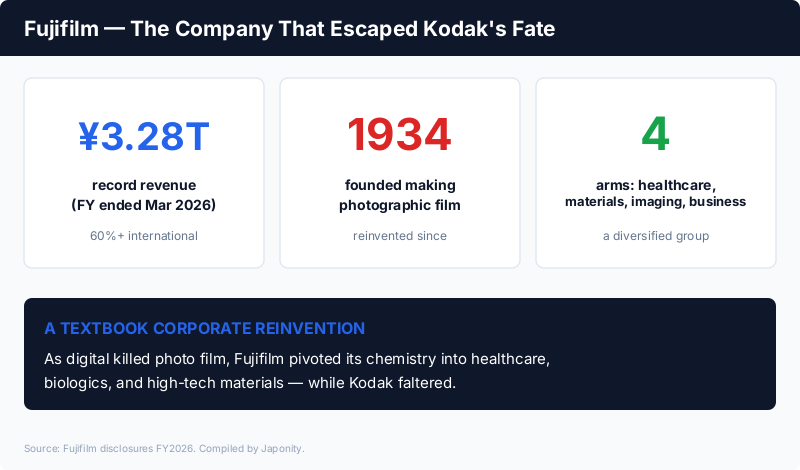
Founded in 1934 to make photographic film, Fujifilm watched its core market collapse in the 2000s. Instead of fading, it redeployed the deep chemistry behind film — thin-film coating, fine particles, antioxidants, collagen science — into entirely new industries. Today Fujifilm is a diversified group reporting record revenue of around ¥3.28 trillion (fiscal year ended March 2026), with more than 60% earned internationally.
Four businesses, one chemistry
Fujifilm now spans four arms: Healthcare (medical imaging, diagnostics, and a fast-growing biopharmaceutical contract-manufacturing business, Fujifilm Diosynth); Electronics & advanced materials (a world leader in display films and a rising force in semiconductor materials, targeting ¥300 billion in chip-materials sales); Imaging (where Instax instant cameras and X-series cameras thrive); and Business Innovation (office solutions, formerly Fuji Xerox). The connective tissue is materials science — the same expertise that once made film, now making drugs, displays, and chips possible.
Why it matters for global partners and investors
- Investors get exposure to healthcare, biologics manufacturing, and semiconductor materials through a diversified company with a proven ability to reinvent.
- The biologics-manufacturing business is strategically important as drugmakers outsource production; Fujifilm has invested heavily to expand global capacity.
- The lesson — redeploying a dying core competency into new growth markets — is a model studied by companies facing disruption everywhere.
Frequently asked questions
What does Fujifilm make today?
Fujifilm is a diversified group spanning healthcare (medical imaging, diagnostics, and biopharmaceutical contract manufacturing), advanced and electronic materials (display films, semiconductor materials), imaging (Instax and digital cameras), and office/business solutions.
How did Fujifilm survive the death of film?
It redeployed the chemistry behind photographic film into new industries — healthcare, biologics, cosmetics, and high-tech materials — transforming into a diversified company while Kodak, its old rival, went bankrupt.
Why is Fujifilm important now?
It is a record-revenue, globally diversified leader in healthcare and high-tech materials, including a major biopharmaceutical contract-manufacturing business and growing semiconductor-materials operations.
Looking to partner with, or source from, a reinvented Japanese leader? Contact Japonity — we connect international businesses with Japan’s best companies, products, and technologies.
Interested in Japanese business opportunities?
Whether you're looking for technology partners, engineering talent, or market insights — we can help connect you with the right Japanese organizations.
Get in Touch →