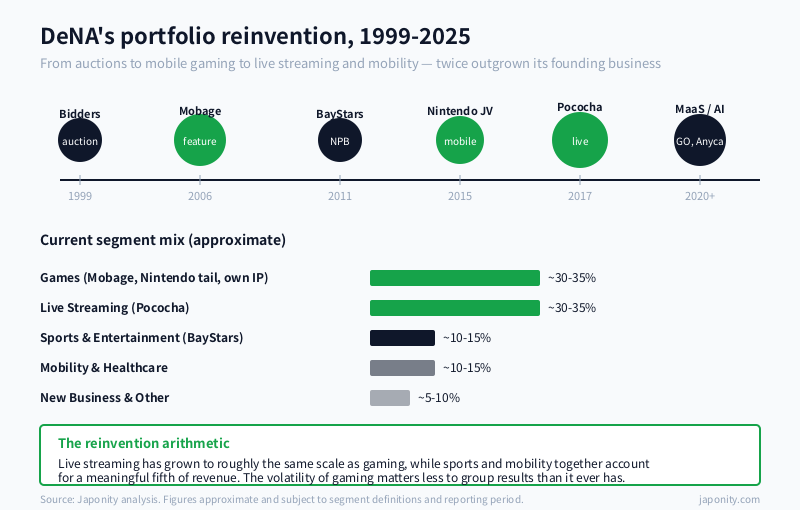
DeNA Co., Ltd. is the most under-appreciated reinvention story in Japanese technology. Founded in 1999 by Tomoko Namba, an ex-McKinsey partner, the company began as a bidding-auction site called Bidders, pivoted into mobile gaming in the late 2000s with the Mobage platform, briefly held the position of Japan’s second-largest mobile gaming company behind GREE around 2011-2012, struck a headline-grabbing alliance with Nintendo for smartphone games in March 2015, bought a money-losing Nippon Professional Baseball team (the Yokohama BayStars) from TBS in 2011 and turned it into one of the league’s strongest franchises, launched the live-streaming app Pococha in 2017 that became its single fastest-growing business by 2022, and since 2019 has been pushing aggressively into Mobility-as-a-Service through Anyca, 0COMMUTE, and an AI-driven taxi-dispatch joint venture with Mobility Technologies. Namba stepped down from operational leadership in 2011, returned as chairperson, then took back the CEO seat in 2021 to lead the next phase. No other Japanese internet company has so visibly outgrown its founding business twice.
From Bidders to Mobage: the auction site that became a gaming platform
DeNA was incorporated in March 1999, at the height of the first Japanese internet boom. Namba had left McKinsey & Company the previous year, drawn by what she has described as the once-in-a-career opportunity to build a Japanese internet company from scratch. The founding business, Bidders, was a consumer-to-consumer auction site that competed directly with Yahoo! Auctions Japan — a battle DeNA effectively lost, although Bidders ran for more than a decade before being shut down in 2011.
The pivot that defined the company came around 2006. DeNA had been quietly building Mobaoku, a mobile-phone auction service, and in February 2006 launched Mobage Town (later renamed simply Mobage) — a social network and casual gaming platform built specifically for Japan’s then-dominant feature phones. Mobage’s timing was almost perfect: feature-phone users in Japan were paying flat-rate data subscriptions through NTT DoCoMo, KDDI’s au, and SoftBank, and a generation of teenage and young-adult users had nothing comparable to do on their phones. By 2010 Mobage had tens of millions of registered users and a vibrant ecosystem of in-house and third-party game studios. DeNA’s market capitalisation peaked in the low trillions of yen in early 2012, briefly making it one of the most valuable Japanese internet companies after Yahoo Japan and Rakuten.
The smartphone transition and the Nintendo deal
The smartphone wave that began in earnest in Japan around 2011-2012 was an existential challenge for Mobage. Apple’s App Store and Google Play bypassed the carrier-billing relationships that had made Japanese mobile gaming so profitable, and a new generation of free-to-play smartphone titles — most notably GungHo’s Puzzle & Dragons (2012) and Mixi’s Monster Strike (2013) — captured the audience that Mobage had served on feature phones. DeNA’s response was slower than its rival GREE’s, and through 2013-2014 the company’s gaming revenue declined even as the wider Japanese mobile game market grew.
The Nintendo alliance announced on 17 March 2015 was the boldest answer DeNA could plausibly give. Under the agreement, Nintendo took a roughly 10 per cent stake in DeNA and DeNA took an approximately 1.24 per cent stake in Nintendo, with the two companies committing to jointly develop smartphone games using Nintendo’s intellectual property. Miitomo (March 2016) was the first mobile app from Nintendo of any kind; it was followed by Super Mario Run (2016), Fire Emblem Heroes (2017), Animal Crossing Pocket Camp (2017), and Mario Kart Tour (2019). The deal briefly added several hundred billion yen of market capitalisation to DeNA.
The longer-term outcome was more mixed. Nintendo’s mobile strategy through the early 2020s shifted toward bringing more development in-house and focusing on the Switch console; Miitomo was shut down in 2018, and the Nintendo cross-shareholding was unwound in 2024 with Nintendo selling back most of its DeNA stake. What the alliance did accomplish — and what justifies its existence in hindsight — was to give DeNA seven years of association with the most valuable Japanese gaming brand in the world, at a moment when its own intellectual-property pipeline was weakest.
The BayStars: how an internet company bought into NPB
In December 2011 DeNA announced it would buy the Yokohama BayStars baseball franchise from TBS Holdings for a reported figure of around 9.5 billion yen, becoming only the third internet-era company (after SoftBank with the Fukuoka Hawks and Rakuten with the Tohoku Rakuten Golden Eagles) to acquire a Nippon Professional Baseball team. At the time the BayStars were one of the league’s chronic underperformers, both on the field and at the gate, and TBS had been an absentee owner for nearly a decade.
The turnaround under DeNA is, by the standards of Japanese professional sports, exceptional. Average home attendance at Yokohama Stadium has roughly doubled since the 2011 acquisition, the team reached the Japan Series in 2017, and in 2024 the BayStars won the Japan Series for the first time since 1998. DeNA also took a majority stake in the operating company of Yokohama Stadium itself in 2015-2016, becoming one of the rare NPB franchises to own both the team and the venue — a structural advantage that drove ticketing, food-and-beverage, and corporate-hospitality economics far ahead of league peers.
The sports business is small in revenue terms relative to gaming or live streaming, but it has done two things for DeNA that the numbers understate. First, it gave the company a permanent presence in Yokohama, which has become the locus of DeNA’s stadium-led smart-city and mobility experiments. Second, it dramatically lifted brand recognition outside Tokyo’s internet-native crowd — for a generation of Yokohama families, DeNA is the baseball team before it is anything else.
Pococha: the live-streaming business nobody outside Japan noticed
Pococha launched in January 2017 as a vertical-video live-streaming app, positioned between the intimacy of small-scale Japanese entertainment and the gift-economy model that had matured on Chinese platforms like YY and on Korean platforms like AfreecaTV. The app’s distinguishing design choice was an explicit “no top creators take everything” structure: streamers earn through a tiered ranking system based on engagement rather than gift volume alone, with caps designed to keep mid-tier and entry-level creators economically viable.
By 2022 Pococha had become DeNA’s single fastest-growing business by revenue, with the company reporting it as the largest live-streaming app in Japan by gross merchandise value. The user economics were structurally attractive: a relatively small number of paying viewers supported a much larger creator base, and average revenue per paying user was high relative to Western social-app benchmarks. DeNA attempted a U.S. launch in 2022; the international expansion produced disappointing results and Pococha U.S. was scaled back in 2023-2024, but the Japanese business has continued to grow.
The strategic role of Pococha inside DeNA is now larger than gaming in some respects. It absorbs a substantial share of group operating profit, it has shifted the revenue mix away from the IP-dependent volatility of mobile games toward a more recurring user-economy model, and it has given DeNA real institutional capability in payments, creator economics, and community moderation — capability the company is now reusing in adjacent businesses.
The segment mix and the reinvention arithmetic
DeNA today reports under five main business segments. The table below summarises the rough shape of the consolidated group in the post-Nintendo, post-Pococha-U.S.-pullback era.
| Segment | Approx. share of group revenue | Strategic role | Key assets |
|---|---|---|---|
| Games | ~30-35% | Cash generator; volatile by title | Mobage platform, Nintendo-IP titles (tail), own IP, joint ventures |
| Live Streaming (Pococha) | ~30-35% | Growth engine; highest operating leverage | Pococha app, creator economy, payments stack |
| Sports & Entertainment | ~10-15% | Brand anchor; venue economics | Yokohama DeNA BayStars, Yokohama Stadium, Kawasaki Brave Thunders (B.League) |
| Mobility & Healthcare | ~10-15% | Long-bet portfolio | Anyca (car sharing), 0COMMUTE, AI taxi dispatch JV, DeNA Life Science |
| New Business & Other (everystar, social, ad-tech) | ~5-10% | Optionality; some shrinking | everystar/everylesson (horse racing data), ad-tech residual |
The headline arithmetic of the reinvention is in the first two rows. A decade ago, gaming was close to the entirety of DeNA’s revenue and almost all of its operating profit. Today, live streaming has grown to roughly the same scale as gaming, sports and mobility together account for a meaningful fifth of revenue, and the volatility of the gaming segment matters less to group results than it ever has. That is a structurally different company from the Mobage-era DeNA of 2011-2012.
Mobility: Anyca, 0COMMUTE, and the AI-dispatch bet
DeNA’s push into mobility began earlier than most outside observers realise. Anyca, the company’s peer-to-peer car-sharing platform, launched in 2015 — pre-dating Toyota’s own equivalent. Anyca’s model lets private car owners list vehicles for rental by other users; DeNA handles insurance, payments, and the booking platform. The business is small in revenue terms but has given DeNA operating experience in vehicle ownership, parking, and consumer mobility that few internet companies in Japan possess.
The larger mobility bet was the AI taxi-dispatch business. In 2018 DeNA launched MOV, an AI-driven taxi-hailing app, in competition with Sony-backed S.RIDE and JapanTaxi. In early 2020 DeNA merged MOV into Mobility Technologies as a joint venture, taking a substantial equity stake in the combined entity that now operates the GO app — Japan’s largest taxi-hailing platform by some measures. The arrangement is structurally similar to what SoftBank did with Uber and Didi: take a position in the platform consolidator rather than continue to fund a head-to-head fight.
0COMMUTE, launched in 2020-2021, is DeNA’s smaller experiment in shared-route commuting and on-demand bus service, run with municipalities and corporate clients. AI Drive, the umbrella brand for DeNA’s autonomous-driving research, is more a research line than a product business, but it gives the company a presence in the autonomous-mobility conversation that its peer Japanese internet companies do not have.

Healthcare, horse racing, and the long tail of bets
DeNA Life Science, the group’s healthcare arm, runs Mycode — a direct-to-consumer genetic testing service launched in 2014 — and an ongoing suite of digital-health products. The healthcare business has been the slowest of DeNA’s bets to scale, partly because of regulatory and reimbursement constraints and partly because the U.S.-style direct-to-consumer genetics market has not formed in Japan in the same way. DeNA has continued to fund the business through multiple management cycles, which is in itself a signal.
everystar and everylesson, DeNA’s horse-racing data and learning services, have a loyal user base in Japan’s surprisingly large recreational horse-racing community — JRA wagering turnover runs in the trillions of yen annually, and content businesses adjacent to it have durable economics. These long-tail businesses individually rarely move the consolidated needle, but collectively they keep DeNA’s product portfolio broad enough that the company never depends on any single bet.
The Namba return and the governance question
Namba stepped down as president in 2011 to care for her ailing husband, handing operational control first to Isao Moriyasu and later, in March 2019, to Hiroyuki Iwasa. In June 2021 she returned as president and CEO — an unusual move for a Japanese internet founder, and one she has framed publicly as a response to the magnitude of the AI-driven reinvention DeNA needed to undertake. Namba has spent her second tenure pushing harder on AI integration across the portfolio, on Pococha’s monetisation and international strategy, and on the mobility and healthcare bets.
The governance pattern is unusual by Japanese standards. Few Japanese listed companies have had a female founder-CEO return to the operational seat a decade after stepping back. Namba’s background — ex-McKinsey partner, Stanford GSB MBA, fluent English speaker, public-policy presence — gives her a profile closer to a U.S. or European founder-CEO than to most of her Japanese internet peers. DeNA’s investor communications, English-language disclosure quality, and willingness to entertain international partnerships are visibly stronger than those of comparably-sized Japanese internet companies.
Why DeNA is Japan’s most under-appreciated reinvention
The standard Japanese internet narrative — Rakuten’s e-commerce drama, SoftBank’s Vision Fund saga, LINE Yahoo’s complicated merger, Mercari’s plateau — leaves DeNA strangely under-covered. The reasons are partly structural: DeNA never built a single dominant consumer brand at the scale of Rakuten Ichiba or LINE, and Pococha is barely visible outside Japan. The Nintendo alliance got the headlines but is no longer the strategic story. The BayStars are a sports business in a sports market most foreign analysts do not follow. Mobility is early.
What the standard narrative misses is the reinvention discipline. DeNA has now made two structurally complete pivots — Bidders to Mobage in the 2000s, Mobage to a Pococha-plus-portfolio model in the late 2010s and 2020s — without either a financial crisis or a hostile takeover forcing the change. The third pivot, into AI-augmented mobility and live-streaming-driven creator economics, is underway under a returned founder-CEO with the institutional credibility to push it through. The market capitalisation has not rewarded the company commensurately; the operating reality may yet do so.
For foreign companies and investors, the practical implication is that DeNA is one of the most accessible Japanese internet platforms to partner with on creator-economy, mobility, and sports-tech experiments — small enough to move quickly, large enough to underwrite real distribution, English-fluent at the leadership level, and unusually willing to enter equity-anchored joint ventures. That combination is rare in Japanese tech.
FAQ
Who founded DeNA and who runs it now?
DeNA was founded in March 1999 by Tomoko Namba, a former McKinsey partner. Namba served as CEO until 2011, returned as chairperson, and resumed the CEO role in June 2021. She continues to lead the company.
What is Mobage and is it still operating?
Mobage (originally Mobage Town, launched 2006) is DeNA’s mobile gaming platform. It is still operating but has shrunk significantly from its 2011-2012 peak as Japanese mobile gaming shifted from feature-phone-era platforms to the Apple App Store and Google Play. Games remain a major segment of DeNA’s business at roughly 30-35 per cent of revenue.
Does DeNA still work with Nintendo?
The 2015 cross-shareholding alliance between DeNA and Nintendo was largely unwound in 2024, with Nintendo selling back most of its DeNA stake. Some legacy titles co-developed under the partnership (such as Mario Kart Tour and Animal Crossing Pocket Camp) remain operational under shared arrangements, but new joint development is not the core of either company’s mobile strategy today.
What is Pococha?
Pococha is DeNA’s live-streaming app, launched in January 2017. It is the largest live-streaming platform in Japan by gross merchandise value and is one of the two largest segments of DeNA’s business by revenue. A U.S. launch in 2022 was scaled back in 2023-2024; the Japanese business continues to grow.
Does DeNA still own the Yokohama BayStars?
Yes. DeNA acquired the Yokohama BayStars in December 2011 from TBS Holdings and remains the controlling owner. The team won the Japan Series in 2024, its first championship since 1998. DeNA also holds a majority stake in the operating company of Yokohama Stadium.
Working with DeNA
Japonity helps foreign companies, investors, and creator-economy platforms identify and approach the right counterparts at DeNA — across games, live streaming, mobility, sports, and healthcare. Whether you are evaluating a Pococha partnership, an Anyca-style mobility pilot, a BayStars sponsorship, or an equity-anchored joint venture along the Nintendo or Mobility Technologies template, the relevant operating teams and decision-makers vary significantly by segment. If you would like a structured introduction, please visit our business matching service.
Related from Japonity — Japan’s telecom & digital ecosystems
- SoftBank Group — From PHS reseller to Arm + Stargate AI infrastructure giant
- Rakuten Group — The points-economy empire and the mobile bet that almost broke it
- LY Corporation (LINE Yahoo) — Japan’s super-app holding company — SoftBank + Naver under government pressure
- NTT Corporation — Japan’s $140B telecom giant and the IOWN photonic-network bet
- KDDI Corporation — Japan’s #2 mobile carrier and the Mitsubishi-shosha-linked telco
Want to source Japanese products beyond these company profiles? Japonity also runs a Japan Sourcing Hub — a research-grade catalogue of 1,185 verified Japanese food products and 200+ overseas EC stores, ready for B2B procurement.
Interested in Japanese business opportunities?
Whether you're looking for technology partners, engineering talent, or market insights — we can help connect you with the right Japanese organizations.
Get in Touch →