No private institution shapes the daily political weather in Japan quite like The Yomiuri Shimbun. Founded in Tokyo in November 1874 — five years before its progressive rival The Asahi Shimbun — the paper today prints around six to seven million paid copies a day across morning and evening editions, a figure that, even after a generational decline from the ten-million-plus peak of the early 2000s, makes it by most measures the largest paid-circulation general-interest newspaper in the world. Around that flagship daily sits a wider Yomiuri Group unique among Japanese media: a privately controlled newspaper at the political centre-right, the Yomiuri Giants — the most popular and historically winningest baseball team in Japan’s Nippon Professional Baseball league — a long-running roughly fourteen per cent stake in Nippon Television Holdings, a sports daily (Hochi Shimbun), and an amusement-park subsidiary (Yomiuri Land). At the centre of that complex sat, until his death in December 2024 at the age of ninety-eight, Tsuneo Watanabe — group chairman from 1991, the most consistently named “most powerful media figure” in post-war Japan, and the human embodiment of the Yomiuri-as-establishment proposition that defines the paper’s relationship with the Liberal Democratic Party.
From a Meiji-era Tokyo daily to the world’s largest paid newspaper
The Yomiuri Shimbun was founded in Tokyo on 2 November 1874 by a small group of journalists and entrepreneurs, under the headline name Yomiuri — literally “read-and-sell”, a reference to the old Edo-period street-criers who shouted news from broadsides and then sold the printed sheet. It leaned, in the language of the period, towards the koshinbun (“small newspaper”) tradition of plain-language general-interest reporting rather than the political-debate-heavy oshinbun (“big newspaper”) format then dominant.
The defining transformation came under Matsutaro Shoriki, the former senior police bureaucrat who acquired control in 1924 and turned the paper into a mass-circulation national daily through aggressive editorial expansion, sports promotion, and pricing strategy. Shoriki — also the founder of the Yomiuri Giants in 1934 and the post-war founder of Nippon Television — is, more than any single figure other than Watanabe, the architect of the modern Yomiuri Group. By the 1970s the Yomiuri had overtaken Asahi to become Japan’s largest paid daily and has held that rank uninterrupted since. The corporate parent, The Yomiuri Shimbun Holdings, is headquartered in Otemachi in central Tokyo and is a private joint-stock company; its shares are unlisted and held by the Yomiuri Group employee shareholding association, senior management, and allies of the Watanabe family.
Six to seven million copies, and what the number actually means
The Yomiuri Shimbun’s combined morning-and-evening paid circulation is in the order of six to seven million copies, down from a ten-million-plus peak in the early 2000s — a decline of broadly forty per cent over twenty-odd years, but slower than at Asahi and considerably slower than at Mainichi or Sankei. The Yomiuri retains an unusually loyal subscriber base in the suburban and regional readerships that Asahi has lost faster, and its morning-edition density in the Kanto region around Tokyo is the single largest concentration of paid daily print circulation anywhere in the world. By most reasonable measures Yomiuri remains the largest paid-print general-interest newspaper on the planet, sustained by a Japanese household-delivery subscription model — managed through a national network of independent newspaper agencies (shimbun hanbai-ten) — that is materially more durable than the kiosk-driven models of most Western markets. The long-term direction of travel, even at Yomiuri, is nonetheless unambiguous.
The four-paper map of Japanese national journalism
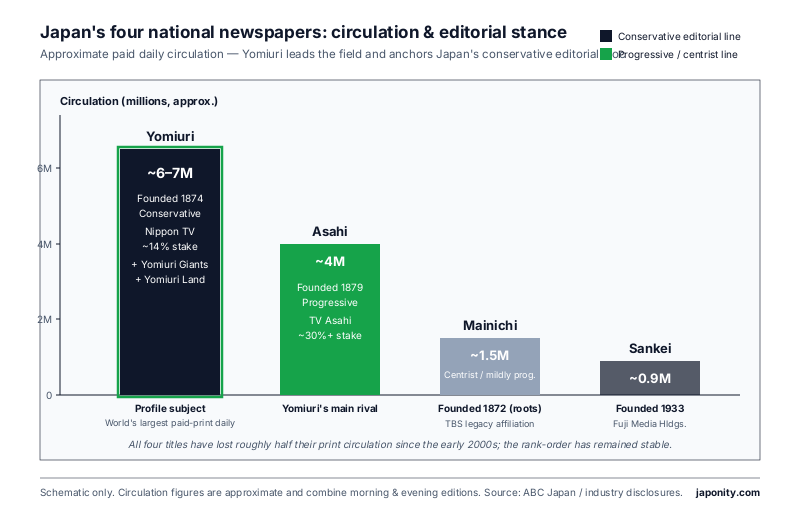
To understand Yomiuri’s position, it helps to set the four national general-interest dailies side by side. The market is unusually concentrated by global standards: the four titles below, plus the business-focused Nikkei and a handful of sports dailies, account for the overwhelming majority of paid national circulation.
| Newspaper | Founded | Editorial stance | Paid circulation (approx.) | Affiliated broadcaster |
|---|---|---|---|---|
| Yomiuri Shimbun | 1874 (Tokyo) | Conservative, pro-LDP establishment | ~6–7M (down from ~10M+ in 2000s) | Nippon Television Holdings (~14% strategic stake) |
| The Asahi Shimbun | 1879 (Osaka) | Left-of-centre, progressive | ~4M (down from ~8M in 2000s) | TV Asahi Holdings (~30%+ stake) |
| Mainichi Shimbun | 1872 (Osaka roots) | Centrist to mildly progressive | ~1.5M (down from ~4M in 2000s) | TBS Holdings (legacy / loose affiliation) |
| Sankei Shimbun | 1933 (Osaka) | Conservative to right-of-centre | ~0.9M (down from ~2M in 2000s) | Fuji Media Holdings (Fujisankei Communications Group) |
Two features of this map are worth flagging. Every one of the four nationals has paired itself with a commercial broadcaster on broadly congruent political alignment — Yomiuri with the establishment-friendly Nippon TV, Asahi with the progressive TV Asahi, Sankei with the more conservative Fuji News Network — producing two loose left-right media blocs within Japanese commercial broadcasting. And all four have lost a substantial slice of print circulation in the past two decades while the rank-order has remained stable. What sets Yomiuri apart is the layer of non-newspaper assets accumulated around the flagship daily — the Giants, Yomiuri Land, and the Nippon TV stake. The group is a media-sports-broadcasting complex in a way the others are not.
The Yomiuri Giants: why a baseball team sits at the centre of a newspaper
The Yomiuri Giants (often just Kyojin — “the Giants”) were founded in 1934 by Matsutaro Shoriki as the first professional baseball team in Japan, originally as a vehicle to give the touring American All-Stars including Babe Ruth a domestic opponent. The Giants are the founding member and historically dominant club of Nippon Professional Baseball’s Central League, and the most successful franchise in the history of Japanese baseball by Japan Series titles — a record materially exceeding any other NPB club’s. The team plays its home games at the Tokyo Dome and is, by polling and merchandise revenue, the most popular professional sports team in Japan.
The Giants are not a side project. They are an editorial and commercial pillar of the Yomiuri Group: the flagship’s sports section is built around Giants coverage, the affiliated Hochi Shimbun anchors its reporting on the team, and the Nippon Television broadcasting relationship was historically anchored in Giants game broadcasts, which at their late-twentieth-century peak commanded prime-time national audiences essentially unavailable to any other content. The editorial identity of the Yomiuri Shimbun as Japan’s establishment-conservative paper of record is reinforced, in a way without Western newspaper analogue, by its ownership of the country’s most popular baseball franchise.
Nippon Television Holdings: the broadcasting complement
The Yomiuri Group’s relationship with Nippon Television Holdings (TSE: 9404) is one of the defining structures of post-war Japanese media. Nippon TV was founded in 1953 by Matsutaro Shoriki and was the first commercial terrestrial television broadcaster in Japan to obtain a licence. The Yomiuri Group has held a strategic stake continuously since the broadcaster’s founding; the publicly disclosed figure today is in the region of fourteen per cent, held through a combination of the Yomiuri Shimbun Holdings and affiliated group entities.
That stake is unusual in two ways. It is materially smaller than Asahi Shimbun’s roughly thirty-per-cent-plus holding in TV Asahi Holdings, reflecting a deliberately looser corporate alignment. And Nippon Television Holdings is kept as a separately listed and separately governed broadcaster — not consolidated into the Yomiuri Group accounts. The alignment functions as a long-running strategic partnership rather than a parent-subsidiary relationship, with editorial coordination on baseball, election coverage, and special programming but operational independence preserved on both sides. Nippon Television Holdings is, on its own, the commercially most successful of Japan’s major terrestrial broadcasters by viewership share and operating profit over most of the past decade — its 2023 acquisition of a controlling stake in Studio Ghibli sealed an anime-library position the other Tokyo broadcasters cannot match.
The Yomiuri Group portfolio: newspaper, baseball, broadcasting, sports daily, theme park
The flagship daily is only one piece of a wider portfolio that defines the group’s commercial and editorial footprint.
| Property | What it is | Reach / role |
|---|---|---|
| The Yomiuri Shimbun (flagship daily) | Morning and evening Japanese-language general-interest daily | ~6–7M paid circulation; world’s largest paid-print newspaper by most measures |
| The Japan News | Yomiuri’s English-language daily and digital edition | Long-running English-language Japan-affairs publication; partnership content with international titles |
| Yomiuri Giants | Nippon Professional Baseball Central League club, founded 1934 | Japan’s most popular and historically winningest baseball team; home at Tokyo Dome |
| Nippon Television Holdings (~14% strategic stake) | Listed broadcaster (9404.T) — Nippon TV, BS Nippon, NNN affiliation | Commercial market-leader broadcaster; Studio Ghibli controlling stake since 2023 |
| Hochi Shimbun | Sports and entertainment daily affiliated with the Yomiuri Group | Anchored in Giants and NPB coverage; entertainment and horse racing heavy |
| Yomiuri Land | Amusement park in Inagi, on the Tokyo/Kanagawa border | Long-running family-destination park; ferris wheel and seasonal illuminations |
| Chuokoron-Shinsha | Major Japanese-language book and magazine publisher acquired by Yomiuri in 1999 | Publisher of Chuokoron monthly and an influential non-fiction list |
| Yomiuri Symphony Orchestra (Yomikyo) | Tokyo-based professional symphony orchestra founded 1962 | One of Japan’s leading orchestras; group cultural-properties anchor |
The shape of the Yomiuri portfolio differs structurally from Asahi’s. Asahi has a deeper single broadcaster stake (TV Asahi Holdings) and is more concentrated around publishing and broadcasting. Yomiuri’s portfolio is broader: alongside the newspaper and the broadcaster stake, it owns one of the cultural pillars of Japanese popular life in the Giants, a mass-leisure asset in Yomiuri Land, a Japanese book-publishing house in Chuokoron-Shinsha, and a major Tokyo orchestra. The group is, in a way no other Japanese newspaper group is, a national cultural conglomerate rather than purely a media one.
Tsuneo Watanabe and the politics of the establishment newspaper
No individual was more closely identified with the modern Yomiuri Shimbun than Tsuneo Watanabe. Born in 1926, Watanabe joined the Yomiuri as a political reporter in 1950, rose through the political-affairs desk during the early Cold War decades, and was appointed group chairman in 1991 — a role he held, in one formal title or another, until his death on 19 December 2024 at the age of ninety-eight.
Watanabe’s editorial influence over the Yomiuri’s political line was, by all serious accounts, defining. The paper’s positioning as the reliable establishment voice — supportive of the LDP’s broad orientation on national security, the US-Japan alliance, constitutional revision, and economic policy, while reserving sharp criticism for LDP leaders it judged tactically wanting — was his deliberate construction. He maintained personal relationships with successive LDP prime ministers from Kakuei Tanaka through Shinzo Abe and was, in periods of factional crisis, one of a small handful of non-elected figures whose private counsel materially shaped party decisions. Watanabe was also the architect of the Yomiuri’s multi-year war-responsibility editorial project of the mid-2000s, an unusually firm acknowledgement of Japan’s responsibility for the Pacific War that rejected historical-revisionist tendencies within parts of the conservative movement. His death in December 2024 closed a generational chapter and reopened, inside the group, the question of who — and on what terms — would set the editorial line going forward.
Ownership, governance, and the limits of strategic flexibility
Like Asahi and Nikkei, The Yomiuri Shimbun is a private joint-stock company with no listed shares, no external institutional capital, and no possibility of a hostile takeover. The shareholder register is divided among the Yomiuri Group employee shareholding association, senior management, and Watanabe-family allies, with precise percentages not publicly disclosed. The structural consequences are familiar: Yomiuri is insulated from activist investors, hostile bids, and the quarterly pressure that has hollowed out comparable Western papers, and the group has used that insulation to maintain editorial consistency over a generational time horizon and to cross-subsidise a flagship daily that, like all major print newspapers, would be loss-making on a stand-alone basis at any market-rate cost of capital. Whether the same insulation breeds strategic inertia — particularly around international expansion, where Yomiuri has nothing remotely comparable to Nikkei’s 2015 acquisition of the Financial Times — is a recurring question in Japanese media-industry circles. The Japan News, the group’s English-language daily, is a serious product but small by Nikkei Asia standards and much smaller still by FT or Bloomberg standards.
The next decade: declining print, durable establishment identity, succession risk
Three questions define Yomiuri’s strategic horizon. How far does the print decline run, and how much of the digital flagship can be converted into a paying subscriber base of the scale required to compensate for the eventual erosion of the household-delivery model that has underwritten the group’s economics for most of a century? Can the Nippon TV stake, the Giants, Yomiuri Land, and the wider cultural-properties portfolio continue to generate the cash flows that have cross-subsidised the newspaper, given that linear television advertising is under pressure from streaming and Giants’ broadcast-rights economics have softened materially from their late-twentieth-century peak? And, most importantly, in a post-Watanabe era, who within the group sets the editorial line, and on what terms — given that Watanabe’s personal centrality to the paper’s positioning was, by any honest assessment, unprecedented and is now unrecoverable?
None of these has a settled answer. What is clear is that the institutional identity of The Yomiuri Shimbun — establishment, conservative, pro-LDP, organisationally cautious, broadly aligned with the post-war US-Japan alliance and the constitutional-revision agenda — is the most durable editorial identity of any major Japanese national daily, and Yomiuri remains the centre-of-gravity title around which the rest of the national debate is organised.
FAQ
When was The Yomiuri Shimbun founded, and who owns the company today?
The Yomiuri Shimbun was founded in Tokyo on 2 November 1874 by a group of Meiji-era journalists and entrepreneurs, originally as a small-format koshinbun (“small newspaper”) aimed at a broader Tokyo readership than the elite-oriented political papers of the period. The modern paper was decisively shaped by Matsutaro Shoriki, who acquired control in 1924 and built the mass-circulation national daily that overtook Asahi to become Japan’s largest paper by the 1970s. The corporate parent, The Yomiuri Shimbun Holdings, is headquartered in Otemachi, Tokyo, and is a private joint-stock company with no listed shares; the shareholder register is divided among the Yomiuri Group employee shareholding association, senior management, and allies of the Watanabe family. The exact ownership percentages are not publicly disclosed.
What is Yomiuri’s paid circulation, and is it really the largest newspaper in the world?
The Yomiuri Shimbun’s combined morning-and-evening paid daily circulation is in the order of six to seven million copies, down from a peak of more than ten million in the early 2000s. By most reasonable measures of paid-print circulation, Yomiuri remains the largest paid general-interest newspaper in the world — the only papers in the same league are The Asahi Shimbun, which trails Yomiuri by roughly two to three million copies, and a small number of Indian-language dailies whose paid-versus-bulk distribution mix is harder to audit cleanly. The Japanese household-delivery subscription model, managed through a national network of independent newspaper agencies, has been more durable than the kiosk-driven models prevalent in Western markets, which is why the absolute numbers remain so high even after the decline.
Why does The Yomiuri Shimbun own a baseball team?
The Yomiuri Giants were founded in 1934 by Matsutaro Shoriki, the figure who built the modern Yomiuri Shimbun, originally as a vehicle to provide a domestic opponent for the touring American All-Stars (including Babe Ruth) on their 1934 visit to Japan. The Giants are the founding member of Nippon Professional Baseball’s Central League and the most successful franchise in the history of Japanese baseball by Japan Series titles, with a record that materially exceeds any other NPB club’s. The team is structurally embedded in the Yomiuri Group: the flagship newspaper’s sports coverage is built around the Giants, the affiliated Hochi Shimbun sports daily anchors its reporting on the team, and the Nippon Television broadcasting relationship was historically built on Giants game broadcasts. Ownership of Japan’s most popular baseball team is not a side asset but an editorial and commercial pillar of the Yomiuri Group.
What is Yomiuri’s relationship with Nippon Television Holdings?
The Yomiuri Group holds a strategic stake of roughly fourteen per cent in Nippon Television Holdings (TSE: 9404), the listed parent of Nippon TV, BS Nippon, and the wider Nippon News Network (NNN). Nippon TV was founded in 1953 by Matsutaro Shoriki, the same figure who built the modern Yomiuri and the Giants. The Yomiuri stake is materially smaller than Asahi Shimbun’s roughly thirty-per-cent-plus stake in TV Asahi Holdings, and the alignment is deliberately looser: Nippon TV is kept as a separately listed and separately governed broadcaster, not consolidated into the Yomiuri Group accounts. The practical effect is a long-running strategic partnership rather than a parent-subsidiary relationship, with editorial coordination on baseball, election coverage, and special programming but operational independence preserved on both sides.
Who was Tsuneo Watanabe, and what changes with his death in December 2024?
Tsuneo Watanabe (1926–2024) was the chairman of the Yomiuri Group from 1991 until his death on 19 December 2024 at the age of ninety-eight, and the most consistently named “most powerful media figure” in post-war Japan. He joined the Yomiuri in 1950 as a political reporter, built the paper’s political-affairs desk through the early Cold War decades, and constructed its editorial positioning as the reliable establishment voice broadly aligned with the Liberal Democratic Party. He maintained personal relationships with successive LDP prime ministers from Kakuei Tanaka through Shinzo Abe and was, in periods of factional crisis, one of a small handful of non-elected figures whose private counsel materially shaped party decisions. He was also the architect of the Yomiuri’s multi-year war-responsibility editorial project of the mid-2000s, an unusually firm acknowledgement of Japan’s responsibility for the Pacific War. His death closed a generational chapter for the paper and reopened, inside the group, the question of who sets the editorial line going forward — particularly given that his personal centrality to the paper’s positioning was, by any honest assessment, unprecedented and is now unrecoverable.
Working with Yomiuri Shimbun
Looking to advertise across The Yomiuri Shimbun’s print, digital, and Hochi Shimbun properties, license editorial content or photographic archives, partner on English-language reporting through The Japan News, scope research and broadcasting collaborations across the Yomiuri/Nippon Television Holdings axis, or explore sponsorship and content opportunities with the Yomiuri Giants and Yomiuri Land? Get in touch via Japonity’s business-matching service — we connect foreign media, advertisers, sponsors, and content partners with the right counterparties inside Japan’s largest newspaper-broadcasting-sports-leisure conglomerate.
Related from Japonity — Japan’s media & broadcasting
- Nikkei Inc. — Japan’s $1.3B Financial Times-owning newspaper
- The Asahi Shimbun Company — Japan’s #2 newspaper and the politicized media question
- Fuji Media Holdings — The 2025 governance reset activists forced on Japan’s Daiba broadcaster
- Nippon Television Holdings — Japan’s #1 commercial broadcaster + Studio Ghibli + Hulu Japan
Want to source Japanese products beyond these company profiles? Japonity also runs a Japan Sourcing Hub — a research-grade catalogue of 1,185 verified Japanese food products and 200+ overseas EC stores, ready for B2B procurement.
Interested in Japanese business opportunities?
Whether you're looking for technology partners, engineering talent, or market insights — we can help connect you with the right Japanese organizations.
Get in Touch →