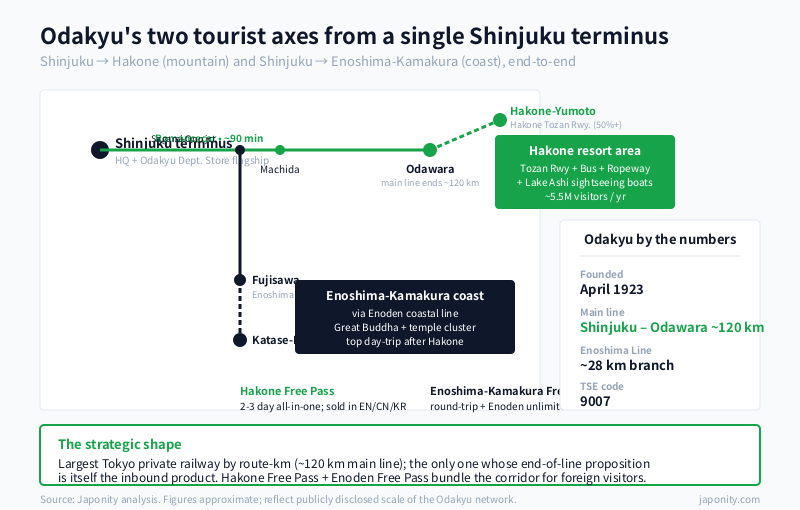
Odakyu Electric Railway is the private rail operator that has, more than any other Tokyo-based company, organised itself around the proposition that a railway line is most valuable when the line ends in a tourist destination. Approximately 120 kilometres of main-line track run from Shinjuku — the busiest passenger station on earth — southwest to Odawara, where Odakyu’s majority-owned Hakone Tozan Railway takes passengers up into the volcanic resort landscape of Hakone. A separate 28-kilometre branch, the Odakyu Enoshima Line, peels south to the Pacific coast at Fujisawa for connecting service to Enoshima island and the temple town of Kamakura. Around that physical network, Odakyu has assembled an unusually tourism-weighted conglomerate: the Odakyu Department Store at Shinjuku, the Odakyu Hotel Centuries chain, Odakyu Bus, the Hakone Tozan Railway and Hakone Tozan Bus operations on the mountain, and the Hakone Free Pass and Enoshima-Kamakura Free Pass — foreign-tourist-friendly all-in-one tickets that have become some of the most marketed Japanese travel products outside the country. Hakone alone draws on the order of 5.5 million visitors annually, and a meaningfully rising share of them are non-Japanese. For hospitality investors looking at Tokyo’s tourism corridors, Odakyu is the access infrastructure to two of them at once.
From a 1923 express railway to a tourism conglomerate
Odakyu Electric Railway was incorporated in April 1923 as the Odawara Express Railway Company — “Odakyu” is the contraction of Odawara Kyuko, literally “Odawara express” — with the original ambition of running a fast suburban service between Shinjuku and Odawara that could compete with the existing Japanese Government Railways route by offering a shorter end-to-end journey. The line opened in stages through the late 1920s, and the company’s strategic identity as a Shinjuku-Odawara express operator was set within a decade of incorporation. The Enoshima branch from Sagami-Ono to Katase-Enoshima, opened in 1929, added the Pacific coast leg that has been part of the network ever since.
What distinguishes the Odakyu story from the parallel histories of Tokyu, Seibu and Keio is that the company’s founding terminus on the country side — Odawara — sat at the gateway to Hakone, an established Edo-era hot-spring destination that already had its own narrow-gauge mountain railway. Through the post-war decades Odakyu progressively built and acquired the tourism infrastructure between the two ends of the line. The Hakone Tozan Railway, the steep mountain rack-and-pinion line continuing up from Odawara to Gora at the foot of Mount Hakone, became a consolidated subsidiary; the Hakone Tozan Bus network connecting the mountain villages, Lake Ashi and the Hakone Ropeway came under the same group umbrella. The Romancecar limited-express service, introduced in its modern form in the late 1950s, was built explicitly as a tourist product: reserved-seat express trains from Shinjuku direct to Hakone-Yumoto, marketed at weekend leisure travellers as much as commuters.
The 1960s and 1970s added the Odakyu Tama Line, branching off the main line at Shin-Yurigaoka to serve the Tama New Town development, and consolidated the network at approximately its current shape. Headquarters have remained at Shinjuku throughout, immediately adjacent to the Shinjuku terminal that hosts the dedicated Odakyu platforms and the Odakyu Department Store standing directly over them.
The Hakone thesis
The single most important strategic fact about Odakyu Electric Railway is that the company controls, end to end, the most-used foreign-tourist access route to the Hakone resort area. A traveller arriving at Haneda or Narita typically reaches central Tokyo, transfers at Shinjuku to an Odakyu Romancecar, arrives at Hakone-Yumoto roughly ninety minutes later, transfers to the Hakone Tozan Railway up the mountain, and then circulates between the mountain villages, Lake Ashi, the Owakudani volcanic valley and the Hakone Ropeway on Odakyu-group bus, rail and pirate-ship sightseeing-boat services. The Hakone Free Pass — a single ticket covering the round-trip Shinjuku-Hakone leg and unlimited use of essentially every Odakyu-affiliated transport mode inside Hakone for two or three consecutive days — is the marketed product that bundles this experience for non-Japanese visitors. It is sold in English, Chinese, Korean and other languages at Shinjuku and online, and it is one of the most visible inbound-tourism transport packages in Japan.
The economics of this position are unusual among Tokyo private railways. Tokyu, Seibu and Keio derive the bulk of their transport revenue from commuter season tickets sold to residents along the corridor. Odakyu carries an equivalent commuter base on the Shinjuku-Machida-Odawara stretch and on the Enoshima branch, but it also captures a structurally larger share of leisure and inbound-tourist revenue through Hakone. Annual visitor volume to the Hakone area is on the order of 5.5 million, and the inbound share has been climbing since the pre-pandemic period and resumed climbing after reopening. Each foreign visitor who reaches Hakone through the Free Pass channel generates revenue across multiple Odakyu-group entities — the express train, the mountain railway, the buses, the ropeway, the sightseeing boat, and frequently a night at an Odakyu-group hotel — in a way that a typical commuter does not.
The Enoshima-Kamakura coastal leg
Less famous internationally than Hakone but increasingly visible in foreign itineraries is the Enoshima-Kamakura coastal leg served by the Odakyu Enoshima Line. The branch leaves the main line at Sagami-Ono and runs approximately 28 kilometres south through Fujisawa to Katase-Enoshima, with onward connections to Enoshima island and to the Enoshima Electric Railway — the Enoden — which links Enoshima to Kamakura along a much-photographed coastal alignment. Kamakura itself, the former shogunal capital with its Great Buddha and dense cluster of major Buddhist temples, is the most-visited day-trip destination from Tokyo after Hakone and Nikko.
Odakyu sells an Enoshima-Kamakura Free Pass on the same logic as the Hakone product: round-trip Shinjuku-Fujisawa and unlimited use of the Enoshima Line and the Enoden, packaged as a single inbound-tourist ticket. The result is that Odakyu controls the rail access from Tokyo to the two most-marketed short-trip leisure destinations in the Kanto region — Hakone in the mountains and Enoshima-Kamakura on the coast — through a single Shinjuku terminus and two free-pass products.
What the Odakyu group actually does
Odakyu’s consolidated structure looks at first glance like a classic Japanese rail-conglomerate portfolio. On closer inspection, the tourism axis runs through every major segment in a way that distinguishes it from the more commuter-and-property-weighted peers. The segments break down approximately as follows.
| Segment | Principal businesses | Strategic role |
|---|---|---|
| Transportation (rail) | Odakyu Line (Shinjuku-Odawara, ~120 km), Odakyu Tama Line, Odakyu Enoshima Line (~28 km); Romancecar limited express | Backbone of the Shinjuku-Hakone-Enoshima axis |
| Mountain & coast tourism rail | Hakone Tozan Railway (Odakyu-controlled subsidiary); Hakone Ropeway and Lake Ashi sightseeing operations within the group | Captures the in-resort transport leg of the Hakone visitor day |
| Bus | Odakyu Bus; Hakone Tozan Bus; airport-limousine and intercity coach operations | Fills the last-mile gap in the corridor and the resort |
| Retail | Odakyu Department Store (Shinjuku flagship over the Odakyu terminus); Odakyu OX supermarkets along the line | Captures Shinjuku-station foot traffic and corridor household spending |
| Hotel & hospitality | Odakyu Hotel Centuries chain, including Hyatt Regency Tokyo formerly under a partnership and a string of mountain and coastal resort properties | Captures the overnight leg of leisure travel into Hakone and Enoshima |
| Real estate | Odakyu Real Estate; residential development along the rail corridor; Shinjuku station-area redevelopment | Long-cycle property book anchored on the corridor |
| Travel & lifestyle services | Hakone Free Pass and Enoshima-Kamakura Free Pass marketing; Odakyu Travel agency; group catering and cleaning services | Packages the corridor product for inbound and domestic leisure markets |
The shape of this portfolio is not accidental. Where Tokyu’s playbook is “control the rail corridor and rebuild the terminus”, Odakyu’s playbook is “control the rail corridor and capture the leisure day at the country end of the line”. The mountain-rail, ropeway, sightseeing-boat and resort-hotel assets are the in-resort continuation of the same Shinjuku-Odawara journey that begins on the Romancecar.
Odakyu compared with Tokyo’s other major private railways
Odakyu sits within the cohort of Tokyo’s principal private railway operators alongside Tokyu, Seibu and Keio. All four have evolved into integrated rail-real-estate-retail groups, but the strategic shapes diverge meaningfully. The comparison is instructive because it sharpens what Odakyu is, and what it is not.
| Operator | Network & terminus | Distinctive strategic axis |
|---|---|---|
| Tokyu Corporation | Southwestern Tokyo, Yokohama (~104 km); Shibuya terminus | Shibuya station-area redevelopment; Tokyu Hotels; very heavy property weight |
| Odakyu Electric Railway | Shinjuku-Odawara (~120 km main line) + Enoshima Line (~28 km); Shinjuku terminus | Hakone and Enoshima-Kamakura tourism axis; Hakone Tozan Railway control; foreign-tourist Free Pass franchise |
| Seibu Holdings | Northwestern Tokyo, Saitama, Chichibu; Ikebukuro / Shinjuku termini | Prince Hotels chain; Saitama Seibu Lions baseball; post-restructuring discipline |
| Keio Corporation | Western Tokyo (Shinjuku-Hachioji axis, ~84 km); Shinjuku terminus | Tighter geographic focus; Shinjuku terminal anchor; smaller group footprint |
By network length, Odakyu is the largest of the four — its approximately 120-kilometre main line plus the Tama and Enoshima branches give it the most route-kilometres of any single Tokyo-based private railway, ahead of Tokyu’s roughly 104 kilometres and meaningfully ahead of Keio. By group-company count and consolidated revenue Tokyu has historically been larger. But by tourism-revenue mix Odakyu is in a category of its own among the four. Tokyu’s hotel and resort book is real but secondary; Seibu’s Prince Hotels are nationally distributed rather than corridor-anchored; Keio is structurally a commuter franchise. Odakyu is the operator whose end-of-line proposition — Hakone for the mountains, Enoshima-Kamakura for the coast — is itself the principal inbound-tourism product.
The Tokyo Stock Exchange listing reflects this. Odakyu trades under code 9007, alongside Tokyu (9005), Keio (9008) and Seibu’s listed parent (9024) in the private-rail cluster of the transport sector. Among the four, Odakyu is the one whose share-price story is most directly geared to inbound tourism reopening cycles.
The Romancecar product
The Romancecar is the most distinctive single passenger product in the Odakyu portfolio and the principal way most foreign visitors first encounter the company. It is the brand name for Odakyu’s reserved-seat limited-express services from Shinjuku to Hakone-Yumoto, Karakida on the Tama Line, and Katase-Enoshima on the Enoshima Line. The fleet consists of several generations of dedicated rolling stock, including the cab-forward “VSE” and “GSE” sets whose front-end observation lounges have made the Romancecar one of the more photographed Japanese trains internationally. Journey time from Shinjuku to Hakone-Yumoto is approximately ninety minutes, making Hakone a feasible day trip for a visitor who would otherwise lose half a day to a local-train connection.
Operationally, the Romancecar is the leisure complement to the commuter service that fills Odakyu’s main line during weekday peak hours. Commuters pay the standard fare on rapid and express services into Shinjuku; leisure travellers — disproportionately weekend, holiday and inbound — pay an additional limited-express surcharge for the reserved seat. The product is one of the cleaner examples in Japanese railway operation of price discrimination between two segments sharing the same physical infrastructure.
Leadership and governance
Odakyu’s senior leadership has, through the post-pandemic period, been organised around a chairman and president configuration typical of large listed Japanese rail operators. The presidency has been held in recent years by Hiroaki Hoshino, who has overseen the post-pandemic recovery of inbound tourism volumes and the continued positioning of the group around the Hakone and Enoshima axes. Specific role assignments evolve year to year and should be verified against the most recent disclosure documents; the company communicates them through standard listed-company disclosures.
Governance follows standard Japanese listed-company practice with a board including outside directors and ordinary shareholder meeting cycles. There is no controlling shareholder block; ownership is distributed across Japanese trust banks, retail shareholders along the rail corridor, and modest cross-shareholdings with selected business partners. Shareholder benefits — discounted Romancecar and Hakone-related travel — are a well-established part of the retail-shareholder proposition along the line.
Why Odakyu matters to non-Japanese counterparties
For hospitality investors and operators, Odakyu is the most concentrated single point of access to two of the most-marketed Japanese leisure destinations outside Tokyo. The Odakyu Hotel Centuries chain is mid-market consolidation territory; the Hakone resort area more broadly is one of the few Japanese tourism markets where new high-end hotel inventory has continued to be built and absorbed through the post-2015 inbound cycle. For travel and tour operators, the Hakone Free Pass and Enoshima-Kamakura Free Pass are pre-packaged products that wholesale and online-travel partners outside Japan can integrate into itineraries with minimal additional infrastructure. For real-estate investors, the corridor between Shinjuku and Machida — with the Tama New Town catchment in between — is one of the most stable residential property markets in the Tokyo region. For retail brands, the Odakyu Department Store standing over the Shinjuku terminus captures a passenger flow that approaches that of any single department store in Japan.
What makes Odakyu distinctive among Tokyo’s private railways is the unusual integration of its tourism axis. The company controls, end to end, the rail-and-bus journey from one of the world’s busiest passenger stations to a major hot-spring resort and a major coastal temple district, packages that journey as a single all-in-one ticket marketed in multiple languages, and captures the in-resort retail, hotel and transport spend through majority-owned subsidiaries. As Japan’s inbound visitor count continues its post-reopening climb, Odakyu’s mix shift toward leisure and inbound is one of the cleaner pure-play exposures in the listed Tokyo private-rail cluster.
FAQ
When was Odakyu founded and where is it headquartered?
Odakyu Electric Railway was incorporated in April 1923 as the Odawara Express Railway Company — “Odakyu” being the contraction of Odawara Kyuko, “Odawara express” — with the founding ambition of operating a fast suburban service between Shinjuku and Odawara. The line opened in stages through the late 1920s. Headquarters have remained at Shinjuku throughout the company’s history, immediately above and adjacent to the Shinjuku terminal that hosts the Odakyu Line platforms and the Odakyu Department Store flagship. Odakyu trades on the Tokyo Stock Exchange under code 9007.
What rail lines does Odakyu operate?
Odakyu operates three principal lines totalling approximately 150 route-kilometres. The Odakyu Line — the main line — runs approximately 120 kilometres from Shinjuku to Odawara, with the Romancecar limited-express service continuing onward to Hakone-Yumoto on Odakyu-Hakone Tozan track. The Odakyu Tama Line branches off at Shin-Yurigaoka and serves the Tama New Town development. The Odakyu Enoshima Line runs approximately 28 kilometres from Sagami-Ono south through Fujisawa to Katase-Enoshima for connecting service to Enoshima and Kamakura. Through Odakyu’s majority-owned Hakone Tozan Railway, the company also operates the rack-and-pinion mountain railway from Odawara up to Gora at the foot of Mount Hakone.
What is the Hakone Free Pass?
The Hakone Free Pass is a single all-in-one ticket sold by Odakyu that covers the round-trip Shinjuku-Hakone rail leg plus unlimited use of essentially every Odakyu-affiliated transport mode within the Hakone resort area — the Hakone Tozan Railway, the Hakone Tozan Bus network, the Hakone Ropeway, and the Lake Ashi sightseeing pirate-ship boats — for either two or three consecutive days. It is sold in English and other languages at Shinjuku station and online and is one of the most visible inbound-tourist transport packages in Japan. A separate Enoshima-Kamakura Free Pass packages the equivalent product for the Pacific-coast leg.
How does Odakyu compare with Tokyu, Seibu and Keio?
All four are major Tokyo-based private railway groups with integrated rail-real-estate-retail-hotel portfolios, but the strategic axes diverge. Tokyu has spent a decade rebuilding Shibuya as a property-anchored play. Seibu owns the nationally distributed Prince Hotels chain and the Saitama Seibu Lions baseball team. Keio is the tightest commuter franchise of the four, running the western Tokyo corridor into Shinjuku. Odakyu is the largest of the four by route-kilometres at approximately 120 main-line kilometres plus the Tama and Enoshima branches, and is distinctive in its concentration on inbound and leisure tourism through Hakone and Enoshima-Kamakura — a revenue mix the other three do not match.
Why does Odakyu matter for foreign hospitality investors?
Odakyu controls, end to end, the most-used inbound-tourist access routes to two of the most-marketed Japanese leisure destinations outside Tokyo — Hakone and the Enoshima-Kamakura coast. The Hakone Free Pass and the Enoshima-Kamakura Free Pass package those journeys as pre-built tourist products. The Odakyu Hotel Centuries chain and the surrounding Hakone hotel market are areas where new mid- and high-end inventory has continued to be built and absorbed through the post-2015 inbound cycle. For hospitality investors evaluating Japanese leisure exposure that is not pure Kyoto or pure Tokyo central, the Odakyu corridor is one of the cleanest single-operator exposures available.
Working with Odakyu Group
For hospitality partners and travel groups, the practical entry points to Odakyu are Odakyu Hotel Centuries for corporate contracting and management agreements, and Odakyu Travel together with the Hakone Tozan Group on the in-resort side for tour-product and Free Pass distribution partnerships. For commercial property tenants, Odakyu’s leasing organisation in Shinjuku handles the inventory in and around the Shinjuku terminal, including the Odakyu Department Store building and the redeveloped western Shinjuku station blocks. For consumer brands seeking retail distribution, the Odakyu Department Store at Shinjuku and the Odakyu OX supermarket network along the corridor offer one of the most concentrated single-station consumer-facing footprints in central Tokyo. For infrastructure suppliers, Odakyu’s procurement organisation handles Romancecar and commuter rolling stock, signalling, station systems, and bus-fleet contracts on cycles that align with rail-industry norms.
If your company provides hospitality management, tour-operator and online-travel distribution, mid-market hotel brand partnerships, rail infrastructure technology, station-area mobility solutions, or inbound-tourism services relevant to the Shinjuku-Hakone and Shinjuku-Enoshima-Kamakura corridors — or if you are evaluating Japanese inbound-tourism exposure as part of a Japan investment strategy — Japonity’s business matching service can help structure a credible first conversation with the right counterparty inside the Odakyu group.
Related from Japonity — Japan’s passenger railways & rail conglomerates
- JR East — The world’s largest railway by passengers — and Japan’s biggest station-retail empire
- JR Central — The Tokaido Shinkansen monopoly and the maglev moonshot
- Tokyu Corporation — The Shibuya-redeveloping rail conglomerate
- Hankyu Hanshin Holdings — Kansai’s railway-real-estate-entertainment empire
- Seibu Holdings — Tokyo’s western-suburb rail empire + Prince Hotels + Lions
Want to source Japanese products beyond these company profiles? Japonity also runs a Japan Sourcing Hub — a research-grade catalogue of 1,185 verified Japanese food products and 200+ overseas EC stores, ready for B2B procurement.
Interested in Japanese business opportunities?
Whether you're looking for technology partners, engineering talent, or market insights — we can help connect you with the right Japanese organizations.
Get in Touch →