From the observation deck of the Tokyo Skytree, 350 metres above the eastern Sumida ward, the visitor is standing on top of a railway company. The world’s tallest free-standing radio tower — 634 metres, opened in May 2012 — is owned and operated by Tobu Tower Sky Tree Co., Ltd., a wholly-owned subsidiary of Tobu Railway Co., Ltd. (東武鉄道株式会社, TSE: 9001). Founded in 1897 as Tobu Tetsudo to serve the cotton-mill towns of Saitama and Gunma, Tobu today operates approximately 463 route-kilometres of private railway — the second-longest private network in Japan after Kintetsu — running from Asakusa and Ikebukuro out to the World Heritage shrines of Nikko, the hot-spring corridor of Kinugawa, and across the northern Kanto plain. The Skytree, the Toshogu pilgrimage trade, the Ikebukuro Tobu Department Store and a portfolio of approximately 150 group companies make Tobu one of the most distinctive — and least understood by overseas investors — of Tokyo’s great private-railway conglomerates.
The northern private rail empire: a different geography from Tokyu and Odakyu
Tokyo’s private railways are usually narrated through the lens of the southwest — Tokyu around Shibuya, Odakyu out to Hakone, Keio along the Inokashira axis. That narrative misses the northern quadrant entirely. Tobu Railway is the dominant private operator of Tokyo’s north: north and northeast out of Asakusa and Ikebukuro, through working-class Adachi and Katsushika wards, across the Saitama suburbs of Soka and Kasukabe, and onward into Tochigi and Gunma prefectures. It is a network that historically served textile mills and farmhands rather than department-store shoppers; it has only in the last two decades pivoted decisively toward inbound tourism, the Skytree economy, and Tokyo metropolitan redevelopment.
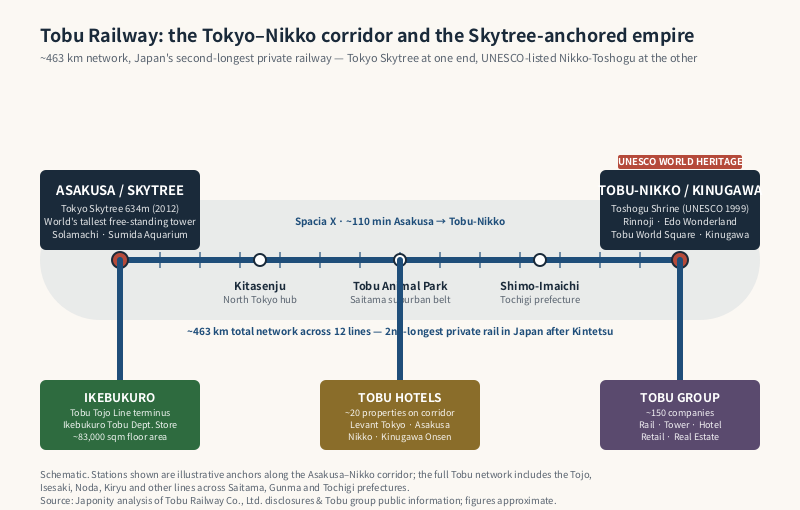
The scale of the network is the first thing to grasp. At approximately 463 route-kilometres across twelve lines, Tobu’s rail footprint is substantially larger than Tokyu, Odakyu, Keio or Seibu; only Kintetsu in the Nara–Ise corridor runs more private track. The two headline commuter lines, the Tobu Skytree Line (from Asakusa out through Tobu Animal Park) and the Tobu Tojo Line (from Ikebukuro out through Saitama), each carry hundreds of thousands of riders every weekday. The Tobu Nikko Line, the tourist artery, threads from the suburbs to the shrine town and Kinugawa Onsen.
1897 to 1945: cotton, coal, and the eastward push
Tobu Tetsudo — literally “East Edo Railway” — was incorporated in November 1897 by a group of Saitama and Tokyo industrialists led by Heizaemon Nezu (root of the Nezu family that continues to chair the group today). The first segment, opened in 1899, ran from Kitasenju in north Tokyo out to Kuki in Saitama, serving the silk and cotton mills of the eastern Kanto plain. By the 1910s the network had reached Tatebayashi and Ashikaga in Gunma; by 1929, electrified through-running had pushed the line up to Tobu Nikko station, opening the Toshogu shrine complex to a new mass tourism market that had previously belonged to the state-owned national railway.
The interwar competition with the state railway for the Tokyo–Nikko tourist trade is the formative episode of Tobu’s identity. Tobu’s direct, electrified Asakusa–Nikko service, launched in the 1929–1933 period, cut a journey that had previously required a slow transfer at Utsunomiya, and established Tobu as the consumer-facing operator of one of Japan’s most important pilgrimage and heritage destinations. Almost a century later, that tourist franchise — Toshogu, Rinnoji, Nikko National Park, Edo Wonderland, Kinugawa Onsen — remains a defining commercial moat.
The Skytree decision: a railway company builds the world’s tallest tower
In March 2008, after a competitive site-selection process run by NHK and a consortium of Japanese broadcasters seeking a new digital terrestrial transmission tower to replace the ageing Tokyo Tower, Tobu Railway and the consortium announced that the new tower would be built on Tobu-owned land in Oshiage, Sumida ward — adjacent to Tobu’s Asakusa terminal and on the site of a disused Tobu rail yard. Construction began in July 2008; the tower topped out at 634 metres in March 2011 and opened to the public in May 2012 as the Tokyo Skytree, the world’s tallest free-standing tower and second-tallest structure of any kind.
The strategic logic for Tobu was distinctively Japanese-private-railway. The Skytree was not, in itself, the business. The business was the redevelopment of the surrounding 36,900 square metres of Oshiage land into Tokyo Skytree Town — comprising the tower, the Solamachi shopping and dining complex (more than 300 retail tenants), the Sumida Aquarium, the Konica Minolta planetarium, an office tower, and the upgraded Tobu Skytree Line station. The model is a near-perfect application of the Kobayashi playbook a century after Kobayashi himself: anchor a railway terminal with a destination that generates both peak commuter and off-peak weekend traffic, and capture the surrounding retail and real-estate uplift.
Since opening, the Skytree complex has reportedly received well over 350 million cumulative visitors. For Tobu, the tower transformed the eastern Sumida ward — previously outside the city’s standard tourist itinerary — into a top-five destination for inbound visitors, one station from Asakusa Senso-ji. In a single decade, Tobu had reframed its brand: from a slightly old-fashioned commuter railway into the proprietor of one of Tokyo’s defining twenty-first-century landmarks.
The seven-segment empire today
Tobu Railway is the listed parent and the rail-operating entity; around it sits a group of approximately 150 companies operating across railway, retail, hotels, real estate, leisure and tourism. The group is run as a coordinated holdings structure even though its listed vehicle is the railway itself (rather than a separate holding company, as Hankyu Hanshin or Seibu use).
| Segment | Core businesses | Profile |
|---|---|---|
| Railway | Tobu Skytree Line, Tojo Line, Isesaki Line, Nikko Line, Noda Line, et al. (~463 km, 12 lines) | Second-longest private rail network in Japan; ~2.4 million passenger-trips per weekday |
| Tower & Tourism | Tokyo Skytree, Solamachi, Sumida Aquarium, Edo Wonderland (Nikko), Tobu World Square | Tower & observation; inbound tourism flagship; Nikko heritage franchise |
| Department Store | Tobu Department Store Ikebukuro (one of Japan’s largest by floor area), Funabashi store | Ikebukuro is a tier-1 department store; floor area ~83,000 sqm |
| Hotels | Tobu Hotel Group — Tobu Hotel Levant Tokyo, Tobu Hotels in Asakusa, Nikko, Kinugawa, Utsunomiya | Mid-to-upscale chain; concentrated along Tobu rail corridor and at tourist termini |
| Real Estate | Tokyo Skytree Town, Ikebukuro terminal estate, Asakusa, Saitama residential development | Tower-led urban estate plus suburban residential; high concentration at network termini |
| Bus & Leisure | Tobu Bus, Tobu Top Tours travel agency, Nikko area transport, golf courses | Supports the tourism franchise; last-mile in Nikko and Kinugawa |
| Limited Express & Inbound | Spacia and Spacia X to Nikko and Kinugawa; Liberty to Aizu; through-running with Tokyo Metro and JR | Premium tourist product; Spacia X (launched 2023) is the new flagship |
Consolidated group revenue runs in the range of approximately JPY 600 to 700 billion annually, with railway and tower/tourism providing the most visible cash flows and real estate providing the highest-margin returns. The Skytree alone receives several million paid visitors per year; combined with Solamachi retail and the Asakusa connection, the Oshiage cluster is one of the highest-density inbound tourism nodes in Tokyo.
Spacia X and the Nikko premium-tourist franchise
If the Skytree is Tobu’s twenty-first-century symbol, the Spacia X limited express — launched in July 2023 — is its twenty-first-century product. The Spacia X is a six-car premium train designed by industrial designer Ken Okuyama, with a private compartment, a cafe car serving Nikko-themed Japanese tea and craft beer, and four classes of seating ranging from standard reserved to a “cockpit suite” private cabin. It runs Asakusa to Tobu-Nikko and Kinugawa Onsen in roughly 110 minutes for the fastest service.
The Spacia X runs alongside the older Spacia trains Tobu has operated on the Nikko route since 1990. The strategic intent is overt: capture the premium inbound traveller comparing Nikko against alternatives like Hakone (Odakyu’s Romancecar) or Ise-Shima (Kintetsu’s Shimakaze), and trade up the Toshogu pilgrimage market — historically a domestic trip — into a globally legible premium experience.
The Nikko cluster sits at the centre of this franchise. Toshogu Shrine, the mausoleum of Tokugawa Ieyasu and a UNESCO World Heritage Site since 1999; Rinnoji Temple; Futarasan Shrine; the cedar-lined Nikko National Park; the hot springs at Kinugawa and Yumoto; the Edo Wonderland theme park (operated by an affiliated company); and Tobu World Square, the miniature-architecture park — all anchor at one end of the Tobu line, with the Skytree and Asakusa at the other. The corridor is, in commercial terms, a single integrated product.
Ikebukuro Tobu Department Store: the western flagship
Often overlooked by visitors who use Tobu only for Skytree access is the group’s other major terminal asset: the Ikebukuro Tobu Department Store, the western terminus of the Tobu Tojo Line. With approximately 83,000 square metres of retail floor area, the Ikebukuro store is one of Japan’s largest department stores by floor space — competing for the title with Hankyu Umeda and Isetan Shinjuku — and the anchor tenant of Ikebukuro’s west side, opposite the Seibu Department Store on the east side of the same JR station.
The Ikebukuro Tobu Department Store is a curious legacy. Tobu acquired the original Kikuya store on the site in 1962 and expanded the building incrementally, producing a structure famously difficult to navigate but commercially dense. Together with the Funabashi store in Chiba, Tobu Department Store contributes both a meaningful operating segment and a strategic anchor at the Tojo Line terminal, in classic Kobayashi-model fashion.
Peer comparison: Tobu among Tokyo’s major private railways
| Group | Core region of Tokyo | Network length | Distinctive assets |
|---|---|---|---|
| Tobu Railway (9001) | North & northeast (Asakusa, Ikebukuro, Saitama, Nikko) | ~463 km | Tokyo Skytree, Nikko-Toshogu franchise, Ikebukuro Tobu DS |
| Tokyu Corporation (9005) | Southwest (Shibuya, Yokohama) | ~104 km | Shibuya redevelopment, Tokyu Department Store, Tokyu Hotels |
| Seibu Holdings (9024) | Northwest (Ikebukuro, Saitama) | ~177 km | Seibu Lions, Prince Hotels, Karuizawa estate |
| Odakyu Electric Railway (9007) | West (Shinjuku, Hakone) | ~120 km | Hakone tourism cluster, Romancecar, Odakyu DS |
| Keio Corporation (9008) | West (Shinjuku, Hachioji) | ~85 km | Keio Department Store, Mt. Takao tourism |
Two observations are visible in the comparison. First, Tobu’s network is by far the longest of the Tokyo private railways — roughly four times the length of Tokyu — reflecting its deep penetration into Saitama, Gunma and Tochigi prefectures rather than dense concentration inside the Yamanote loop. Second, Tobu is the only Tokyo private rail that owns a UNESCO World Heritage tourist franchise (Nikko-Toshogu) at one end of its line and the world’s tallest free-standing tower at the other. That combination is structurally unique among Japanese private railways.
What the Skytree foreign-tourist boom means for hospitality investors
For overseas hospitality investors, food and beverage operators, and consumer brands evaluating eastern Tokyo, the Tobu portfolio creates a specific set of commercial entry points. The Skytree Town complex hosts more than 300 retail and dining tenants in Solamachi; new tenant slots open as the leasing cycle turns, and Tobu’s tower-and-tourism commercial team manages a steady flow of brand activations and pop-up partnerships. Asakusa and the surrounding Taito ward, two stations west, are the densest inbound tourism corridor in Tokyo and the natural extension of the Skytree visitor flow. The Tobu Hotels chain, headquartered at Tobu Hotel Levant Tokyo in Kinshicho, runs around twenty properties along the Tobu rail corridor and in the Nikko–Kinugawa area; expansion partnerships, management contracts, and franchise structures are active commercial topics.
At the Nikko end of the line, the calculus is different. Accommodation quality has historically lagged demand — particularly at the premium end. Branded arrivals over the last five years (Ritz-Carlton Nikko opened 2020 in nearby Chuzenji; Fairfield by Marriott) have begun to address the gap, and Tobu’s landholdings around the Tobu-Nikko station and Kinugawa Onsen are among the largest concentrated tourism estates held under a single Japanese corporate umbrella.
Governance and the next chapter
Tobu Railway is led from its Sumida ward headquarters under the continuing leadership of the Nezu family — descended from founder Heizaemon Nezu — with chairman Yoshizumi Nezu at the head of the supervisory chain and a salaried president responsible for day-to-day operations. The Nezu family also chairs the Nezu Museum in Aoyama, one of Tokyo’s most important private collections of East Asian art, which sits culturally adjacent to the group. The Tokyo Stock Exchange listing (code 9001) is among the oldest continuously listed Japanese securities, dating to the prewar period.
The strategic questions facing Tobu through the late 2020s are recognisable across the Japanese private rail sector but with particular Tobu inflections. How aggressively to expand the Skytree-area real estate footprint beyond the original Skytree Town parcel. How to extract premium yield from the Nikko tourist corridor as inbound visitor numbers continue to climb past pre-pandemic peaks. How to redevelop the Ikebukuro west-side terminal real estate, where the department store building is now decades old and the surrounding precinct is being redrawn under broader Toshima ward planning. How to manage the long-tail of suburban Saitama and Gunma branches as the Japanese rural population continues to shrink. None of these is existential. All of them shape the next quarter-century of the northern private rail empire.
FAQ
Q1. Does Tobu Railway really own the Tokyo Skytree?
Yes. The Tokyo Skytree is owned and operated by Tobu Tower Sky Tree Co., Ltd., a wholly-owned subsidiary of Tobu Railway Co., Ltd. The surrounding Tokyo Skytree Town complex — including the Solamachi shopping and dining mall, the Sumida Aquarium, and the office tower — is also developed and managed by Tobu group entities on land Tobu has owned since the site’s prior life as a rail yard.
Q2. How long is Tobu’s rail network compared to other Japanese private railways?
Tobu operates approximately 463 route-kilometres across twelve lines, making it the second-longest private railway in Japan after Kintetsu in the Kansai region. Within Tokyo’s private railways, Tobu is by a wide margin the longest network — roughly four times the length of Tokyu — reflecting its extension out into Saitama, Gunma and Tochigi prefectures.
Q3. What is the relationship between Tobu and the Nikko-Toshogu World Heritage site?
Tobu does not own the shrines themselves, which are religious institutions, but it operates the dominant tourist transport corridor to the Nikko area, including the Spacia and Spacia X limited express services from Asakusa to Tobu-Nikko and Kinugawa Onsen. Tobu group companies also operate Edo Wonderland, Tobu World Square, the Tobu Nikko Hotel, and multiple properties in Kinugawa Onsen.
Q4. How does Tobu compare to Tokyu or Odakyu strategically?
All three are private-railway-and-real-estate conglomerates built on variations of the Kobayashi model. Tokyu is concentrated around the Shibuya urban-renewal programme and operates a much shorter, denser network in southwest Tokyo. Odakyu is built around the Shinjuku terminal and the Hakone tourism cluster. Tobu is uniquely positioned with a northern, much longer network anchored by the Tokyo Skytree at one end and the Nikko-Toshogu UNESCO heritage area at the other — a tourist-corridor profile that more closely resembles Kintetsu in Kansai than the other Tokyo private rails.
Q5. How can a non-Japanese hospitality or retail company approach Tobu?
Each part of the group has its own commercial counterparty. For Solamachi retail leasing or Skytree activations, the Tower & Town commercial team manages tenant relationships. For hotel partnerships, Tobu Hotel Management runs the chain and considers management contracts. For Nikko-area tourism collaborations, the Tobu Top Tours travel agency and the Nikko regional office are the entry points. For department-store buying, the Ikebukuro store’s overseas brand team is the relevant desk. Japonity can help foreign companies map the right counterparty and structure an introduction.
Working with Tobu Group
Tobu Railway and its group of approximately 150 companies are an unusually broad commercial counterparty for foreign businesses targeting eastern Tokyo, the Skytree visitor economy, or the Nikko inbound tourism corridor. Brands seeking Solamachi or Skytree-area retail presence, hospitality operators evaluating Nikko or Kinugawa Onsen development sites, F&B operators looking at the eastern Tokyo and Asakusa traffic, and consumer brands targeting the Ikebukuro Tobu Department Store buying team all have reason to engage with the group.
If you are exploring a partnership, leasing conversation, hotel management contract, or inbound-tourism collaboration with any part of the Tobu group, Japonity can help you identify the right entity, prepare a Japanese-language briefing, and structure a first meeting. Start at /business-matching/.
Related from Japonity — Japan’s passenger railways & rail conglomerates
- JR East — The world’s largest railway by passengers — and Japan’s biggest station-retail empire
- JR Central — The Tokaido Shinkansen monopoly and the maglev moonshot
- Tokyu Corporation — The Shibuya-redeveloping rail conglomerate
- Hankyu Hanshin Holdings — Kansai’s railway-real-estate-entertainment empire
- Seibu Holdings — Tokyo’s western-suburb rail empire + Prince Hotels + Lions
Want to source Japanese products beyond these company profiles? Japonity also runs a Japan Sourcing Hub — a research-grade catalogue of 1,185 verified Japanese food products and 200+ overseas EC stores, ready for B2B procurement.
Interested in Japanese business opportunities?
Whether you're looking for technology partners, engineering talent, or market insights — we can help connect you with the right Japanese organizations.
Get in Touch →