Ask a Western technology investor to list Japan’s strategically important tech firms and you will hear Sony, Toyota, Renesas, Tokyo Electron, perhaps Hitachi. You are unlikely to hear NEC Corporation. Yet NEC quietly sits on three of the most consequential infrastructure layers of the modern digital economy: it is one of three vendors that share the global subsea telecommunications cable manufacturing market, alongside SubCom of the United States and Alcatel Submarine Networks of France; it is consistently ranked at or near the top of the US National Institute of Standards and Technology’s facial-recognition accuracy benchmarks, the de facto global standard for biometric identification; and it is the prime contractor for the Japan Self-Defense Forces’ command, control, communications, computers and intelligence (C4I) backbone. The company that once defined Japanese consumer electronics — the PC-98 desktop, the BIGLOBE dial-up service, the N-series mobile phone — has, over two decades, exited almost every consumer market it once dominated and rebuilt itself as a government, defence and infrastructure integrator. That pivot is among the least appreciated industrial transformations in modern Japan.
From Western Electric joint venture to national champion
Nippon Electric Company, Limited was founded in Tokyo in July 1899 as a joint venture between local Japanese investors and Western Electric, the manufacturing arm of American Telephone & Telegraph. It was Japan’s first joint-stock company with foreign capital participation, established to supply switching equipment and telephones to the rapidly modernising Japanese telegraph and telephone network. The Western Electric relationship — which evolved through ITT after the 1925 break-up and persisted in various forms until the 1970s — gave NEC privileged access to the global state of the art in switching, transmission and, later, semiconductor technology, while the Japanese Ministry of Communications and its successor NTT gave NEC privileged access to the Japanese domestic market. For most of the twentieth century, NEC, Fujitsu, Hitachi and Oki Electric were the four “NTT family” vendors that effectively split Japan’s telecom equipment procurement.
That dual position — globally networked technically, domestically protected commercially — shaped almost everything NEC subsequently did. It is why NEC was an early entrant in computers, satellites, semiconductors and undersea cables. It is also why, when the protected domestic market dissolved in the deregulated 1990s, NEC found itself over-extended across consumer and B2B segments and structurally unprepared for the price competition of the global PC and mobile-phone markets.
“Computers & Communications”: the slogan that defined an era
In 1977, then-chairman Koji Kobayashi articulated a vision he labelled “C&C” — Computers and Communications — arguing that the two would converge into a single integrated industry. The slogan, more than a decade ahead of its time, became NEC’s organising principle for the 1980s and 1990s. Under it, NEC simultaneously pursued a dominant Japanese PC platform (the PC-98 line, launched in 1982, controlling more than half of Japan’s PC market through the early 1990s), Japan’s leading mobile-phone brand (the N-series), one of the world’s largest semiconductor businesses (NEC was the world’s largest semiconductor vendor by revenue in 1989, 1990 and 1991), Japan’s leading internet service provider (BIGLOBE, launched 1996), enterprise mainframes and Unix servers, public-sector systems integration, telecom carrier equipment, and undersea cable systems.
It was an extraordinary breadth, and for a decade it worked. Then it stopped working. The PC-98’s proprietary architecture lost to IBM PC compatibles running Microsoft Windows, which standardised the global PC market on Intel x86 rather than NEC’s V30 processors and PC-98 BIOS. By the late 1990s, NEC was retreating from its own platform. Mobile phones followed: the global handset market consolidated around Nokia, Samsung and later Apple, and the Japanese vendors found themselves trapped in the domestic “Galápagos” feature-phone ecosystem just as smartphones reset the entire industry.
The great unwinding: a decade of consumer exits
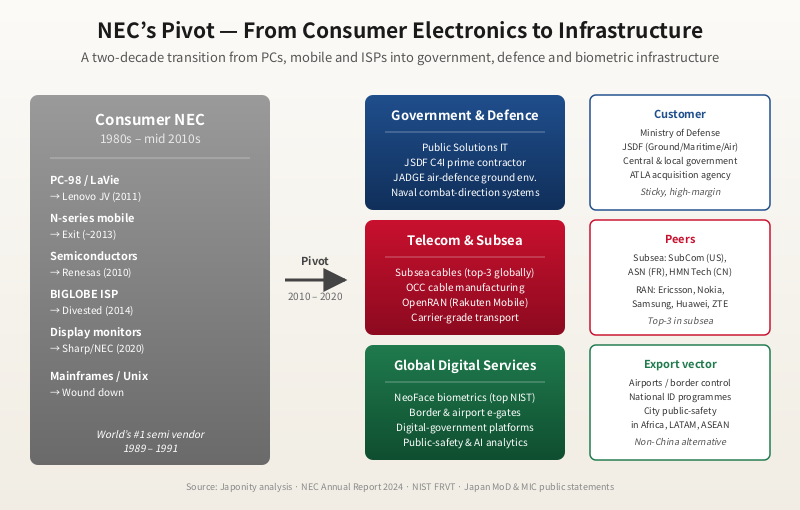
Between roughly 2010 and 2015, NEC executed one of the most aggressive consumer-business exits any major Japanese conglomerate has attempted. In 2010, NEC spun off its semiconductor business into Renesas Electronics, a three-way merger with Hitachi’s and Mitsubishi Electric’s chip operations. In 2011, NEC’s PC business was transferred into a joint venture with Lenovo, NEC Lenovo Japan Group, in which Lenovo holds a majority stake; NEC retained a minority interest and the NEC brand continued on the boxes, but operational control moved to Lenovo. In 2013, NEC effectively exited the mobile handset business, ending production of its own-brand smartphones and feature phones after the smartphone era had decisively passed it by. In 2014, the BIGLOBE consumer ISP was sold to a private-equity-led consortium and subsequently passed through several owners before becoming part of KDDI’s group.
Viewed from the outside, the unwinding looked like managed decline. Viewed from the inside, it was deliberate triage: NEC’s leadership recognised that competing in consumer-facing global commodity markets against Korean, Chinese and US giants was structurally unwinnable, and reallocated capital and engineering talent toward business-to-government infrastructure where the company retained genuine advantage — public-sector systems integration, biometric identification, undersea cables, telecom carrier equipment and defence systems.
| NEC consumer-era brand | Status today | Year |
|---|---|---|
| NEC semiconductors (DRAM, logic) | Spun off as Renesas Electronics (with Hitachi and Mitsubishi Electric) | 2010 |
| PC-98 / LaVie / VALUESTAR PCs | NEC Lenovo Japan Group JV (Lenovo majority, NEC minority) | 2011 |
| N-series mobile phones | Exited handset business; brand retired | ~2013 |
| BIGLOBE ISP | Sold to PE consortium; subsequently part of KDDI group | 2014 |
| NEC display monitors | Sold to Sharp; rebranded under Sharp/NEC Display Solutions | 2020 |
What remained looks very different from the NEC of the 1990s. The current revenue base is dominated by Public Solutions (national and local government IT), Public Infrastructure (carrier-grade networks, broadcasting and aviation), Enterprise (banking, manufacturing and retail systems), Network Services (telecom operators in Japan and abroad), and a Global Digital Services arm that bundles biometrics, AI-driven safety and digital-government platforms for export. Consumer is a rounding error.
NeoFace: the biometric crown jewel
If one single business unit illustrates the post-pivot NEC, it is the biometric identification group, anchored by the NeoFace face-recognition engine. NEC has been investing in pattern-recognition research since the 1970s and has submitted its algorithms to successive rounds of the US National Institute of Standards and Technology’s face-recognition vendor tests (FRVT), the global industry benchmark, since the early 2000s. Across multiple NIST FRVT one-to-one and one-to-many evaluations over the past decade, NEC’s algorithms have repeatedly ranked at or near the top on identification accuracy, particularly under demanding operational conditions involving lower-quality imagery, varied pose and demographic robustness. The peers regularly contesting the top positions are a small group of specialised vendors and research labs, predominantly from China and the United States; NEC is the only Japanese name consistently in the leading cluster.
The book of business behind NeoFace is unusually international. NEC biometric systems are deployed in immigration and border-control programmes in dozens of countries, including national e-gate and traveller-identification systems at major international airports; in national identity programmes across Africa, Latin America and South-East Asia; in city-level public-safety deployments; and in private-sector applications from stadium ticketing to financial-services authentication. The strategic significance is twofold: biometrics is a high-margin software business that avoids commoditised hardware competition, and it positions NEC as a credible neutral alternative to Chinese facial-recognition vendors in jurisdictions where governments are uncomfortable installing Chinese-origin identification infrastructure.
Undersea cable: the most under-appreciated franchise
Roughly 99 percent of intercontinental internet, voice and data traffic flows through submarine telecommunications cables. The global market for manufacturing and installing those cables is, on any given year, dominated by three vendors of comparable scale: SubCom (United States, originally part of AT&T, now controlled by Cerberus Capital), Alcatel Submarine Networks (France, currently held by Nokia and the subject of a long-running French government intervention), and NEC Submarine Cable Solutions, headquartered in Yokohama. Chinese vendor HMN Tech, formerly Huawei Marine, is a rising fourth player but operates under significant geopolitical constraints in Western consortium projects.
NEC’s undersea capability rests on two manufacturing pillars. Optical cable is produced through OCC Corporation, NEC’s Yokohama-area subsidiary. Repeaters — the optical amplifiers that boost the signal every 60 to 80 kilometres along a cable — and overall system integration are handled by NEC’s submarine systems engineering arm. NEC has been laying transoceanic cables since 1964 and operates one of Japan’s two domestic cable-laying ships, the Subaru. Over the past five years, NEC has been awarded prime-contractor or significant supply roles on major projects connecting Japan, Singapore, the United States, India and the Pacific island states, including consortium cables backed by hyperscale cloud and content providers.
For Japan, the franchise is strategically unique. As an island nation that is simultaneously a hub for trans-Pacific and intra-Asian cable systems, Tokyo increasingly treats subsea-cable resilience as a national-security matter; MIC and METI have both supported diversification of cable-landing geographies and the resilience of Japan-attached systems. NEC is the only domestic vendor with end-to-end capability across cable manufacturing, repeater design, installation and maintenance — a strategic asset no other Japanese technology company can match.
Defence: the C4I prime contractor
NEC’s defence business is older and quieter than Mitsubishi Heavy Industries’ platform franchise, and structurally different. Where MHI builds the ships, aircraft, tanks and missiles, NEC builds the command, control, communications, computers and intelligence (C4I) systems that connect them. NEC is the prime contractor for the JSDF’s central command system, the JADGE air-defence ground environment, naval combat-direction systems on JMSDF surface combatants, and a wide range of radar, electronic-warfare and sensor systems. It is also a key supplier of satellite communications equipment and ground stations to the Ministry of Defense and the Cabinet Intelligence and Research Office.
As Japan executes its programmed doubling of defence spending toward two percent of GDP by the late 2020s, the C4I and ISR (intelligence, surveillance, reconnaissance) layers of the budget are growing faster than platform procurement, because joining existing and new platforms into a Joint All-Domain Operations architecture is a stated MoD priority. NEC is the natural domestic prime for that layer of the build-out, and is increasingly engaged with allied programmes through the relaxed Three Principles on Transfer of Defence Equipment and Technology. The defence business is small in revenue terms relative to public-sector IT, but margins are high, customer relationships are sticky, and the budget tailwind is structural.
OpenRAN, Rakuten Mobile and the telecom-equipment second wind
For most of the past decade, NEC’s traditional carrier-equipment business — the legacy strength inherited from the NTT family days — looked like a slow-decline asset, squeezed between Ericsson and Nokia at the high end and Huawei and ZTE at the low end. The arrival of Open Radio Access Network (OpenRAN) architecture, which disaggregates radio-access network hardware and software onto standardised interfaces, has changed that trajectory.
NEC is one of two principal radio and systems-integration partners (alongside Altiostar, now part of Rakuten Symphony) on Rakuten Mobile’s nationwide greenfield OpenRAN deployment in Japan, widely regarded as the first at-scale public OpenRAN network in the world. From that base, NEC has positioned itself as one of a small number of non-Chinese, non-traditional-incumbent OpenRAN system integrators for international operators, including engagements with NTT Docomo, Deutsche Telekom, Vodafone and others exploring multi-vendor RAN deployments. The bet is that OpenRAN gives NEC a route back into global telecom equipment in a configuration that plays to its systems-integration strengths and avoids head-on hardware competition with the Nordic giants and the Chinese vendors.

Leadership and the 2025 Mid-Term Management Plan
NEC has been led since April 2021 by Takayuki Morita, who succeeded Nobuhiro Endo as president and CEO after a long career inside the company spanning carrier networks, global business and corporate strategy. Morita inherited a company that had already executed most of the consumer-exit work and faced the harder question of how to grow the remaining infrastructure portfolio. His 2025 Mid-Term Management Plan, articulated in 2023, targets revenue and adjusted operating-income growth from Public Solutions, Public Infrastructure and Global Digital Services, with margin expansion through software-and-services mix shift and operating discipline.
The plan elevates three strategic technology pillars — biometrics and AI-driven identification, network and security infrastructure (including OpenRAN and subsea), and digital-government and public-safety platforms — as the export vectors through which NEC intends to move from “Japan’s most underrated tech company” to a recognised global infrastructure brand.
Why NEC matters now
Three forces are putting NEC in a more favourable position than it has occupied in twenty years. First, the geopolitical re-evaluation of digital infrastructure — subsea cables, identification systems, telecom networks — is driving Western and aligned-emerging-market governments to seek non-Chinese alternatives, and NEC is one of the very few credible global suppliers across all three. Second, Japan’s defence and resilience budgets disproportionately benefit C4I, ISR and dual-use technology suppliers rather than platform builders. Third, NEC has finished its consumer-business unwinding and now reports as a focused infrastructure-and-services company, with fewer drags on margins than during the long restructuring period.
None of that guarantees a re-rating. NEC’s international visibility is still low relative to its strategic positioning, its non-Japan revenue share remains below where it ultimately needs to be, and competing against entrenched US and European rivals in digital-government and biometrics is not easy. But the franchise underneath is now clearer, and more strategically aligned with where governments and operators are spending, than at any point since the C&C era.
FAQ
Is NEC still in the PC or mobile-phone business in any form?
Effectively no. NEC’s PC operations were transferred in 2011 to a joint venture with Lenovo (NEC Lenovo Japan Group), in which Lenovo holds the majority stake and operational control; NEC retains a minority interest and the NEC brand still appears on some Japan-market consumer PCs, but the business is not consolidated as NEC’s own operation. NEC exited own-brand mobile handsets around 2013 after failing to scale in smartphones. Display monitors were sold to Sharp in 2020. NEC’s consumer-facing business today is a small fraction of group revenue.
How does NEC’s facial-recognition technology actually rank globally, and against whom?
NEC’s NeoFace algorithms have been submitted to successive US National Institute of Standards and Technology Face Recognition Vendor Tests (FRVT) and have repeatedly ranked at or near the top on one-to-one verification and one-to-many identification accuracy, particularly on demanding operational subsets. Vendors regularly clustering at the top across recent rounds include a small group of mostly Chinese and US specialists alongside NEC; the exact ordering varies test by test. NEC is the only Japanese vendor consistently in that leading group and is unusually well-positioned commercially in jurisdictions seeking non-Chinese alternatives.
What is NEC’s role in undersea cables, and how does it compare with SubCom and Alcatel Submarine Networks?
NEC, through its NEC Submarine Cable Solutions group and OCC subsidiary, is one of three vendors of comparable scale capable of supplying turnkey transoceanic submarine cable systems — cable, repeaters, installation and maintenance — alongside SubCom (US) and Alcatel Submarine Networks (France, owned by Nokia). A fourth vendor, HMN Tech (formerly Huawei Marine), is a significant Chinese player but is largely excluded from Western consortium projects on security grounds. NEC has been awarded prime or major supply roles on a series of trans-Pacific and Asia-region cable systems, including projects backed by hyperscale cloud and content providers.
How big is NEC’s defence business and how is it different from Mitsubishi Heavy Industries’ defence business?
NEC’s defence business is materially smaller in revenue terms than its public-sector IT or telecom businesses, but it is strategically central to the Japan Self-Defense Forces because NEC is the prime contractor on the C4I, air-defence ground environment, naval combat-direction and major radar systems that connect Japan’s defence platforms. Mitsubishi Heavy Industries, by contrast, builds the platforms themselves — ships, submarines, tanks, missiles, aircraft. The two companies are complementary primes rather than head-to-head competitors and frequently collaborate as systems integrator (NEC) and platform builder (MHI) on the same programmes.
What is OpenRAN and why is NEC’s role with Rakuten Mobile significant?
Open Radio Access Network is an industry initiative to disaggregate the radio-access portion of mobile networks into hardware and software components connected by open, standardised interfaces, allowing operators to mix vendors rather than buying turnkey systems from a single supplier such as Ericsson, Nokia or Huawei. Rakuten Mobile’s nationwide Japanese network, launched commercially in 2020, is widely regarded as the first at-scale public OpenRAN deployment, and NEC has been a principal radio and systems-integration partner. The reference deployment has positioned NEC as one of the leading non-traditional OpenRAN system integrators for operators exploring multi-vendor radio networks internationally.
Working with NEC
For governments evaluating biometric identification platforms, telecom operators planning OpenRAN deployments, consortia procuring subsea cable systems, defence ministries seeking C4I and ISR cooperation, or enterprise buyers sourcing public-safety, digital-government or AI-driven analytics platforms, NEC sits at a strategic intersection of Japanese technology that few other firms can occupy. Japonity’s business matching service helps foreign organisations identify the right NEC business unit, navigate Japanese government procurement and export-licensing frameworks (METI, MIC, the Acquisition, Technology & Logistics Agency where defence-adjacent), and structure introductions through the appropriate Japanese commercial and government channels. Contact us via the business matching page to begin a structured engagement.
Related from Japonity — Japan’s electronics & IT services
- Panasonic Holdings — Tesla batteries, airline IFE and consumer appliances under one holdco
- Sharp Corporation — The Foxconn rescue eight years on — pivot from large-TV LCDs
- Fujitsu — The PC giant that bet its future on services — Fugaku to Uvance
- Seiko Epson — From watches to printers and 3LCD projectors — Japan’s quiet B2B compounder
Want to source Japanese products beyond these company profiles? Japonity also runs a Japan Sourcing Hub — a research-grade catalogue of 1,185 verified Japanese food products and 200+ overseas EC stores, ready for B2B procurement.
Interested in Japanese business opportunities?
Whether you're looking for technology partners, engineering talent, or market insights — we can help connect you with the right Japanese organizations.
Get in Touch →